




- HVAC
- Connected Thermostat Market
Connected Thermostat Market Size, Share, and Growth Forecast, 2026 - 2033
Connected Thermostat Market by Connectivity Technology (Bluetooth, Wi-Fi, Others), End-user (Commercial, Residential, Others), Distribution Channel, and Regional Analysis for 2026 - 2033

Connected Thermostat Market Size and Trends Analysis
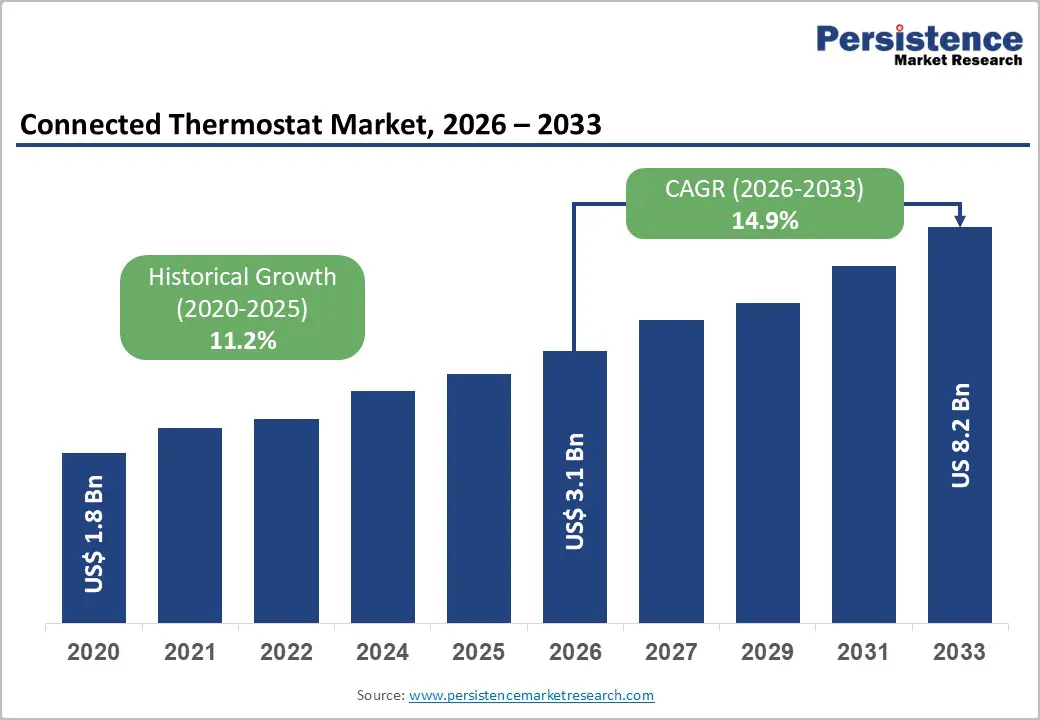
The global connected thermostat market size is likely to be valued at US$3.1 billion in 2026 and is expected to reach US$8.2 billion by 2033, growing at a CAGR of 14.9% between 2026 and 2033, driven by utility demand-response programs, energy-efficiency regulations, and broader smart home adoption.
A connected thermostat is typically defined as a Wi-Fi-enabled device capable of remote monitoring, automated scheduling, and integration with building and home energy systems. Demand is increasing due to the ability of connected thermostats to optimize HVAC performance, reduce energy consumption, and enhance user comfort. Adoption is strongest in regions with high energy costs and regulatory pressure on building efficiency.
Key Industry Highlights:
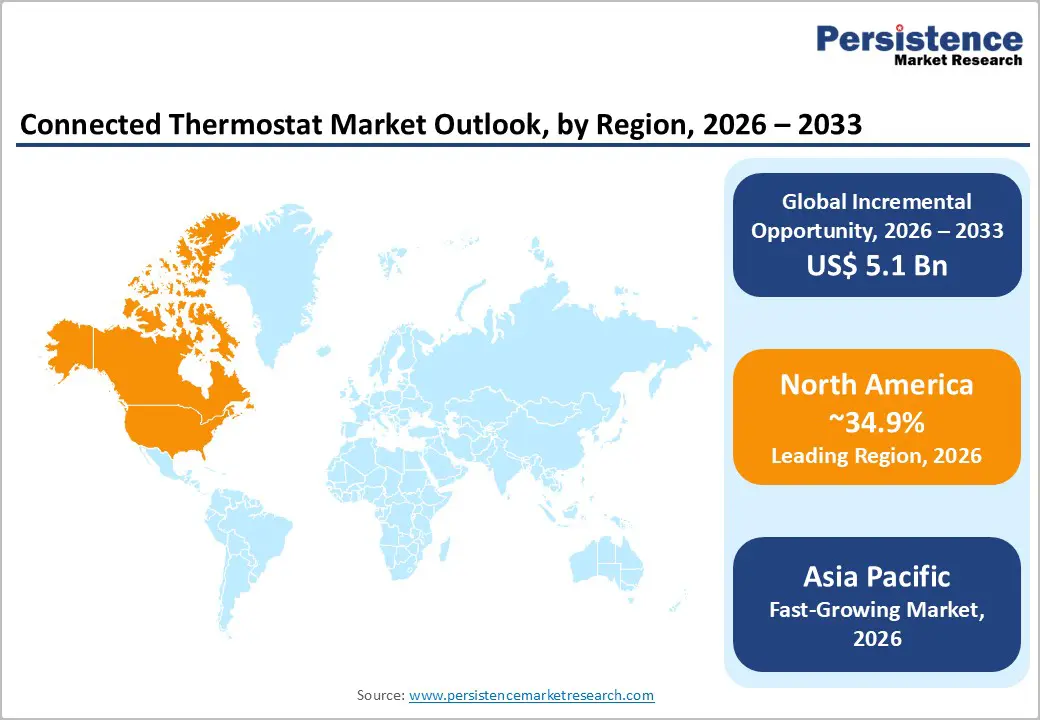
- Leading Region: North America is projected to account for 34.9% of the market share, supported by strong smart home adoption and established demand-response programs.
- Fastest-growing Region: Asia Pacific is the fastest-growing region, driven by rapid urbanization, increasing digital connectivity, and rising adoption of energy-efficient building technologies.
- Investment Plans: Market participants are increasingly investing in integrated energy management solutions, AI-enabled thermostats, and ecosystem partnerships, with a strong focus on expanding affordable product portfolios and enhancing interoperability across smart home and building systems.
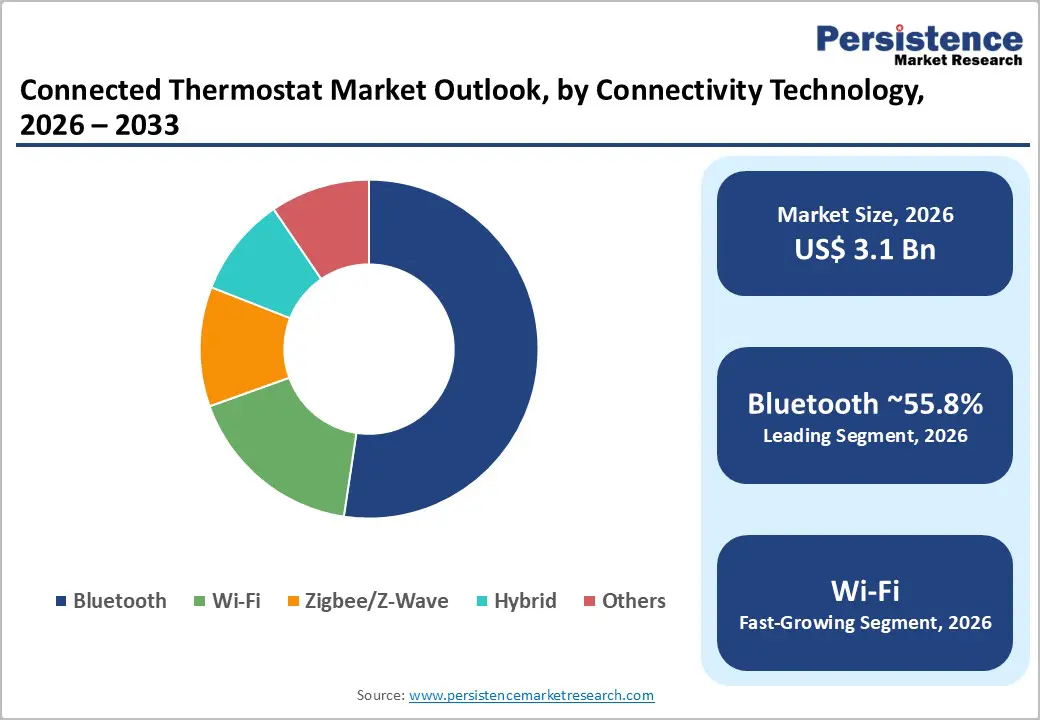
- Dominant Connectivity Technology: Bluetooth is the dominant segment, anticipated to account for 55.8% of the market share, driven by its ease of installation, low power consumption, and strong adoption in retrofit and cost-sensitive applications.
- Dominant End-user: The commercial segment is estimated to hold 52.3% of the market share, driven by large-scale HVAC optimization needs and increasing adoption of building automation systems.
| Key Insights | Details |
|---|---|
| Connected Thermostat Market Size (2026E) | US$3.1 Bn |
| Market Value Forecast (2033F) | US$8.2 Bn |
| Projected Growth (CAGR 2026 to 2033) | 14.9% |
| Historical Market Growth (CAGR 2020 to 2025) | 11.2% |
DRO Analysis
Driver Analysis - Energy-Efficiency Mandates and Utility Demand-Response Programs
Governments and utilities are prioritizing energy efficiency and grid stability, positioning connected thermostats as critical demand-side management tools. HVAC systems represent a significant portion of building energy consumption, making thermostats a practical control point for reducing peak demand. Utilities increasingly deploy demand-response programs that allow remote temperature adjustments during peak load periods, delivering measurable energy savings. This dual benefit, cost reduction for consumers and grid optimization for utilities, creates a strong economic case for adoption. The result is accelerated deployment across both residential and commercial sectors, particularly in regions with established energy-efficiency frameworks.
Smart Home Integration and Digital Control Ecosystems
Connected thermostats are becoming core components of smart home ecosystems, driven by increasing consumer demand for automation and remote control. Integration with mobile applications, voice assistants, and home automation platforms enhances usability and convenience. These systems allow users to monitor and adjust temperature settings in real time, improving energy management and comfort. The shift toward interconnected devices is also encouraging manufacturers to prioritize interoperability and cloud-based services. This trend strengthens product value propositions and drives adoption across mid- and high-income households, as well as professionally managed residential properties.
Building Decarbonization and Regulatory Compliance Requirements
Global efforts to reduce carbon emissions are accelerating the adoption of intelligent building technologies, including connected thermostats. Regulations targeting building energy performance are encouraging the use of automated control systems that improve efficiency and enable performance tracking. In commercial environments, compliance with building codes increasingly requires advanced HVAC control systems. Connected thermostats support these requirements by providing data analytics, remote monitoring, and integration with building management systems. This regulatory push is creating sustained demand, particularly in developed markets undergoing building retrofits and energy-efficiency upgrades.
Restraint Analysis - High Upfront Costs and Retrofit Complexity
Despite long-term energy savings, the initial cost of connected thermostats and installation can be a barrier, especially in older buildings. Many systems require wiring upgrades, compatibility checks, and professional installation, increasing total deployment costs. This challenge is more pronounced in retrofit projects where legacy HVAC systems may not support modern controls. As a result, adoption may be delayed among cost-sensitive consumers and small businesses. The financial barrier does not eliminate demand but slows market penetration and extends sales cycles.
Data Privacy and System Compatibility Concerns
Connected thermostats collect and process user behavior data, including occupancy patterns and temperature preferences. This raises concerns regarding data security and privacy, particularly in regions with strict data protection regulations. At the same time, compatibility issues with existing smart home devices and building systems can create integration challenges. Commercial users, in particular, require interoperability with established protocols such as building management systems. These concerns can increase decision-making complexity and discourage large-scale deployments, especially in enterprise environments.
Opportunity Analysis - Expansion of Commercial Building Automation and Service-Based Models
The commercial segment presents significant growth potential as connected thermostats become part of integrated building automation systems. Beyond hardware sales, vendors are increasingly offering services such as remote monitoring, predictive maintenance, and energy analytics. These service-based models generate recurring revenue and improve customer retention. Demand is particularly strong in office buildings, retail spaces, and institutional facilities where energy optimization delivers substantial cost savings. This shift toward integrated solutions is expected to expand market value beyond device sales alone.
Affordable Product Innovation and Mass-Market Adoption
Recent product launches indicate a clear trend toward lower-cost, user-friendly connected thermostats designed to accelerate adoption across a broader customer base. Manufacturers are focusing on simplified installation processes, including wire adapters, guided mobile setup, and app-based configuration, which reduce dependency on professional installers. This approach is particularly effective in retrofit markets and among first-time smart home users. Companies such as ecobee and Resideo Technologies have introduced entry-level models that balance essential smart features with competitive pricing, making them accessible to middle-income households and small businesses. This shift is especially relevant in emerging markets and price-sensitive segments where upfront cost remains a primary adoption barrier.
Integration with Home Energy Management Systems
Connected thermostats are increasingly being integrated into comprehensive home energy management platforms, transforming them from standalone devices into central control hubs for residential energy systems. These platforms connect HVAC operations with renewable energy sources such as solar panels, battery storage systems, and backup generators, enabling coordinated energy usage across the household. Companies such as Google Nest and ecobee are actively enhancing their ecosystems to support these integrations, allowing users to optimize energy consumption based on real-time conditions and utility pricing. This integration enables advanced capabilities such as load balancing, peak demand reduction, and automated energy optimization, which are increasingly important as distributed energy resources gain traction. In regions with dynamic pricing or demand-response programs, connected thermostats can automatically adjust settings to minimize costs and reduce grid strain. As a result, thermostats are evolving into intelligent energy management interfaces, creating new opportunities for partnerships between HVAC manufacturers, energy providers, and technology companies.
Category-wise Analysis
Connectivity Technology
Bluetooth is the dominant segment, anticipated to account for 55.8% of the market share in 2026 due to its ease of installation, low power consumption, and suitability for short-range communication. It is particularly effective in retrofit scenarios where users prefer simple setup processes without extensive network configuration. Bluetooth-enabled thermostats appeal to consumers seeking basic smart functionality without reliance on continuous internet connectivity, making them attractive for entry-level deployments and regions with limited broadband infrastructure. Recent product strategies from players such as Resideo Technologies and ecobee highlight simplified installation and user-friendly onboarding, which align closely with Bluetooth-enabled or hybrid connectivity approaches. These developments are especially relevant in North America and parts of Europe where retrofit demand remains high. The growing emphasis on plug-and-play solutions is reinforcing Bluetooth’s position in cost-sensitive and retrofit-heavy segments, even as more advanced connectivity options evolve.
Wi-Fi is the fastest-growing connectivity technology due to its ability to support remote access, cloud integration, and advanced analytics. Wi-Fi-enabled thermostats allow users to control HVAC systems through mobile applications, enabling real-time adjustments, energy monitoring, and participation in demand-response programs. These capabilities are increasingly essential in both residential and commercial environments where automation and energy optimization are priorities. Major developments from companies such as Google Nest and Alarm.com demonstrate the shift toward Wi-Fi-centric ecosystems, with devices designed to integrate seamlessly into broader smart home and building management platforms. In Asia Pacific, rising internet penetration and smart home adoption in countries such as China and India are accelerating Wi-Fi adoption. This trend is further supported by increasing investments in digital infrastructure, making Wi-Fi the backbone of next-generation connected thermostat deployments.
End-user Insights
The commercial segment is estimated to hold 52.3% of the market share in 2026 due to the significant energy-saving potential in large buildings. Offices, retail spaces, and institutional facilities benefit from centralized HVAC control and automation, which can substantially reduce operational costs. Connected thermostats enable facility managers to monitor and adjust temperature settings across multiple zones, improving both efficiency and occupant comfort. Companies such as Johnson Controls and Schneider Electric are actively expanding their building automation portfolios, integrating connected thermostats into broader energy management systems. In regions such as North America and Europe, commercial adoption is further driven by regulatory requirements for energy efficiency and building performance monitoring. These developments are strengthening the role of connected thermostats as essential components of smart building infrastructure.
Industrial applications are experiencing rapid growth as facilities seek to optimize energy usage and maintain controlled environments. Warehouses, manufacturing plants, and data centers require precise temperature management to ensure operational efficiency and equipment reliability. Connected thermostats provide real-time monitoring, predictive control, and automation, enabling energy savings and improved process stability. Key players such as Siemens and Daikin Industries are advancing industrial HVAC solutions with integrated smart controls, particularly in high-growth regions such as Asia Pacific. For example, increasing industrial automation initiatives in countries such as Japan and China are driving demand for intelligent temperature control systems. These developments are positioning connected thermostats as critical tools in industrial digitalization, supporting both energy efficiency and operational optimization.
Regional Insights
North America Connected Thermostat Market Trends - Utility-Driven Smart HVAC Adoption and Integrated Energy Ecosystems
North America is the leading regional market, projected to account for 34.9% of market share in 2026, with the U.S. dominating due to high HVAC penetration, strong smart home adoption, and well-established demand-response programs. The region benefits from advanced digital infrastructure, high broadband penetration, and a mature ecosystem of technology providers. Major players such as Google Nest, ecobee, and Resideo Technologies continue to introduce upgraded devices with enhanced automation and energy management features, reinforcing market maturity.
Key growth drivers include energy-efficiency initiatives, utility incentives, and increasing consumer awareness of smart home solutions. Utilities across the U.S. are actively deploying thermostat-based demand-response programs, allowing remote adjustment of HVAC systems during peak load periods. For example, partnerships between thermostat providers and regional utilities have expanded rebate programs, encouraging large-scale residential adoption. At the commercial level, companies such as Johnson Controls are integrating connected thermostats into broader building management systems, improving operational efficiency in office and retail spaces. Investment trends indicate a shift toward integrated solutions combining hardware, software, and services. Companies are enhancing interoperability with voice assistants, security systems, and energy platforms, creating unified smart ecosystems. The increasing collaboration between thermostat manufacturers and energy service providers is also enabling subscription-based models and grid-interactive capabilities. These developments are expected to sustain North America’s leadership position, supported by continuous innovation and strong regulatory backing.
Europe Connected Thermostat Market Trends - Regulation-Led Energy Efficiency and Smart Building Integration
Europe represents a significant market driven by stringent energy-efficiency regulations and rising energy costs. Countries such as Germany, the U.K., France, and Spain are leading adoption due to their strong focus on reducing carbon emissions and improving building performance. The region’s regulatory environment, including building energy directives and renovation mandates, is accelerating the deployment of connected HVAC control systems.
Regulatory frameworks emphasize building automation, energy monitoring, and smart readiness, creating favorable conditions for connected thermostat adoption. Companies such as tado° have expanded their presence across Europe with solutions tailored for multi-country compliance and integration with heating systems such as boilers and heat pumps. Similarly, Schneider Electric and Siemens are investing in smart building technologies that incorporate connected thermostats into larger energy management platforms. Market growth is supported by strong environmental policies and increasing consumer awareness of energy conservation, particularly following energy price volatility across the region. Renovation initiatives aimed at improving the efficiency of older buildings are further driving adoption. However, market fragmentation across countries requires localized strategies, as regulatory requirements and consumer preferences vary significantly. Companies that offer interoperable and adaptable solutions are gaining a competitive edge in this evolving landscape.
Asia Pacific Connected Thermostat Market Trends - Urbanization-Fueled Growth and Cost-Competitive Smart HVAC Expansion
Asia Pacific is the fastest-growing region, driven by rapid urbanization, expanding middle-class populations, and increasing adoption of smart technologies. Key markets include China, Japan, India, and Southeast Asian countries, all of which are experiencing rising demand for energy-efficient building solutions. The region benefits from strong manufacturing capabilities and cost advantages, enabling the production of competitively priced connected thermostats. Leading HVAC manufacturers such as Daikin Industries and Mitsubishi Electric are expanding their smart HVAC portfolios with integrated thermostat solutions, particularly in Japan and Southeast Asia. In China, domestic and international companies are leveraging large-scale urban development projects to deploy smart building technologies, including connected climate control systems.
Rising energy demand and government initiatives promoting energy efficiency are further supporting market expansion. In India, building efficiency standards are encouraging the adoption of advanced HVAC control systems in commercial developments, while smart city initiatives are creating new opportunities for connected infrastructure. Companies are increasingly forming partnerships with local distributors and technology providers to strengthen market presence. Growth opportunities are particularly strong in urban residential developments and commercial infrastructure projects. The combination of affordability, increasing digital connectivity, and supportive policy frameworks is expected to drive sustained adoption. As a result, Asia Pacific is emerging as a critical growth engine for the connected thermostat market, with long-term potential supported by both demand expansion and manufacturing strength.
Competitive Landscape
The global connected thermostat market is moderately fragmented, with a mix of global and regional players competing across consumer and commercial segments. Market leadership is concentrated among established HVAC and smart home technology providers. Competitive positioning is influenced by product innovation, brand recognition, distribution networks, and ecosystem integration capabilities. Key players are focusing on product innovation, ecosystem integration, and market expansion. Strategies include developing affordable devices, enhancing software capabilities, and forming partnerships to expand distribution channels. Subscription-based services and energy management solutions are emerging as important revenue streams.
Key Industry Developments
- In January 2025, ecobee announced the launch of its Smart Thermostat Essential at CES 2025, introducing a lower-cost, easy-to-install device designed to expand access to smart home energy savings and accelerate adoption among price-sensitive consumers.
- In December 2025, Resideo Technologies announced the Honeywell Home X8S Smart Thermostat, featuring advanced sensing, energy optimization, and integration with smart home ecosystems such as video doorbells, strengthening its premium product portfolio.
Companies Covered in Connected Thermostat Market
- Google Nest
- ecobee
- Resideo Technologies
- Johnson Controls
- Schneider Electric
- Siemens
- Carrier Global Corporation
- Trane Technologies
- Daikin Industries
- Mitsubishi Electric
- Lennox International
- Emerson Electric
- tado°
- Alarm.com
- Bosch Thermotechnology
- Danfoss
Frequently Asked Questions
The global connected thermostat market size is estimated to be US$3.1 billion in 2026.
The connected thermostat market is projected to reach US$8.2 billion by 2033.
Key trends include integration with smart home ecosystems, growth of demand-response programs, rising adoption of Wi-Fi-enabled devices, and expansion of connected thermostats into broader home energy management systems. The market is also witnessing a shift toward affordable, easy-to-install products to drive mass adoption.
The commercial end-user segment is the leading segment, accounting for 52.3% of the market share, due to high energy-saving potential and widespread adoption of building automation systems.
The connected thermostat market is expected to grow at a CAGR of 14.9% from 2026 to 2033.
Some of the major players include Google Nest, ecobee, Resideo Technologies, Johnson Controls, and Schneider Electric.


