




- Home Care & Utilities
- Collapsible Wardrobe Market
Collapsible Wardrobe Market Size, Trends, Share, and Growth Forecast, 2026 - 2033
Collapsible Wardrobe Market by Product (Fabric, Plastic, Metal, Others), Price Range (Economy, Mid-Range, Premium), Distribution Channel (Online, Offline), End-user (Residential, Commercial, Others), and Regional Analysis for 2026 - 2033

Collapsible Wardrobe Market Size and Trends
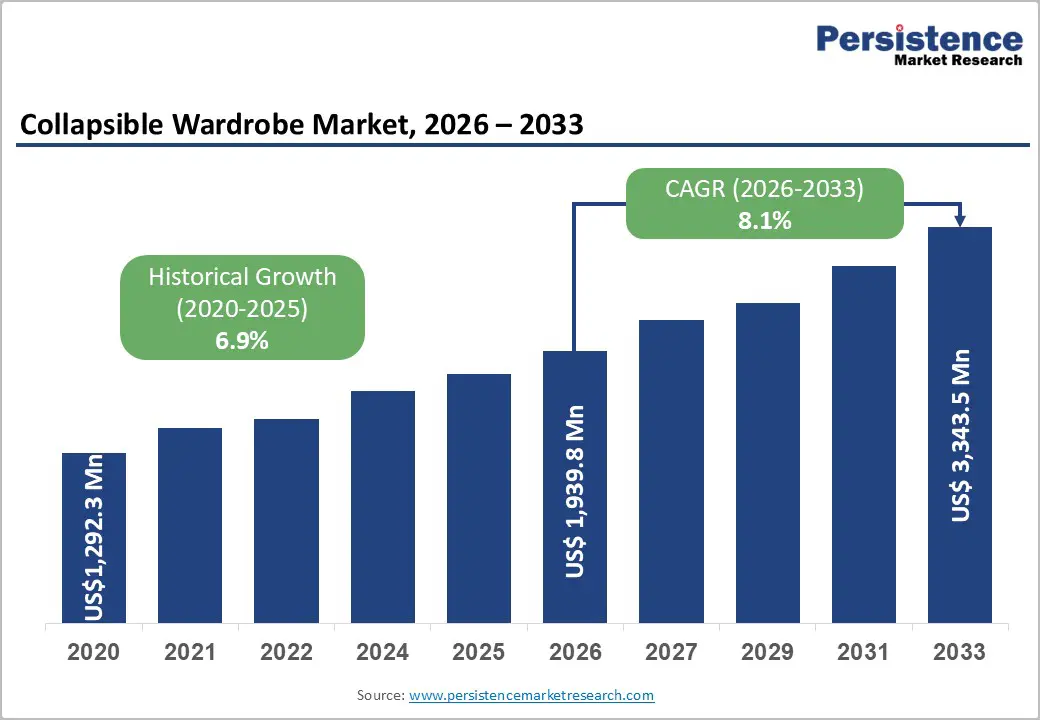
The global collapsible wardrobe market size is projected to rise from US$ 1,939.8 million in 2026 to US$ 3,343.5 million by 2033. It is anticipated to witness a CAGR of 8.1% during the forecast period from 2026 to 2033.
Rapid urbanization, smaller living spaces, and evolving consumer preferences for flexible, cost-effective storage solutions are the primary catalysts accelerating collapsible wardrobe demand globally. Rising rental housing adoption, particularly among millennials and Gen Z in densely populated cities, is creating consistent demand for portable, easy-to-assemble storage units. The robust growth of e-commerce platforms has dramatically improved product accessibility, enabling manufacturers to reach price-sensitive consumers in emerging economies.
Key Industry Highlights:
- Leading Product: Fabric wardrobes dominate with over 30% market share in 2026, valued at more than US$ 581.9 Mn, driven by their lightweight, portable, and cost-effective nature suited for renters and urban households. Plastic wardrobes are the fastest growing, offering enhanced durability, water resistance, and improved structural strength for long-term usage.
- Leading Price Range: Economy segment leads with over 50% share in 2026, valued at more than US$ 970 Mn, supported by strong demand from price-sensitive consumers, students, and migrant populations. Mid-range is the fastest-growing, driven by increasing preference for better durability, aesthetics, and value-for-money offerings among young professionals and nuclear families.
- Leading Distribution Channel: Offline channels dominate with over 60% market share in 2026, valued at more than US$ 1,163.9 Mn, due to consumer preference for physical product verification and immediate availability. Online channels are the fastest-growing, expanding at a CAGR of 13.4%, fueled by rising e-commerce penetration, convenience, and competitive pricing.
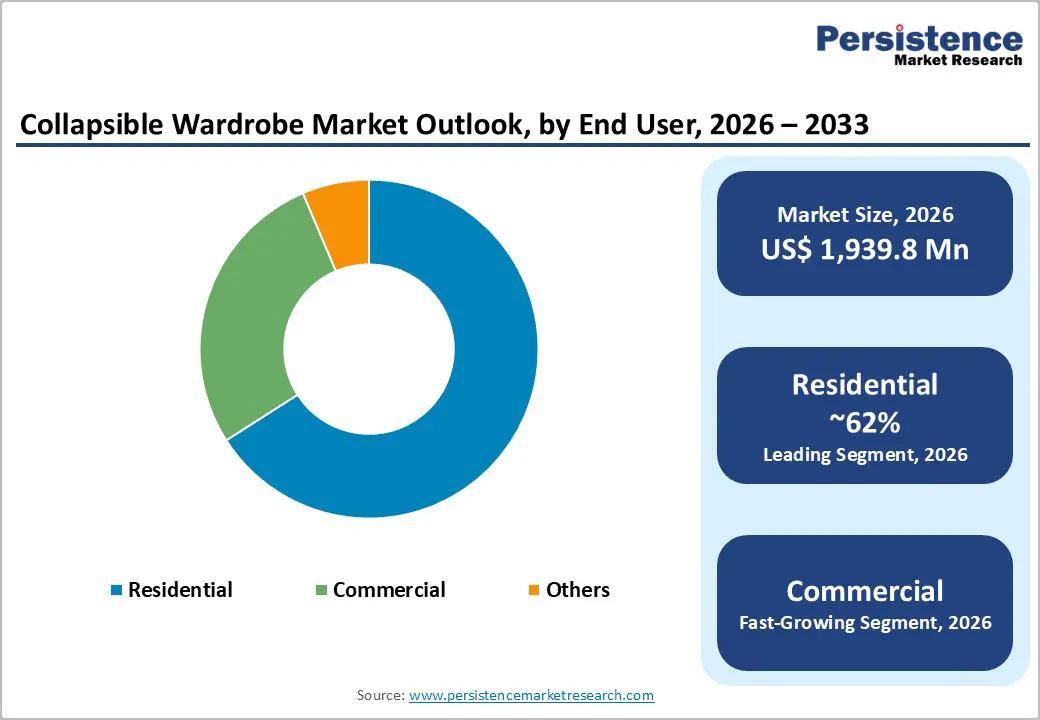
- Leading End User: Residential segment holds the largest share at over 62% in 2026, valued at more than US$ 1,202.7 Mn, driven by demand for space-saving and affordable storage solutions in urban homes. Commercial is the fastest-growing, supported by increasing adoption in hostels, co-living spaces, and budget hospitality sectors.
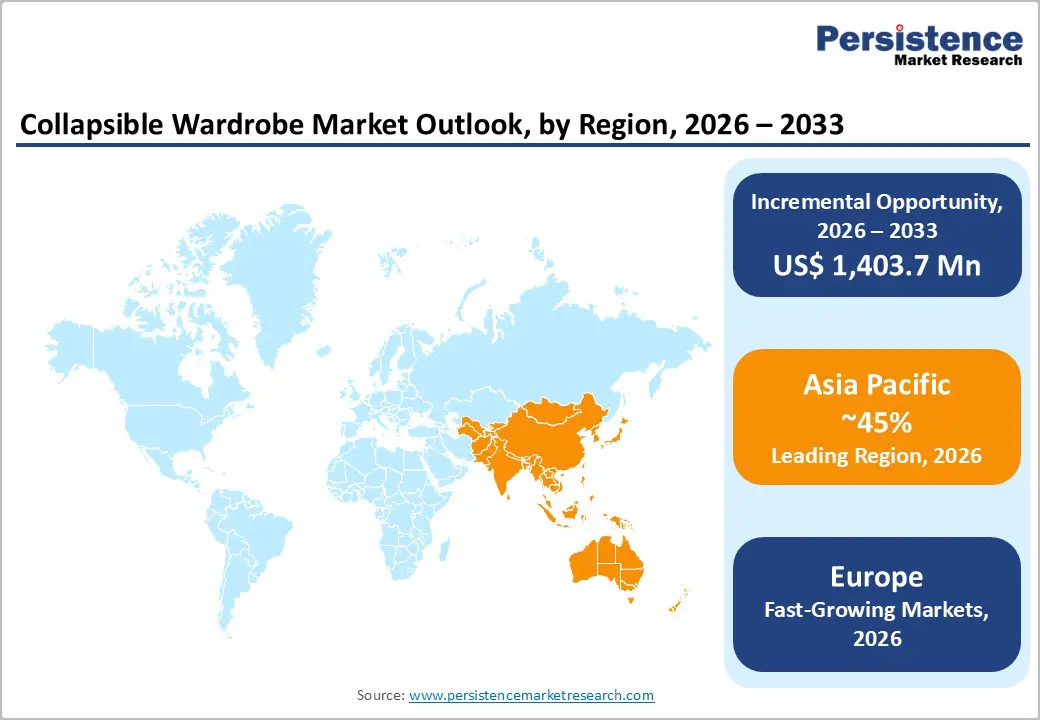
- Leading Region: Asia Pacific leads with over 45% share in 2026, valued at US$ 872.9 Mn, driven by rapid urbanization, strong manufacturing base, and price-sensitive demand in countries like China and India. North America holds over 21% share, supported by a large renter population and a strong e-commerce ecosystem, while Asia Pacific remains the fastest-growing region.
| Key Insights | Details |
|---|---|
| Collapsible Wardrobe Market Size (2026E) | US$ 1,939.8 Mn |
| Market Value Forecast (2033F) | US$ 3,343.5 Mn |
| Projected Growth (CAGR 2026 to 2033) | 8.1% |
| Historical Market Growth (CAGR 2020 to 2025) | 6.9% |
DRO Analysis
Driver - Rising Urbanization and Space Constraints Driving Demand for Compact Storage Solutions
The rapid pace of urbanization globally is significantly boosting demand for collapsible wardrobes. According to United Nations (UN) data, nearly 68% of the global population is expected to live in urban areas by 2050, leading to smaller living spaces and higher demand for multifunctional furniture. Collapsible wardrobes provide flexible, lightweight, and portable storage options, making them ideal for urban apartments and rental housing. Increasing migration to cities in countries such as India, China, and Brazil is creating a growing need for affordable and easy-to-install furniture. This aligns closely with the broader modular furniture market, which is gaining traction due to convenience and cost efficiency, thereby positively influencing the adoption of collapsible wardrobe solutions.
Growth of E-commerce and DIY Furniture Trends Enhancing Market Accessibility
The proliferation of online retail platforms has significantly improved accessibility to collapsible wardrobes. Platforms such as Amazon, Flipkart, and IKEA online stores have enabled consumers to compare prices, designs, and materials easily. According to World Bank digital adoption data, global e-commerce penetration has increased by over 20% post-2020, driving furniture sales online. The rising DIY culture, particularly among millennials, supports the demand for easy-to-assemble and portable furniture. Collapsible wardrobes, often requiring minimal tools and assembly time, perfectly fit this trend. This aligns with the expansion of the ready-to-assemble furniture market, which emphasizes affordability, customization, and ease of transportation, thereby contributing to sustained demand growth.
Restraint - Perceived Durability and Structural Concerns Limiting Premium Adoption
A significant restraint is the persistent consumer perception that collapsible or portable wardrobes lack the structural integrity and longevity of traditional wooden or built-in wardrobes. Consumer surveys reveal that over 48% of potential buyers cite concerns about material durability as a primary reason for not purchasing collapsible units. This is particularly problematic in markets with high-humidity environments, where fabric-based wardrobes may develop mold or deteriorate faster. The absence of strong standardization in load-bearing specifications means product quality varies widely across manufacturers, further eroding consumer trust and limiting market penetration in higher-income segments where long-term furniture investments are preferred.
Intensifying Competition from Low-Cost Imports and Market Fragmentation
The market faces significant pressure from an influx of low-cost imports, primarily from China and Southeast Asia, which creates intense price competition and squeezes margins for established players. According to World Trade Organization (WTO) data, furniture and home goods remain among the most heavily traded categories globally, with Chinese exports of household furniture exceeding a billion annually. This price erosion limits the ability of mid-tier manufacturers to invest in product innovation, branding, or quality improvements. The highly fragmented nature of the market, comprising numerous unorganized regional players, makes it challenging to establish consistent quality benchmarks and inhibits the formation of consumer brand loyalty.
Opportunity - Sustainable Material Innovation and Eco-Conscious Consumer Preferences
Increasing environmental consciousness among global consumers is creating a compelling opportunity for collapsible wardrobe manufacturers to develop and market sustainable product lines. According to the European Environment Agency (EEA), the furniture sector contributes meaningfully to solid waste streams, and consumers, particularly in Europe and North America, are increasingly seeking products made from recycled, biodegradable, or sustainably sourced materials. The EU Ecodesign for Sustainable Products Regulation (ESPR), which came into force in 2024, is pushing manufacturers toward extended product lifespans, repairability, and the use of recycled materials. Companies that proactively develop collapsible wardrobes using FSC-certified wood, recycled plastics, or organic cotton fabrics stand to gain significant competitive differentiation.
Rising Demand from the Hospitality and Commercial Sectors
The global hospitality industry's recovery post-pandemic, coupled with the rapid proliferation of co-living and serviced apartment concepts, is generating significant demand for flexible, cost-effective storage solutions. According to the World Tourism Organization (UNWTO), international tourist arrivals rebounded strongly. Co-living operators, which have grown substantially in cities like Singapore, London, New York, and Berlin, prioritize furniture solutions that can be quickly reconfigured or replaced, making collapsible wardrobes ideal. The rapid expansion of budget and boutique hotel chains in emerging markets further amplifies this commercial opportunity, particularly in India and Southeast Asia, where the hotel construction pipeline remains robust, offering manufacturers a scalable and profitable B2B channel.
Category-wise Analysis
Product Insights
Fabric dominates the market, capturing more than 30% market share in 2026, due to its strong alignment with consumer demand for lightweight, portable, and cost-effective storage solutions. It’s easy to assemble, fold, and relocate, making them ideal for renters, students, and temporary housing needs. Their breathable material also helps prevent moisture buildup, addressing concerns related to mold and odor. Wide availability in customizable designs and colors enhances their appeal among urban consumers seeking aesthetic yet functional furniture.
Plastic is expected to grow rapidly due to increasing preference for durable, water-resistant, and low-maintenance storage options. Plastic wardrobes cater to consumers in humid regions where fabric may degrade faster. They offer better structural rigidity and longer lifespan, fulfilling the need for semi-permanent yet affordable storage. Growing innovation in modular plastic designs and improved load-bearing capacity is further driving adoption among middle-income households.
Price Range Insights
Economy holds over 50% market share in 2026, due to high demand from price-sensitive consumers, especially in developing urban markets. These wardrobes fulfill basic storage needs at minimal cost, making them accessible to students, migrant workers, and low-income households. Their simple design, easy installation, and affordability align well with short-term usage requirements. The expanding rental population further reinforces demand for budget-friendly, temporary furniture solutions.
Mid-Range is expected to grow significantly due to rising consumer inclination toward better quality, durability, and aesthetics without a substantial price increase. This segment addresses the needs of nuclear families and young professionals seeking a balance between cost and longevity. Enhanced materials, improved structural strength, and modern designs are attracting buyers upgrading from economy options while remaining cost-conscious.
Distribution Channel Insights
Offline commands the largest market share at over 60% in 2026, due to consumer preference for physically verifying product quality, size, and material before purchase. Furniture stores and local retailers provide immediate availability and personalized assistance, addressing concerns related to durability and usability. In many regions, offline channels also offer installation support, which enhances customer confidence, especially among first-time buyers.
Online is expected to grow at a CAGR of 13.4% due to increasing digital penetration and the convenience of doorstep delivery. E-commerce platforms cater to evolving consumer needs for price comparison, product variety, and customer reviews. Attractive discounts, easy returns, and bundled offers are encouraging younger consumers to shift online. Improved logistics and faster delivery timelines are making online purchases more reliable for furniture categories.
End-user Insights
Residential holds over 62% share in 2026 due to widespread use in homes where space optimization and affordability are key priorities. Collapsible wardrobes meet the needs of compact living spaces, especially in urban apartments and shared accommodations. Their portability and ease of assembly make them suitable for frequent relocation. Growing nuclear families and rental housing trends are further driving demand.
Commercial is expected to grow significantly due to increasing usage in hostels, PG accommodations, offices, and temporary housing facilities. Businesses require flexible and cost-efficient storage solutions that can be easily installed and replaced. Collapsible wardrobes address the need for scalable furniture in high-turnover environments. Expansion of co-living spaces and budget hospitality sectors is further supporting growth in this segment.
Regional Insights
North America Collapsible Wardrobe Market Trends
North America holds over 21% share in 2026, reaching US$ 407.4 Mn value, driven by strong e-commerce penetration and a large renter base, with over 40 million renter households in the U.S. Rising apartment living and minimalist lifestyles are sustaining demand for portable and modular storage solutions. Leading platforms such as Amazon.com, along with omnichannel retailers, enhance product accessibility and market reach. Canada reflects similar trends, particularly in cities like Toronto and Vancouver, where compact housing is prevalent. Increasing consumer preference for eco-friendly materials is encouraging retailers to introduce sustainable and certified products.
Asia Pacific Collapsible Wardrobe Market Trends
Asia Pacific holds over 45% share in 2026, reaching US$ 872.9 Mn in value & expected to grow at the highest rate, fueled by rapid urbanization, expanding middle-class populations, and strong price-sensitive demand. China leads both production and consumption, supported by an urbanization rate exceeding 65%, creating a sustained need for affordable, space-saving furniture. Large manufacturers strengthen supply capabilities across global markets. India is emerging rapidly due to rising urban housing demand and growing e-commerce penetration via platforms like Flipkart and Amazon India. Southeast Asian countries, including Vietnam, Indonesia, and the Philippines are also witnessing strong growth driven by young populations and increasing adoption of organized retail.
Europe Collapsible Wardrobe Market Trends
Europe is expected to hold more than 20% share by 2026, led by high urban density, strong sustainability focus, and well-established online and offline retail networks. Countries like Germany, where over 50% of the population lives in rented housing, drive significant demand for flexible storage solutions. Compact living in cities such as Paris and London further supports adoption. Regulatory frameworks like the Ecodesign for Sustainable Products Regulation are pushing manufacturers toward recyclable materials and modular designs. Premiumization is evident in Nordic markets, where consumers prefer durable, aesthetically refined products from brands such as Inter IKEA Holding B.V.
Competitive Landscape
The collapsible wardrobe market is moderately fragmented, with a mix of global players and regional manufacturers competing on price, quality, and innovation. Leading companies focus on product differentiation through material innovation, ergonomic design, and sustainability. Strategic initiatives such as partnerships with e-commerce platforms, expansion into emerging markets, and investment in R&D are key growth strategies. Companies are adopting direct-to-consumer models and leveraging digital marketing to enhance brand visibility. The rise of private labels and local manufacturers intensifies competition, driving continuous innovation and cost optimization.
Key Developments:
- In February 2025, Sauder Building Products will showcase its latest cabinetry and closet innovations at IBS 2025 in Las Vegas, featuring an expanded booth with solutions for residential and multifamily projects. Highlights include new aluminum frame glass closet doors, advanced accessories, and a collaborative Design Studio offering interactive design inspiration.
- In September 2024, IKEA introduced an upgraded PAX wardrobe featuring an innovative foldable frame that enables faster, vertical assembly with minimal space requirements. The new design reduces assembly time by nearly half and improves accessibility, making the wardrobe easier to install for a wider range of customers.
Companies Covered in Collapsible Wardrobe Market
- Inter IKEA Holding B.V.
- Dorel Industries Inc.
- Sauder Woodworking Company
- Oppein Home Group Inc.
- Suofeiya Home Collection Co., Ltd.
- Holike Creative Home Co., Ltd.
- GoldenHome Living Co., Ltd.
- Häfele SE & Co KG
- The Stow Company
- Shangpin Home Collection Co., Ltd.
- Topstrong Living Innovation
- Lifestyle International Pvt. Ltd.
- Others
Frequently Asked Questions
The collapsible wardrobe global market is projected to be valued at US$ 1,939.8 Mn in 2026.
The rising urbanization, compact living spaces, and increasing demand for affordable, portable storage solutions are key drivers of the market.
The market is expected to witness a CAGR of 8.1% from 2026 to 2033.
Innovation in eco-friendly materials and customizable designs offers significant growth potential, creating strong growth opportunities.
Inter IKEA Holding B.V., Dorel Industries Inc., Sauder Woodworking Company, Oppein Home Group Inc., Suofeiya Home Collection Co., Ltd., Holike Creative Home Co., Ltd., GoldenHome Living Co., Ltd. are among the leading key players.


