




- Agrochemicals
- Chicken Manure Fertilizers Market
Chicken Manure Fertilizers Market Size, Share, and Growth Forecast, 2026 – 2033
Chicken Manure Fertilizers Market by Product Type (Raw Solid Manure, Composted Manure, Pelletized Manure, Liquid Manure), Application (Field Crop, Horticulture, Turf & Ornamentals, Greenhouses & Nurseries, Home & Garden), End-User (Large Commercial Farms, Organic Farms, Small Holders, Home Gardeners, Landscape Management Companies), and Regional Analysis for 2026-2033

Chicken Manure Fertilizers Market Share and Trends Analysis
The global chicken manure fertilizers market size is likely to be valued at US$ 2.0 billion in 2026 and is estimated to reach US$ 3.1 billion by 2033, growing at a CAGR of 6.5% during the forecast period 2026−2033. This growth is driven by increasing global adoption of sustainable and organic farming practices, rising demand for eco?friendly soil amendments, and growing regulatory and consumer pressure to reduce chemical fertilizer use. Enhanced processing technologies, such as composting, pelletizing, and liquid formulations, and rising awareness of soil health also support market expansion.
Key Industry Highlights
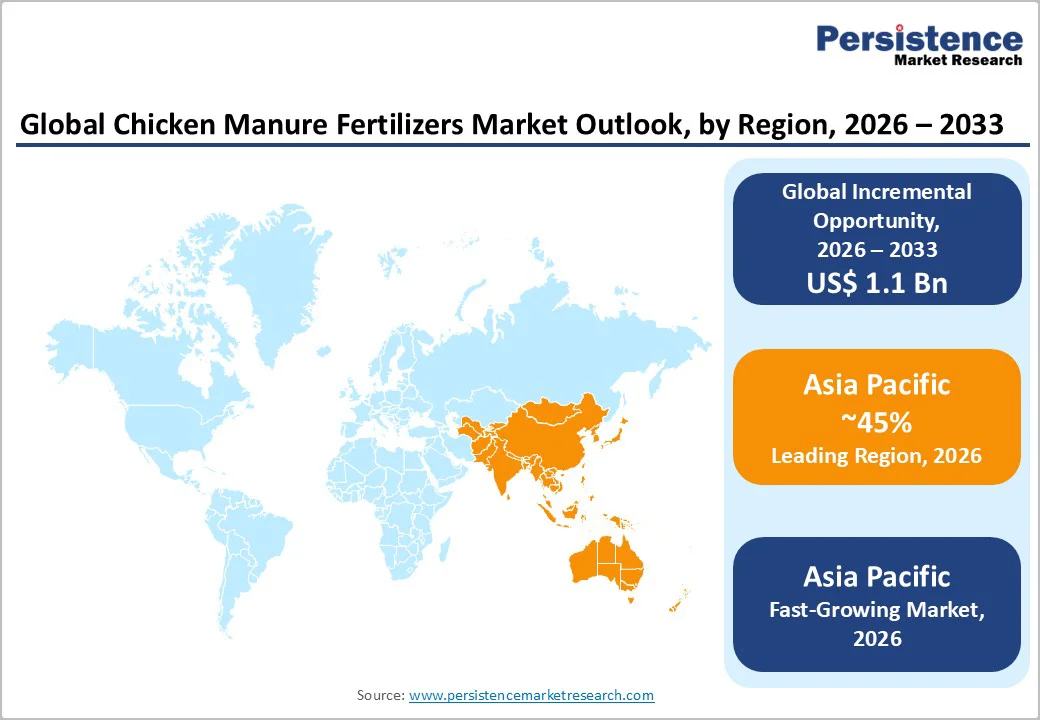
- Dominant Region: Asia Pacific is projected to hold over 45% market share, owing to large-scale agricultural activities and intense soil fertility needs.
- Fastest-growing Regional Market: Asia Pacific is also expected to be the fastest-growing market through 2033, driven by increasing adoption of regenerative agriculture and precision farming technologies.
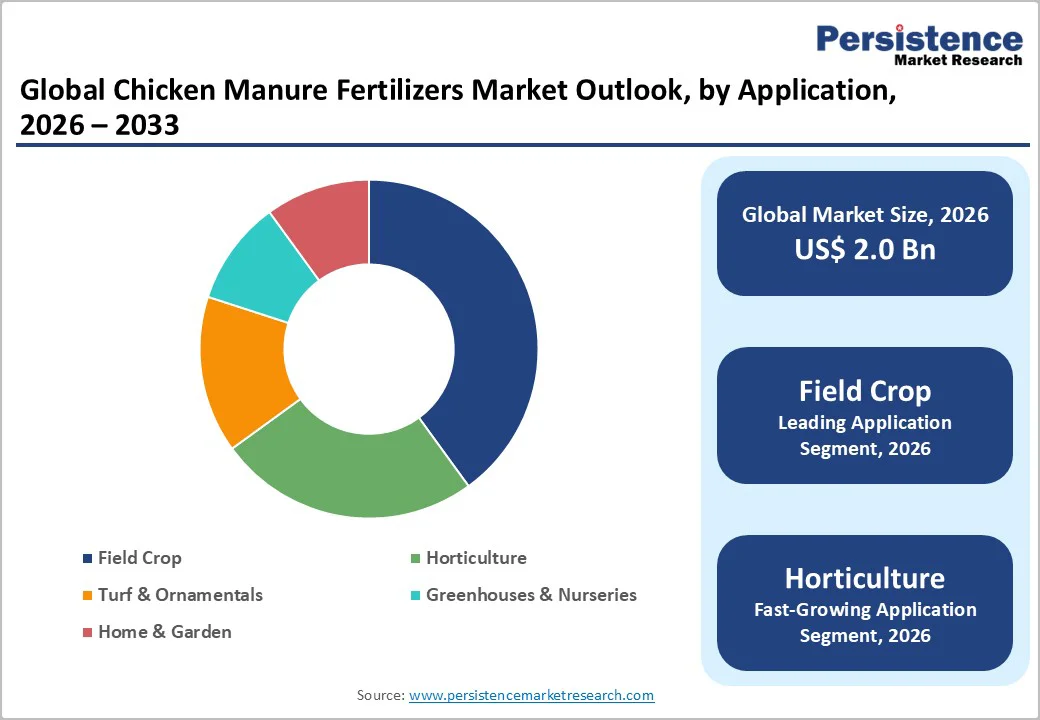
- Leading Application: Field crops are projected to lead with over 40% market share, boosted by a high demand for grains and staple crops and alignment with traditional farming practices.
- Fastest-growing Application: Horticulture is likely to be the fastest-growing from 2026 to 2033, on account of the rising demand for organic fruits, vegetables, and ornamental plants.
- March 2025: U.K. High Court ruled chicken manure as "waste" under Waste Framework Directive, requiring strict disposal plans for poultry producers in Herefordshire.
| Key Insights | Details |
|---|---|
| Chicken Manure Fertilizers Market Size (2026E) | US$ 2.0 Bn |
| Market Value Forecast (2033F) | US$ 3.1 Bn |
| Projected Growth (CAGR 2026 to 2033) | 6.5% |
| Historical Market Growth (CAGR 2020 to 2025) | 6.1% |

Market Factors – Growth, Barriers, and Opportunity Analysis
Surging Demand for Organic Farming
Rising consumer awareness about health and environmental sustainability has significantly increased the adoption of organic farming practices. Farmers are shifting from chemical-based fertilizers to natural alternatives that improve soil fertility and crop quality. Chicken manure serves as a nutrient-rich, cost-effective solution that enhances soil structure, increases microbial activity, and supports sustainable crop production. Its high nitrogen, phosphorus, and potassium content allows crops to grow efficiently without the risks associated with synthetic chemicals, aligning with the global emphasis on clean and safe food production. According to FiBL and IFOAM – Organics International, as of 2023, 98.9 million hectares of land worldwide are managed organically, representing 2.1% of total global farmland, reflecting the steady rise of organic cultivation.
The push toward organic certification and premium crop pricing has created a steady demand for nutrient-dense organic fertilizers. Farmers leveraging chicken manure can achieve higher yields while maintaining compliance with organic farming standards. Environmental considerations such as reducing chemical runoff, enhancing biodiversity, and promoting circular waste utilization make chicken manure an attractive option. Using poultry waste as fertilizer aligns with sustainable agricultural practices, turning farm by-products into valuable inputs and supporting long-term, scalable nutrient management strategies for crop production.
Pathogen and Quality Control Challenges
Pathogen contamination in chicken manure poses significant risks for its application in agriculture. Manure can harbor harmful microorganisms such as salmonella, E. coli, and other bacteria that threaten crop safety and human health. Without proper treatment, these pathogens can persist in soil, contaminate water sources, and compromise food quality. The complexity of managing these biological risks increases operational costs and requires strict monitoring protocols. Ensuring pathogen-free manure involves controlled composting, thermal treatments, or chemical interventions, which can extend processing time and reduce overall efficiency.
Quality control challenges further limit consistent utilization of chicken manure. Variability in nutrient composition, moisture content, and organic matter affects its performance as a fertilizer. Farmers and agribusinesses demand predictable results to optimize crop yield, and inconsistent batches can undermine confidence in manure-based products. Establishing standardized quality parameters and implementing rigorous testing is essential but resource-intensive. This unpredictability restricts large-scale adoption, as stakeholders prefer alternatives with uniform nutrient profiles. Managing these biological and quality constraints is critical to achieving safe, effective, and reliable use of chicken manure in agricultural operations.
Product Innovation and Value-added Formulations
Product innovation and value-added formulations present a significant opportunity as they transform traditional nutrient sources into more efficient, user-friendly solutions. Advances in processing techniques allow for tailored nutrient ratios, slow-release options, and enhanced bioavailability, which improve crop performance while reducing environmental impact. These innovations cater to farmers seeking predictable results, higher yields, and cost-effective inputs, creating a strong differentiation from conventional fertilizers. Value-added products also support sustainable practices by minimizing nutrient loss and promoting soil health, aligning with growing regulatory and consumer expectations for environmentally responsible agriculture.
Enhanced formulations create new revenue streams by appealing to specialized segments such as high-value crops, organic farming, and precision agriculture. Customized blends, granulated or pelleted forms, and enriched microbial additives expand the usability and convenience for end-users. This approach allows companies to command premium pricing and build brand loyalty through superior performance and reliability. By integrating innovation with practicality, producers can address evolving agricultural demands, reinforce long-term customer relationships, and position themselves at the forefront of efficiency-driven solutions in crop nutrition.
Category-wise Analysis
Product Type Insights
Raw solid manure is likely to remain the leading product type in 2026, projected to account for over 65% of the market share. Its dominance stems from the relative simplicity of production and lower processing requirements compared to other forms. The solid format aligns well with field crop applications and traditional farming practices, allowing for straightforward handling, storage, and distribution. Farmers benefit from its cost-effectiveness, reliable nutrient content, and compatibility with large-scale land use. These factors collectively reinforce its position as the preferred choice among conventional agricultural operations, sustaining its leadership.
Liquid chicken manure fertilizers are anticipated to experience the fastest growth during 2026-2033 due to their efficiency and ease of application. This format allows nutrients to be absorbed more rapidly by plants, making it ideal for precision agriculture, greenhouses, and hydroponic systems. The convenience of direct soil or foliar application reduces labor requirements and improves operational efficiency. Demand is further fueled by a shift toward technology-driven farming methods that prioritize fast-acting, manageable nutrient solutions, positioning liquid formulations as a high-potential growth segment in the evolving agricultural landscape.
Application Insights
Field crops are projected to dominate, expected to account for over 40% of the chicken manure fertilizers market revenue share in 2026. This leadership is driven by strong demand for grains, pulses, and staple crops, particularly across Asia Pacific where high-nitrogen fertilizers are critical for yield enhancement. Farmers rely on consistent nutrient supply to meet large-scale production requirements. The segment’s alignment with traditional farming practices, cost-efficiency, and proven performance underpins its sustained dominance in the agricultural landscape.
Horticulture is anticipated to be the fastest-growing segment from 2026 to 2033, driven by the increasing demand for fruits, vegetables, and ornamental plants. Growth is supported by rising consumer preference for organic produce, urban farming initiatives, and government programs promoting sustainable agriculture practices, such as Pradhan Mantri Krishi Vikas Yojana (PKVY). The segment also benefits from precision nutrient management and tailored fertilizer solutions, which enhance crop quality and yield. These factors position horticulture as a high-potential growth avenue within the evolving agricultural ecosystem, attracting increased adoption from both commercial and smallholder farmers.
End-User Insights
Large commercial farms are expected to dominate the end-user segment, projected to account for over 55% of the market share in 2026. Their scale and operational volume drive consistent requirements for cost-effective, high-nutrient fertilizers that support extensive crop production. Chicken manure offers a reliable and economical solution, meeting both yield and soil health objectives. The segment’s dependence on proven nutrient sources, combined with streamlined procurement and application practices, reinforces its dominant position. These factors ensure sustained demand and a stable revenue base within the agricultural fertilizer ecosystem.
Organic farms are anticipated to be the fastest-growing end-user segment through 2033, fueled by the rapid expansion of certified organic cultivation across global markets. Rising consumer preference for clean-label, chemical-free produce is strengthening the shift toward natural nutrient sources, positioning manure-based fertilizers as a strategic input for organic compliance. These farms prioritize soil regeneration, microbial activity, and long-term fertility, making chicken manure an ideal solution due to its balanced nutrient profile and sustainability benefits. As organic cultivated area increases and certification standards tighten, demand from organic farms is expected to accelerate, reinforcing their role as a high-potential growth contributor.
Regional Insights
North America Chicken Manure Fertilizers Market Trends
North America is poised to emerge as the fastest-growing regional market for chicken manure fertilizers, driven by a strong shift toward sustainable and organic farming practices. Rising consumer preference for chemical-free produce and certified organic crops is motivating farmers to adopt nutrient-rich manure-based fertilizers to enhance soil fertility and crop productivity. Large-scale operations and specialty farms are increasingly integrating these fertilizers into conventional and organic systems. The availability of high-quality poultry waste, combined with technological advancements in composting and processing, ensures consistent nutrient content and reliable supply, supporting widespread adoption across agricultural and horticultural applications.
Investments in advanced processing infrastructure, including pelletization units, odor-control systems, and precision nutrient formulation, are further accelerating market growth. These innovations improve ease of handling, storage stability, and application efficiency, making chicken manure fertilizers more appealing to commercial farmers and smallholders alike. Government incentives and soil health programs promoting reduced chemical use and sustainable agriculture practices provide additional support for adoption. With rising awareness of environmental benefits, soil restoration needs, and organic certification requirements, North America is positioned for sustained growth and increasing reliance on chicken manure-based fertilizer solutions.
Europe Chicken Manure Fertilizers Market Trends
Europe represents a significant market for chicken manure fertilizers, powered by a strong adoption of organic and sustainable farming practices across the continent. Farmers increasingly prioritize nutrient-rich, eco-friendly inputs to enhance soil fertility, restore degraded lands, and meet strict regulatory standards for chemical use in agriculture. Countries such as Germany, France, and the Netherlands are investing in manure processing technologies, including composting, pelletization, and odor-control systems, to improve product quality, consistency, and usability. The emphasis on high-value horticulture, protected cultivation, and integrated crop-livestock systems further supports the utilization of poultry-based fertilizers across diverse agricultural segments.
Regulatory frameworks in Europe, including environmental protection and organic certification standards, strongly influence fertilizer selection, favoring manure-based and sustainable inputs. Rising consumer demand for chemical-free produce encourages farmers to adopt chicken manure fertilizers to comply with quality and certification requirements. Supportive government programs and subsidies for sustainable agriculture practices also accelerate adoption. The combination of stringent regulations, focus on soil health, and growing preference for organic inputs positions Europe as a strategically important region for the chicken manure fertilizer market, ensuring steady growth and innovation in the sector.
Asia Pacific Chicken Manure Fertilizers Market Trends
Asia Pacific is projected to capture over 45% of the chicken manure fertilizers market share in 2026, anchored by its extensive agricultural footprint and strong reliance on nutrient-rich organic fertilizers for staple crop production. Continuous cropping cycles and widespread soil degradation heighten the need for cost-efficient fertility solutions, making manure-based inputs a strategic choice across major farming economies. The region benefits from a rapidly expanding poultry sector that ensures steady feedstock availability and competitive pricing. Supportive government programs promoting soil restoration and reduced chemical dependency further elevate adoption among small and medium growers, solidifying Asia Pacific’s position as the dominant regional market.
Asia Pacific is also anticipated to be the fastest-growing regional market through 2033, supported by an accelerated shift toward regenerative farming and expanded use of precision technologies that enhance organic fertilizer efficiency. Rising demand for chemical-free produce and increasing certification activity in markets such as India, China, Vietnam, and Indonesia are driving preference for manure-based inputs with reliable nutrient profiles. Investments in composting facilities, pelletization units, and odor-control technologies are improving product quality and enabling wider application in horticulture, protected cultivation, and integrated crop–livestock systems. This combination of structural demand, modernization, and sustainability-driven policies positions the region for sustained high-growth performance.
Competitive Landscape
The global chicken manure fertilizers market remains moderately fragmented, shaped by a wide mix of small and medium specialty fertilizer producers, regional cooperatives, and a limited number of integrated agribusiness companies. Local processors maintain strong positions due to their proximity to poultry operations and the ability to supply cost-effective, consistent products tailored to regional soil and crop needs. Competition is driven more by processing capability, reliability, and nutrient quality than by global scale.
Market share concentration stays comparatively low as production depends on localized manure availability, diverse composting and pelletizing methods, and region-specific farming practices. Regulatory variations and fragmented distribution channels further reduce consolidation opportunities, supporting broad participation and limiting dominance by global fertilizer manufacturers.
Key Industry Developments
- In September 2025, USPOULTRY's Family Farm Environmental Excellence Award recognized exemplary environmental stewardship by family-owned poultry/egg farms supplying member companies. The 2025 recipients/finalists highlighted farms with advanced practices in nutrient management, litter processing, wastewater treatment, and conservation.
- In July 2025, a Malawi pilot turned chicken waste into organic fertilizer, helping smallholder farmers revive soil health and boost crop yields. The initiative offers a low-cost, sustainable solution to declining soil fertility.
- In January 2025, Argo Development Partners announced plans to open a poultry bio-processing facility in Ottawa County, Oklahoma, to convert chicken litter via anaerobic digestion into renewable natural gas, liquid fertilizer, and solid fertilizer. The project secured an air permit from Oklahoma DEQ, with enclosed negative-pressure systems to mitigate smells.
Companies Covered in Chicken Manure Fertilizers Market
- Olmix Group
- The Farm’s Choice
- Ag Organic
- Stutzman Environmental Products
- Rocky Point
- Fertagon
- Bio Greens Sustainable Solutions Pvt Ltd
- Indian Organic Fertilizers Pvt Ltd
- Jaipur Bio Fertilizers
- CropAgro
- Ductor Oy
- Perfect Blend LLC
Frequently Asked Questions
The global chicken manure fertilizers market is projected to reach US$ 2.0 billion in 2026.
Rising demand for organic farming, soil fertility restoration, sustainable agriculture practices, and eco-friendly crop inputs is primarily driving the market.
The market is poised to witness a CAGR of 6.5% from 2026 to 2033.
Key market opportunities include growth in organic farming, smallholder agriculture, sustainable fertilizers, poultry waste management, and soil health enhancement.
Some of the key market players include Olmix Group, The Farm’s Choice, Ag Organic, Stutzman Environmental Products, Rocky Point, and Fertagon.


