




- Medical Devices
- Caries Detection Device Market
Caries Detection Device Market Size, Share, and Growth Forecast, 2026 – 2033
Caries Detection Device Market by Device Format (Handheld Devices, Benchtop Devices), Technology Type (Laser Fluorescence Caries Detectors, Others), Application (Primary Caries Detection, Secondary/Recurrent Caries Detection, Others), and Regional Analysis for 2026-2033

Caries Detection Device Market Size and Trends Analysis
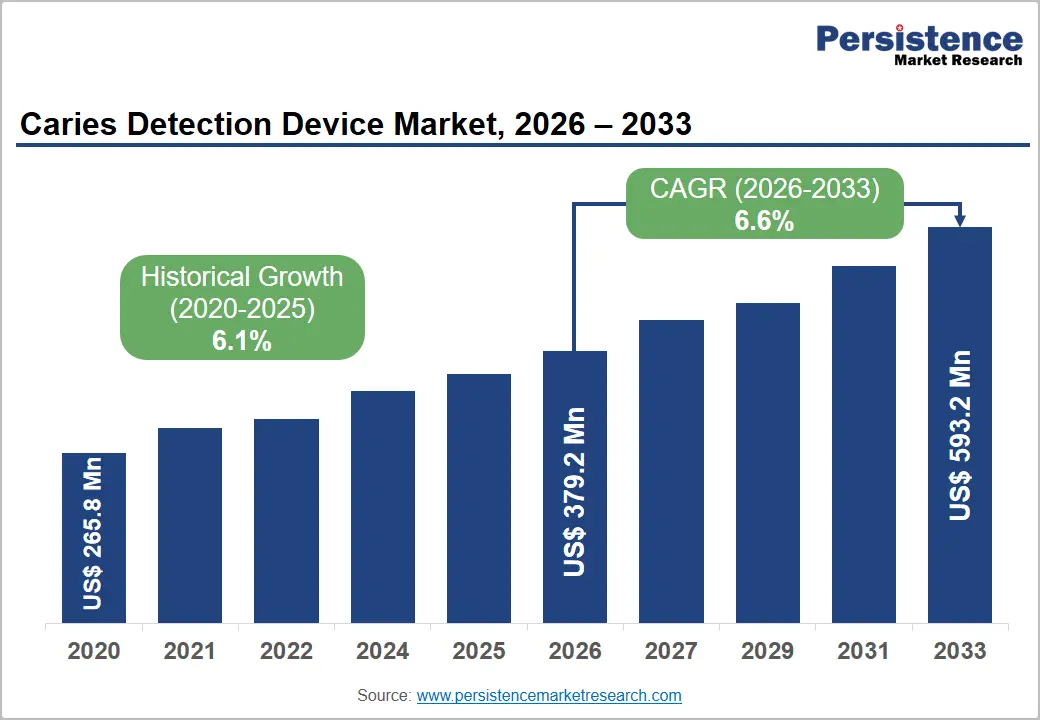
The global caries detection device market size is likely to be valued at US$379.2 million in 2026 and is estimated to reach US$593.2 million by 2033, growing at a CAGR of 6.6% during the forecast period from 2026 to 2033, driven by the convergence of rising untreated caries burden, earlier-diagnosis protocols, and digital dentistry adoption across preventive and restorative care workflows.
Demand is strengthening because aging populations, pediatric preventive care programs, and sugar-linked disease prevalence are increasing diagnostic volumes across both routine check-ups and high-risk follow-up cases. Regulatory clearances for AI-enabled radiographic analysis, fluorescence-based tools, and near-infrared imaging platforms are improving clinical confidence and accelerating procurement decisions.
Key Industry Highlights:
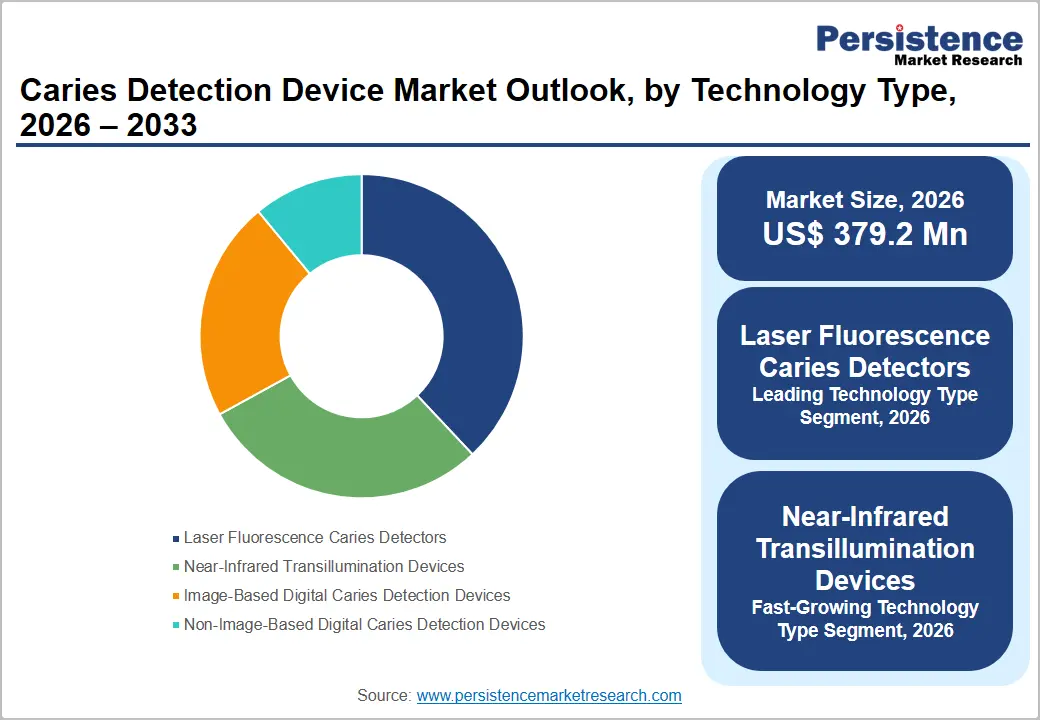
- Leading Technology Type: Laser fluorescence caries detectors are poised to hold over 38% revenue share in 2026, driven by two decades of validated clinical integration across mainstream dental examination protocols.
- Fastest-growing Technology Type: Near-infrared transillumination devices are forecast to record the fastest technology segment growth, driven by radiation-free detection capability and expanding adoption within pediatric and preventive dentistry specialties.
- Leading Application: Primary caries detection is estimated to hold roughly 35% revenue share in 2026, driven by foundational placement within all dental examination workflows across clinical settings and patient demographics.
- Fastest-Growing Application: Caries monitoring and lesion progression assessment is anticipated to record the fastest application segment growth, driven by the global clinical transition toward minimally invasive dentistry protocols requiring longitudinal lesion quantification tools.
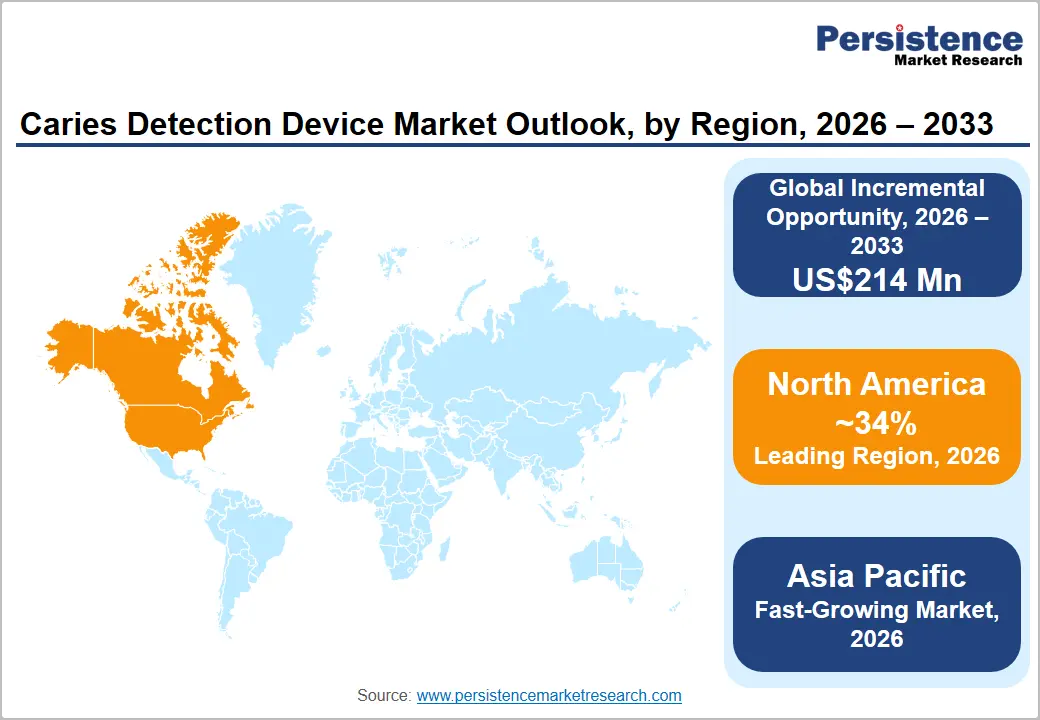
- Regional Leadership: North America is projected to capture roughly 34% of the market share by 2026, while Asia Pacific is forecast to record the fastest growth due to oral health policy momentum and rapid dental clinic digitization.
- Competitive Environment: The market reflects a moderately fragmented structure, with key players such as Dentsply Sirona, DEXIS, Pearl, Align Technology, and KaVo Dental leveraging imaging installed bases, AI software, and workflow integration to strengthen positioning.
DRO Analysis
Driver - Rising Untreated Caries Burden and Preventive Dentistry Emphasis
Untreated dental caries remains one of the most persistent oral health burdens globally, which directly increases the value of devices capable of detecting lesions earlier and with greater consistency. When disease prevalence stays high across children, adults, and older populations, providers face greater pressure to identify non-cavitated lesions before restorative intervention becomes more invasive and costly. This shifts clinical preference toward adjunctive diagnostic tools that improve visibility of proximal, enamel, and recurrent lesions during routine examinations and recall visits.
The demand effect is reinforced by public-health pressure to move oral care toward prevention rather than late-stage repair. The World Health Organization (WHO) stated in 2025 that oral diseases affect nearly 3.7 billion people globally, while untreated dental caries in permanent teeth remains the most common health condition worldwide. That scale raises screening volume, encourages earlier intervention pathways, and supports investment in fluorescence, transillumination, and digital detection systems that help dentists triage disease progression with greater precision.
Restraint - Limited Awareness and Training Gaps in Developing Markets
Inadequate clinical training infrastructure for digital caries detection methodologies in developing regions reduces effective device utilization rates even where procurement has occurred. Underutilization limits measurable diagnostic value, reducing the probability of repeat purchases or platform upgrades. Dental curriculum gaps across Sub-Saharan Africa, South and Southeast Asia mean that practitioners default to conventional detection methods.
This training gap reduces scalability of device deployment programs undertaken by manufacturers and governmental dental health initiatives. Device effectiveness depends substantially on operator competence; without structured training ecosystems, clinical outcomes do not differentiate sufficiently from conventional methods. Consequently, procurement decision-makers in these markets deprioritize caries detection device investment, constraining revenue growth in markets that represent the largest unmet patient burden globally.
Opportunity - Integration of Artificial Intelligence in Caries Detection Workflow
AI-augmented caries detection represents the most consequential innovation pathway available to device manufacturers during the 2026–2033 period. Machine learning models trained on large annotated dental imaging datasets enable automated lesion identification with sensitivity and specificity metrics exceeding conventional clinical assessment benchmarks. Regulatory frameworks, including the FDA's De Novo pathway for software as a medical device (SaMD), now provide structured approval channels for AI-enabled diagnostic tools, reducing time-to-market uncertainty.
Manufacturers integrating AI diagnostic layers into image-based digital caries detection devices can differentiate on clinical performance metrics, supporting premium pricing strategies and deeper institutional contracts. The interoperability of AI modules with electronic health record (EHR) platforms creates workflow value beyond diagnostics, enabling longitudinal caries progression tracking. This data continuity function generates recurring software revenue streams that augment hardware sales, strengthening manufacturer revenue models across multi-year clinical relationships.
Category-wise Analysis
Device Format Insights
Handheld devices are anticipated to secure around 62% of the caries detection device market share in 2026, reflecting strong clinical preference for portable diagnostic solutions that integrate into chairside examination workflows without fixed infrastructure requirements. KaVo Dental's DIAGNOpen system exemplifies how compact handheld design accelerates chairside adoption across both solo practices and group clinics. Portability-driven procurement dominates purchasing decisions in markets where space constraints and mobile clinic deployment scenarios are prevalent.
Benchtop devices are expected to be the fastest-growing segment, propelled by increasing adoption within hospital-based dental departments and dental school training environments where throughput volume and imaging precision requirements favor stationary, high-resolution diagnostic platforms. Precision diagnostic capability at the institutional level is converting capital expenditure commitments into multi-unit procurement contracts across academic and tertiary care settings.
Technology Type Insights
Laser fluorescence caries detectors are poised to dominate with a forecast market share of over 38% in 2026, powered by established clinical validation records, broad regulatory clearance across major markets, and integration into mainstream dental practice protocols developed over two decades of commercial deployment. Acteon Group's Soprolife device demonstrates how mature laser fluorescence platforms maintain clinical confidence through continuous software refinement and expanded lesion category coverage. Validated diagnostic accuracy sustains procurement preference among evidence-driven clinical buyers despite the emergence of competing optical modalities.
Near-infrared transillumination (NIRT) devices are estimated to be the fastest-growing segment, fueled by their capacity to detect proximal and sub-surface enamel lesions without ionizing radiation exposure, aligning with patient safety preferences and pediatric dental care protocols that restrict X-ray frequency. Radiation-free diagnostic positioning is accelerating NIRT adoption as a primary detection modality within child-focused and public health dental programs.
Application Insights
Primary caries detection is likely to be the leading segment with a projected 35% of the caries detection device market share in 2026 due to its foundational role across all dental examination protocols, encompassing the initial identification of active carious lesions at first patient presentation across all age cohorts and clinical settings. Carestream Dental's CariVu device demonstrates how primary detection platforms integrate into routine examination workflows without displacing existing diagnostic steps. First-line diagnostic utility ensures consistent demand irrespective of specialty focus or practice scale.
Caries monitoring and lesion progression assessment is anticipated to be the fastest-growing segment, fueled by the clinical shift toward minimally invasive dentistry protocols that prioritize lesion stabilization over immediate restorative intervention, requiring longitudinal monitoring tools that quantify remineralization and progression rates between appointments. QLF-D Biluminator by Inspektor Research Systems demonstrates the market appetite for quantitative fluorescence tools that support interval monitoring without additional patient radiation exposure.
Regional Insights
North America Caries Detection Device Market Trends
North America is expected to lead with an estimated 34% of the caries detection device market share in 2026, supported by strong digital dentistry penetration, rapid adoption of AI-assisted radiographic diagnostics, and high dental expenditure across preventive and restorative care settings. The region benefits from broad installed imaging infrastructure, which allows clinics to integrate fluorescence, transillumination, and image-based detection systems into routine workflows.
U.S. Caries Detection Device Market Insights
The U.S. is projected to account for nearly 79% of the North America market share in 2026, supported by high utilization of digital radiography, strong purchasing capacity among private dental networks, and continued regulatory support for AI-enabled diagnostic platforms. The country is also benefiting from a large untreated caries burden across pediatric and adult populations, which sustains demand for early-stage lesion detection tools.
Canada Caries Detection Device Market Insights
Canada is forecast to hold around 14% of the North America market share in 2026, supported by broader access to dental care through federal coverage expansion and continued investment in oral healthcare delivery. The Canadian Dental Care Plan is increasing patient entry into formal dental care pathways, which is raising examination volumes and strengthening the commercial case for efficient chairside diagnostic technologies.
Europe Caries Detection Device Market Trends
Europe is projected to capture approximately 28% of the caries detection device market share in 2026, driven by established dental care infrastructure, high digital imaging adoption, and growing regulatory alignment around AI-enabled diagnostic software. The region is also benefiting from increased emphasis on preventive oral care, treatment efficiency, and modernization of diagnostic workflows in both private and public dental systems.
Germany Caries Detection Device Market Insights
Germany is expected to contribute nearly 21% of the Europe market in 2026, supported by advanced dental practice infrastructure, strong clinician engagement with digital workflows, and a well-established role in dental equipment commercialization. The country remains a key launch and demonstration hub for imaging and diagnostic technologies due to its importance within the European dental industry ecosystem.
U.K. Caries Detection Device Market Insights
The U.K. is likely to account for about 16% of the Europe market in 2026, supported by NHS dental access reforms, rising patient throughput, and growing demand for faster diagnostic workflows in general practice. Government efforts to expand urgent dental appointments and improve treatment prioritization are increasing the value of chairside technologies that enhance lesion detection and clinical documentation without materially extending appointment times.
Asia Pacific Caries Detection Device Market Trends
Asia Pacific is forecast to be the fastest-growing market for caries detection devices, stimulated by rising oral disease prevalence, expanding middle-class spending on dental care, and rapid digitization of private dental clinics. The regional market is witnessing stronger demand for early-stage diagnostic tools as preventive dentistry gains importance across pediatric and urban adult populations.
China Caries Detection Device Market Insights
China is projected to represent nearly 31% of the Asia Pacific market in 2026, supported by rising oral health awareness, expanding private dental chain networks, and continued investments in digital dental equipment across urban centers. National oral health promotion initiatives and cavity prevention campaigns are improving screening awareness, which supports stronger demand for early-stage diagnostic technologies.
Japan Caries Detection Device Market Insights
Japan is expected to hold approximately 18% of the Asia Pacific market in 2026, supported by advanced dental technology adoption, a large aging population, and growing emphasis on healthcare digitization. The country offers a favorable environment for caries monitoring and image-assisted diagnostic devices because clinics increasingly prioritize efficient diagnosis, treatment planning accuracy, and longitudinal preventive care for older patients.
Competitive Landscape
The global caries detection device market is moderately fragmented, with competition shaped by a mix of dental imaging incumbents, specialized diagnostic device manufacturers, and emerging AI-enabled software developers. Competitive positioning depends on imaging quality, regulatory clearances, workflow integration, and the ability to support both diagnosis and patient communication. Key participants include Dentsply Sirona, DEXIS, KaVo Dental, Pearl, and Align Technology.
Competition is increasingly shifting from stand-alone hardware toward integrated diagnostic ecosystems combining imaging, software analytics, cloud storage, and treatment planning support. Vendors with established radiography installed bases hold an advantage because they can cross-sell caries detection functionality into existing workflows. Newer AI-focused entrants are differentiating through radiographic annotation, lesion segmentation, and decision-support interfaces rather than through standalone device hardware alone.
Key Industry Developments:
- In January 2026, CaviSense introduced a 10-second, radiation-free chairside test for early caries risk at Yankee Dental Congress, reinforcing the shift toward preventive diagnostics through rapid detection of active enamel demineralization before visible cavitation.
- In January 2025, VideaHealth launched Caries 3.0, an upgraded dental AI model designed to improve early caries detection accuracy and reduce false positives, reinforcing the role of AI-enabled diagnostics in enhancing clinical consistency and chairside decision-making.
Companies Covered in Caries Detection Device Market
- Dentsply Sirona
- DEXIS
- KaVo Dental
- Acteon Group
- Carestream Dental
- Air Techniques
- Align Technology
- Pearl
- VideaHealth
- Overjet
- Planmeca
- Owandy Radiology
- Ortek Therapeutics
- AdDent
- Quantum Dental Technologies
Frequently Asked Questions
The global caries detection device market is projected to reach US$379.2 million in 2026.
The caries detection device market is driven by the rising global burden of dental caries, growing emphasis on early and minimally invasive diagnosis, and increasing integration of AI-enabled and image-based diagnostic technologies into routine dental workflows.
The caries detection device market is poised to witness a CAGR of 6.6% from 2026 to 2033.
Key market opportunities in the caries detection device market lie in expanding lesion monitoring applications, integration of AI with digital imaging platforms, and rising adoption of radiation-free diagnostic tools across preventive and pediatric dentistry.
Some of the key market players include Dentsply Sirona, DEXIS, KaVo Dental, Pearl, and Align Technology.


