




- Agrochemicals
- Calcium Ammonium Nitrate Market
Calcium Ammonium Nitrate Market Size, Share, and Growth Forecast 2026 - 2033
Calcium Ammonium Nitrate Market by Grade (Technical, Reagent, Fertilizer, Other), by Form (Solid, Liquid), by Application (Water Treatment, Inorganic Fertilizer, Concrete, Explosives, Ice Packs, Other), by End-use Industry (Agriculture, Construction, Pharmaceutical, Mining, Others), by Regional Analysis, 2026 - 2033

Calcium Ammonium Nitrate Market Size and Trends Analysis
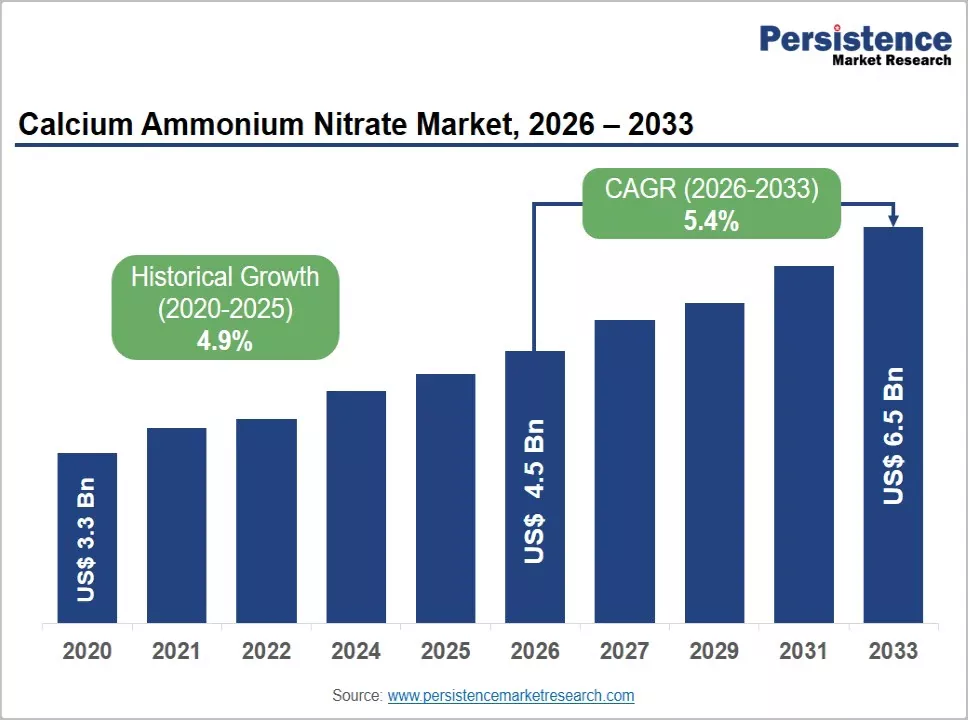
The global calcium ammonium nitrate market size is expected to be valued at US$4.50 billion in 2026 and is projected to reach US$6.50 billion by 2033, growing at a CAGR of 5.4% during the forecast period from 2026 to 2033, driven by stricter regulations on straight ammonium nitrate in the European Union, reinforced by the EU Fertilising Products Regulation (EU) 2019/1009), which have redirected demand toward calcium ammonium nitrate (CAN) as a safer dual-nutrient fertilizer that provides both nitrogen and calcium to the soil.
The market is also supported by sustained nitrogen fertilizer demand across intensifying agricultural systems in Asia Pacific and increasing restrictions on higher-risk nitrate products in regulated markets. The Food and Agriculture Organization of the United Nations (FAO) estimates that global cereal production will need to increase by approximately 70% by 2050, supporting long-term demand for efficient nitrogen fertilizers and creating favorable conditions for the calcium ammonium nitrate market.
Key Industry Highlights:
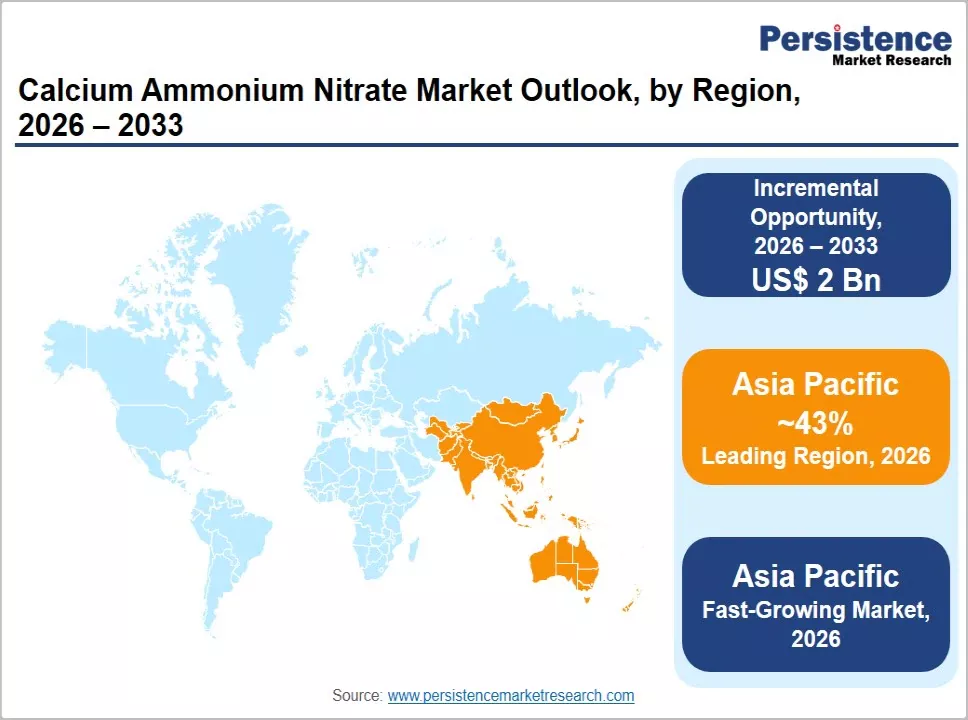
- Regional Leader: Asia Pacific is expected to dominate the global calcium ammonium nitrate market, accounting for 43% of global market value in 2026, equivalent to US$1.94 billion, and expanding at a CAGR of 6.1% during the forecast period. Growth is supported by rising demand from China's soil improvement programs, India's balanced fertilization initiatives, and Vietnam's expanding horticulture export industry.
- Leading Grade: Technical-grade CAN is anticipated to account for 78.0% of the market, supported by established demand from bulk grain cooperatives, mining explosives formulators, and concrete admixture manufacturers. Its established use across these applications provides a relatively stable demand base and limits substitution by lower-grade alternatives, except when significant price differences emerge.
- Dominant Segment: Agriculture is set to account for 87.0% of end-use demand in 2026, representing approximately US$3.92 billion. Demand is supported by soil nutrient management programs and expanding soil health initiatives across South Asia and Sub-Saharan Africa. The agricultural segment is expected to maintain a share above 85% throughout the forecast period.
- Fastest Growing Segment: Water treatment is emerging as a growing application for calcium ammonium nitrate, supported by the adoption of calcium nitrate dosing systems in wastewater networks in countries such as India, Indonesia, and the Philippines. Although the application remains relatively small compared with agricultural demand, increasing adoption in municipal wastewater treatment could create an incremental revenue opportunity through 2030.
- Key Market Opportunity: Producers that invest in high-purity, soluble CAN formulations compatible with GMP pharmaceutical standards and precision fertigation systems are positioning to capture margin-accretive niches, the Pharmaceutical and Water Treatment segments collectively growing faster than the core agricultural base, creating a strategic opportunity for differentiation that commodity-scale producers cannot easily replicate.
Market Dynamics
Drivers - Accelerating Nitrogen Demand across High-Intensity Cropping Systems
Global agriculture's shift toward high-yield cereal and oilseed cultivation is concentrating nitrogen fertilizer demand at scale. Calcium ammonium nitrate, which delivers both nitrate-nitrogen for immediate crop uptake and ammonium-nitrogen for sustained release, increasingly suits precision agronomists managing split-application programs on wheat, maize, and canola. Per International Fertilizer Association (IFA) data, global nitrogen fertilizer consumption has grown consistently, with CAN gaining share particularly in temperate grain belts where calcium co-application also addresses soil acidification.
Procurement teams at large European cereal cooperatives specify CAN granules explicitly to balance nitrogen efficiency against acidification risk, a dynamic unavailable with urea or ammonium nitrate alone. This agronomic differentiation anchors the product's pricing premium and sustains volume demand independent of commodity price cycles.
Regulatory Displacement of Pure Ammonium Nitrate
Stricter controls on straight ammonium nitrate are actively converting demand into the calcium ammonium nitrate segment. Following the Beirut port explosion in August 2020, a cascade of national and supranational regulators reviewed ammonium nitrate storage, transport, and handling standards.
The United Kingdom Health and Safety Executive (HSE) updated its ammonium nitrate safety guidance in 2022, while the European Chemicals Agency (ECHA) reinforced classification requirements under CLP Regulation (EC) No 1272/2008. Manufacturers, including Yara International ASA and EuroChem Group AG, have responded by expanding CAN production capacity to absorb the demand displaced from higher-risk formulations. This regulatory tailwind is structural rather than cyclical, providing multi-year demand visibility for calcium ammonium nitrate producers and distributors operating across compliant supply chains.
Restraints - Natural Gas Price Volatility and Feedstock Cost Pressure
Calcium ammonium nitrate production depends on ammonia synthesis, which requires natural gas as both feedstock and fuel. The International Energy Agency (IEA) documented that European natural gas prices reached historic peaks during 2021-2022, forcing temporary curtailments at major nitrogen fertilizer plants across Germany, the Netherlands, and the U.K. When gas costs spike, CAN producers face acute margin compression because the product's commodity pricing leaves limited room for cost pass-through to farmers. This feedstock exposure introduces earnings volatility that complicates long-term capacity investment decisions and discourages new entrants from committing to asset-heavy production infrastructure.
Security Regulations Constraining Distribution Flexibility
Because calcium ammonium nitrate retains oxidizing properties above specified nitrogen thresholds, it remains subject to security and transport regulations that increase logistics costs and constrain distribution networks. In the United States, the Department of Homeland Security (DHS) enforces reporting requirements under the Chemical Facility Anti-Terrorism Standards (CFATS) programme for nitrogen-based fertilizers, adding compliance overhead for distributors and end-users. These controls slow inventory turnover, particularly for smaller agricultural retailers, and restrict the informal spot-market channels through which farmers in developing economies conventionally source inputs.
Opportunities - Precision Fertigation and Controlled-Release Formulation Development
The global pivot toward fertigation, delivering dissolved nutrients through drip and sprinkler irrigation systems, is opening a high-value segment for liquid and enhanced calcium ammonium nitrate formulations. Irrigation-intensive horticulture and fruit production in India, Spain, and Israel is generating demand for water-soluble CAN grades compatible with fertigation equipment. Nutrien Ltd. has invested in soluble specialty nutrient lines since 2023, recognizing that precision delivery reduces nitrogen leaching and improves nitrogen use efficiency, increasingly a compliance requirement under EU Nitrates Directive 91/676/EEC and equivalent national programs. Producers that develop low-biuret, high-solubility CAN variants compatible with drip-tape systems can command meaningful price premiums over standard granular product and access horticulture buyers who purchase year-round rather than seasonally.
Infrastructure-Led Demand Expansion in South and Southeast Asia
Government-backed agricultural intensification programs across South Asia are expanding the addressable market for calcium ammonium nitrate substantially. India's Ministry of Chemicals and Fertilizers has promoted balanced fertilization to correct the nitrogen-phosphorus-potassium imbalance in Indian soils, explicitly encouraging calcium and nitrate co-application. Coromandel International Ltd. and Deepak Fertilisers & Petrochemicals are expanding domestic CAN capacity in response to both policy signals and rising farmer awareness of micronutrient deficiency.
The calcium ammonium nitrate sector in South Asia benefits from simultaneous demand pull, agronomic need, policy support, and rising rural purchasing power, representing a structurally attractive growth theatre for producers capable of establishing localized distribution infrastructure before competitors consolidate channel relationships.
Category-wise Insights
Which Grade Leads the Calcium Ammonium Nitrate Market?
The technical grade segment is expected to account for 78.0% of the global calcium ammonium nitrate market in 2026, equivalent to US$3.51 billion. Technical-grade CAN dominates as it addresses the single largest application: bulk nitrogen fertilization across cereal and forage cropping systems where product consistency and handling safety outweigh analytical purity requirements. Large grain cooperatives in France, Germany, and Ukraine specify Technical-grade CAN for pneumatic spreader application, valuing its prilled or granular form factor over laboratory-grade certification. Industrial buyers, concrete admixture producers and mining explosives formulators, also procure Technical-grade product, reinforcing volume concentration in this category.
The fertilizer-grade segment is likely to be the fastest-growing segment, supported by government subsidy programs in emerging economies that promote standardized and traceable nutrient products. In India, the Nutrient Based Subsidy (NBS) scheme, restructured in 2023, expanded support for calcium-containing nitrogenous fertilizers, strengthening procurement incentives for fertilizer-grade CAN that complies with specified nutrient content and labeling requirements.
Form Analysis
Solid form is set to account for 71.0% of the global calcium ammonium nitrate market in 2026, equivalent to US$3.19 billion. Solid CAN, predominantly in prilled or granulated form, dominates because it aligns with existing farm mechanization: broadcast spreaders, pneumatic applicators, and bulk handling infrastructure across commercial grain farms in Europe and North America are engineered around dry granular inputs. Cold-storage logistics and shelf stability further favor solid form in supply chains that span thousands of kilometers between production plants and end-use fields.
Liquid CAN is likely to be the fastest-growing form, driven by rapid fertigation adoption in Mediterranean and South Asian horticulture. Following Israel's Netafim expanding its global drip-irrigation system installations through 2023-2024, demand for soluble calcium nitrate and liquid CAN blends compatible with injection systems has risen sharply among tomato, pepper, and citrus growers who require continuous, programmable nutrient delivery.
Which Application Is Driving Calcium Ammonium Nitrate Demand?
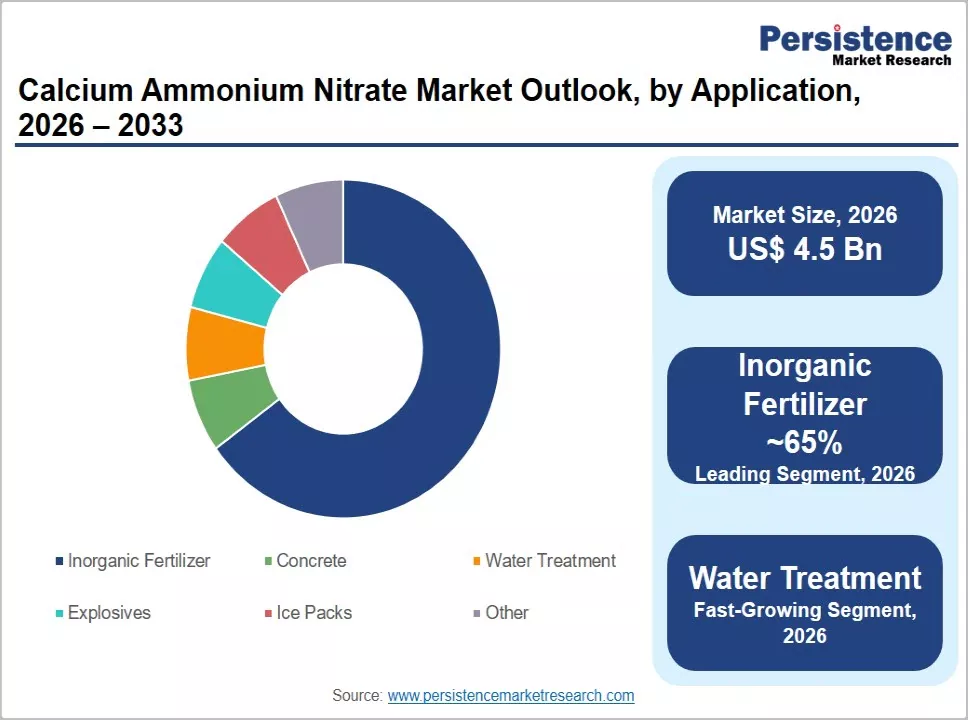
Inorganic fertilizers are anticipated to account for 65.0% of the global calcium ammonium nitrate market in 2026, equivalent to US$2.92 billion. Cereal producers across the European Union, which collectively apply approximately 11 million tons of CAN annually per Fertilizers Europe data, rely on the product as a primary top-dressing nitrogen source in wheat and barley systems. The dual-nutrient profile, delivering immediately available nitrate alongside calcium to correct soil pH, reduces the need for separate lime applications, lowering effective cost-per-hectare for integrated farm businesses managing large acreages under tight operating margins.
Water treatment is expected to be the fastest-growing application segment. Municipal water utilities in South and Southeast Asia are increasingly adopting calcium nitrate-based dosing to control hydrogen sulfide formation in wastewater collection networks, a method validated by Veolia Water Technologies across multiple European and Asian installation projects since 2022. Growing urban populations and expanding sewerage infrastructure are creating durable procurement demand from municipal authorities that previously lacked organized chemical dosing programs.
Which End-Use Industry Is Fueling Calcium Ammonium Nitrate Adoption?
Agriculture is expected to account for 87.0% of the global calcium ammonium nitrate market in 2026, equivalent to US$3.92 billion. The sector's dominance is structurally anchored: CAN's combination of nitrate and ammonium nitrogen fractions, alongside its calcium content of approximately 8% CaO, makes it the preferred top-dressing fertilizer for pH-sensitive soils across Northern and Central European grain belts, where acidification from repeated urea application is an established agronomic problem.
The pharmaceutical segment is anticipated to be the fastest-growing end-use segment. Reagent and high-purity calcium ammonium nitrate grades are gaining traction as controlled-release excipients and cooling agents in pharmaceutical cold-chain pack formulations. BASF SE's pharmaceutical excipients division has explored calcium salt formulations for controlled-temperature logistics since 2023, reflecting the broader industry shift toward validated, traceable thermal management materials that meet Good Manufacturing Practice (GMP) standards set by the European Medicines Agency (EMA).
Regional Insights
What Is Powering Growth in the North America Calcium Ammonium Nitrate Market?
North America is set to account for 20.0% of the global calcium ammonium nitrate market in 2026, representing US$0.90 billion. The region's demand is primarily concentrated in the U.S. Corn Belt and Canadian Prairie grain-producing provinces, where CAN competes directly with urea ammonium nitrate (UAN) solutions. CF Industries Holdings, Inc. and Koch Fertilizer remain the dominant domestic production forces, with supply chain integration from ammonia production through to retail distribution. Regulatory rationalization under the U.S. Environmental Protection Agency (EPA) Risk Management Program is further incentivizing transitions toward CAN from higher-hazard alternatives.
U.S. Calcium Ammonium Nitrate Market Size
The U.S. calcium ammonium nitrate market is likely to represent 90.0% of the North America regional market in 2026, equivalent to US$0.81 billion. Demand concentrates in the Midwest's wheat and corn production systems, where split-nitrogen application scheduling rewards CAN's dual-release nitrogen profile. Advancing adoption of variable-rate application technology among large-scale operators is expected to sustain demand growth through 2033 as agronomic precision requirements rise.
Europe Calcium Ammonium Nitrate Market Trends and Insights
Europe is expected to account for 27.0% of the global calcium ammonium nitrate market in 2026, representing US$1.22 billion. The region is the global epicenter of CAN adoption, shaped by decades of regulatory preference for CAN over straight ammonium nitrate under EU Nitrates Directive 91/676/EEC and fertilizer product regulation. Grupa Azoty and Achema AB anchor Eastern European production capacity, while the European Green Deal's Farm to Fork Strategy, targeting a 20% reduction in fertilizer use by 2030, introduces efficiency pressure that may consolidate demand around higher-performance, premium CAN formulations rather than reduce volume proportionally.
Germany Calcium Ammonium Nitrate Market Size
The Germany calcium ammonium nitrate market is anticipated to account for 26.0% of the Europe regional market in 2026, equivalent to US$0.32 billion. Germany's intensive cereal and oilseed cultivation, combined with German Fertilizer Ordinance (Düngeverordnung) requirements on nitrogen application planning, drives systematic CAN use in professional farm management programs. Continued consolidation among German agricultural cooperatives is expected to increase CAN procurement volumes per buyer, rewarding large-scale producers with logistics cost advantages.
U.K. Calcium Ammonium Nitrate Market Size
The U.K. calcium ammonium nitrate market is expected to account for 17.0% of the Europe regional market in 2026, equivalent to US$0.21 billion. The Agriculture Act 2020 and associated Sustainable Farming Incentive (SFI) scheme are reshaping UK fertilizer procurement toward demonstrably efficient nitrogen products, a positioning that favors CAN's dual-nutrient profile. Post-Brexit divergence from EU fertilizer regulation creates both compliance complexity and potential product differentiation opportunities for domestic formulators.
France Calcium Ammonium Nitrate Market Size
The France calcium ammonium nitrate market is likely to represent 12.0% of the Europe regional market in 2026, equivalent to US$0.15 billion. France's large-scale wheat production, the European Union's largest wheat producer, sustains structural CAN demand through cooperative procurement networks that specify prilled CAN for aerial and spreader application. Nitrates Action Programme revisions under the French Ministry of Agriculture and Food Sovereignty are expected to incentivize precision nitrogen management, directing additional procurement toward calcium-enriched formulations.
Asia Pacific Calcium Ammonium Nitrate Market Trends and Insights
Asia Pacific is expected to account for 43.0% of the global calcium ammonium nitrate market in 2026, representing US$1.94 billion, and is the fastest-growing regional market, expanding at an estimated CAGR of 6.1% through 2033. Population-driven food production pressure, soil micronutrient deficiency programs, and active government fertilizer subsidy expansion across China, India, and Vietnam are compounding growth simultaneously. The region's production base is expanding rapidly, with multiple capacity announcements from domestic producers positioning Asia Pacific as both the leading demand center and an increasingly competitive supply hub.
China Calcium Ammonium Nitrate Market Size
The China calcium ammonium nitrate market is forecast to account for 55.0% of the Asia Pacific regional market in 2026, equivalent to US$1.06 billion. China's Ministry of Agriculture and Rural Affairs has systematically promoted calcium and magnesium micronutrient supplementation in its soil improvement campaigns since 2022, directly elevating CAN as a preferred compound-effect fertilizer. Domestic producers are scaling prilled-CAN output to serve both the cereal and the rapidly expanding protected-horticulture segment.
Japan Calcium Ammonium Nitrate Market Size
The Japan calcium ammonium nitrate market is likely to represent 11.0% of the Asia Pacific regional market in 2026, equivalent to US$0.21 billion. Japan's precision horticulture sector, particularly its greenhouse vegetable and floriculture operations, drives demand for high-purity, low-chloride CAN formulations compatible with hydroponic and fertigation systems. Adoption of smart greenhouse management platforms is expected to accelerate controlled-environment agriculture, sustaining premium CAN demand.
India Calcium Ammonium Nitrate Market Size
The India calcium ammonium nitrate market is expected to account for 24.0% of the Asia Pacific regional market in 2026, equivalent to US$0.46 billion. India's National Mission for Sustainable Agriculture (NMSA) promotes soil health card-driven nutrient management, creating a policy-endorsed pathway for calcium ammonium nitrate adoption where soil tests indicate nitrogen and calcium deficiency simultaneously. Capacity investments by Deepak Fertilisers & Petrochemicals and Gujarat State Fertilizers & Chemicals are positioning domestic supply to serve both the agricultural and mining blasting-agent segments.
Competitive Landscape
The global calcium ammonium nitrate industry is moderately concentrated at the production level but more fragmented in distribution and specialty formulation. Yara International ASA, EuroChem Group AG, and Nutrien Ltd. collectively command significant capacity across the primary markets of Europe and North America, competing principally on production cost efficiency, agronomic service depth, and distribution network density
Regional producers, including Acron Group, Grupa Azoty, and Achema AB in Europe, and Coromandel International Ltd. and Gujarat State Fertilizers & Chemicals in South Asia, compete on proximity to demand centers and domestic subsidy access. The primary basis of competitive advantage is shifting: producers with integrated digital agronomy platforms and soluble specialty CAN product lines are capturing premium segments that bulk commodity producers cannot access on price alone. OCI Global and Uralchem JSC represent capacity positioned to serve export markets opportunistically as regulatory and geopolitical dynamics reshape trade flows.
Key Industry Developments:
- In August 2026, CF Industries, JERA, and Mitsui broke ground on the US$3.7 billion Blue Point One low-carbon ammonia plant in Louisiana, with 1.4 million tonnes/year capacity and production targeted for 2029.
- In July 2026, Yara agreed to acquire Gulf Coast Ammonia’s Texas City plant for US$1.3 billion, adding 1.3 million tonnes/year of ammonia capacity and strengthening its fertilizer production and ammonia supply platform in the U.S.
- In June 2026, OCI Global agreed to sell 50% of OCI Nitrogen to AGROFERT, giving the European nitrogen-products manufacturer operational control while retaining a 50% economic interest and supporting future development of the Geleen facility.
Companies Covered in Calcium Ammonium Nitrate Market
- Yara International ASA
- EuroChem Group AG
- Nutrien Ltd.
- CF Industries Holdings Inc.
- OCI Global
- BASF SE
- Acron Group
- Grupa Azoty
- Koch Fertilizer
- Achema AB
- Uralchem JSC
- Coromandel International Ltd.
- Deepak Fertilisers & Petrochemicals
- Gujarat State Fertilizers & Chemicals
- Fauji Fertilizer Company
- SABIC
- Borealis AG
- INCITEC Pivot Limited
- Haifa Group
- Helm AG
Frequently Asked Questions
The global calcium ammonium nitrate market is valued at US$4.50 billion in 2026 and is projected to reach US$6.50 billion by 2033, growing at a CAGR of 5.4%. The primary growth catalyst is sustained nitrogen fertilizer demand across intensifying agricultural systems in Asia Pacific, reinforced by regulatory displacement of straight ammonium nitrate in European and North American markets.
The expanding government-mandated balanced fertilization programs, including India's National Mission for Sustainable Agriculture (NMSA), and accelerating demand from precision fertigation systems in commercial horticulture. The International Fertilizer Association (IFA) confirms that dual-nutrient nitrogen-calcium formulations are gaining specification preference among professional agronomists managing acidification-sensitive crop rotations globally.
The agriculture end-use segment holds the largest share at 87.0% of the global calcium ammonium nitrate market, driven by CAN's dual-nutrient nitrogen-and-calcium delivery profile, which addresses both nitrogen nutrition and soil acidification correction in a single application. This agronomic versatility across cereal, oilseed, and horticulture systems creates entrenched procurement preferences that make the segment structurally resilient to substitution.
Asia Pacific dominates the global calcium ammonium nitrate market, holding 43% of global value in 2026 at an estimated US$1.94 billion. Two structural factors sustain its leadership: population-driven food production intensification requiring greater nitrogen input efficiency, and active government subsidy programs, including China's Ministry of Agriculture and Rural Affairs soil improvement initiatives, that directly incentivize calcium ammonium nitrate adoption over lower-cost but less agronomically balanced alternatives.
The most significant opportunity lies in developing high-purity, water-soluble calcium ammonium nitrate formulations for precision fertigation systems and pharmaceutical thermal management applications, segments where commodity producers are underinvested. Producers with specialty chemistry capabilities and Good Manufacturing Practice (GMP) certification, such as BASF SE, are best positioned to capture premium margins as the EU Nitrates Directive 91/676/EEC tightens nitrogen application efficiency requirements through the forecast period.
The calcium ammonium nitrate industry is led by Yara International ASA, EuroChem Group AG, Nutrien Ltd., CF Industries Holdings, Inc., and OCI Global, competing primarily on production cost efficiency, distribution network density, and agronomic service capability. The landscape is moderately concentrated at production scale but fragmenting at the specialty formulation level, where smaller innovators, including Haifa Group and Borealis AG, compete on product performance and application-specific technical support.


