




- Automotive Components & Materials
- Brake Accumulators Market
Brake Accumulators Market Size, Share, and Growth Forecast, 2026 - 2033
Brake Accumulators Market by Product (Hydraulic Brake Accumulators, Electro-Hydraulic & Brake-By-Wire Backup Accumulators, Others), Vehicle (Passenger Vehicles, Electric & Hybrid Vehicles, Others), Braking Application, and Regional Analysis for 2026 - 2033

Brake Accumulators Market Size and Trends Analysis
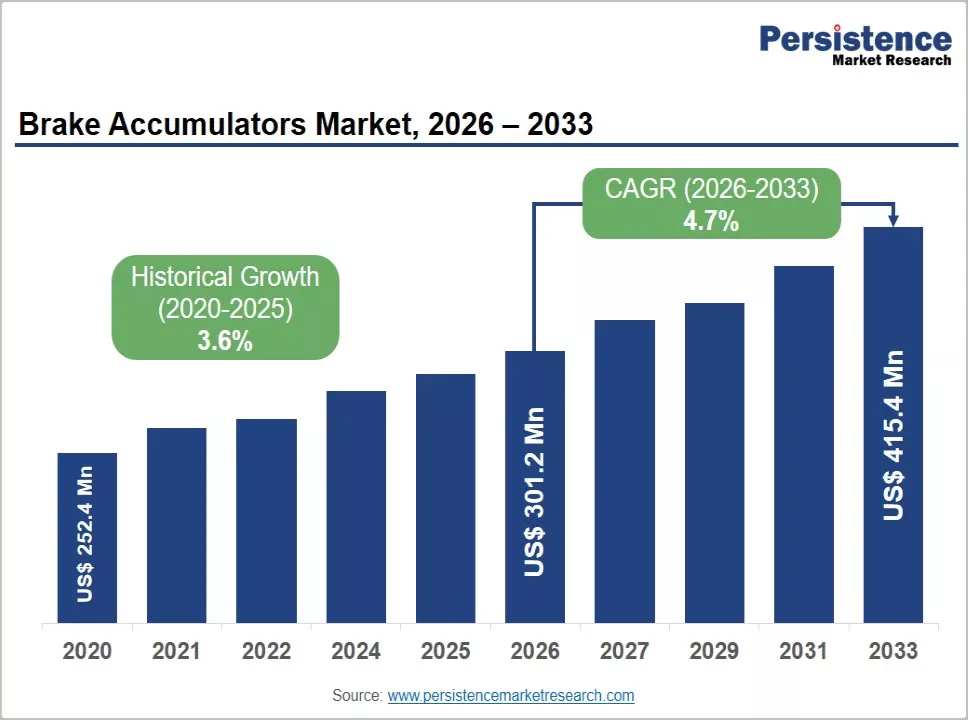
The global brake accumulators market size is likely to be valued at US$301.2 million in 2026 and is expected to reach US$415.4 million by 2033, growing at a CAGR of 4.7% between 2026 and 2033, driven by vehicle manufacturers’ increasing focus on braking reliability, electronic brake control, and system redundancy.
Demand across passenger vehicles, commercial vehicles, off-highway equipment, and specialized transportation continues to support the adoption of established hydraulic accumulator technologies. Meanwhile, vehicle electrification and the development of brake-by-wire systems are creating opportunities for advanced pressure-storage solutions, particularly in vehicle architectures that retain hydraulic braking capabilities.
Key Industry Highlights:
- Leading Region: Asia Pacific, accounting for an estimated 39.4% of the global brake accumulators market, supported by large-scale automotive manufacturing and growing demand in China and India.
- Fastest-growing Region: Asia Pacific, driven by vehicle production expansion, electric-vehicle manufacturing, and investment in advanced braking technologies.
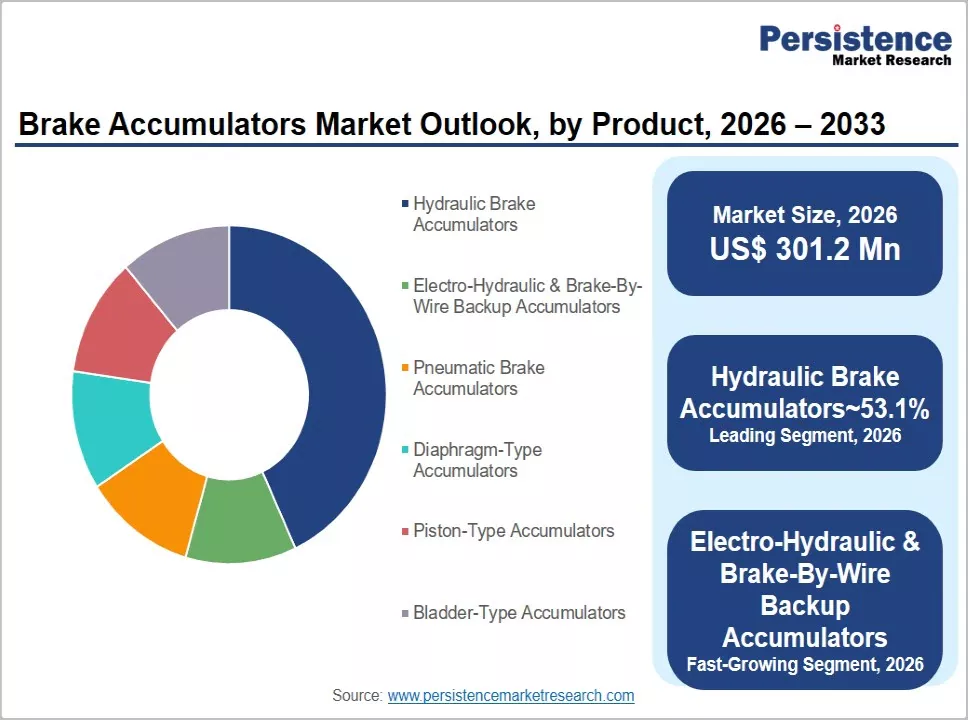
- Dominant Product: Hydraulic brake accumulators, with an anticipated 53.1% of market share, supported by established use in hydraulic braking systems across passenger vehicles, commercial vehicles, and off-highway equipment.
- Leading Vehicle: Passenger vehicles, representing an anticipated 61.3% share, driven by high vehicle production volumes and widespread use of hydraulic and integrated electro-hydraulic braking systems.
DRO Analysis
Drivers - Expanding Vehicle Production and Demand for Reliable Braking Systems
Growth in global vehicle production supports demand for braking components across passenger cars, commercial vehicles, construction equipment, mining machinery, and agricultural vehicles. The International Organization of Motor Vehicle Manufacturers reported that global vehicle production reached approximately 96.4 million units in 2025, representing a 3.9% increase from 2024. Asia accounted for more than 61% of global production, highlighting the importance of regional manufacturing networks.
This manufacturing scale creates opportunities for accumulator suppliers serving hydraulic braking systems and related industrial applications. Demand also extends beyond original equipment installation to replacement components, maintenance, and specialized equipment operating under demanding conditions.
Commercial vehicles and off-highway machinery can require durable pressure-storage solutions because of their operating loads and duty cycles. However, production growth does not translate directly into equivalent accumulator demand, since component requirements vary by vehicle type and braking architecture. Suppliers should therefore prioritize vehicle platforms that combine production scale with a clear technical requirement for hydraulic pressure storage.
Electrification and Advances in Electronic Braking Systems
Vehicle electrification is changing braking-system design as manufacturers integrate regenerative braking with conventional friction braking. The International Energy Agency reported that global electric-car sales exceeded 20 million in 2025, representing approximately one-quarter of new car sales worldwide. This transition increases the importance of coordinated braking control, predictable deceleration, and reliable pressure generation in vehicles using electro-hydraulic systems.
Some advanced brake-by-wire architectures retain hydraulic actuators or backup pressure-generation systems, creating opportunities for accumulator components where the design requires stored hydraulic pressure. Other architectures use fully electromechanical braking and may eliminate the need for hydraulic accumulators. This distinction is important for suppliers evaluating future demand. Rather than treating electrification as a uniform growth driver, manufacturers should focus on vehicle platforms that retain hydraulic functions and require pressure-storage capabilities. Early collaboration with brake-system integrators can help accumulator suppliers adapt product specifications to emerging requirements for compact packaging, response time, durability, and system redundancy.
Restraint - Qualification Costs, Price Competition, and Changes in Braking Architecture
Brake accumulators operate in safety-critical environments where pressure retention, fatigue resistance, leakage prevention, temperature tolerance, and predictable performance are essential. Meeting these requirements involves engineering, material selection, testing, and qualification costs that can challenge smaller manufacturers. Automotive suppliers must also maintain consistent production quality and comply with demanding OEM specifications throughout the product lifecycle.
Technology changes present another structural challenge. As manufacturers adopt fully electromechanical braking systems, some hydraulic accumulator applications may disappear rather than transition to alternative accumulator designs. Standardized hydraulic products also face price competition, particularly in cost-sensitive automotive and industrial markets. These factors can limit pricing power and increase investment risk. Suppliers must balance customization with manufacturing efficiency while maintaining reliability, traceability, and qualification standards.
Opportunities - Emergency Braking Redundancy and Electro-Hydraulic Systems
The development of electronically controlled braking systems creates opportunities for accumulators in applications that require hydraulic pressure reserves or backup braking capability. Electro-hydraulic architectures can combine electronic commands with hydraulic pressure generation, while selected hybrid braking systems retain hydraulic components to support braking under defined operating or fault conditions.
Manufacturers such as Bosch and ZF have developed braking technologies that demonstrate the industry's movement toward integrated electronic and hydraulic systems. These developments create opportunities for accumulator suppliers to improve pressure response, reduce packaging requirements, enhance sealing performance, and support longer operating life. The most attractive opportunities are likely to involve early-stage collaboration with braking-system engineers. Suppliers should identify platforms where hydraulic backup is an explicit part of the system architecture and demonstrate that their components meet relevant pressure, durability, and reliability requirements.
Regional Manufacturing Expansion and Specialized Vehicle Applications
Asia Pacific offers opportunities for accumulator manufacturers because of its large vehicle-production base, expanding domestic demand, and growing electric vehicle ecosystem. China is a major manufacturing center, while India offers demand across passenger vehicles, commercial transportation, agricultural equipment, and industrial machinery. Japan contributes established automotive engineering capabilities, and Southeast Asian markets are expanding their vehicle manufacturing and electric mobility industries.
These conditions create opportunities for localized production, supplier partnerships, and cost-effective products designed for regional operating requirements. Additional opportunities exist in heavy-duty transportation, construction, mining, agriculture, rail, and aerospace applications, where hydraulic pressure-storage components may remain relevant. Manufacturers can strengthen their position through local sourcing, application-specific testing, dependable aftermarket support, and close collaboration with equipment producers. A diversified application portfolio can also help suppliers reduce exposure to changes in passenger-vehicle braking technology.
Category-wise Analysis
Product Insights
Hydraulic brake accumulators are expected to be the leading product category, with an anticipated market share of approximately 53.1% of market share in 2026. Their established use across passenger vehicles, commercial vehicles, off-highway equipment, and industrial machinery supports demand. These components store hydraulic energy and release pressure when required, helping maintain braking performance. Companies such as HYDAC, Parker Hannifin, and Bosch Rexroth offer relevant hydraulic accumulator and fluid-power expertise. Product selection depends on pressure requirements, available space, durability, and leakage prevention.
Electro-hydraulic and brake-by-wire backup accumulators are anticipated to be the fastest-growing product category, supported by braking systems that require electronic control alongside hydraulic pressure generation or backup. For example, integrated electro-hydraulic braking systems may use stored pressure to support reliable operation. However, fully electromechanical systems may reduce accumulator demand.
Vehicle Insights
Passenger vehicles are expected to be the leading vehicle category, with an anticipated share of 61.3% of the market. High global production volumes and widespread use of hydraulic braking systems support demand. For example, conventional hydraulic brakes and integrated electro-hydraulic systems may require accumulators depending on their design. OEMs prioritize compact packaging, consistent pressure response, durability, and leakage prevention, making automotive-grade validation and supplier relationships important competitive factors.
Electric and hybrid vehicles are anticipated to be the fastest-growing vehicle category. Regenerative braking must work smoothly with friction braking to deliver predictable deceleration. Hybrid and electro-hydraulic vehicles may require pressure-storage or backup components, while fully electromechanical systems may not. This makes accumulator demand dependent on the braking architecture rather than electrification alone.
Regional Insights
North America Brake Accumulators Market Trends
North America benefits from established automotive supply chains, commercial transportation, and off-highway equipment manufacturing. Demand for brake accumulators is linked to hydraulic braking systems, electronically controlled braking, and specialized machinery. The U.S. and Mexico are particularly important owing to their vehicle production, component engineering, and cross-border manufacturing networks. Opportunities depend on the braking architecture used in each platform, as fully electromechanical systems may reduce hydraulic accumulator requirements.
U.S. Brake Accumulators Market Trends
The U.S. supports demand through passenger vehicles, heavy-duty trucks, agricultural machinery, and construction equipment. ZF and Bendix Commercial Vehicle Systems are relevant examples of companies developing advanced braking and vehicle-control technologies. Their work on integrated braking, electronic controls, and commercial-vehicle safety influences component specifications and creates opportunities for suppliers able to meet demanding reliability and validation requirements. Federal electronic stability control requirements also reinforce the importance of dependable braking performance, although they do not mandate accumulators specifically.
Europe Brake Accumulators Market Trends
Europe combines advanced automotive engineering, established component suppliers, and stringent vehicle-safety and environmental requirements. In 2025, EU passenger-car registrations increased by 1.8%, while battery-electric cars accounted for 17.4% of registrations. These shifts encourage braking-system innovation, but accumulator demand will depend on whether individual platforms retain hydraulic pressure storage.
Germany Brake Accumulators Market Trends
Germany's automotive engineering base makes it important for advanced braking technologies. In January 2025, ZF announced a major brake-by-wire contract covering planned electro-mechanical braking production for nearly five million vehicles over the contract period. This development illustrates the transition toward braking systems that may not require conventional hydraulic accumulators, making architecture-specific product development essential for suppliers.
France Brake Accumulators Market Trends
France contributes through passenger-vehicle production, commercial transportation, and automotive technology development. The increase in battery-electric registrations in 2025 supports further investment in integrated braking systems. Suppliers serving French vehicle programs must accommodate different hydraulic and electromechanical configurations while meeting applicable safety and durability requirements. Europe's evolving regulatory framework, including Euro 7's provisions for brake-particle emissions, also increases attention to overall braking-system performance, although it does not mandate a particular accumulator design.
Asia Pacific Brake Accumulators Market Trends
Asia Pacific is the leading regional market, with an estimated 39.4% share, and is anticipated to grow fastest through 2033. Its large vehicle-manufacturing base, expanding commercial transportation, and electric-vehicle investment support demand for braking components. Regional vehicle-production volumes indicate the scale of the opportunity, but accumulator demand remains dependent on system design.
China Brake Accumulators Market Trends
China produced approximately 34.53 million vehicles in 2025, including 16.63 million new-energy vehicles. This scale supports local suppliers and global component manufacturers serving conventional and electrified vehicle platforms.
Companies such as BYD and Bosch illustrate the region's mix of electric-vehicle manufacturing and automotive-system supply. As manufacturers develop integrated braking solutions for electric vehicles, suppliers can pursue opportunities in electro-hydraulic systems while accounting for architectures that eliminate hydraulic pressure storage.
India Brake Accumulators Market Trends
India's expanding automotive industry supports demand across passenger vehicles, commercial vehicles, agricultural machinery, and industrial equipment. Government figures based on industry data recorded production of approximately 5.38 million passenger vehicles and 1.11 million commercial vehicles in 2025.
Manufacturers such as Tata Motors and Mahindra serve important passenger-vehicle and commercial or utility-vehicle segments. Their varied platforms create opportunities for cost-effective hydraulic components and specialized braking solutions. Localization, dependable quality, and competitive pricing will remain important for suppliers serving domestic and export-oriented production.
Competitive Landscape
The brake accumulators market includes specialized hydraulic accumulator manufacturers, diversified fluid-power suppliers, aerospace component manufacturers, and integrated braking-system companies. Parker Hannifin, HYDAC, Bosch Rexroth, Roth Hydraulics, EPE Italiana, and HAWE Hydraulik have relevant capabilities in hydraulic pressure-storage technology. ZF, Knorr-Bremse, and AUMOVIO participate in broader braking-system technologies and influence component requirements through system integration.
Market participants compete through application-specific engineering, product reliability, pressure and fatigue performance, manufacturing efficiency, and long-term OEM relationships. Larger suppliers can combine accumulators with broader hydraulic or braking portfolios, while specialized manufacturers can focus on customized designs and demanding applications. Localization, aftermarket distribution, modular product development, and collaboration during vehicle engineering are important strategic priorities.
Key Industry Developments
- In February 2026, Knorr-Bremse AG announced an investment of up to €200 million in a new modular campus in Chennai, India, bringing together production, engineering, and artificial intelligence activities.
Companies Covered in Brake Accumulators Market
- HYDAC International GmbH
- Bosch Rexroth AG
- Parker Hannifin Corporation
- Eaton Corporation plc
- Freudenberg Sealing Technologies
- ZF Friedrichshafen AG
- Continental AG
- Knorr-Bremse AG
- Haldex AB
- Nippon Accumulator Co., Ltd.
- Roth Hydraulics GmbH
- Accumulators, Inc.
- Hydroll Oy
- PMC Hydraulics Group
- HAWE Hydraulik SE
- Bucher Hydraulics GmbH
Frequently Asked Questions
The global brake accumulators market is valued at US$301.2 million in 2026.
The brake accumulators market is expected to reach US$415.4 million by 2033.
Key trends include the development of electro-hydraulic braking systems, integration of electronic braking controls, demand for reliable hydraulic pressure storage, and growing investment in application-specific accumulator designs for electric and hybrid vehicles.
Hydraulic brake accumulators are the leading product segment, with an anticipated 53.1% market share, supported by their established use in hydraulic braking systems.
The brake accumulators market is projected to grow at a CAGR of 4.7% from 2026 to 2033.
Key companies include HYDAC, Parker Hannifin, Bosch Rexroth, ZF Friedrichshafen, and Continental AG.


