




- Industrial Goods & Service
- Bimetallic Lugs Market
Bimetallic Lugs Market Size, Share, and Growth Forecast 2026 - 2033
Bimetallic Lugs Market by Product Type (Splice Lugs, Mechanical Lugs, Compression Lugs), by Hole Type (Single Hole, Two Hole, Four Hole), by Connection Method (Crimping (Compression), Mechanical Bolting, Soldered, Hybrid), by End-User (Energy & Utilities, Construction & Infrastructure, Manufacturing, Telecommunications, Transportation, Renewable Energy, Others), by Regional Analysis, 2026 - 2033

Bimetallic Lugs Market Size and Trend Analysis
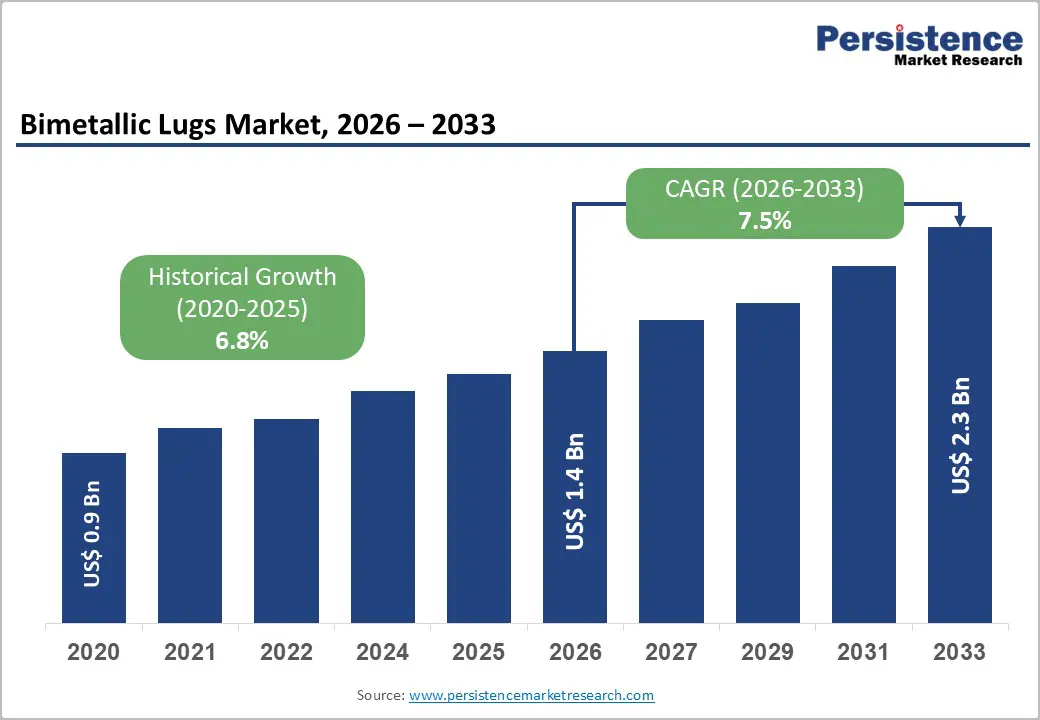
The global bimetallic lugs market size is likely to be valued at US$1.4 billion in 2026 and is expected to reach US$2.3 billion by 2033, growing at a CAGR of 7.5% during the forecast period from 2026 to 2033.
The market is primarily propelled by the accelerating global transition toward renewable energy infrastructure and the widespread modernization of electrical grid networks.
Key Market Highlights
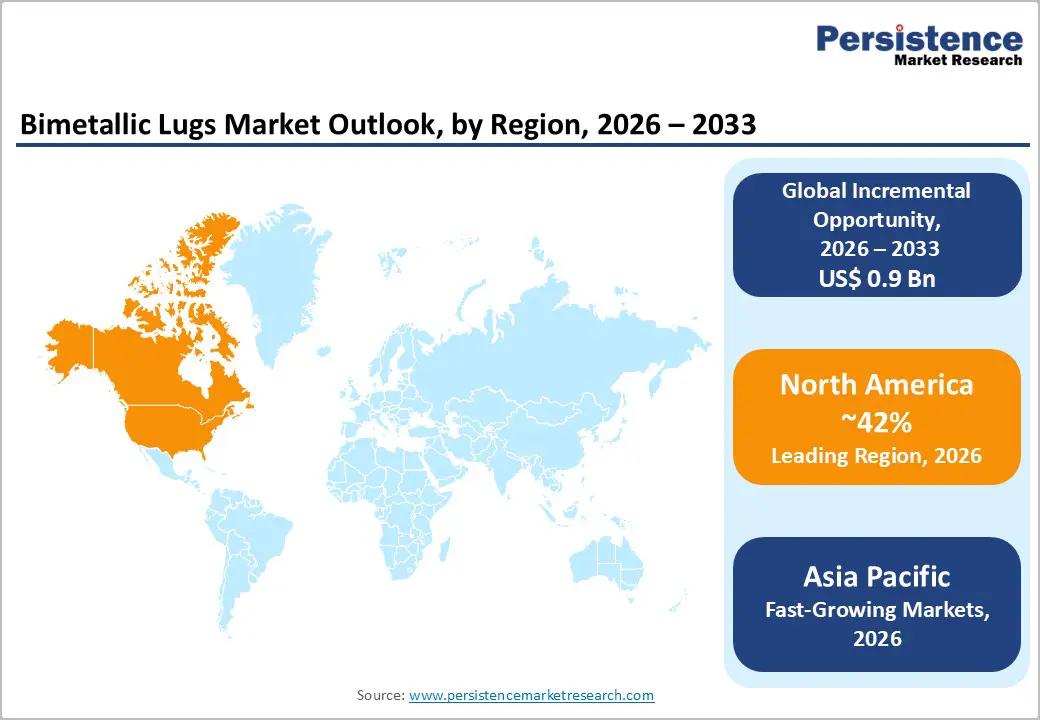
- Leading Region: North America leads the bimetallic lugs market holding 42% share, driven by extensive grid modernization under the Inflation Reduction Act, stringent UL/NEMA compliance requirements, and significant renewable energy investments creating consistent, high-volume demand for certified bimetallic termination products.
- Fastest Growing Region: Asia Pacific is the fastest growing region with rising CAGR of 9.6%, propelled by China's grid expansion, India's rural electrification programs, and ASEAN manufacturing growth, collectively driving exceptional demand for bimetallic lugs throughout the forecast period 2026 - 2033.
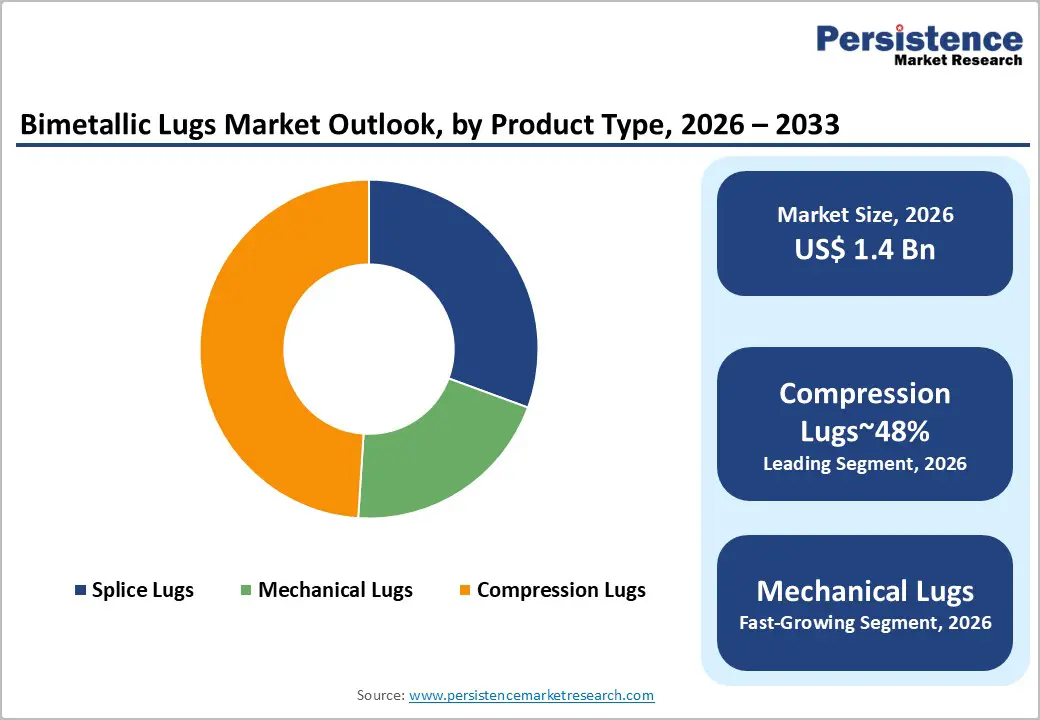
- Dominant Segment: Compression Lugs dominate the By Product Type category with approximately 48% share, preferred for their gas-tight connections, compliance with IEC 61238-1 and UL 486A-486B standards, and superior performance in high-voltage power distribution infrastructure.
- Fastest Growing Segment: Renewable Energy within the End-User category is the fastest growing segment, as solar PV and wind installations require corrosion-resistant bimetallic terminations, supported by global clean energy mandates and record-breaking renewable capacity additions worldwide.
- Key Market Opportunity: Rapid expansion of battery energy storage systems (BESS) and smart grid infrastructure presents a compelling opportunity, with over 100 GWh of U.S. storage projects in the pipeline and significant grid investments across the Asia Pacific driving demand for high-performance bimetallic connectors.
| Key Insights | Details |
|---|---|
| Bimetallic Lugs Market Size (2026E) | US$ 1.4 Billion |
| Market Value Forecast (2033F) | US$ 2.3 Billion |
| Projected Growth CAGR (2026 - 2033) | 7.5% |
| Historical Market Growth (2020 - 2025) | 6.8% |
Market Dynamics
Market Growth Drivers
Accelerating Global Electrification and Grid Modernization
Global electricity demand is rising rapidly, with the International Energy Agency (IEA) projecting an increase of over 50% between 2022 and 2040. This surge is driving large-scale expansion and modernization of transmission and distribution networks worldwide. Governments are investing heavily in smart grids and new substations to improve reliability and efficiency.
The United States has allocated more than USD 65 billion under the Infrastructure Investment and Jobs Act for grid upgrades. In this evolving infrastructure landscape, bimetallic lugs play a critical role by enabling safe and efficient aluminum-to-copper connections. These components help prevent galvanic corrosion while ensuring low-resistance electrical conductivity. Their reliability and performance make them essential in modern grid systems, leading to consistent demand from utilities, EPC contractors, and infrastructure developers across global markets.
Renewable Energy Deployment and EV Charging Infrastructure
The renewable energy sector is experiencing significant growth, with the International Renewable Energy Agency (IRENA) reporting a record addition of 295 GW in 2022. Expanding solar and wind installations require dependable electrical connectors, including bimetallic lugs, for grounding, cable termination, and interconnections. At the same time, the rapid expansion of EV charging infrastructure is further increasing demand for reliable connection solutions.
The European Union has mandated at least one public charging station every 60 km on major highways by 2026. Bimetallic lugs are particularly suitable for these applications due to their ability to withstand high current loads and thermal cycling conditions. Their durability and performance under demanding environments make them a preferred choice, positioning renewable energy and EV infrastructure as major growth drivers for the global bimetallic lugs market.
Market Restraints
Volatility in Raw Material Prices
Bimetallic lugs are primarily made from copper and aluminum, both of which are subject to significant price fluctuations in global commodity markets. According to the London Metal Exchange (LME), copper prices increased by more than 35% between 2020 and 2022 before stabilizing. Such volatility directly impacts manufacturing costs, making it challenging for producers to maintain consistent pricing strategies. Smaller manufacturers are particularly vulnerable, as sudden price increases can put pressure on margins and reduce profitability.
This uncertainty can also limit investments in capacity expansion and product innovation. Additionally, fluctuating raw material costs create instability in the supply chain, making long-term procurement planning difficult for buyers. As a result, customers may delay purchases or seek alternative solutions, which can moderate overall market growth and create challenges for manufacturers aiming to maintain steady revenue streams.
Availability of Alternative Connector Technologies
The bimetallic lugs market faces competition from alternative connection technologies such as compression sleeves, mechanical connectors, and insulation-piercing connectors (IPCs). In certain low-voltage applications, contractors often prefer these alternatives due to their simpler installation processes and lower initial costs. Additionally, advancements in single-metal aluminum lugs, including improved tin plating and anti-oxidant coatings, are gradually reducing the need for bimetallic designs in some applications.
Although these alternatives may not match the long-term performance of bimetallic lugs, they remain attractive in price-sensitive markets. This is particularly evident in developing regions, where cost considerations often outweigh performance benefits. As a result, the presence of substitute technologies can limit market penetration and slow adoption rates, especially in segments where budget constraints and ease of installation are primary decision factors.
Market Opportunities
Expansion of Smart Grid and Energy Storage Projects
The growing focus on smart grid development and battery energy storage systems (BESS) presents a strong opportunity for bimetallic lug manufacturers. According to the U.S. Department of Energy (DOE), more than 100 GWh of energy storage projects were in development as of 2023. These projects require extensive cabling infrastructure with reliable aluminum-to-copper connections, increasing demand for high-performance bimetallic lugs.
In addition, smart grid systems incorporate advanced monitoring devices, sensors, and communication equipment, all of which require precise and durable electrical terminations. This creates a need for specialized lugs that meet strict IEC and UL standards. Manufacturers that focus on developing application-specific, high-quality products can capture premium pricing and secure long-term contracts with utilities and EPC firms. Overall, the expansion of smart grids and energy storage is opening new avenues for innovation and sustained revenue growth.
Rising Demand from High-Growth Economies in Asia Pacific
Rapid industrialization and urbanization in countries such as India, Vietnam, and Indonesia are driving strong demand for electrical infrastructure components, including bimetallic lugs. India’s National Infrastructure Pipeline (NIP), with investments exceeding USD 1.4 trillion through 2025, is a key growth driver. Programs like the Revamped Distribution Sector Scheme (RDSS) are focused on upgrading electricity networks across multiple cities.
China’s 14th Five-Year Plan emphasizes grid modernization and clean energy expansion, further boosting demand. Southeast Asian countries are also witnessing increased investments in industrial and urban development projects. For manufacturers, these markets present significant opportunities for volume-driven growth. Establishing local production facilities, forming strategic partnerships, and expanding distribution networks can help companies strengthen their presence and capitalize on rising demand in these fast-growing economies.
Category-wise Insights
By Product Type Analysis
Compression lugs hold the largest share in the bimetallic lugs market, accounting for approximately 48% of total demand. Their dominance is driven by superior electrical conductivity, high mechanical strength, and strong resistance to vibration, making them ideal for high-voltage and industrial applications. The crimping process ensures a permanent, gas-tight connection by deforming the lug barrel around the conductor, effectively preventing oxidation and reducing contact resistance.
The increasing use of hydraulic and battery-operated crimping tools has made installation faster and more efficient, further supporting their adoption. Additionally, compliance with standards such as IEC 61238-1 and UL 486A-486B reinforces their reliability in utility-grade applications. These advantages make compression lugs the preferred choice across energy, infrastructure, and manufacturing sectors, ensuring their continued leadership in the global market.
By Hole Type Analysis
The single-hole segment leads the market, accounting for approximately 52% of total demand due to its versatility and cost-effectiveness. Single-hole lugs are widely used in applications such as panel boards, switchgear, motor terminals, and busbars. Their simple design reduces material usage while still meeting performance requirements for most low- and medium-voltage installations.
This makes them highly suitable for residential, commercial, and light industrial applications. The widespread use of standard terminal blocks further supports the adoption of single-hole configurations. In addition, ongoing construction activities, particularly in Asia Pacific and the Middle East, are driving strong demand for standard electrical components. As urbanization and infrastructure development continue to expand, the single-hole segment is expected to maintain its dominant position in the market.
By Connection Method Analysis
Crimping, also known as compression, is the leading connection method, holding approximately 55% of the market share. It is widely preferred due to its ability to deliver consistent, reliable, and gas-tight connections that meet strict safety standards. Unlike soldering or bolting, crimping minimizes human error and ensures uniform results across installations. This leads to improved reliability and reduced maintenance requirements over time.
Modern crimping tools, including die-indexed systems, support a wide range of lug sizes and simplify installation processes. Industry standards organizations such as NEMA and IEC actively recommend compression connections for medium- and high-voltage applications. These advantages have made crimping the preferred method for utilities, contractors, and industrial users, reinforcing its strong position in the global bimetallic lugs market.
By End-User Analysis
The energy and utilities sector represents the largest end-user segment, accounting for approximately 34% of total market demand. This dominance is driven by the widespread use of aluminum conductors in power transmission and distribution systems, which require reliable bimetallic connections. As grid expansion and modernization projects continue globally, the demand for high-quality termination solutions remains strong.
Renewable energy integration, substation upgrades, and electrification initiatives further contribute to growth in this segment. According to the World Bank, more than USD 800 billion is expected to be invested in global power infrastructure by 2030. This significant investment highlights the critical role of the energy and utilities sector in driving demand for bimetallic lugs, ensuring its continued leadership in the market.
Regional Insights
North America Bimetallic Lugs Market Trends
North America is a mature and significant market for bimetallic lugs, with the United States leading regional demand. Strong regulatory frameworks, including standards such as NEMA CC 1 and UL 486A-486B, ensure the use of certified and high-quality connectors. Government initiatives such as the Bipartisan Infrastructure Law and the Inflation Reduction Act are driving large-scale investments in grid modernization, renewable energy, and EV infrastructure.
The U.S. Department of Energy has identified over 100 transmission projects eligible for federal support, further boosting demand. Canada is also upgrading its aging power infrastructure, particularly in provinces like Ontario and Quebec. Additionally, the region benefits from a strong innovation ecosystem that supports the development of advanced connector technologies compatible with smart grids. These factors collectively sustain North America’s leadership in the global bimetallic lugs market.
Europe Bimetallic Lugs Market Trends
Europe’s market growth is driven by ambitious clean energy targets under initiatives such as the European Green Deal and REPowerEU. The region aims to achieve over 1,200 GW of renewable capacity by 2030, creating strong demand for reliable electrical components. Germany leads the market, supported by its Energiewende policy and investments in offshore wind energy.
The UK and France are also key contributors, with ongoing grid reinforcement projects. The adoption of EN 61238-1 standards ensures regulatory consistency across the region, simplifying compliance for manufacturers. Countries like Spain and Italy are witnessing rapid solar energy expansion, further driving demand. Additionally, Europe’s focus on sustainability and environmentally friendly materials is influencing product development, encouraging manufacturers to adopt recyclable and RoHS-compliant solutions.
Asia Pacific Bimetallic Lugs Market Trends
Asia Pacific is the fastest-growing region in the bimetallic lugs market, driven by rapid industrialization and infrastructure development. China leads the region, with significant investments in grid expansion and renewable energy projects. The country’s goal of achieving carbon neutrality by 2060 continues to accelerate demand for electrical components. India is another major contributor, supported by government initiatives such as rural electrification and solar energy programs.
Developed markets like Japan and South Korea maintain stable demand due to advanced manufacturing sectors and data center expansion. Meanwhile, Southeast Asian countries, including Vietnam and Indonesia, are emerging as high-growth markets due to increasing industrial activity. The region’s cost advantages and expanding engineering capabilities are attracting global manufacturers, making Asia Pacific a key hub for production and demand.
Competitive Landscape
The global bimetallic lugs market is moderately fragmented, with a mix of large multinational corporations and regional players competing across different segments. Leading companies such as ABB Ltd., Schneider Electric SE, and Eaton Corporation plc maintain strong positions due to their extensive product portfolios and global distribution networks. Key competitive factors include product quality, adherence to international standards such as IEC, UL, and NEMA, and the ability to offer customized solutions.
Companies are also focusing on developing advanced crimping tools and integrated systems to enhance customer value. Additionally, there is a growing emphasis on sustainability, with manufacturers investing in environmentally compliant materials and processes. The expansion of e-commerce platforms and direct sales channels is further reshaping procurement practices, enabling companies to reach a broader customer base and strengthen their market presence.
Key Market Developments
- In January 2025: ABB Ltd. announced an expansion of its electrification product range including bimetallic compression lugs meeting updated IEC 61238-1 standards, targeting utility-scale renewable energy projects across Europe and Asia Pacific.
- In September 2024: TE Connectivity Ltd. launched a new series of high-ampacity bimetallic lugs designed specifically for EV fast-charging infrastructure, certified to UL 486A-486B, with enhanced thermal resistance for continuous high-current applications.
- In March 2024: Panduit Corp. introduced a range of tin-plated bimetallic lugs with enhanced anti-oxidant properties for harsh industrial environments, expanding its industrial and manufacturing segment product portfolio.
Companies Covered in Bimetallic Lugs Market
- ABB Ltd.
- Schneider Electric SE
- 3M Company
- Eaton Corporation plc
- Panduit Corp.
- Weidmüller Interface GmbH & Co. KG
- Legrand SA
- Hubbell Incorporated
- TE Connectivity Ltd.
- Amphenol Corporation
- Molex LLC
- HellermannTyton Group PLC
- Lapp Group
- Huber+Suhner AG
- Burndy LLC
- Ilsco Corporation
- Tyco Electronics
- NSi Industries LLC
Frequently Asked Questions
The global Bimetallic Lugs Market is projected to reach US$ 2.3 Billion by 2033, growing from an estimated US$ 1.4 Billion in 2026, at a CAGR of 7.5% during the 2026-2033 forecast period.
The primary demand drivers include accelerating global electrification and grid modernization programs, particularly in North America and Asia Pacific, as well as the rapid deployment of renewable energy infrastructure such as solar PV and wind installations, both of which require reliable aluminum-to-copper electrical connections.
Compression Lugs are the leading product type segment, holding approximately 48% of market share. Their dominance is attributed to superior performance in high-voltage applications, compliance with IEC 61238-1 and UL 486A-486B standards, and widespread adoption in utility-scale energy infrastructure projects.
North America leads the global Bimetallic Lugs Market, supported by robust regulatory standards (UL, NEMA), large-scale grid investment under the U.S. Inflation Reduction Act and Bipartisan Infrastructure Law, and a mature electrical construction sector with high demand for certified termination products.
The expansion of battery energy storage systems (BESS) and smart grid projects represents the most significant near-term opportunity, with over 100 GWh of storage projects in the U.S. pipeline alone. Additionally, the rapid electrification of transportation and EV charging infrastructure is creating new and growing addressable markets for high-performance bimetallic lugs.
The key market players include ABB Ltd., Schneider Electric SE, 3M Company, Eaton Corporation plc, Panduit Corp., Weidmüller Interface GmbH & Co. KG, Legrand SA, Hubbell Incorporated, TE Connectivity Ltd., Amphenol Corporation, Molex LLC, HellermannTyton Group PLC, Lapp Group, Huber+Suhner AG, and Burndy LLC.


