




- Home Care & Utilities
- Bentonite Cat Litter Market
Bentonite Cat Litter Market Size, Share, and Growth Forecast 2026 - 2033
Bentonite Cat Litter Market by Product Type (Calcium Bentonite, Sodium Bentonite, Blend), Composition (Clay Mix, Clay and Silica), Distribution Channel (Online, Offline), and Regional Analysis, 2026 - 2033

Bentonite Cat Litter Market Size and Trend Analysis
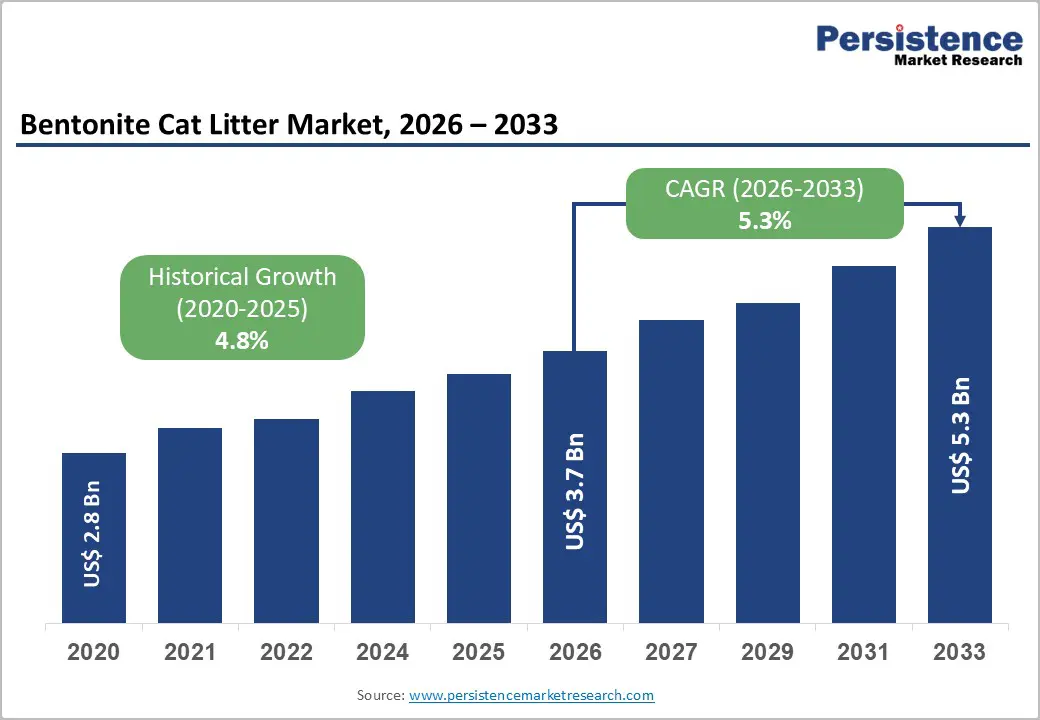
The global Bentonite Cat Litter market size is likely to be valued at US$ 3.7 Billion in 2026 and is expected to reach US$ 5.3 Billion by 2033, growing at a CAGR of 5.3% during the forecast period from 2026 to 2033. The market's consistent and structurally sustained growth is driven by the accelerating global pet humanization trend, rising cat ownership rates across both developed and emerging economies, and growing consumer preference for clumping bentonite cat litter's superior odor control and hygiene management performance over alternative litter substrates.
Key Industry Highlights:
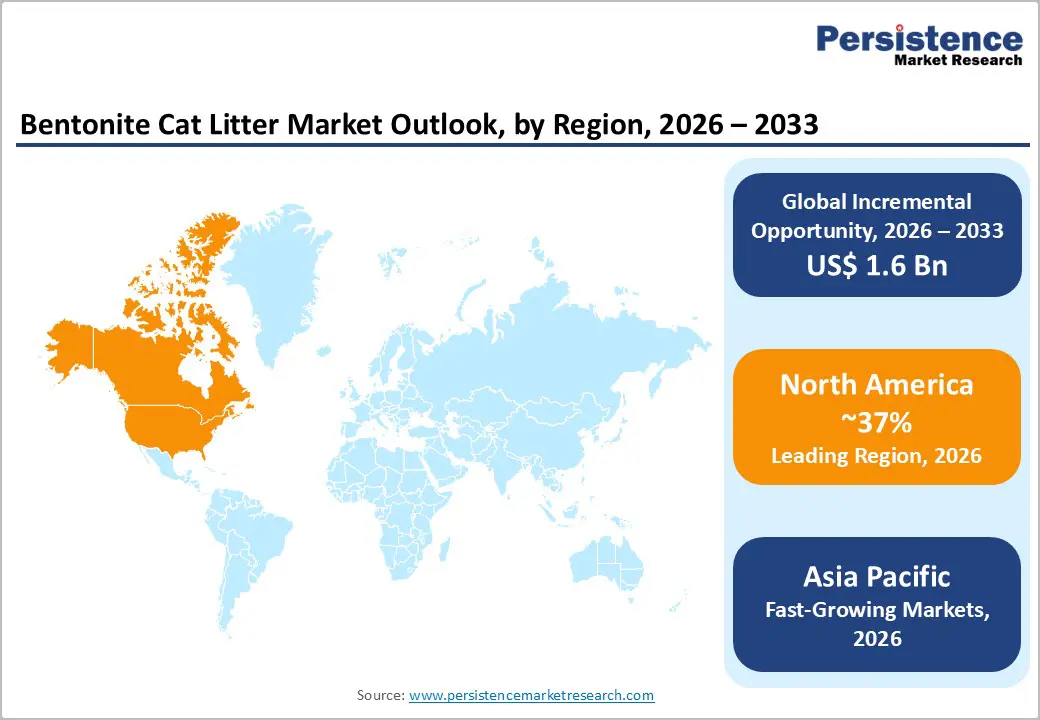
- Leading Region: North America leads the Bentonite Cat Litter market holding 37% share, due to high cat ownership, strong consumer spending on pet care, premium sodium bentonite deposits in the U.S., and well-established retail and e-commerce distribution networks.
- Fastest-Growing Region: Asia Pacific is the fastest-growing region with rising CAGR of 6.8%, driven by rapid urban pet adoption in China, premium pet care spending in Japan, and expanding bentonite litter production and distribution across emerging Asian markets.
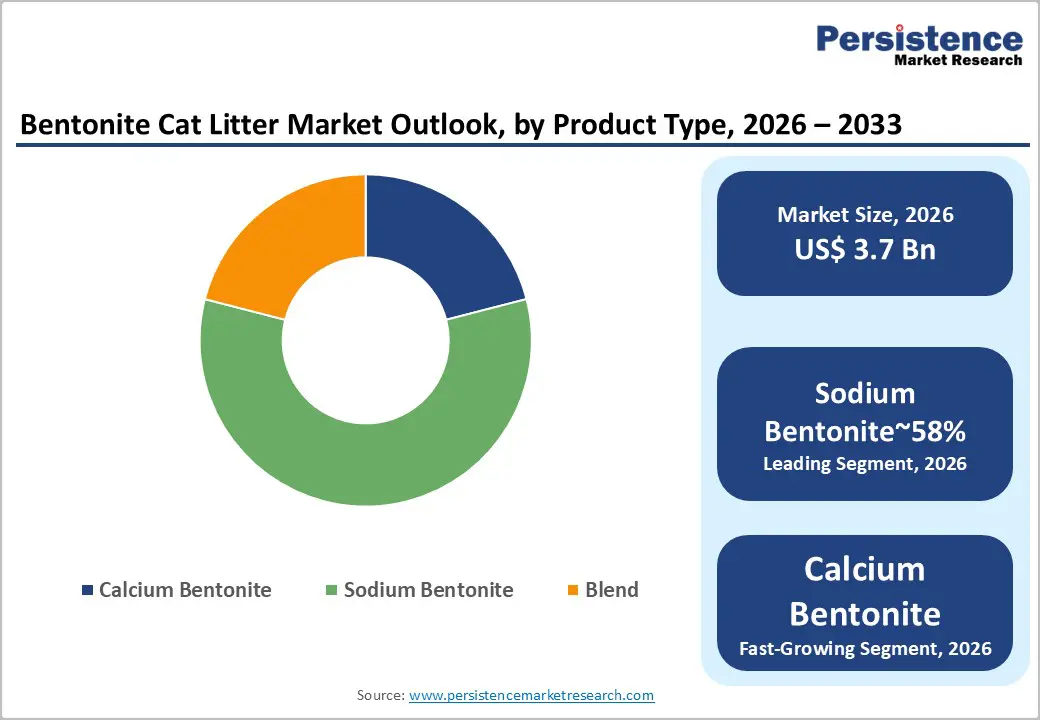
- Leading Segment: Sodium Bentonite leads the product type segment with around 58% share, supported by superior liquid absorption, strong clumping performance, and its extensive use in leading global branded cat litter products.
- Fastest-Growing Segment: Online distribution is the fastest-growing channel due to subscription services, convenience, repeat purchase automation, and expanding e-commerce platforms that simplify delivery of bulky cat litter products to households.
- Key Opportunity: Asia Pacific offers major growth opportunities due to rising cat ownership, expanding middle-class pet spending, and growing e-commerce platforms enabling premium bentonite litter brands to reach new first-time pet owners.
| Key Insights | Details |
|---|---|
|
Bentonite Cat Litter Market Size (2026E) |
US$ 3.7 Billion |
|
Market Value Forecast (2033F) |
US$ 5.3 Billion |
|
Projected Growth CAGR (2026–2033) |
5.3% |
|
Historical Market Growth (2020–2025) |
4.8% |
Market Dynamics
Drivers - Rising Global Cat Ownership and Pet Humanization Trend Sustaining Structural Bentonite Cat Litter Demand
The global pet care industry has undergone a major transformation, largely driven by the growing trend of pet humanization, where pet owners increasingly treat their companion animals as family members who deserve high-quality care, nutrition, and hygiene products. This cultural shift is one of the strongest structural factors supporting the consistent growth of the Bentonite Cat Litter market worldwide. According to the American Pet Products Association (APPA), total U.S. pet industry spending reached US$147 billion in 2023, with pet supplies and over-the-counter medicines, including cat litter, representing a significant portion of this expenditure.
The COVID-19 pandemic also accelerated pet adoption globally, with APPA reporting that approximately 23 million U.S. households adopted a new pet between 2020 and 2021. These new pet owners continue to generate recurring demand for cat litter, creating a stable long-term consumption pattern. Meanwhile, China’s rapidly expanding urban middle class has embraced cat ownership, with the China Pet Industry White Paper 2023 estimating more than 65 million domestic cats in urban households. Companies such as Yausen International Group Limited and other Chinese private-label manufacturers are expanding production capacity to meet this fast-growing demand.
Superior Clumping Performance and Odor Control Properties Reinforcing Bentonite's Category Dominance Over Alternative Litter Substrates
The strong technical performance of Sodium Bentonite-based clumping cat litter continues to reinforce its dominance over alternative litter materials across global markets. Bentonite’s natural properties, such as the ability to absorb liquids at 15 times its dry weight, form firm clumps quickly, and control odors effectively, make it highly preferred among cat owners. When cat urine contacts bentonite granules, the material rapidly forms solid clumps that allow easy and hygienic removal, reducing the need to replace the entire litter box.
In addition, the clay’s natural surface chemistry helps absorb odors and neutralize ammonia by controlling pH levels, improving overall hygiene. According to the U.S. Geological Survey (USGS) Mineral Commodity Summaries, a significant share of bentonite production, especially from Wyoming, which supplies around 70% of U.S. output, is used for cat litter manufacturing. Leading brands such as ARM & HAMMER and Clump & Seal from Church & Dwight, Fresh Step® and Scoop Away from The Clorox Company, and CATSAN from Mars combine sodium bentonite with fragrances, antimicrobial additives, and activated carbon technology to enhance odor control and maintain strong consumer loyalty.
Restraints - Growing Environmental Concerns Over Bentonite Mining Practices and Non-Biodegradable Litter Disposal Impacting Sustainability Perception
Despite its strong market position, the Bentonite Cat Litter market faces increasing scrutiny regarding environmental sustainability. Bentonite clay is primarily extracted through open-cast strip mining, a process that can disrupt topsoil, alter local water systems, and require extensive land restoration efforts after mining operations are completed. Environmental organizations and regulators are increasingly focusing on these impacts as sustainability becomes a higher priority for consumers and policymakers. In addition, used bentonite cat litter is non-biodegradable and typically disposed of in municipal solid waste landfills, creating an additional environmental concern.
According to the U.S. Environmental Protection Agency (EPA), cat litter contributes to household landfill waste streams because it cannot be easily recycled or composted once mixed with pet waste. As environmentally conscious millennials and Gen Z consumers, identified by NielsenIQ as major drivers of premium pet product purchases, place greater emphasis on sustainability, demand for eco-friendly alternatives is increasing. As a result, bentonite litter manufacturers face growing pressure to improve sustainability messaging, adopt responsible mining practices, and introduce environmentally friendly product innovations.
Health Concerns Associated with Sodium Bentonite Dust Inhalation Creating Consumer Preference Shift in Certain Demographics
Another challenge for the Bentonite Cat Litter market is growing consumer concern about potential health risks related to dust exposure during litter handling. Fine dust particles can be generated when cat litter is poured, scooped, or disturbed by pets inside indoor environments. Some bentonite deposits may contain trace amounts of crystalline silica, which has raised concerns about long-term respiratory exposure. The International Agency for Research on Cancer and the World Health Organization classify inhaled crystalline silica from occupational exposure as a Group 1 carcinogen.
Although this classification applies primarily to high-level industrial exposure rather than normal household use, it has still influenced consumer perception among health-conscious pet owners. Advocacy groups and veterinary professionals often recommend low-dust litter options to minimize potential respiratory irritation for both cats and owners. As a result, manufacturers are investing in improved granulation technologies, dust-reduction treatments, and advanced filtration processes to create low-dust or dust-free formulations. However, these additional processing steps increase production costs and may impact product pricing in competitive retail markets.
Opportunities - E-Commerce Channel Expansion and Direct-to-Consumer Subscription Models Unlocking Premium Revenue Growth
The rapid shift toward e-commerce is creating major growth opportunities for bentonite cat litter manufacturers, particularly through direct-to-consumer sales and subscription delivery models. The COVID-19 pandemic significantly accelerated online purchasing of household essentials, including pet care products, and many consumers have continued using these channels due to convenience. Cat litter is a heavy and frequently purchased product, making it ideal for home delivery services that eliminate the need for repeated store visits. Online platforms such as Amazon and Chewy.com have become important sales channels for pet supplies.
Chewy reported more than US$11.1 billion in net sales in 2023, with its AutoShip subscription program accounting for about 80% of total revenue. Major manufacturers including Church & Dwight and The Clorox Company are expanding their digital presence through Amazon Brand Stores and direct-to-consumer websites. These channels allow companies to sell premium products at higher margins while building stronger customer relationships through recurring subscription purchases. In China, e-commerce platforms such as JD.com and Tmall are also driving strong online sales of bentonite cat litter through promotional bundles and targeted marketing campaigns.
Emerging Markets Cat Ownership Growth and Premiumization in Asia Pacific Creating High-Growth Export Demand
The rapid growth of cat ownership in Asia Pacific is creating significant export and revenue opportunities for global bentonite cat litter manufacturers. Rising disposable incomes, urbanization, and changing lifestyles are encouraging more households to adopt companion animals across countries such as China, Japan, South Korea, Thailand, and Vietnam. China represents one of the fastest-growing markets, with more than 65 million domestic cats in urban households according to the China Pet Industry White Paper 2023. Japan also represents a highly valuable market despite its smaller cat population of around 9.9 million animals.
Japanese pet owners typically prioritize premium quality products, including litter with superior odor control, low dust content, and advanced hygiene features. This strong demand allows premium brands to command higher selling prices. Companies such as Intersand Group, known for brands like EverClean, and Klybeck Lifesciences AG are actively expanding their presence in Asian markets through distributor partnerships and online retail platforms. These companies are targeting urban millennial consumers with premium scented, antibacterial, and high-performance bentonite litter products.
Category-wise Analysis
By Product Type Insights
Sodium Bentonite leads the global Bentonite Cat Litter market by product type, accounting for approximately 58% of total segment revenue in 2026. This strong position is driven by its superior clumping performance, which has made clumping cat litter the most preferred format among cat owners worldwide since the concept was commercialized by Thomas Nelson in 1984. Sodium Bentonite, mainly sourced from large deposits in Wyoming and South Dakota in the United States, offers exceptional absorption properties.
According to the United States Geological Survey, these reserves are among the highest-quality natural Sodium Bentonite sources globally. The mineral can absorb about 15 times its dry weight in liquid, forming strong, scoopable clumps that allow users to remove waste selectively without replacing the entire litter box. This reduces overall litter consumption and lowers cost per use for consumers. Leading branded products such as Clump & Seal, Fresh Step, and CATSAN Active Plus rely on Sodium Bentonite formulations, confirming its strong presence in the premium cat litter category. Calcium Bentonite accounts for about 27% of product type revenue, supported by its lower raw material cost and strong availability across Mediterranean, Middle Eastern, and Asian bentonite mining regions.
By Composition Insights
Clay mix dominates the global bentonite cat litter market by composition, holding around 68% of total composition segment revenue in 2026. This leadership reflects the commercial maturity and proven performance of clay-based bentonite formulations, which have become the standard product format in both mass-market and premium cat litter categories worldwide. Clay Mix cat litter is typically produced using processed and granulated Sodium or calcium bentonite combined with fragrance agents, odor neutralizers, and antimicrobial additives.
This formulation structure forms the foundation for many globally recognized cat litter brands from companies such as Church & Dwight, The Clorox Company, Mars, Incorporated, and Intersand Group. The long-standing consumer trust in clay-based litter products, along with large-scale manufacturing efficiency and strong retail presence, continues to support this segment’s dominance. Clay and silica blend formulations account for roughly 32% of segment revenue. These hybrid products are gaining traction in premium and specialty pet retail channels as companies such as Minerals Technologies Inc. and Imerys S.A. introduce products that combine bentonite’s clumping ability with silica gel’s enhanced moisture absorption and longer-lasting odor control.
By Distribution Channel Insights
Offline distribution channels lead the global market, accounting for approximately 62% of total distribution channel revenue in 2026. This dominance reflects the continued importance of physical retail stores, including mass merchandise chains, pet specialty retailers, grocery supermarkets, and home improvement outlets, as the primary purchase locations for cat litter products in major markets. Large retailers such as Walmart, Target Corporation, PetSmart, and Petco maintain strong shelf presence for leading cat litter brands. Cat litter’s heavy weight, frequent purchase cycle, and bulky packaging formats traditionally favor in-store purchases because shipping and delivery logistics can be expensive.
As a result, brick-and-mortar retail has remained the dominant distribution channel even as e-commerce adoption rises. Major manufacturers such as Church & Dwight and The Clorox Company continue to maintain strong partnerships with retail chains, positioning their ARM & HAMMER and Fresh Step products prominently on store shelves. However, online sales represent about 38% of market revenue and are growing rapidly. Subscription programs such as Chewy AutoShip, Amazon Subscribe & Save, and Tmall pet retail stores are driving faster channel growth by offering convenience, automated reordering, and competitive pricing.
Regional Insights
North America Bentonite Cat Litter Trends
North America leads the global Bentonite Cat Litter market, primarily driven by the United States, which remains the world’s largest consumer of cat litter products. According to the 2023–2024 National Pet Owners Survey conducted by the American Pet Products Association, around 46.5 million U.S. households own cats, with average annual spending on cat litter estimated at approximately US$182 per household. The region also benefits from strong raw material supply because the United States is the world’s largest producer of sodium bentonite.
Data from the United States Geological Survey indicates that Wyoming and South Dakota together produce nearly 70% of U.S. bentonite output, much of which is used by domestic cat litter manufacturers. This gives companies such as Church & Dwight, The Clorox Company, and Minerals Technologies Inc. strong supply security and cost advantages. Leading brands including ARM & HAMMER, Clump & Seal, Fresh Step, and Scoop Away dominate retail sales. In Canada, the growing pet care industry, valued at more than CAD 8 billion according to Pets Canada, supports a premium cat litter segment led by Intersand Group, which exports its products to over 50 countries.
Europe Bentonite Cat Litter Market Trends
Europe represents a mature and brand-driven market for Bentonite Cat Litter, supported by one of the world’s highest cat ownership rates. According to the European Pet Food Industry Federation, Europe has more than 127 million domestic cats, creating strong and consistent demand for cat litter products. Major markets such as Germany, United Kingdom, France, and Spain collectively represent the largest regional consumption centers. Germany leads demand due to its large pet population of over 16.7 million cats and its strong retail pet care industry.
The country is also the home market for Mars, Incorporated, whose CATSAN brand is one of the most recognized cat litter brands across European supermarkets and pet stores. In the United Kingdom, approximately 11.1 million cats live in households according to the Pet Food Manufacturers Association, supporting a premium litter segment with high consumer demand for advanced odor control and low-dust formulations. At the regulatory level, the European Union’s REACH Regulation and Chemicals Strategy for Sustainability are encouraging companies such as Imerys S.A. and Minerals Technologies Inc. to invest in low-crystalline-silica mineral processing technologies.
Asia Pacific Bentonite Cat Litter Market Trends
Asia Pacific is the fastest-growing regional market for bentonite cat litter, driven by rising pet ownership and rapid urbanization across major Asian economies. China is the largest growth engine, with more than 65 million domestic cats according to the China Pet Industry White Paper 2023. Increasing disposable income and the growing number of young urban pet owners are significantly boosting demand for convenient and premium cat litter products. Domestic manufacturers such as Yausen International Group Limited and MCL Bentonite are expanding production to serve both domestic consumption and export markets.
E-commerce platforms, including Tmall, JD.com, and Pinduoduo dominate product distribution in Chinese urban areas. Japan maintains a premium-focused pet care market, with about 9.9 million cats recorded by the Japan Pet Food Association. Japanese consumers often prefer high-quality, fragrance-enhanced, antibacterial, and ultra-low-dust bentonite litter products. Emerging markets such as India are also experiencing steady growth in pet ownership, supported by expanding organized pet retail platforms such as Heads Up For Tails.
Competitive Landscape
The global bentonite cat litter market is moderately consolidated at the branded consumer product level, with several large multinational companies holding strong market positions. Key industry leaders include Church & Dwight, The Clorox Company, and Mars, Incorporated, which maintain market leadership through strong brand recognition, extensive retail distribution networks, and long-term supply agreements for high-quality Wyoming Sodium Bentonite. These companies continuously invest in product innovation, particularly in fragrance technology, odor control additives, antimicrobial formulations, and low-dust processing improvements. Mineral producers such as Imerys S.A. and Minerals Technologies Inc. compete through vertically integrated operations that supply both branded litter products and private-label manufacturing for retailers. Intersand Group differentiates itself through premium international branding and strong export market expertise. Emerging trends in the competitive landscape include subscription-based e-commerce models, sustainability-focused bentonite sourcing strategies, and the introduction of premium low-dust formulations designed for health-conscious pet owners. Regional suppliers such as Swell Well Minechem Pvt. Ltd., MCL Bentonite, and Iran Bentonite Co. remain competitive through cost-efficient mineral processing and private-label supply capabilities.
Key Developments:
- In March 2025: Church & Dwight Co., Inc. expanded its ARM & HAMMER Platinum cat litter portfolio by introducing a multi-cat formula with moisture-activated baking soda technology for stronger odor neutralization and clumping performance, specifically designed to address odor management challenges in multi-cat households.
- In October 2024: The Clorox Company introduced sustainability-focused packaging improvements for its Fresh Step clumping cat litter line, shifting toward bags containing 50% recycled plastic and labeled through the How2Recycle program to reduce packaging waste and support the company’s broader ESG sustainability commitments.
- In June 2024: Intersand Group expanded distribution of its premium OKO PLUS bentonite cat litter across Southeast Asia, forming new importer partnerships in Thailand, Vietnam, and Indonesia to meet increasing regional demand for premium pet care products driven by rising urban pet ownership.
Companies Covered in Bentonite Cat Litter Market
- Church & Dwight Co., Inc.
- The Clorox Company
- Imerys S.A.
- Minerals Technologies Inc.
- Mars, Incorporated
- Intersand Group
- Klybeck Lifesciences AG
- Elsey's
- MCL Bentonite
- Ceylan Mineral
- Yausen International Group Limited
- Swell Well Minechem Pvt. Ltd.
- Iran Bentonite Co.
- Barus Golden
- Oil-Dri Corporation of America
- Nestle Purina PetCare
Frequently Asked Questions
The global Bentonite Cat Litter market is valued at about US$ 3.7 billion in 2026 and is projected to reach US$ 5.3 billion by 2033, growing at a CAGR of 5.3%.
Market growth is driven by rising global cat ownership, increasing pet humanization trends, growing demand for clumping litter, and Sodium Bentonite’s superior absorption and odor control performance preferred by cat owners.
Sodium Bentonite leads the product type segment with about 58% revenue share in 2026 due to its high absorption capacity, strong clumping ability, and wide use in leading branded cat litter products.
North America leads the Bentonite Cat Litter market due to high cat ownership, strong retail distribution networks, abundant Sodium Bentonite reserves in the U.S., and the presence of major pet care brands.
The biggest opportunity lies in Asia Pacific, where rising pet adoption, urbanization, and expanding e-commerce platforms are increasing demand for premium bentonite cat litter products among new cat owners.


