




- Medical Devices
- Belgium Dialysis Market
Belgium Dialysis Market Size, Share, and Growth Forecast 2026 - 2033
Belgium Dialysis Market by Product (Hemodialysis Devices, Peritoneal Dialysis Devices, Continuous Renal Replacement Therapy [CRRT], Consumables), by Indication (Acute Kidney Injury [AKI], Chronic Kidney Disease [CKD], End Stage Renal Disease [ESRD]), End-user, Analysis for 2026 - 2033

Belgium Dialysis Market Size and Trend Analysis
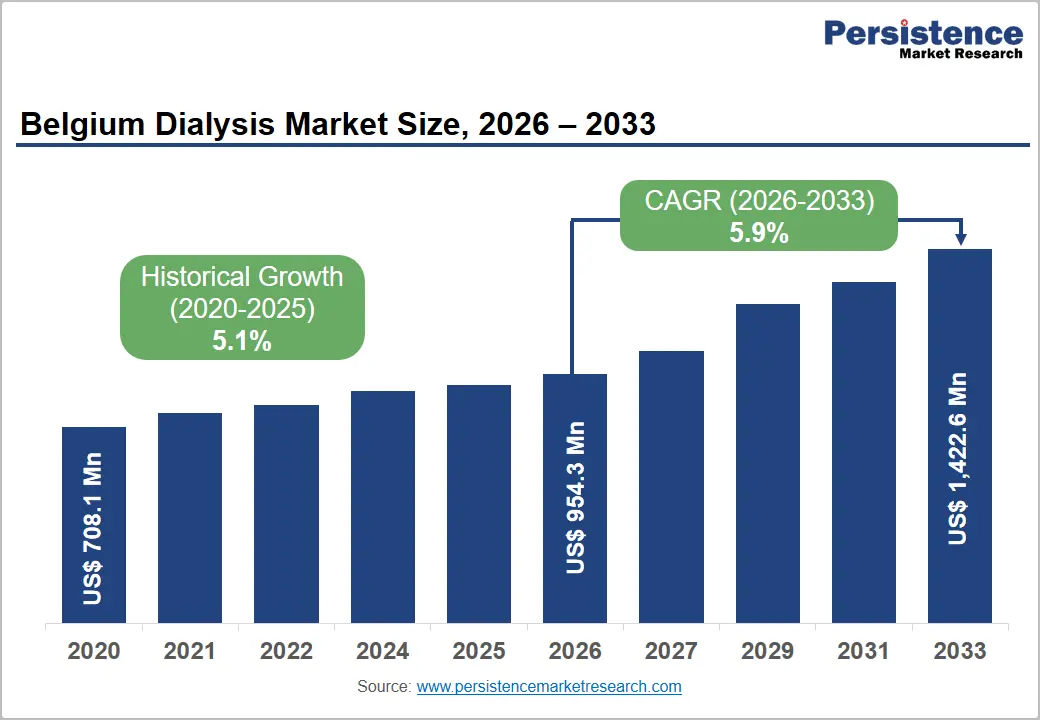
Belgium dialysis market size is expected to be valued at US$ 954.3 million in 2026 and projected to reach US$ 1,422.6 million, growing at a CAGR of 5.9% between 2026 and 2033, owing to the country’s advanced universal healthcare system, rising prevalence of chronic kidney disease (CKD), and increasing incidence of end-stage renal disease (ESRD).
Growing adoption of home-based peritoneal dialysis and continuous renal replacement therapy (CRRT) technologies is further supporting market expansion across hospitals and home-care settings.
Belgium’s aging population is a major contributor to rising dialysis demand, with individuals aged 65 years and above projected to account for over 22% of the total population by 2030, according to Statbel. Additionally, the increasing burden of diabetes and hypertension, which are key risk factors for renal disorders, continues to drive the need for advanced dialysis products, consumables, and renal care services throughout the country.
Key Industry Highlights:
- Leading Market: Belgium's dialysis market is anchored by Hospitals & Clinics as the dominant end-user, holding ~52% share in 2026, driven by large nephrology departments in academic medical centers across Brussels, Ghent, Antwerp, and Leuven.
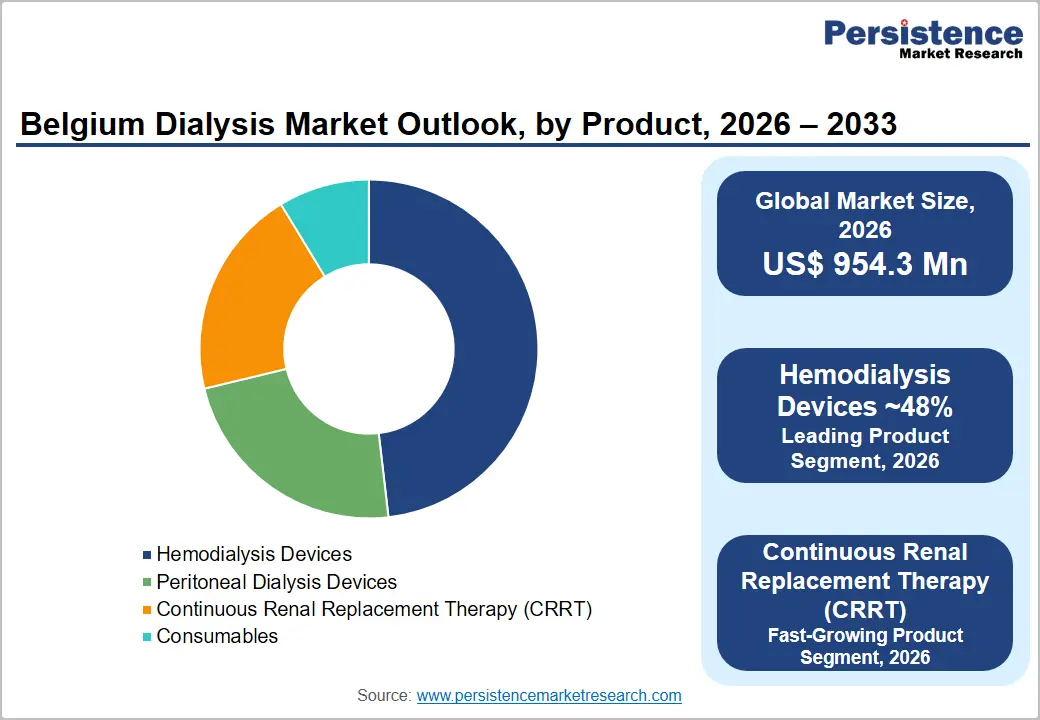
- Fast-Growing Product Segment: Continuous Renal Replacement Therapy (CRRT) is the fastest-growing product segment, propelled by rising AKI incidence in ICU settings, expanded clinical protocols in Belgian university hospitals, and improving CRRT system portability and ease of use.
- Dominant Product Segment: Hemodialysis Devices lead with ~48% share in 2026, supported by Belgium's high ESRD prevalence over 1,300 RRT patients pmp and a well-established in-center dialysis infrastructure reimbursed under RIZIV/INAMI.
- Fastest Growing Opportunity: Home-based peritoneal dialysis and automated PD (APD) represent the highest-growth opportunity, with Belgium's home dialysis penetration below 20% well beneath leading EU peers offering substantial expansion headroom under favorable national health policy.
- Key Opportunity: The decentralization of dialysis care to ambulatory and satellite centers, driven by the Belgian Society of Nephrology and federal health policy, creates compelling procurement demand for compact, connected hemodialysis systems and integrated supply solutions.
Market Dynamics
Drivers - High and Rising Prevalence of End-Stage Renal Disease in Belgium
Belgium continues to record one of the highest renal replacement therapy (RRT) utilization rates in Europe, significantly supporting demand for dialysis equipment, consumables, and renal care services. According to the European Renal Association and the Belgian Society of Nephrology, the country has consistently reported RRT prevalence rates exceeding 1,300 patients per million population positioning Belgium among the leading dialysis markets within the European Union. The growing number of patients requiring long-term renal support has increased the need for hemodialysis systems, dialyzers, vascular access devices, and related treatment infrastructure across hospitals and dialysis centers.
The Registre Belge de la Dialyse et de la Transplantation has documented more than 6,500 chronic dialysis patients nationwide, reflecting the country’s expanding ESRD burden. The rising prevalence of diabetes and cardiovascular diseases remains a major contributing factor to chronic kidney disease progression. According to Sciensano, nearly 7% of Belgium’s adult population is affected by type 2 diabetes, further accelerating kidney-related complications. This expanding patient base is expected to sustain long-term growth for dialysis machines, consumables, and renal monitoring technologies throughout Belgium.
Restraints - Shortage of Nephrologists and Specialized Renal Care Workforce
Belgium is facing an increasing shortage of nephrologists, dialysis nurses, and specialized renal care professionals, which is becoming a major operational challenge for the dialysis market. Similar to other Western European countries, the healthcare system is struggling to expand its skilled workforce at the same pace as the growing dialysis patient population. Studies published by the European Association of Hospital Pharmacists and research featured in the Nephrology Dialysis Transplantation have highlighted widening workforce gaps across European healthcare systems, particularly in nephrology and chronic disease management.
As the number of ESRD patients continues to rise, limited staffing capacity may create bottlenecks in dialysis treatment delivery and patient monitoring services. Existing dialysis centers could face operational pressure due to increasing patient volumes and insufficient availability of trained professionals. Although Belgium maintains strong reimbursement support and an advanced healthcare infrastructure, workforce limitations may restrict the establishment of new dialysis units and slow service expansion. These challenges could ultimately affect treatment accessibility, patient management efficiency, and overall market growth potential in the coming years.
Opportunities - Expansion of Home-Based Peritoneal Dialysis and CRRT Adoption
The increasing adoption of home-based dialysis therapies presents a significant growth opportunity for the Belgium dialysis market. Continuous Renal Replacement Therapy (CRRT) is emerging as the fastest-growing segment due to rising demand for personalized and intensive renal care solutions. At the same time, peritoneal dialysis (PD) is gaining wider acceptance because of its convenience, lower hospital dependency, and improved quality-of-life benefits for patients. The Belgian College of Physicians for Nephrology along with European clinical guidelines increasingly recommend PD as a preferred first-line treatment option for suitable chronic kidney disease patients.
Belgium’s healthcare authorities, including the Federal Public Service Health, are actively promoting home dialysis programs to reduce the burden on hospitals and improve long-term treatment efficiency. This shift is encouraging manufacturers to introduce automated peritoneal dialysis (APD) systems integrated with telehealth platforms, remote patient monitoring, and home-training support services. Despite ongoing adoption, Belgium’s home dialysis penetration remains below 20%, significantly lower than leading markets such as the Netherlands and Australia. This comparatively lower penetration rate provides strong future growth potential for companies offering advanced home dialysis technologies and connected renal care solutions.
Category-wise Insights
Product Analysis
Hemodialysis Devices lead the Product category with ~48% market share in 2025, firmly establishing hemodialysis as Belgium's dominant dialysis modality. This leadership reflects the country's well-established network of hospital-based and satellite in-center hemodialysis units, where a large majority of the ~6,500+ chronic dialysis patients registered with the RBDT receive thrice-weekly treatment sessions. Hemodialysis machines including advanced online hemodiafiltration (HDF) systems from leading manufacturers are central to this infrastructure. The segment is further supported by the routine consumption of high-flux dialyzers, blood tubing sets, needles, and dialysis concentrates as associated consumables. Key suppliers including Fresenius Medical Care AG & Co. KGaA and B. Braun Melsungen AG maintain strong installed bases of hemodialysis equipment across Belgian renal units, reinforcing the segment's enduring market dominance.
Indication Insights
End Stage Renal Disease (ESRD) represents the leading Indication segment, accounting for ~55% of Belgium's dialysis market in 2025. ESRD patients require life-sustaining, permanent renal replacement therapy either through dialysis or transplantation generating the highest and most predictable device and consumable utilization volumes in the market. According to the European Renal Association (ERA-EDTA) registry, Belgium maintains an ESRD incidence rate above 200 new cases per million population annually, with diabetic nephropathy and hypertensive renal disease as the leading causes. Belgium's kidney transplant waiting list exceeds demand, meaning a substantial and growing proportion of ESRD patients rely on long-term hemodialysis or peritoneal dialysis. This sustained patient cohort anchors the dominant revenue contribution of the ESRD indication segment throughout the forecast period.
End-user Insights
Hospitals & clinics constitute the leading end-user segment, accounting for ~52% of the Belgium dialysis market in 2026. Belgium's centralized hospital nephrology departments located in major academic and regional hospitals across Brussels, Ghent, Liège, Antwerp, and Leuven, serve as the primary delivery points for both in-center hemodialysis and complex CRRT for critically ill patients with acute kidney injury (AKI). University hospitals such as UZ Leuven, CHU de Liège, and UZ Gent operate large nephrology and intensive care units with significant dialysis equipment inventories.
The concentration of CRRT, almost exclusively deployed in hospital ICU settings, alongside the sheer volume of routine HD sessions conducted in hospital-attached dialysis units, underpins the segment's dominance. Ongoing hospital capacity investments and digitalization of renal care workflows further consolidate hospitals as the primary procurement channel for dialysis technologies in Belgium.
Regional Insights
Belgium Dialysis Market Trends and Insights
Belgium's dialysis market is shaped by a unique combination of high RRT prevalence, universal healthcare access, and a proactive national nephrology policy framework. The country's federal health system, through RIZIV/INAMI, ensures comprehensive reimbursement coverage for all approved dialysis modalities, sustaining high treatment uptake rates. The market is witnessing a gradual shift from predominantly in-center hemodialysis toward home-based peritoneal dialysis and automated PD, supported by patient preference for greater autonomy and quality of life.
The Belgian Register for Dialysis and Transplantation (RBDT) tracks this transition annually, with home modalities accounting for a growing share of new patient initiations. Urban centers, including Brussels, Antwerp, and Ghent host high concentrations of dialysis capacity, while satellite center development is progressively improving access in rural and semi-urban areas. Technology adoption in Belgium is driven by leading manufacturers, including Fresenius Medical Care, Baxter International, B. Braun, and Nipro Corporation, who maintain strong distribution and service networks. Digital health integration, including remote dialysis monitoring and telehealth nephrology consultations, is emerging as a key differentiator, supported by Belgium's eHealth platform under the Federal Public Service Health. The overall market trajectory remains strong, underpinned by demographic aging, rising CKD burden, and continued government investment in renal care infrastructure through the forecast period.
Competitive Landscape
Belgium dialysis market is moderately consolidated, with global leaders Fresenius Medical Care AG & Co. KGaA, Baxter International Inc., and B. Braun Melsungen AG collectively commanding the majority of device and consumable revenues. These players leverage integrated product portfolios spanning machines, dialyzers, catheters, and solutions alongside dedicated service and training networks. Key differentiators include clinical evidence portfolios, digital health platform capabilities, and established relationships with hospital procurement bodies. Emerging players such as Outset Medical and Quanta Dialysis Technologies are disrupting traditional modalities with compact, home-compatible systems, while local specialist Dialife SA addresses niche consumable requirements.
Key Developments:
In June 2025, UZ Leuven reported a significant rise in kidney transplants involving living donors, performing 21 such procedures in 2024 compared with lower levels in previous years. The increase was attributed to growing public awareness, adoption of less invasive surgical techniques, and advanced blood filtration methods that improved transplant safety and feasibility.
Companies Covered in Belgium Dialysis Market
- Fresenius Medical Care AG & Co. KGaA
- Baxter International Inc.
- Nipro Corporation
- B. Braun Melsungen AG
- Asahi Kasei Corporation (Asahi Kasei Medical Co., Ltd.)
- Nikkiso Co., Ltd.
- Medtronic plc
- Outset Medical, Inc.
- Quanta Dialysis Technologies Ltd.
- Dialife SA
- JMS Co., Ltd.
- Others
Frequently Asked Questions
Belgium dialysis market is estimated at US$ 954.3 million in 2026.
Major demand drivers include high renal replacement therapy prevalence, increasing CKD cases from diabetes and hypertension, strong reimbursement coverage, and rising adoption of home-based dialysis therapies.
Hospitals and clinics dominate the Belgium dialysis market due to large nephrology departments, ICU-based CRRT usage, and high procurement of dialysis equipment and consumables.
Key opportunities include expansion of home-based automated peritoneal dialysis, growing CRRT adoption, and development of satellite dialysis centers across underserved Belgian regions.
Leading companies include Fresenius Medical Care, Baxter International, B. Braun, Nipro Corporation, Medtronic, and Asahi Kasei Medical, supported by strong renal care portfolios.


