


- Executive Summary
- Global Baby Care Product Market Snapshot, 2025 and 2032
- Market Opportunity Assessment, 2025 - 2032, US$ Bn
- Key Market Trends
- Future Market Projections
- Premium Market Insights
- Industry Developments and Key Market Events
- PMR Analysis and Recommendations
- Market Overview
- Market Scope and Definition
- Market Dynamics
- Drivers
- Restraints
- Opportunity
- Key Trends
- Macro-Economic Factors
- Global Sectorial Outlook
- Global GDP Growth Outlook
- COVID-19 Impact Analysis
- Forecast Factors - Relevance and Impact
- Value Added Insights
- Product Adoption Analysis
- Regulatory Landscape
- List of Suppliers
- Porter’s Five Forces Analysis
- PESTLE Analysis
- Promotional Strategies, By Key Players
- Price Analysis, 2025A
- Key Highlights
- Key Factors Impacting Product Prices
- Pricing Analysis, By Product
- Regional Prices and Product Preferences
- Global Baby Care Product Market Outlook
- Key Highlights
- Market Volume (Units) Projections
- Market Size (US$ Bn) and Y-o-Y Growth
- Absolute $ Opportunity
- Market Size (US$ Bn) Analysis and Forecast
- Historical Market Size (US$ Bn) Analysis, 2019-2024
- Current Market Size (US$ Bn) Analysis and Forecast, 2025 - 2032
- Global Baby Care Product Market Outlook: Product Type
- Introduction / Key Findings
- Historical Market Size (US$ Bn) and Volume (Units) Analysis, By Product Type, 2019 - 2024
- Current Market Size (US$ Bn) and Volume (Units) Analysis and Forecast, By Product Type, 2025 - 2032
- Cosmetic
- Hygiene & Toiletries
- Food/Formula
- Grooming Products
- Clothing & Laundry Products
- Feeding & Nursing Products
- Others
- Market Attractiveness Analysis: Product Type
- Global Baby Care Product Market Outlook: Distribution Channel
- Introduction / Key Findings
- Historical Market Size (US$ Bn) Analysis, By Distribution Channel, 2019 - 2024
- Current Market Size (US$ Bn) Analysis and Forecast, By Distribution Channel, 2025 - 2032
- Supermarkets/Hypermarkets
- Retail Stores
- Drug Stores
- Specialty Stores
- E-commerce
- Market Attractiveness Analysis: Distribution Channel
- Key Highlights
- Global Baby Care Product Market Outlook: Region
- Key Highlights
- Historical Market Size (US$ Bn) and Volume (Units) Analysis, By Region, 2019 - 2024
- Current Market Size (US$ Bn) and Volume (Units) Analysis and Forecast, By Region, 2025 - 2032
- North America
- Europe
- East Asia
- South Asia and Oceania
- Latin America
- Middle East & Africa
- Market Attractiveness Analysis: Region
- North America Baby Care Product Market Outlook
- Key Highlights
- Historical Market Size (US$ Bn) Analysis, By Market, 2019 - 2024
- By Country
- By Product Type
- By Distribution Channel
- Current Market Size (US$ Bn) Analysis and Forecast, By Country, 2025 - 2032
- U.S.
- Canada
- Current Market Size (US$ Bn) and Volume (Units) Analysis and Forecast, By Product Type, 2025 - 2032
- Cosmetic
- Hygiene & Toiletries
- Food/Formula
- Grooming Products
- Clothing & Laundry Products
- Feeding & Nursing Products
- Others
- Current Market Size (US$ Bn) Analysis and Forecast, By Distribution Channel, 2025 - 2032
- Supermarkets/Hypermarkets
- Retail Stores
- Drug Stores
- Specialty Stores
- E-commerce
- Market Attractiveness Analysis
- Europe Baby Care Product Market Outlook
- Key Highlights
- Historical Market Size (US$ Bn) Analysis, By Market, 2019 - 2024
- By Country
- By Product Type
- By Distribution Channel
- Current Market Size (US$ Bn) Analysis and Forecast, By Country, 2025 - 2032
- Germany
- France
- U.K.
- Italy
- Spain
- Russia
- Türkiye
- Rest of Europe
- Current Market Size (US$ Bn) and Volume (Units) Analysis and Forecast, By Product Type, 2025 - 2032
- Cosmetic
- Hygiene & Toiletries
- Food/Formula
- Grooming Products
- Clothing & Laundry Products
- Feeding & Nursing Products
- Others
- Current Market Size (US$ Bn) Analysis and Forecast, By Distribution Channel, 2025 - 2032
- Supermarkets/Hypermarkets
- Retail Stores
- Drug Stores
- Specialty Stores
- E-commerce
- Market Attractiveness Analysis
- East Asia Baby Care Product Market Outlook
- Key Highlights
- Historical Market Size (US$ Bn) Analysis, By Market, 2019 - 2024
- By Country
- By Product Type
- By Distribution Channel
- Current Market Size (US$ Bn) Analysis and Forecast, By Country, 2025 - 2032
- China
- Japan
- South Korea
- Current Market Size (US$ Bn) and Volume (Units) Analysis and Forecast, By Product Type, 2025 - 2032
- Cosmetic
- Hygiene & Toiletries
- Food/Formula
- Grooming Products
- Clothing & Laundry Products
- Feeding & Nursing Products
- Others
- Current Market Size (US$ Bn) Analysis and Forecast, By Distribution Channel, 2025 - 2032
- Supermarkets/Hypermarkets
- Retail Stores
- Drug Stores
- Specialty Stores
- E-commerce
- Market Attractiveness Analysis
- South Asia & Oceania Baby Care Product Market Outlook
- Key Highlights
- Historical Market Size (US$ Bn) Analysis, By Market, 2019 - 2024
- By Country
- By Product Type
- By Distribution Channel
- Current Market Size (US$ Bn) Analysis and Forecast, By Country, 2025 - 2032
- India
- Southeast Asia
- ANZ
- Rest of South Asia & Oceania
- Current Market Size (US$ Bn) and Volume (Units) Analysis and Forecast, By Product Type, 2025 - 2032
- Cosmetic
- Hygiene & Toiletries
- Food/Formula
- Grooming Products
- Clothing & Laundry Products
- Feeding & Nursing Products
- Others
- Current Market Size (US$ Bn) Analysis and Forecast, By Distribution Channel, 2025 - 2032
- Supermarkets/Hypermarkets
- Retail Stores
- Drug Stores
- Specialty Stores
- E-commerce
- Market Attractiveness Analysis
- Latin America Baby Care Product Market Outlook
- Key Highlights
- Historical Market Size (US$ Bn) Analysis, By Market, 2019 - 2024
- By Country
- By Product Type
- By Distribution Channel
- Current Market Size (US$ Bn) Analysis and Forecast, By Country, 2025 - 2032
- Brazil
- Mexico
- Rest of Latin America
- Current Market Size (US$ Bn) and Volume (Units) Analysis and Forecast, By Product Type, 2025 - 2032
- Cosmetic
- Hygiene & Toiletries
- Food/Formula
- Grooming Products
- Clothing & Laundry Products
- Feeding & Nursing Products
- Others
- Current Market Size (US$ Bn) Analysis and Forecast, By Distribution Channel, 2025 - 2032
- Supermarkets/Hypermarkets
- Retail Stores
- Drug Stores
- Specialty Stores
- E-commerce
- Market Attractiveness Analysis
- Middle East & Africa Baby Care Product Market Outlook
- Key Highlights
- Historical Market Size (US$ Bn) Analysis, By Market, 2019 - 2024
- By Country
- By Product Type
- By Distribution Channel
- Current Market Size (US$ Bn) Analysis and Forecast, By Country, 2025 - 2032
- GCC Countries
- Egypt
- South Africa
- Northern Africa
- Rest of Middle East & Africa
- Current Market Size (US$ Bn) and Volume (Units) Analysis and Forecast, By Product Type, 2025 - 2032
- Cosmetic
- Hygiene & Toiletries
- Food/Formula
- Grooming Products
- Clothing & Laundry Products
- Feeding & Nursing Products
- Others
- Current Market Size (US$ Bn) Analysis and Forecast, By Distribution Channel, 2025 - 2032
- Supermarkets/Hypermarkets
- Retail Stores
- Drug Stores
- Specialty Stores
- E-commerce
- Market Attractiveness Analysis
- Competition Landscape
- Market Share Analysis, 2025
- Market Structure
- Competition Intensity Mapping By Market
- Competition Dashboard
- Company Profiles (Details - Overview, Financials, Strategy, Recent Developments)
- KCWW
- Overview
- Segments and Products
- Key Financials
- Market Developments
- Market Strategy
- Procter & Gamble
- Babisil International Ltd
- Kenvue Brands LLC
- Nestlé
- Cotton Babies, Inc.
- Dorel Industries
- Babyganics
- Laboratoires Expanscience
- The Honest Company
- Burt's Bees Baby
- Danone.
- Munchkin
- Seventh Generation Inc.
- Xiran
- BambiniJO
- HOBEA
- Sanosan Baby
- ChemPraco Group
- Amaira Herbals
- KCWW
- Appendix
- Research Methodology
- Research Assumptions
- Acronyms and Abbreviations


- Baby Care & Accessories
- Baby Care Product Market
Baby Care Product Market Size, Share, Trends, Growth, Forecast 2025 - 2032
Baby Care Product Market by Product (Cosmetic, Hygiene & Toiletries, Food/ Formula, Grooming, Clothing & Laundry, Feeding & Nursing, and Others), by Distribution Channel, and Regional Analysis for 2025 - 2032
Baby Care Product Market Share and Trends Analysis
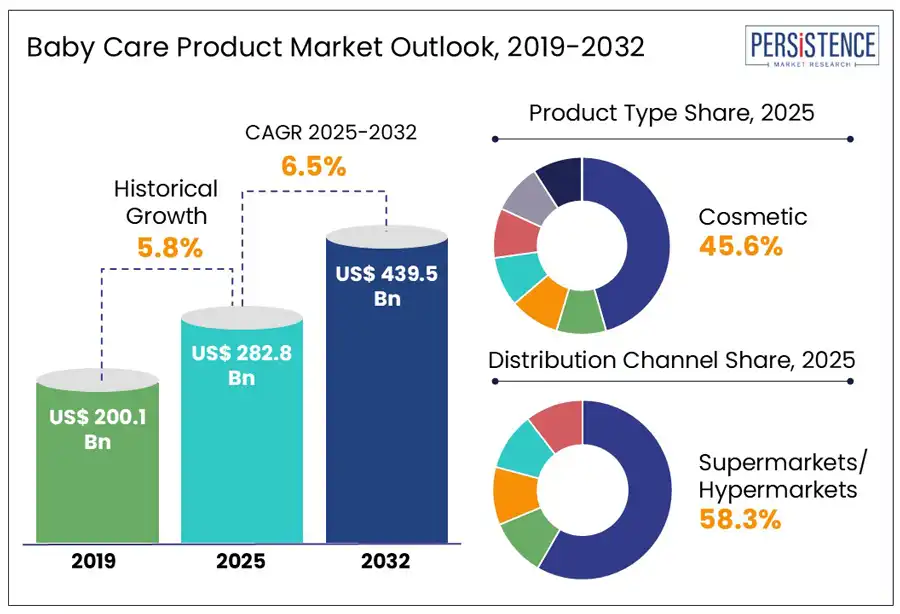
The global baby care product market size is projected at US$ 282.8 billion in 2025 and is expected to reach US$ 439.5 billion by 2032, at a CAGR of 6.5% by 2032. According to the Persistence Market Research report, the growing awareness of baby health and hygiene fuels the need for baby care products. In addition, the availability of various baby products also lures first-time parents to choose from a large pool of varieties.
Key Industry Highlights:
- Parents increasingly seek organic, chemical-free products for eco-friendly diapers and natural skin & hair care solutions.
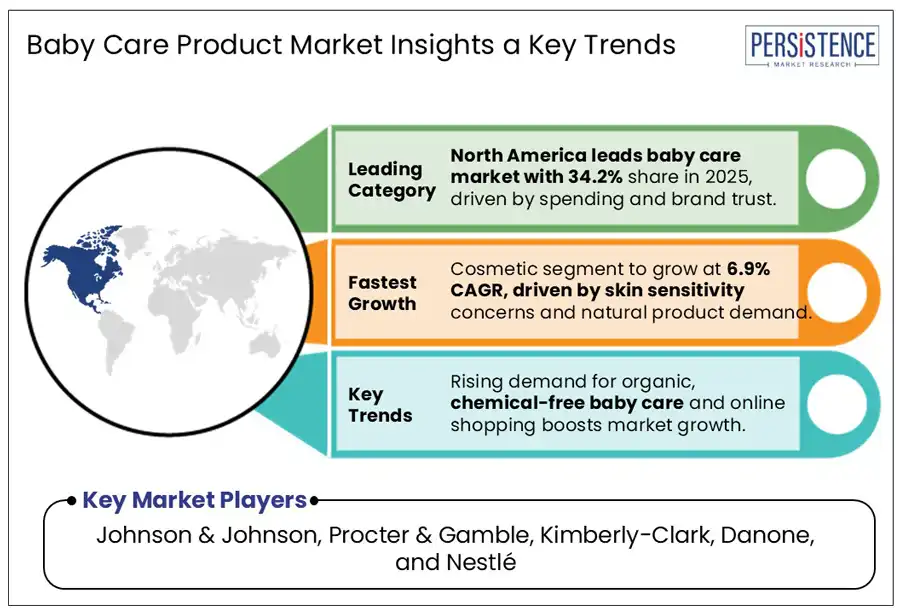
- The cosmetic & toiletries segment is projected to grow at a leading CAGR of 6.9% during the forecast period due to parents' preference for natural and organic skincare.
- North America leads the baby care product market with about 34.2% market share, driven by a preference for premium, organic, and eco-friendly options.
|
Global Market Attribute |
Key Insights |
|
Baby Care Product Market Size (2025E) |
US$ 282.8 Bn |
|
Market Value Forecast (2032F) |
US$ 439.5 Bn |
|
Projected Growth (CAGR 2025 to 2032) |
6.5% |
|
Historical Market Growth (CAGR 2019 to 2024) |
5.8% |
Market Dynamics
Driver - Growing Influence of Digital Parenting and Social Media
The rise of digital parenting and social media has transformed parents’ choices for baby products. Parents now rely on online platforms such as blogs, social media groups, and review sites for recommendations before buying. Influencers play a key role in shaping brand preferences by sharing personal experiences and product reviews. Platforms such as Instagram, YouTube, and TikTok are powerful marketing channels where brands collaborate with influencers to build trust. Real-time feedback and user-generated content significantly enhance engagement, making digital word-of-mouth a major influence on consumer behavior.
Restraint- Increasing Scrutiny and Regulatory Challenges for Ingredient Safety and Product Claims
Currently, increased regulatory scrutiny and challenges related to ingredient safety and product claims pose greater challenges. Governments and health organizations have implemented strict regulations on baby skincare, diapers, and food to ensure that these products are free from harmful chemicals, allergens, and toxins. Compliance with standards such as EU REACH, FDA regulations, and ISO certifications raises costs and slows down product launches.
Furthermore, brands risk legal action for making misleading claims, such as “100% natural” or “hypoallergenic,” unless these statements are scientifically validated. Growing consumer awareness and lawsuits against false advertising are placing additional pressure on companies to improve transparency, conduct thorough testing, and reformulate products to meet evolving safety standards.
Opportunity - Development of Edible and Multi-Purpose Baby Care Products
The rising demand for safe, natural baby care products has resulted in edible, multifunctional formulations. Parents are concerned about chemical exposure, leading brands to create food-grade edible lotions for added safety. Additionally, 2-in-1 shampoos and body washes simplify bath time, while diaper rash creams that also serve as moisturizers enhance convenience. These innovations reflect minimalist parenting trends, emphasizing non-toxic, hypoallergenic, and eco-friendly solutions that prioritize safety and efficiency.
- In 2024, Babyology introduced an Organic Baby Lotion made entirely from 100% edible ingredients, ensuring safety even if accidentally ingested.
- Additionally, in 2021, Mamaearth launched a Milky Soft Head-to-Toe Wash, a gentle 2-in-1 body wash and shampoo formulated with natural ingredients such as milk, oats, and calendula, making bath time easier for parents.
Category-wise Analysis
Product Insights
The cosmetic segment is expected to grow at a leading CAGR of 6.9% by 2032. It is driven by parents' preference for natural and organic skincare. The growing awareness of harmful chemicals such as parabens and sulfates is increasing the demand for safe, plant-based options.
Additionally, rising disposable income and heightened concerns about baby hygiene and skin sensitivity are fueling the growth of dermatologist-approved and hypoallergenic products, contributing to market expansion. In 2024, Aveeno Baby launched a new organic skincare line that emphasizes natural ingredients and is free from parabens, sulfates, and dyes. This move addresses the growing demand for safe, plant-based options as parents seek dermatologist-approved, hypoallergenic products for their babies' sensitive skin.
Distribution Channel Insights
Retail formats such as hypermarkets and supermarkets provide a wide range of baby products to meet the diverse needs of parents. Walmart is the largest supermarket chain in the U.S. It offers a wide variety of baby products, including Johnson & Johnson baby shampoos, Gerber baby food, Pampers diapers, and Graco strollers, all available in one place. They offer a convenient one-stop shopping experience, enabling parents to find everything they need in one location. Additionally, these stores often feature competitive pricing, making baby products at affordable prices. Their economies of scale allow them to negotiate lower prices with suppliers, which they ultimately pass on as savings to customers.
Regional Insights
Asia Pacific Baby Care Product Market Trends
The Asia Pacific baby care product market is projected to reach a CAGR of 7.7% by 2032, driven by a cultural emphasis on premiumization and a rising demand for natural and organic products. Parents are prioritizing high-quality, chemical-free, and eco-friendly products for their infants. This rising awareness of health risks linked to synthetic ingredients has increased demand for organic skincare, diapers, and feeding essentials.
The leading players prefer investing in manufacturing natural and organic products, such as Johnson & Johnson's launch of its "Cottontouch" range with naturally derived ingredients and The Himalaya Drug Company's successful Herbal Baby Care line. Brands such as Pigeon and Mustela are also reinforcing premiumization by offering high-end, dermatologically tested products. Overall, consumer preference for natural, chemical-free baby care is shaping the market in the region.
North America Baby Care Product Market Trends
North America baby care product market is poised to dominate with a revenue share of approximately 34.2% in 2025. Parents' preference for premium, organic, and eco-friendly options fuels the demand. Moreover, parents are particularly focused on chemical-free, plant-based products, for organic skincare, biodegradable diapers, and non-toxic wipes.
Brands are responding with hypoallergenic, fragrance-free formulations certified by USDA Organic and EWG Verified. Growing environmental concerns and rising disposable incomes also encourage investment in eco-conscious solutions. The Honest Company provides eco-friendly, non-toxic baby care products, including biodegradable diapers and wipes. Its focus on transparency and sustainability appeals to parents looking for safe alternatives, highlighting growing demand for premium, organic, and sustainable baby products in North America.
Europe Baby Care Products Market Trends
The surge in e-commerce and subscription models has significantly boosted the market in Europe. Europe is projected to capture nearly 28% of the global market revenue share in 2025. Online retail and direct-to-consumer brands provide parents with convenient access to premium baby care items, while subscription services offer tailored monthly deliveries of essentials like diapers and organic skincare, ensuring consistent supply and cost savings.
- Lillydoo, a German brand, provides eco-friendly diapers and wipes through a customizable subscription model, aligning with consumer preferences for sustainability.
- Similarly, Pampers Club offers a rewards-based subscription for repeat diaper purchases, enhancing convenience and brand loyalty.
Competitive Landscape
The global baby care product market is highly competitive, with key players prioritizing innovation, safety, and organic formulations. Leading companies offer diverse products in skincare, haircare, diapers, wipes, and food. Rising parental awareness of organic options has prompted brands to enhance their market presence, while e-commerce platforms like Amazon and Walmart facilitate penetration. Market leaders follow mergers, acquisitions, and product diversification to stay competitive.
Key Industry Developments:
- In January 2025, Hindustan Unilever Ltd (HUL) sought approval from the Competition Commission of India to acquire a 90.5% stake in Uprising Science Pvt Ltd, the parent company of the beauty brand Minimalist. The deal, valued at Rs 2,670 crore, aims to create synergies in the beauty and personal care product markets.
- In November 2024, Bonya, a new baby formula brand from the makers of Kendamil, launched an affordable baby formula priced nearly half that of Kendamil Organic. Available in Tesco and Sainsbury's, Bonya aims to provide a budget-friendly alternative without compromising nutritional quality.
- In February 2024, Kraft Heinz has collaborated with investment bank Houlihan Lokey to sell its Italy-based infant food brand, Plasmon. This is the company's second attempt to sell the brand, with binding offers expected by March 2025.
- In January 2024, Pampers launched its improved Premium Care Diapers featuring a 360-degree cottony softness, making babies feel like they're wearing nothing. The all-in-one diaper includes an anti-rash blanket and aloe vera lotion to protect delicate skin from rashes.
Companies Covered in Baby Care Product Market
- KCWW
- Procter & Gamble
- Babisil International Ltd
- Unilever
- Kenvue Brands LLC
- Nestlé
- Cotton Babies, Inc.
- Dorel Industries
- Mamaearth
- Babyganics
- Laboratoires Expanscience
- The Honest Company
- Burt's Bees Baby
- Kraft Heinz
- Danone
- Munchkin
- Seventh Generation Inc.
- Xiran
- BambiniJO
- HOBEA
- Sanosan Baby
- Chemco Group
- Amaira Herbals
Frequently Asked Questions
The market is estimated to be valued at US$ 282.8 Bn in 2025.
The growing influence of digital parenting and social media is a key demand driver for the market.
In 2025, North America dominates with 34.2% market share.
Among product, cosmetic segment is expected to grow rapidly at 6.9% CAGR from 2025 to 2032.
Johnson & Johnson, Procter & Gamble, Kimberly-Clark, and Nestlé are the leading players in the baby care product market.


