




- Automotive Components & Materials
- Automotive Transaxle Market
Automotive Transaxle Market Size, Share, and Growth Forecast, 2026 - 2033
Automotive Transaxle Market by Variant (Front Engine Front Wheel Drive Transaxle, Rear Engine Rear Wheel Drive Transaxle, Front Engine Rear Wheel Drive Transaxle, All Wheel Drive Transaxle), Operation (Manual, Automatic), Vehicle Type (Passenger Cars, Commercial Vehicles), and Regional Analysis for 2026 - 2033

Automotive Transaxle Market Size and Trends Analysis
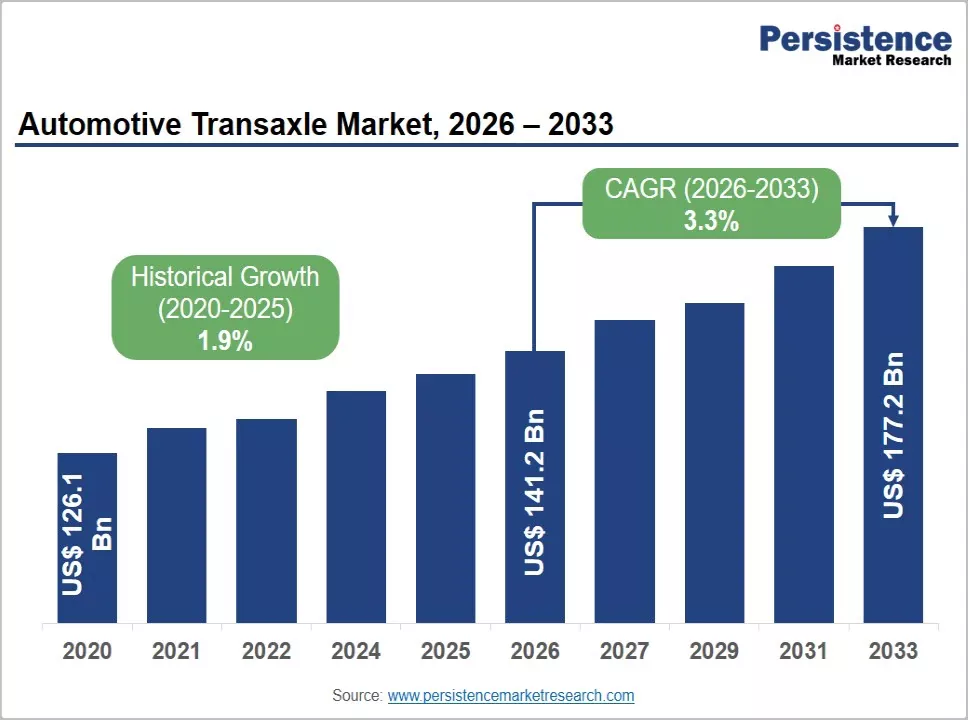
The global automotive transaxle market size is likely to be valued at US$141.2 billion in 2026 and is projected to reach US$177.2 billion by 2033, growing at a CAGR of 3.3% during the forecast period from 2026 to 2033, supported by the continued dominance of Front Wheel Drive passenger cars, rapid growth of electrified powertrains that integrate compact drive units, and rising demand for automatic and dual-clutch transmissions.
The International Energy Agency reports that global electric car sales exceeded 17 million in 2024, representing more than 20% of new car sales, expanding the base of vehicles that use integrated single-speed or multi-speed drive units similar in function to transaxles.
Key Industry Highlights:
- Front engine front wheel drive transaxles are estimated to remain the leading variant in 2026 with about a 61% share, supported by their prevalence in compact, mid-size, and crossover passenger vehicles.
- Automatic transaxles are estimated to account for about 77% of the market by operation in 2026, supported by consumer preference for convenience and the spread of continuously variable and dual-clutch designs.
- Passenger cars are estimated to remain the leading vehicle type with around a 66% share in 2026, driven by large global production volumes.
- All wheel drive transaxles are estimated to be among the fastest-growing variants through 2033, aligned with rising crossover and SUV demand.
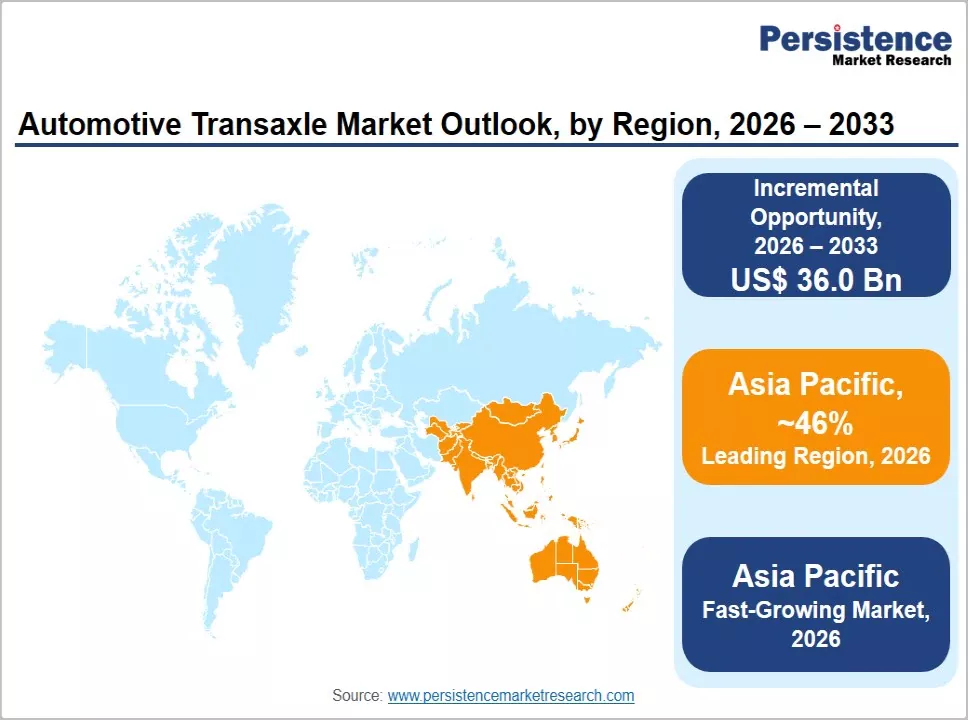
- Asia Pacific is estimated to account for a 46% share of the global market in 2026, supported by the region’s large vehicle production base.
DRO Analysis
Driver: Front Wheel Drive Vehicle Dominance and Powertrain Electrification
The fundamental growth driver for the automotive transaxle market is the wide use of front wheel drive architectures in passenger vehicles and the ongoing shift toward electrified powertrains. A transaxle combines the transmission, differential, and final drive in a single compact unit, which saves space and weight and makes it well suited to transverse-engine passenger cars and crossovers that make up a large share of global vehicle production.
Electrification is reshaping the category rather than displacing it. Hybrid vehicles use transaxle-based designs that integrate electric motors with planetary gear sets and differentials, while battery electric vehicles use compact e-axles that combine motor, reduction gear, and differential. Rising hybrid and electric vehicle output therefore supports demand for integrated drive units, even as traditional multi-speed automatic designs evolve.
Restraint: Shift to Simpler Electric Drivetrains and Cost Pressures
A restraint on the automotive transaxle market is the transition to battery electric vehicles, which generally need simpler single-speed reduction gearing and fewer mechanical components than conventional multi-speed transmissions. As electric vehicle share rises, demand for complex geared transaxles used in internal combustion vehicles may decline, reducing content per vehicle for some suppliers.
Additionally, transaxle manufacturing requires precision machining, heat treatment, and high-volume assembly, exposing suppliers to steel and energy price fluctuations, semiconductor supply constraints for electronically controlled units, and intense pricing pressure from vehicle manufacturers. Investment in new electrified drive units, alongside continued spending on legacy products, also strains supplier capital budgets.
Opportunity: Hybrid Drive Units, E-Axles, and All Wheel Drive Expansion
A significant opportunity lies in the expansion of hybrid transaxles and integrated electric drive units. Vehicle makers are seeking compact, efficient, and cost-effective systems that combine motors, power electronics, and gear reduction, allowing suppliers with electric drive expertise to gain content per vehicle and to serve both hybrid and battery electric platforms.
Growing demand for crossovers and SUVs with all wheel drive capability is also creating opportunity, since transverse-engine platforms increasingly incorporate power transfer units and electrically driven rear axles. Advances in dual-clutch, continuously variable, and multi-speed electric designs, together with lightweight materials and improved efficiency, offer opportunities for suppliers to differentiate through performance and energy savings.
Category-wise Analysis
Variant Insights
Front engine front wheel drive transaxles are projected to hold the largest position in 2026, with an estimated 61% share of the global automotive transaxle market. Their widespread use across compact cars, mid-size vehicles, and family-oriented models reflects efficient underbody packaging, favorable traction characteristics, and established high-volume manufacturing processes.
Rear-mounted transmission configurations associated with front engine rear wheel drive layouts remain concentrated in performance-oriented applications where balanced weight distribution is important. Rear engine rear wheel drive and mid-engine arrangements occupy a specialized niche, primarily serving sports and high-performance vehicles. Meanwhile, all wheel drive transaxles are gaining relevance as crossovers and SUVs increasingly incorporate enhanced traction systems for varied road and weather conditions.
Technology development is also reshaping the variant mix. Hybrid and electrified transaxles are being integrated into established vehicle architectures, increasing the importance of layouts capable of combining mechanical transmission functions with electric motors and associated power electronics.
Operation Insights
Automatic transaxles are expected to command approximately 77% of global demand in 2026, reflecting their strong penetration across passenger vehicles and the increasing availability of advanced transmission technologies. Consumer preference for convenience, smoother shifting, and improved powertrain efficiency continues to support adoption, while dual-clutch and continuously variable systems broaden the range of automatic applications. Most hybrid transaxle architectures also rely on automated operation.
Manual systems continue to serve cost-sensitive applications where lower acquisition costs, mechanical simplicity, and established servicing networks remain relevant. Their presence is comparatively stronger across selected markets in Europe, Asia, Latin America, and Africa, although increasing availability of affordable automatic vehicles is gradually narrowing this base.
The technology mix is likely to shift further toward automated and electrified solutions through 2033. Conventional manual transaxles should remain relevant in entry-level vehicles and enthusiast applications, but their role within new vehicle programs is expected to become more limited as electrification progresses.
Vehicle Type Insights
Passenger cars form the largest application category, representing an estimated 66% of global automotive transaxle demand in 2026. High production volumes of compact cars, mid-size models, and crossovers support this position, particularly where front wheel drive architectures enable efficient use of vehicle space. Increasing hybrid penetration is adding further demand for transaxles designed around electrified powertrains.
Commercial applications are gaining attention through the expansion of light vans, delivery vehicles, and urban fleet platforms. Front wheel drive layouts are common in these applications, while electrified commercial vehicles are creating additional opportunities for integrated transaxle systems as fleet operators expand last-mile delivery and low-emission vehicle deployment.
Regional Insights
Asia Pacific Automotive Transaxle Market Trends
Asia Pacific holds the largest regional position, with an estimated 46% share of the global automotive transaxle market in 2026. Its scale is closely linked to extensive vehicle production across passenger, commercial, hybrid, and new energy vehicle categories. A combination of high-volume domestic demand, export-oriented manufacturing, and established component ecosystems supports sustained transaxle production.
China represents the region's largest individual market, benefiting from substantial conventional and new energy vehicle manufacturing. Japan and South Korea add strength through established transmission suppliers, hybrid powertrain expertise, and advanced automotive engineering. India is also becoming increasingly significant as compact vehicle production expands and consumers adopt automatic transmission options, while Southeast Asia provides additional manufacturing capacity.
The regional technology mix is expected to evolve alongside electrification. Integrated electric drive units, hybrid transaxles, and automated transmission systems should gain greater prominence, while competition is likely to intensify between established global suppliers and rapidly expanding regional manufacturers.
Europe Automotive Transaxle Market Trends
Europe is projected to contribute approximately 24% of global automotive transaxle demand in 2026. The market benefits from a sophisticated automotive manufacturing base, strong premium vehicle production, and extensive engineering capabilities across transmissions and driveline systems. Regulatory requirements surrounding emissions and vehicle efficiency are also accelerating changes in powertrain architecture.
Germany remains a key center for premium vehicle and driveline production, supported by important automotive activity in France, Italy, Spain, and the U.K. Manual transmissions retain a stronger presence in selected European applications than in North America, although automatic, dual-clutch, and hybrid systems continue to expand. Eastern Europe further strengthens the regional supply chain through vehicle and component manufacturing facilities.
The transition toward electrified mobility will increasingly determine the structure of European transaxle demand through 2033. Plug-in hybrids, battery electric platforms, and electric drive units are expected to alter the type of drivetrain content required per vehicle, making technology migration and supplier investment more important than simple production-volume growth.
North America Automotive Transaxle Market Trends
North America is expected to represent around 21% of the global automotive transaxle market in 2026, with demand closely connected to the region's strong crossover, SUV, and light-truck production base. Automatic transmissions dominate vehicle applications, while all wheel drive systems remain relevant across utility-oriented and performance-focused models.
The U.S. generates the largest portion of regional demand, supported by extensive vehicle production and consumer preference for automatic drivetrains. Mexico plays an important role in vehicle and component manufacturing, while Canada contributes through its established automotive production base. Hybrid vehicles are creating additional requirements for dedicated transaxle architectures, alongside specialized demand from performance and mid-engine applications.
Powertrain modernization should remain a central theme through 2033. Hybridization and electrified crossover platforms are expected to influence transaxle requirements, while automakers and suppliers continue adapting manufacturing footprints to support new drivetrain technologies. Investment in localized electric drive and hybrid component production is likely to become increasingly important as vehicle platforms evolve.
Competitive Landscape
The global automotive transaxle market is moderately consolidated, comprising global driveline and transmission suppliers alongside vehicle manufacturers’ in-house drivetrain operations. Key participants include Aisin Corporation, ZF Friedrichshafen AG, Dana Incorporated, GKN Automotive, Magna International Inc., Jatco Ltd, Schaeffler AG, and American Axle & Manufacturing. Competition is shaped by technology capability in automatic and electrified drive units, manufacturing scale, cost competitiveness, and long-term relationships with vehicle manufacturers. Companies continue to invest in hybrid transaxles, integrated e-axles, and lightweight, efficient designs to adapt to the transition toward electrified powertrains.
Key Industry Developments:
- In July 2026, JSW MG Motor India introduced its MG ADAPT architecture in July 2026. The platform supports battery electric, hybrid, plug-in hybrid, and range-extended electric vehicles. Its technologies include a dedicated hybrid transmission and an integrated 10-in-1 electric drive unit, highlighting the growing convergence of conventional transmission functions, electric motors, and power electronics in next-generation drivetrains.
- In February 2026, Valeo announced plans to invest more than €200 million in India in February 2026 under its Elevate 2028 strategy. The investment covers industrial expansion and engineering capabilities, including electric powertrain manufacturing. The company is increasing its capacity to supply automakers transitioning toward electrified drivetrains, supporting demand for integrated electric drive systems.
Companies Covered in Automotive Transaxle Market
- Aisin Corporation
- ZF Friedrichshafen AG
- Dana Incorporated
- GKN Automotive
- Magna International Inc.
- Jatco Ltd
- Schaeffler AG
- American Axle & Manufacturing
- Hyundai Transys
- Tremec
Frequently Asked Questions
The global automotive transaxle market is estimated to reach US$141.2 billion in 2026.
Growth is driven by the dominance of front wheel drive passenger vehicles, rising adoption of hybrid and electric powertrains with integrated drive units, growing demand for automatic transmissions, and expansion of crossover and SUV production.
The automotive transaxle market is projected to grow at a CAGR of 3.3% from 2026 to 2033, reaching approximately US$177.2 billion by 2033.
Expansion of hybrid transaxles and integrated e-axles, growth of all wheel drive crossovers and SUVs, and advances in lightweight and high-efficiency drive unit designs create key opportunities for market participants.
Some of the key market players include Aisin Corporation, ZF Friedrichshafen AG, Dana Incorporated, GKN Automotive, Magna International Inc., Jatco Ltd, Schaeffler AG, and American Axle & Manufacturing.


