




- Automotive Components & Materials
- Automotive Power Window Switch Market
Automotive Power Window Switch Market Size, Share, and Growth Forecast, 2026 - 2033
Automotive Power Window Switch Market by Switch Type (Rocker Switches, Toggle Switches, Push-pull Switches), Sales Channel (Aftermarket, OEM), Vehicle Type (Passenger Car, LCV, HCV), and Regional Analysis for 2026-2033

Automotive Power Window Switch Market Share and Trends Analysis
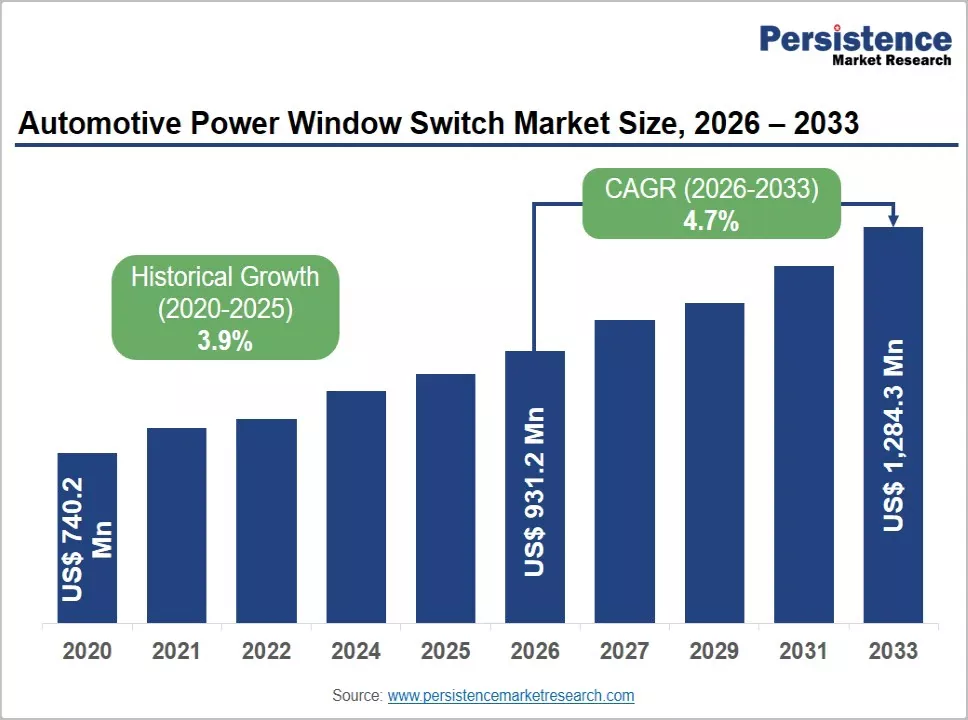
The global automotive power window switch market size is likely to be valued at US$ 931.2 million in 2026 and is estimated to reach US$ 1,284.3 million by 2033, growing at a CAGR of 4.7% during the forecast period 2026−2033.
Rising vehicle production, near-universal adoption of power windows in passenger cars, and growing demand for comfort, convenience, and safety features such as one-touch operation and anti-pinch control are supporting the market. The market has been experiencing steady growth, reflecting mature penetration in developed regions and gradual feature upgrades. However, the forecast period anticipates firmer expansion as emerging markets upgrade from manual windows and automakers integrate window controls into multifunction door modules.
Key Industry Highlights
- Dominant Switch Type: Rocker switches are expected to command around 63% of the revenue share in 2026, while push-pull switches are likely to grow the fastest CAGR of 5.4% through 2033, as premium vehicles adopt one-touch, anti-pinch, and compact control interfaces.
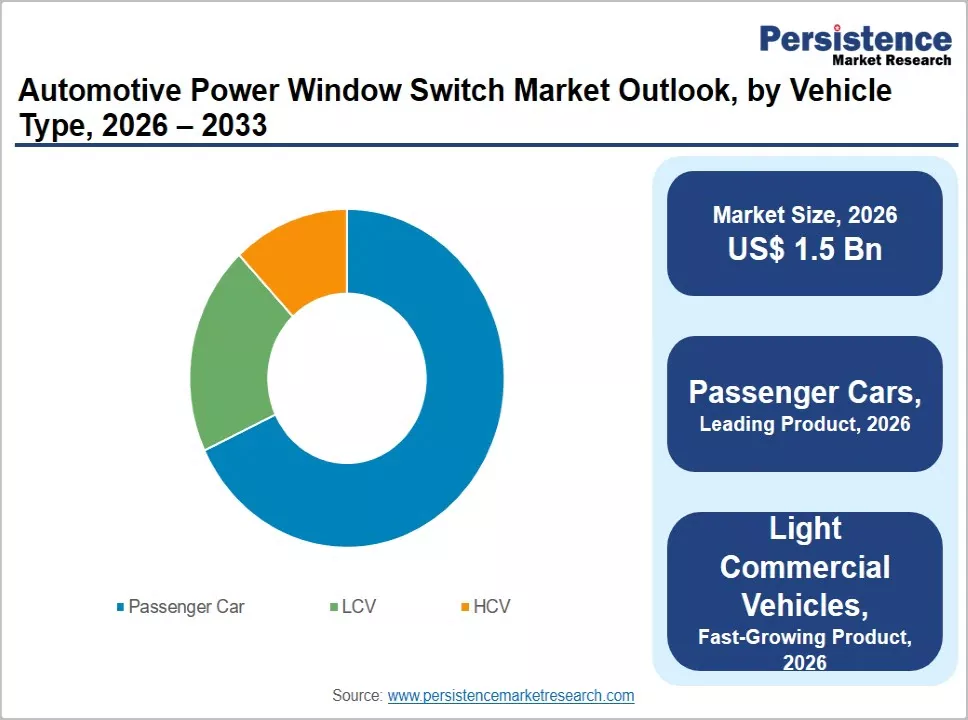
- Leading Vehicle Type: Passenger cars are expected to lead the market with around 71% share in 2026, while light commercial vehicles are likely to be the fastest-growing vehicle type, growing at about 5.3% CAGR between 2026 and 2033, reflecting rising comfort standards in delivery and utility vans.
- Dominant Sales Channel: OEM is anticipated to lead the market with around 78% share in 2026, while the aftermarket is projected to represent the fastest-growing sales channel, expanding at a 5.5% CAGR from 2026 to 2033, supported by high replacement frequency of worn switches.
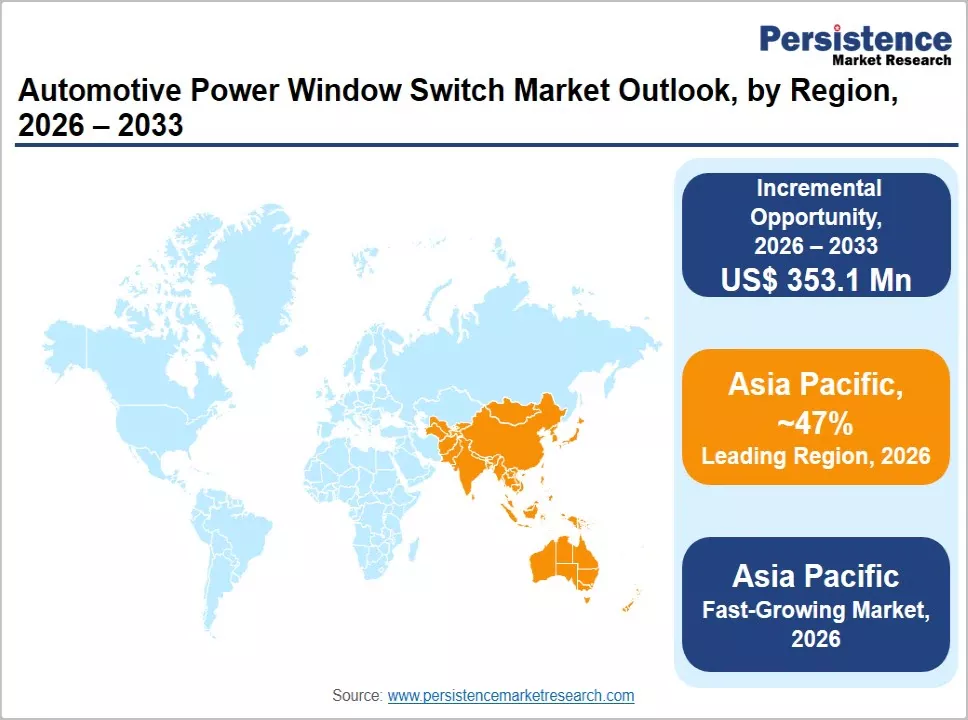
- Regional Leadership: Asia Pacific is poised to dominate the market with an estimated 47% share in 2026, led by vehicle manufacturing in China, India, Japan, and South Korea.
Market Dynamics
Driver: Rising Vehicle Production and Demand for Comfort and Safety Features as Primary Growth Catalyst
Rising vehicle production and demand for comfort and safety features are the leading forces driving the automotive power window switch market growth, as manufacturers equip more vehicles with power windows across all segments. In emerging economies, consumers are upgrading from manual crank windows to electric operation even in entry-level models, which lifts unit demand. Power window switches are also evolving from simple on-off controls into intelligent interfaces that support one-touch up and down, driver master control of all windows, child lock functions, and integration with central locking and remote operation. Window switches are also increasingly designed as part of door-mounted control clusters, which raises the value of each assembly sold to automakers.
Safety regulations and consumer expectations are further supporting growth. Anti-pinch requirements push automakers to use switches and control units that communicate with window motors to detect obstructions and reverse movement, which increases the electronic content of each switch assembly. Advances in sealed switch designs, backlighting, soft-touch materials, and ergonomic layouts improve durability and user experience, while premium and mass-market models alike use more refined door-panel interfaces. Growing vehicle parc and the need to replace worn switches in older cars add stable aftermarket demand throughout the forecast period. Electrified vehicles, which carry comfort features equivalent to those of combustion models, add further volume as global electric vehicle output rises.
Restraint: Mature Penetration, Cost Pressure, and Integration into Multifunction Modules
Mature penetration in developed markets is a key challenge for the automotive power window switch market, as nearly all new passenger cars already include power windows, which limits additional volume growth from feature adoption. Market expansion therefore depends largely on vehicle production growth, emerging-market upgrades, and higher electronic content per switch. Cost pressure from automakers is intense, with annual price reduction expectations and global sourcing strategies that squeeze supplier margins, particularly for standard rocker and toggle switches with limited differentiation. Suppliers must therefore find growth in content upgrades rather than relying on higher unit penetration alone.
The integration of window controls into multifunction door modules and domain controllers also reshapes the competitive landscape. As automakers consolidate door functions such as mirrors, locks, and windows into a single control unit, discrete switch demand can be affected, and suppliers must adapt by offering integrated modules. In addition, quality and reliability concerns in low-cost aftermarket switches, including counterfeit parts and inconsistent contact performance, can damage consumer confidence and increase warranty claims, while fluctuations in prices of copper, silver contacts, and plastics add uncertainty to supplier cost structures.
Opportunity: Smart Door Modules, Emerging Market Upgrades, and Aftermarket Replacement Demand
Smart door modules and advanced user interfaces represent a significant opportunity, as automakers seek to deliver more intuitive control layouts that combine window, mirror, lock, and seat memory functions. Suppliers able to provide integrated switch panels with LIN or CAN communication, ambient lighting, and diagnostic capabilities can increase content per vehicle and secure longer platform contracts. Touch-sensitive and haptic interfaces are also being introduced in premium vehicles, creating room for technology differentiation and higher-value products. Premium trims frequently add lighting, soft-touch coatings, and metal-look finishes, which raise average selling prices.
Emerging market upgrades and aftermarket replacement offer further prospects. Countries in South Asia, Southeast Asia, Latin America, and Africa continue to see growth in vehicle ownership and rising feature penetration, supporting volume expansion for cost-effective switches. In the aftermarket, the large and ageing vehicle fleet creates recurring demand, as frequently used driver-side switches wear out over time. Distributors are widening catalogues, improving online part identification, and offering switch and regulator kits, enabling workshops and do-it-yourself customers to complete repairs quickly and affordably.
Category-wise Analysis
Switch Type Insights
Rocker switches are the leading switch type segment, expected to hold about 63% share of the automotive power window switch market in 2026. They are widely used for their simple operation, ergonomic design, and compatibility with one-touch functionality. Rocker switches are easily integrated into door armrests and master switch panels, and suppliers offer a broad range of illumination and finish options to match interior themes. Standardized designs and large production volumes also help keep costs low, supporting adoption in both economy and mid-range vehicles.
Push-pull switches represent the fastest-growing switch type segment through 2033, expanding at an estimated 5.4% CAGR. Their compact form and tactile feedback, along with intuitive pull-up and push-down operation, are favored in newer designs that prioritize safety and ergonomics, since the pull-to-close action reduces the risk of accidental closing. Toggle switches continue to serve commercial vehicles, off-road applications, and basic passenger models where robustness, simple mechanical operation, and low cost are valued. Sealing improvements and gold-plated or sealed contacts are being used to extend the life of toggle and rocker designs in harsh environments.
Vehicle Type Insights
Passenger cars dominate the vehicle type segment, projected to capture about 71% of the revenue share in 2026. High global production volumes and the near-universal availability of power windows make this the primary demand center. Most passenger cars use multiple switches, including a driver master panel and individual door switches, which increases switch count per vehicle. Premium vehicles add backlighting, soft-touch materials, and integrated memory functions, while compact models focus on cost-effective designs that meet safety and durability requirements. Vehicle platforms with four doors and rear window controls require additional switches, which further supports demand in this segment.
Light commercial vehicles represent the fastest-growing vehicle type segment, anticipated to register a 5.3% CAGR during the 2026–2033 period. Vans, pickups, and small trucks used for delivery and service are increasingly equipped with power windows to improve driver comfort and productivity. Heavy commercial vehicles form a stable niche where durability, sealing against dust and moisture, and resistance to vibration are critical, and switch designs emphasize robust housings and longer mechanical life under demanding duty cycles.
Sales Channel Insights
The OEM channel leads the sales channel segment, expected to account for an estimated 78% share in 2026. Switches are specified during vehicle development and supplied through multi-year programs, with suppliers working closely with automakers on design, quality, and integration. OEM demand benefits from large production volumes and the growing electronic content of switch assemblies, although annual price reductions and strict validation requirements keep the competitive environment demanding.
The aftermarket is the fastest-growing sales channel, projected to expand at about 5.5% CAGR through 2033. Window switches are among the more frequently replaced interior electrical parts, since the driver-side switch is used heavily and is exposed to moisture and wear. Rising average vehicle age and growing independent repair networks support demand, while e-commerce platforms improve availability of both genuine and compatible parts. Suppliers are expanding coverage for newer vehicles and offering improved sealing and contact quality to differentiate from low-cost alternatives. Distributors also benefit from steady replacement cycles across popular vehicle models that remain on the road for many years.
Regional Analysis
North America Automotive Power Window Switch Market Trends
North America is expected to hold about 19% share of the automotive power window switch market in 2026. The U.S. provides the regional growth anchor, supported by high sales of pickups, SUVs, and light trucks that carry full power-window packages and multiple door switches. The country has one of the largest and oldest vehicle fleets in the world, creating a substantial aftermarket for replacement switches and related window components, supported by wide distribution networks and strong do-it-yourself culture. Replacement switches are commonly sold through national auto parts retailers, online marketplaces, and independent repair shops.
Canada contributes to the market through its vehicle fleet and cold-climate conditions that accelerate wear on door switches. The North America market is characterized by competition among global interior electronics suppliers and aftermarket brands, with growing attention to sealed switch designs, anti-pinch compatibility, and the integration of window controls with advanced door modules.
Europe Automotive Power Window Switch Market Trends
Europe is likely to hold about 22% share of the global market in 2026. The region has a strong base of premium automakers and tier-one interior suppliers, which encourages advanced switch interfaces featuring backlighting, soft-touch surfaces, and integrated electronics. Germany leads regional demand through premium vehicle manufacturing, while France, Italy, Spain, and the United Kingdom contribute through compact and mid-size vehicle production. Safety and quality standards support the use of anti-pinch compatible, long-life switch designs.
The Europe market is characterized by the early adoption of multifunction door modules, touch and haptic interfaces in premium segments, and a growing share of electrified vehicles that carry the same comfort features as combustion models. Eastern European countries, including Poland, Czech Republic, Slovakia, and Hungary, are growing as component manufacturing locations due to competitive costs and proximity to assembly plants. A mature independent aftermarket supports steady replacement sales across the region. Sustainability goals also encourage suppliers to use recycled plastics and reduce hazardous substances in switch construction.
Asia Pacific Automotive Power Window Switch Market Trends
Asia Pacific is anticipated to lead the global automotive power window switch market by commanding around 47% share in 2026. China provides the dominant regional growth engine as the largest vehicle producer, with a deep domestic supplier base and strong demand from electric and conventional vehicle programs. Japan and South Korea contribute advanced interior electronics and strong export-oriented vehicle production, with leading suppliers offering sophisticated switch and door module solutions.
India is expected to offer particularly dynamic opportunities, driven by rising passenger car production, increasing feature penetration in entry-level models, and expansion of domestic component manufacturers. Southeast Asian countries such as Thailand and Indonesia are important production hubs for passenger vehicles and pickups, supporting demand for cost-effective and durable switches. The large regional vehicle fleet and expanding repair networks also sustain a significant aftermarket for replacement power window switches. Government incentives for domestic manufacturing and localization are encouraging new switch and interior electronics plants in the region.
Competitive Landscape
The global automotive power window switch market structure is fragmented, with a mix of global tier-one interior electronics suppliers and regional specialists. Leading players, including Robert Bosch GmbH, Alps Alpine Co., Ltd., Tokai Rika Co., Ltd., and Marquardt Group, leverage long-standing OEM relationships, in-house electronics design, and global manufacturing footprints. They invest in R&D to advance sealed switch technologies, haptic and touch interfaces, and integration with door control modules. Suppliers also leverage scale in electronic components to offer integrated door panels that include window, mirror, and lock controls.
Regional and aftermarket-focused competitors such as Standard Motor Products, Inc., Dorman Products, Inc., and Methode Electronics, Inc. concentrate on replacement parts, customized solutions, and cost-efficient supply for specific vehicle platforms. Barriers such as stringent automotive quality standards, validation costs, and long program cycles limit new entrants in the OEM channel, while low-cost manufacturers remain active in the aftermarket. Consolidation is expected to continue gradually as suppliers seek scale and technology breadth in interior electronics.
Key Industry Development
- In 2026, ACDelco released 63 new Professional window regulator and motor part numbers for GM and non-GM models, including 10 smart motors that support auto up/down and anti-pinch functions.
Global Automotive Power Window Switch Market Report – Key Insights & Details
| Key Insights | Details |
|---|---|
| Historical Market Value (2020) | US$ 740.2 Mn |
| Current Market Value (2026) | US$ 931.2 Mn |
| Projected Market Value (2033) | US$ 1,284.3 Mn |
| CAGR (2020-2025) | 3.9% |
| CAGR (2026-2033) | 4.7% |
| Leading Region | Asia Pacific, 47% |
| Dominant Switch Type | Rocker Switches, 63% |
| Top-ranking Vehicle Type | Passenger Car, 71% |
| Incremental Opportunity | US$ 353.1 Mn |
Companies Covered in Automotive Power Window Switch Market
- Robert Bosch GmbH
- Alps Alpine Co., Ltd.
- Tokai Rika Co., Ltd.
- Marquardt Group
- Methode Electronics, Inc.
- Preh GmbH
- ZF Friedrichshafen AG
- Lear Corporation
- Hyundai Mobis Co., Ltd.
- Standard Motor Products, Inc.
- Dorman Products, Inc.
Frequently Asked Questions
The global automotive power window switch market is projected to reach US$ 931.2 million in 2026.
Rising vehicle production, growing adoption of power windows in entry-level models, and demand for comfort and safety features such as one-touch and anti-pinch operation are driving the market.
The market is poised to witness a CAGR of 4.7% from 2026 to 2033.
Smart door modules, emerging market feature upgrades, and aftermarket replacement demand are key market opportunities.
Robert Bosch GmbH, Alps Alpine Co., Ltd., Tokai Rika Co., Ltd., and Marquardt Group are some of the key players in the market.


