




- Automotive Components & Materials
- Automotive Dyno Meter Market
Automotive Dyno Meter Market Size, Share, and Growth Forecast, 2026 - 2033
Automotive Dyno Meter Market by Dyno Type (Engine, Chassis, Powertrain, Electric Motor & E-Axle), Vehicle Type (Hatchback/Sedan, SUV, LCV, HCV), and Regional Analysis for 2026 - 2033

Automotive Dyno Meter Market Size and Trends Analysis
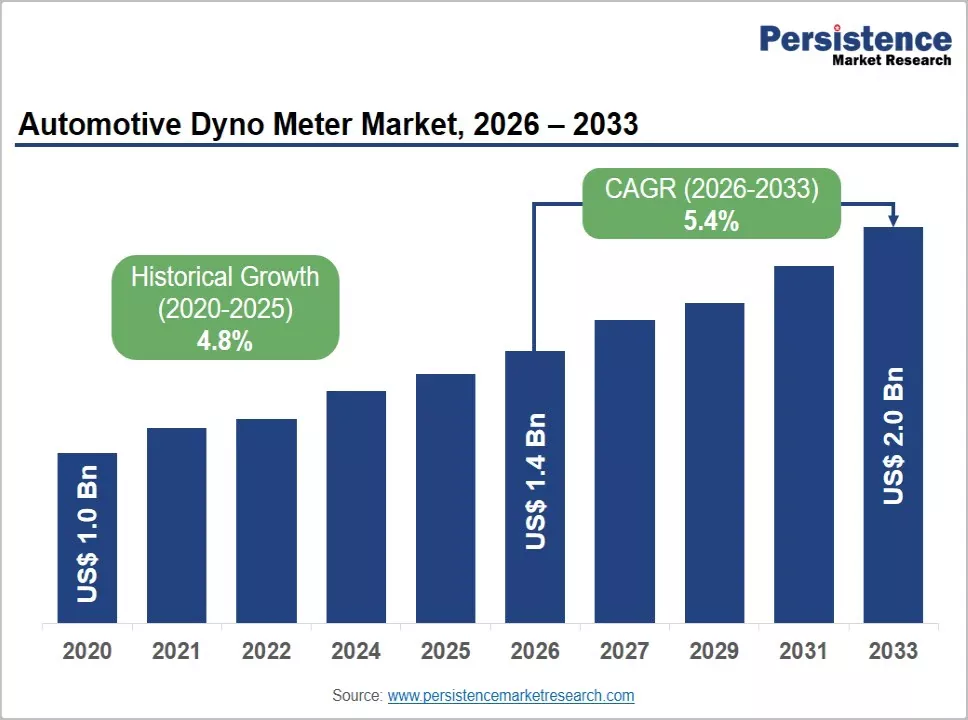
The global automotive dyno meter market size is likely to be valued at US$1.4 billion in 2026 and is expected to reach US$2.0 billion by 2033, growing at a CAGR of 5.4% during the forecast period from 2026 to 2033, driven by the growing need for accurate vehicle performance measurement, emissions compliance, fuel-efficiency validation, and powertrain durability testing.
Demand is also expanding as automakers develop electric and hybrid vehicles that require specialized dyno meters for testing electric motors, batteries, and e-axles.
Key Industry Highlights:
- Leading Region: Asia Pacific is anticipated to be the leading region, accounting for a market share of 40% in 2026, driven by automotive manufacturing scale, electric vehicle adoption, and expanding vehicle testing infrastructure.
- Fastest-growing Region: North America is likely to be the fastest-growing region, supported by advanced automotive R&D infrastructure, emissions testing requirements, and investment in electric and hybrid powertrain validation.
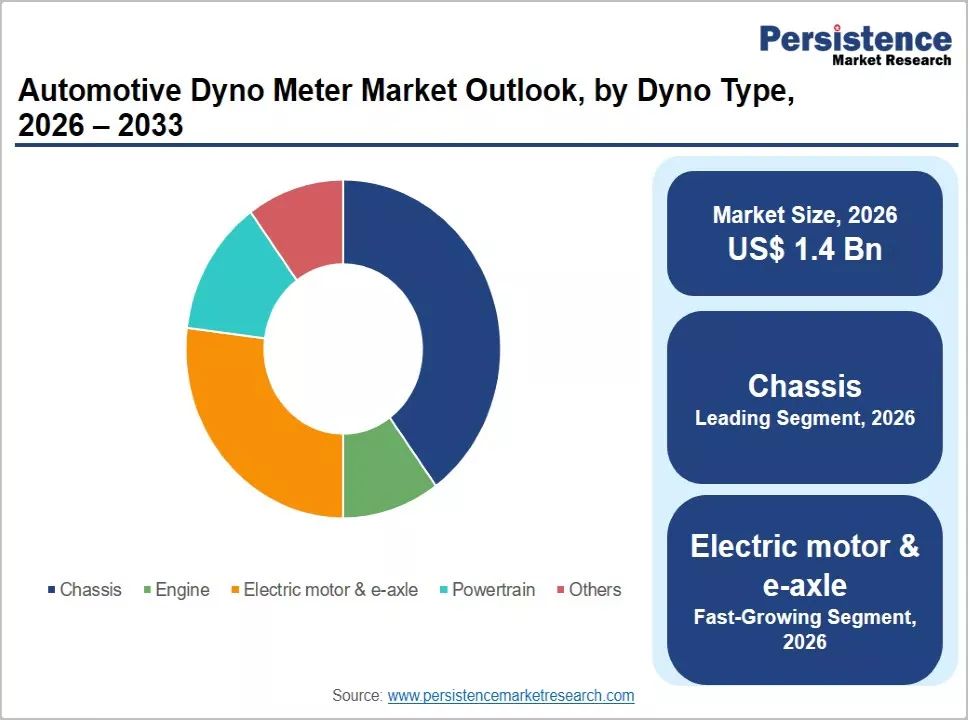
- Leading Dyno Type: Chassis dyno meters are projected to represent the leading dyno type in 2026, accounting for 50% of the revenue share, for demand for full-vehicle performance, emissions, and fuel-economy testing.
- Leading Vehicle Type: Hatchback/Sedan is anticipated to be the leading vehicle type, accounting for over 40% of the revenue share in 2026, supported by high production volumes and extensive performance and emissions testing requirements.
- Key Opportunity: Growing demand for integrated electric powertrain testing, advanced vehicle simulation, and automated performance validation presents significant opportunities for automotive dyno meter manufacturers across conventional, hybrid, and electric vehicles.
DRO Analysis
Driver - Stringent Emissions and Fuel-Economy Regulations
Stricter emissions and fuel-economy regulations are driving demand for advanced automotive dyno meters by increasing the need for accurate vehicle testing and validation. Regulatory authorities require automakers to assess pollutant emissions, fuel consumption, engine performance, and compliance under standardized driving conditions. Chassis dyno meters help replicate road conditions in controlled laboratory environments, while engine dyno meters support precise measurement of torque, power output, and combustion efficiency.
These systems enable manufacturers to identify performance deficiencies, optimize engine calibration, and validate emission-control technologies before vehicles enter commercial production. Consequently, automotive testing facilities continue to invest in reliable, high-precision dyno meter equipment. The expansion of regulatory testing requirements also encourages automotive manufacturers to upgrade existing test facilities with automated measurement systems and advanced data acquisition software.
In major automotive markets, compliance frameworks influence vehicle development cycles and increase the importance of repeatable testing procedures. Dyno meters help manufacturers evaluate powertrain performance across operating speeds, loads, and temperatures while reducing dependence on costly road testing. Their integration with emissions analyzers and vehicle simulation technologies improves testing accuracy and efficiency.
Restraint - Long Equipment Life Cycles and Replacement Inertia
Automotive manufacturers and testing laboratories may continue using existing dyno meters when they still meet core testing requirements, even if newer platforms offer improved automation, accuracy, or software capabilities. Replacing equipment can require significant capital expenditure, facility modifications, staff retraining, and temporary test-cell downtime. These considerations encourage buyers to defer replacement until systems become unreliable, fail to support new vehicle architectures, or no longer satisfy updated testing standards.
Replacement decisions are also complicated by the need to preserve validated procedures, historical test data, and compatibility with existing measurement software. A laboratory may need to requalify equipment and workflows after installing a new dyno meter, adding time and cost to the transition. Where systems can be upgraded through new sensors, controls, or software, buyers may choose incremental improvements instead of complete replacement.
Opportunity - Electric-Motor and E-Axle Testing Systems
Electric-motor and e-axle testing systems present a significant opportunity as automakers expand electric and hybrid vehicle development. Unlike conventional engine testing, electrified powertrains require precise evaluation of motor speed, torque, inverter interaction, thermal behavior, energy losses, and regenerative operation. Specialized dyno meters can reproduce demanding operating conditions and support efficiency mapping across different loads and speeds.
E-axle test systems also allow integrated assessment of motors, transmissions, and power electronics before installation in vehicles. As manufacturers introduce new electric-drive architectures, demand is increasing for high-speed, bidirectional test equipment and control software that can deliver repeatable measurements during design, calibration, and durability validation. Suppliers can strengthen this opportunity by developing flexible dyno meter platforms that accommodate different motor ratings, voltage levels, and e-drive configurations.
Integration with battery simulators, inverters, thermal management equipment, and automated analytics can help laboratories assess electric powertrains efficiently. Modular designs are useful for engineering centers that must test hybrid components and fully electric systems as product portfolios evolve. Automotive suppliers, universities, independent laboratories, and original equipment manufacturers may all require these capabilities for research and validation.
Category-wise Analysis
Dyno Type Insights
Chassis dyno meters are expected to lead, accounting for 50% of revenue in 2026, due to their ability to evaluate complete vehicle performance under simulated road conditions. These systems support emissions testing, fuel-economy assessment, drivability evaluation, and power measurement across different vehicle configurations. Automotive manufacturers use chassis dyno meters to validate vehicle calibration and assess performance before commercial production. HORIBA Ltd. provides chassis dyno meter systems for automotive emissions and performance testing.
Electric motor and e-axle dyno meters are likely to represent the fastest-growing segment, supported by increasing electric and hybrid vehicle development. These systems evaluate torque, rotational speed, power output, efficiency, and thermal behavior under controlled operating conditions. Unlike conventional engine testing equipment, electric-drive dyno meters must accommodate high-speed operation, bidirectional power flow, and regenerative braking characteristics.
Vehicle Type Insights
Hatchback/Sedan is projected to lead the market, capturing around 40% of the revenue share in 2026, supported by their widespread production and extensive testing requirements. Automakers use dyno meters to assess engine output, wheel power, acceleration characteristics, fuel efficiency, emissions performance, and drivetrain durability. These tests help engineers optimize vehicle calibration and verify compliance with applicable performance and environmental standards. For instance, AVL List GmbH provides automotive testing solutions for passenger vehicle development and performance validation.
SUVs are likely to be the fastest-growing vehicle type, due to rising demand for sport utility vehicles and increasingly complex powertrain configurations. Their heavier vehicle platforms, all-wheel-drive systems, and diverse engine options can require specialized testing procedures to assess power delivery, traction, drivability, and durability. Electrification is further expanding testing requirements as manufacturers introduce hybrid and battery-electric SUVs.
Regional Insights
North America Automotive Dyno Meter Market Trends
North America is likely to be the fastest-growing region, driven by automotive R&D investments, powertrain electrification, emissions validation, and vehicle performance testing. Dyno meters are increasingly required to evaluate electric motors, inverters, e-axles, and complete vehicles. For example, in February 2026, DEKRA introduced e-motor, inverter, and integrated e-axle dyno meter testing at its Michigan facility, strengthening regional EV testing capabilities.
U.S. Automotive Dyno Meter Market Trends
The U.S. is expected to dominate the regional market, accounting for approximately 80% of the market share in 2026, driven by vehicle engineering, powertrain development, and emissions testing requirements. Automakers and component suppliers use dyno meters to evaluate torque, power output, durability, and energy efficiency. EV development is increasing demand for specialized electric powertrain testing.
Canada Automotive Dyno Meter Market Trends
Canada is likely to be a significant market for automotive dyno meter, holding approximately 20% of the market share in 2026, supported by automotive research, vehicle testing, and electric mobility development. Testing facilities help manufacturers assess powertrain efficiency and component durability. Electric and hybrid vehicle development is creating opportunities for specialized dyno meters. The University of Waterloo's Green and Intelligent Automotive facility includes a powertrain test cell with three 300-kW dyno meters.
Europe Automotive Dyno Meter Market Trends
Europe is likely to be a significant market for automotive dyno meters in 2026, due to powertrain innovation, emissions compliance, vehicle efficiency improvements, and electric mobility. Manufacturers require advanced testing systems to validate conventional, hybrid, and electric vehicles. In January 2025, Hyundai Motor Group announced an expansion of its European R&D facilities, including improvements to its Nürburgring test center for future electric and high-performance vehicles.
U.K. Automotive Dyno Meter Market Trends
The U.K. is likely to be a significant market for automotive dyno meters, accounting for 15% of Europe market share in 2026, supported by automotive engineering, vehicle performance development, and electrification research. Dyno meters help evaluate electric motors, transmissions, and complete vehicle powertrains under repeatable operating conditions. Demand is reinforced by the development of electric and hybrid vehicle technologies.
Germany Automotive Dyno Meter Market Trends
Germany is anticipated to dominate the regional market, accounting for around 37% of the Europe market share in 2026. Dyno meters are used to assess powertrain performance, energy consumption, emissions, and durability. The development of electric and hybrid vehicles is expanding demand for electric-drive testing equipment. HORIBA operates an automotive test center in Oberursel equipped with a chassis dyno meter and exhaust gas analysis systems.
Asia Pacific Automotive Dyno Meter Market Trends
The Asia Pacific region is expected to lead the market, accounting for a 40% share in 2026. High vehicle production, expanding electric vehicle manufacturing, and investments in automotive testing infrastructure are expected to drive regional growth. China and India remain important markets for validating advanced powertrain technologies. In September 2026, India's Ministry of Heavy Industries reported upgrades to automotive testing infrastructure under the PM E-DRIVE scheme, supporting the testing of electric vehicles, powertrains, emissions, and safety systems.
China Automotive Dyno Meter Market Trends
China is projected to dominate the regional market, holding around a 30% share of the market in 2026, due to large-scale vehicle manufacturing and rapid electric vehicle development. Dyno meters are essential for measuring motor power, torque, efficiency, and powertrain durability. Multi-motor electric vehicles are creating demand for more specialized testing systems.
India Automotive Dyno Meter Market Trends
India is expected to emerge as a significant market, accounting for approximately a 22% share in 2026. India's market is gaining momentum from electric vehicle adoption, automotive component development, and government-backed testing infrastructure. Dyno meters support performance validation for electric motors, batteries, transmissions, and complete powertrains. Research into alternative electric motor technologies is also creating new testing requirements.
Competitive Landscape
The global automotive dyno meter market exhibits a moderately fragmented competitive landscape, driven by rising vehicle testing requirements, powertrain electrification, emissions compliance, and the need for precise performance measurement. The market includes established testing technology providers and specialized dyno meter manufacturers catering to automotive original equipment manufacturers, component suppliers, research institutions, and performance testing facilities.
Key players include AVL List GmbH, HORIBA Ltd., Mustang Dyno, MAHA Maschinenbau Haldenwang GmbH & Co. KG, and SAKOR Technologies. Competition spans engine, chassis, hub, and electric powertrain dyno meters, with manufacturers focusing on product innovation, measurement precision, customized testing solutions, advanced automation software, and compatibility with conventional, hybrid, and electric vehicle platforms.
Key Industry Developments:
- In February 2026, DEKRA launched e-motor, inverter, and integrated e-axle dyno meter testing at its Automotive Test Center of Excellence in Plymouth, Michigan. The facility combines battery simulation with high-speed, high-torque dyno meters for electric powertrain validation.
- In October 2026, SuperFlow introduced the Stuska TrackPack Universal Test Stand, an engine dyno meter designed for engine builders, research and development facilities, and performance testing applications. It combines a water-brake dyno meter with WinDyn 5 data acquisition and control technology.
Companies Covered in Automotive Dyno Meter Market
- AVL List GmbH
- HORIBA Ltd.
- Mustang Advanced Engineering
- Dynojet Research
- SuperFlow Technologies
- SAKOR Technologies
- Rototest
- Meidensha Corporation
- Froude Hofmann
- Power Test Inc.
Frequently Asked Questions
The global automotive dyno meter market is projected to reach US$1.4 billion in 2026.
Increasing vehicle production, stringent emissions testing requirements, and growing electric vehicle powertrain development drive the automotive dyno meter market.
The automotive dyno meter market is expected to grow at a CAGR of 5.4% from 2026 to 2033.
Expanding demand for electric motor and e-axle testing, advanced vehicle simulation, and automated powertrain validation creates key market opportunities.
AVL List GmbH, HORIBA Ltd., Mustang Advanced Engineering, and Dynojet Research are the leading players.


