Assisted Reproductive Technology Market Size, Share, Growth, and Regional Forecast, 2026 - 2033

Assisted Reproductive Technology Market by Technique (In Vitro Fertilization (IVF), Intracytoplasmic Sperm Injection (ICSI), Frozen Embryo Transfer (FET), Intrauterine Insemination (IUI)), Procedure, End-user, and Regional Analysis from 2026 - 2033

ID: PMRREP34642
Calendar

December 2025

200 Pages

Author : Vaishnavi Patil

Key Industry Highlights

  • In vitro fertilization (IVF) remains the most widely adopted ART procedure, followed by ICSI, cryopreservation, and GIFT/ZIFT procedures.
  • Innovations like time-lapse embryo imaging, AI-based embryo selection, microfluidic sperm sorting, and cryopreservation techniques enhance ART success rates and patient outcomes.
  • ART services are primarily offered through fertility clinics, hospitals, and research institutes. Fertility clinics dominate due to specialization in ART procedures, while hospitals and multi-specialty centers provide complementary reproductive services.
  • Research institutions contribute via experimental treatments and advanced technology validation.
  • Intracytoplasmic Sperm Injection (ICSI) accounts for the highest share among ART procedures because it significantly improves fertilization outcomes, especially in male-factor infertility cases.
Key Insights Details

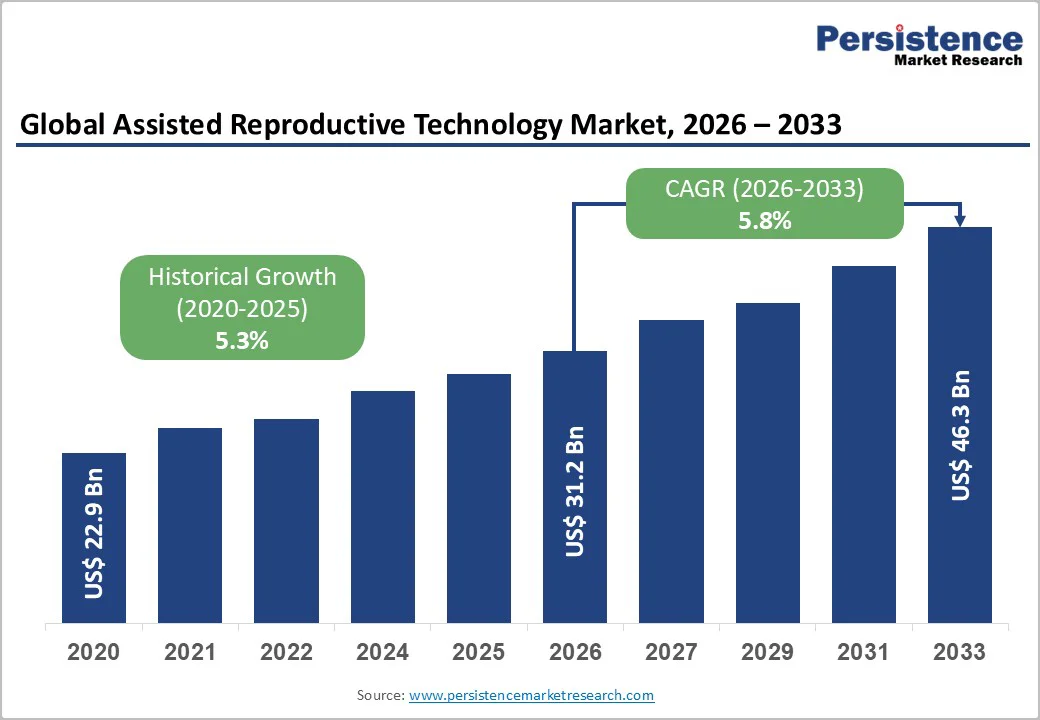
Assisted Reproductive Technology Market Size (2026E) 

US$31.2 Bn 

Market Value Forecast (2033F) 

US$46.3 Bn

Projected Growth (CAGR 2026 to 2033) 

5.8% 

Historical Market Growth (CAGR 2020 to 2024) 

5.3% 

global-assisted-reproductive-technology-market-2026-2033

Market Dynamics

Driver - Growing Adoption of Elective Egg Freezing

The growing adoption of elective egg freezing has emerged as a major driver as more women choose to preserve their fertility proactively. This trend is strongly associated with changing societal dynamics, where women are increasingly prioritizing career advancements, higher education, and financial independence before planning a family. Elective oocyte cryopreservation offers the assurance of using younger, healthier eggs later in life, improving chances of successful conception beyond natural reproductive decline. Technological advancements such as vitrification techniques have improved egg survival rates post-thawing, making the procedure more reliable and clinically acceptable.

Additionally, shifting cultural attitudes toward delayed parenthood, rising age of first-time pregnancies, and awareness campaigns by fertility clinics have increased acceptance of elective egg freezing. The availability of corporate reimbursement programs, especially among multinational companies, further makes this option financially feasible. As fertility preservation becomes part of preventive reproductive planning, women increasingly consider egg freezing as an empowerment tool that supports reproductive autonomy, improves family planning flexibility, and enhances long-term fertility outcomes, thereby accelerating ART market adoption worldwide.

Restraints - Limited Gamete Availability for Donor Programs

Limited gamete availability remains one of the most critical restraints within the assisted reproductive technology (ART) market. Obtaining qualified egg and sperm donors involves stringent screening protocols, including genetic testing, infectious disease screening, age criteria, lifestyle evaluation, and psychological counselling. Due to these strict eligibility guidelines, the pool of acceptable donors becomes significantly smaller. Moreover, donor recruitment is highly dependent on awareness, social acceptance, and compensation policies, which vary widely across regions. Cultural stigma, privacy concerns, and fear of identity disclosure discourage many potential donors, particularly in Asian, Middle Eastern, and conservative societies. Limited diversity in donors further limits suitability, especially for patients seeking specific ethnic, phenotypic, or hereditary matches.

Availability constraints often prolong treatment timelines, increase waiting periods, and compel patients to shift clinics or countries for better donor access. For single women, LGBTQ+ couples, and cross-border patients, dependency on donor gametes is even higher, leading to rising treatment delays and higher costs. Additionally, regulatory restrictions on donor anonymity and the number of offspring per donor further reduce donor accessibility, ultimately affecting ART cycle volume and success rates.

Opportunity - Fertility Preservation Services for Oncology Patients

Fertility preservation for oncology patients is emerging as one of the most significant growth opportunities in the assisted reproductive technology (ART) market. Rising cancer survival rates among adolescents and young adults have made safeguarding long-term reproductive potential a critical aspect of comprehensive oncology care. Treatments such as chemotherapy, radiation, and stem-cell transplants often cause irreversible gonadal damage, driving strong demand for pre-treatment preservation options, including sperm banking, oocyte freezing, embryo cryopreservation, and ovarian tissue banking.

A key driver of this opportunity is the adoption of AI-powered fertility assessment and workflow automation. Advanced tools now enable rapid ovarian reserve analysis, gamete viability prediction, and personalized optimization of stimulation protocols for urgent oncology timelines, while supporting quality control in cryopreservation labs. For example, in September 2025, Hanahealth, the IVF arm of DSS Imagetech, partnered with South Korea’s Kai Health introduced its AI-based embryo assessment tool, Vita Embryo, to IVF labs across India, highlighting how AI can improve efficiency, accuracy, and patient outcomes in fertility preservation.

Globally, healthcare systems are recognizing the emotional and psychological importance of enabling biological parenthood post-recovery. Developed countries increasingly offer insurance support for onco-fertility, while emerging markets are establishing dedicated fertility preservation units in cancer hospitals, creating a favorable environment for market expansion and innovation.

Category-wise Analysis

By Technique Insights

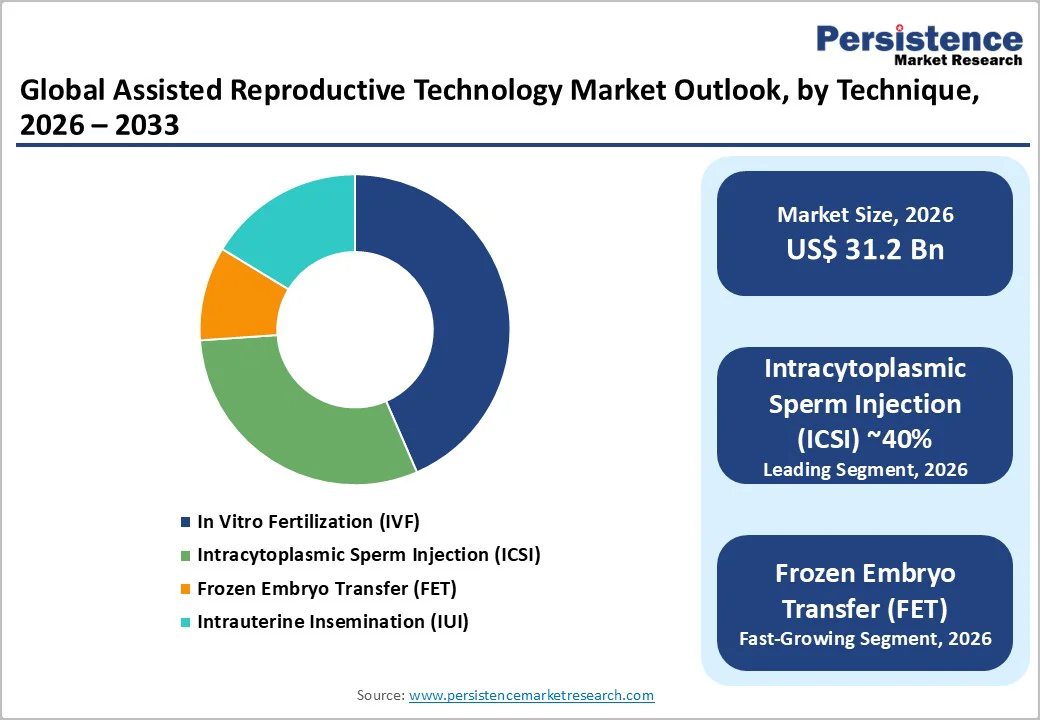
Intracytoplasmic Sperm Injection (ICSI) accounts for the highest share because it directly addresses a major cause of infertility, male-factor issues, which represent a significant proportion of ART cases globally. Unlike conventional IVF, which depends on natural sperm-egg interaction, ICSI allows embryologists to manually inject a single healthy sperm into the egg, dramatically improving fertilization likelihood even when sperm count, motility, or morphology is poor. Additionally, ICSI is routinely used for couples with past IVF failures, low ovarian reserve, older maternal age, unexplained infertility, or poor embryo development, making it widely applicable across patient categories. Clinics often prefer ICSI because it increases the predictability of outcomes and optimizes success rates per retrieval cycle. ICSI also ensures the creation of multiple embryos, enabling future frozen transfer cycles, which further increases procedural volume. These clinical advantages, coupled with patient expectations for higher success probability in a single attempt, have led ICSI to dominate the ART market share.

By End-user Insights

Fertility clinics account for the highest share because they operate as highly specialized centers dedicated solely to reproductive treatment pathways, unlike hospitals that juggle multiple clinical priorities. These clinics offer end-to-end services, including diagnostics, IVF stimulation cycles, embryology labs, genetic screening, counselling, and cryopreservation under one integrated setup, which attracts higher patient volumes. Their infrastructure is optimized specifically for IVF workflows, ensuring better cycle monitoring, faster turnaround, and personalized clinical attention. Fertility clinics also invest heavily in embryology technology, incubators, culture media, and digital tracking systems, leading to higher perceived success rates. Additionally, most infertility treatments are elective, privately paid, and time-sensitive; patients prefer clinics providing confidentiality, flexible appointments, and transparent cost plans. Rapid expansion of private IVF networks globally has further reinforced their dominant share.
global-assisted-reproductive-technology-market-outlook-by-technique-2026-2033

Region-wise Insights

North America Assisted Reproductive Technology Market Trends

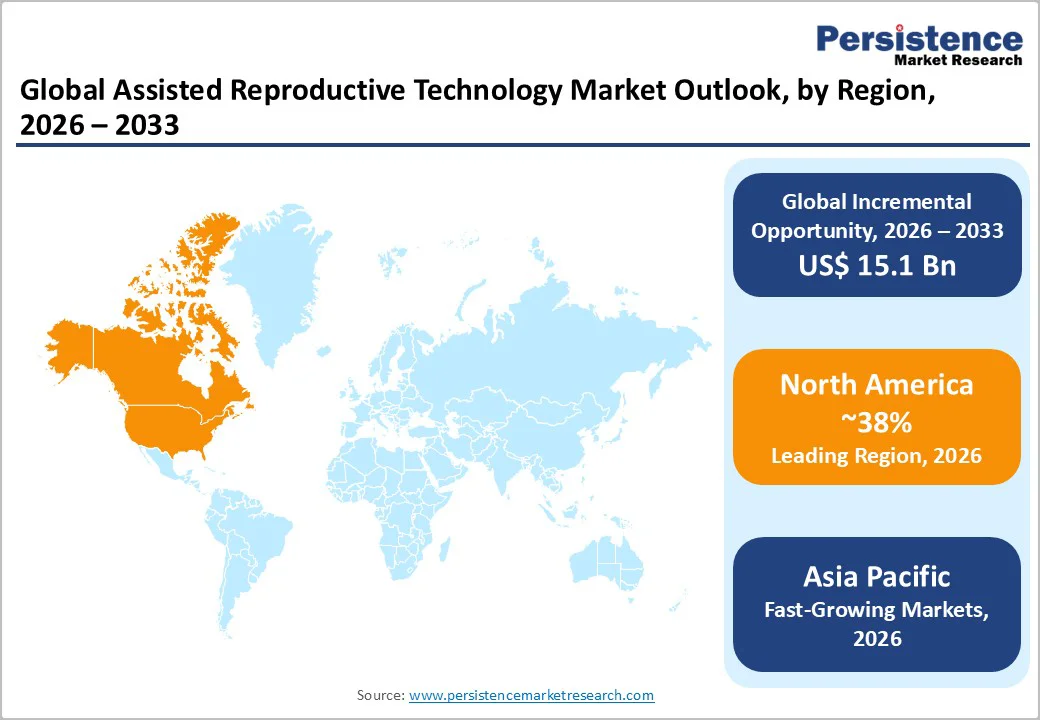
North America leads the global assisted reproductive technology (ART) market due to its advanced healthcare infrastructure, high patient awareness, and well-established fertility clinic networks. The United States, the region’s largest contributor, reports over 430,000 ART cycles annually, resulting in nearly 96,000 births, representing around 2–3% of all national births. Growth is driven by rising infertility rates, delayed parenthood, and increased social acceptance of fertility treatments. Advanced practices such as egg freezing, fertility preservation for medical conditions, and preimplantation genetic testing are increasingly adopted.

Additionally, corporate health plans covering ART procedures, combined with innovations in embryo culture, lab automation, and AI-assisted embryo selection, enhance treatment success and accessibility. The focus on personalized, patient-centric fertility solutions strengthens the U.S.’s leadership role, making North America the most developed and influential region in the global ART landscape.

Europe Assisted Reproductive Technology Market Trends

Europe continues to show robust growth and uptake of assisted reproductive technology (ART), underpinned by extensive data from governmental and professional registries. According to European Society of Human Reproduction and Embryology (ESHRE) data, in 2021 there were 1,103,633 ART treatment cycles up ~20% from 2020 across 37 European countries. In 2022, among the 960,347 cycles reported from 39 European nations, treatments included IVF, ICSI, frozen embryo transfers, oocyte donation, pre-implantation genetic testing (PGT), and intrauterine insemination (IUI).

Clinical pregnancy and live-birth statistics remained broadly stable: for fresh IVF/ICSI cycles, pregnancy per transfer hovered around 32–33%, while frozen embryo transfers saw slightly higher success. The trend toward single-embryo transfer has gained traction, reducing multiple pregnancies: by 2022, single-embryo transfers accounted for 62.6% of transfers, and twin/triplet deliveries declined. Despite Europe’s overall fertility rate being below replacement level, online studies have reported a 5.4% drop in births in 2023, and increasing reliance on ART suggests growing demand as couples delay parenthood. Overall, Europe remains a global leader in ART access, utilization, and technological adoption, with expanding clinic networks, stable success rates, and a continuing shift toward safer singleton births.

Asia Pacific Assisted Reproductive Technology Market Trends

Assisted reproductive technology (ART) has gained significant policy and healthcare momentum across Asia Pacific. In China, ART is now covered under health insurance across all 31 provinces, autonomous regions, and the Xinjiang Production and Construction Corps, reflecting a strong government commitment to reducing fertility-related financial barriers. Similarly, the city of Jingmen in Hubei Province recently announced subsidies of up to 10,000 yuan to support ART procedures, further easing the economic burden for couples seeking treatment.

Across the Asia Pacific region, ART adoption is accelerating due to rising infertility rates, urbanization, delayed parenthood, and growing awareness of fertility options. Countries including China, India, Japan, South Korea, Australia, and Southeast Asian nations are witnessing increasing demand driven by lifestyle changes, stress, pollution, and late marriages. The expansion of private fertility clinics and technologically advanced ART centers is improving access, affordability, and treatment quality for both domestic patients and medical tourists.

Rapid adoption of innovations such as improved IVF protocols, embryo vitrification, genetic testing, and cryopreservation is enhancing success rates and patient confidence. With supportive government policies, maturing infrastructure, and rising acceptance of fertility treatments, the Asia Pacific region is positioned to remain a major engine of growth and innovation in the global ART market over the coming decade.
global-assisted-reproductive-technology-market-outlook-by-region-2026-2033

Competitive Landscape

The global assisted reproductive technology (ART) market is highly competitive, characterized by rapid innovation and continuous adoption of advanced reproductive solutions. Key players compete through technological advancements in IVF, ICSI, embryo culture, cryopreservation, and genetic screening to improve success rates and patient outcomes. Competition also focuses on expanding geographic presence, enhancing clinic networks, and offering integrated, patient-centric services. Pricing strategies, personalized treatment packages, and partnerships with hospitals or research centers further differentiate providers

Key Industry Developments:  

  • In December 2025, the city of Jingmen in Hubei Province, Central China, has introduced new childbirth support policies that include subsidies of up to 10,000 yuan ($1,416) for assisted reproductive technology (ART). These measures, aimed at reducing reproductive and child-raising expenses and encouraging births, will take effect on January 1, 2026, according to Hubei Daily.
  • In November 2025, Mumbai’s Cama Hospital became the state’s first public facility authorized for egg freezing and sperm banking, enabling a fully accredited ART bank for donor gamete collection, screening, and cryopreservation.
  • In June 2025, Berry Fertility, a leading patient fertility management platform, launched a revamped app with a comprehensive suite of new features designed to simplify and support every stage of the fertility journey, including IUI, IVF, egg freezing, and embryo transfers.
  • In June 2025, Ojinmed IVF Center was honored as Mongolia’s Specialty Hospital of the Year at the Healthcare Asia Awards 2025. Renowned for its fertility innovations, the center has supported over 1,800 IVF-assisted births, further strengthening its leadership in advanced reproductive care.
  • In August 2025, Gameto a US-based reproductive health biotech firm, secured US$44 million in Series C funding led by Overwater Ventures, raising its total investment to US$127 million.

Companies Covered in Assisted Reproductive Technology Market

  • The Fertility Institutes
  • Shady Grove Fertility
  • Pacific Fertility Centre
  • Boston IVF
  • Cleveland Clinic Fertility Centre
  • Reproductive Medicine Associates of New Jersey (RMANJ)
  • Columbia University Fertility Centre
  • Mayo Clinic Fertility Centre
  • Texas Fertility Centre
  • UCSF Centre for Reproductive Health
  • Bloom IVF Centre
  • California Cryobank
  • CARE Fertility
  • Monash IVF Group
  • Others
Frequently Asked Questions

The global assisted reproductive technology market is projected to be valued at US$31.2 Bn in 2026.

Increasing infertility among couples due to delayed parenthood, lifestyle changes, stress, pollution, and medical conditions fuels demand for ART treatments.

The global market is poised to witness a CAGR of 5.8% between 2026 and 2033.

Adoption of AI-assisted embryo selection, lab automation, and digital monitoring can improve success rates and operational efficiency.

North America is the Leading Region in the Global Assisted Reproductive Technology Market.

Global Assisted Reproductive Technology Market Report Scope
Report Attribute Details

Historical Data/Actuals 

2020 - 2024  

Forecast Period 

2026 - 2033 

Market Analysis

Value: US$ Bn

Geographical Coverage

  • North America
  • Europe
  • East Asia
  • South Asia and Oceania
  • Middle East and Africa
  • Latin America

Segmental Coverage

  • By Technique
  • By Procedure
  • By End-user
  • By Region

Competitive Analysis 

  • The Fertility Institutes
  • Shady Grove Fertility
  • Pacific Fertility Centre
  • Boston IVF
  • Cleveland Clinic Fertility Centre
  • Reproductive Medicine Associates of New Jersey (RMANJ)
  • Columbia University Fertility Centre
  • Mayo Clinic Fertility Centre
  • Texas Fertility Centre
  • UCSF Centre for Reproductive Health
  • Bloom IVF Centre
  • California Cryobank
  • CARE Fertility
  • Monash IVF Group
  • Others

Report Highlights 

  • Market Forecast and Trends 
  • Competitive Intelligence & Share Analysis  
  • Growth Factors and Challenges 
  • Strategic Growth Initiatives 
  • Future Opportunities and Revenue Pockets 
  • Industry Market Analysis Tools  ? 
Market Segmentation

By Technique 

  • In Vitro Fertilization (IVF)
  • Intracytoplasmic Sperm Injection (ICSI)
  • Frozen Embryo Transfer (FET)
  • Intrauterine Insemination (IUI)

By Procedure

  • Fresh Donor
  • Fresh non-Donor
  • Frozen Donor
  • Frozen non-Donor

By End-user

  • Fertility Clinics
  • Hospitals
  • Research Centers

By Region

  • North America
  • Europe
  • East Asia
  • South Asia and Oceania
  • Latin America
  • Middle East and Africa

Related Reports

  1. Executive Summary
    1. Global Assisted Reproductive Technology Market Snapshot, 2026 and 2033
    2. Market Opportunity Assessment, 2025 - 2033, US$ Bn
    3. Key Market Trends
    4. Future Market Projections
    5. Premium Market Insights
    6. Industry Developments and Key Market Events
    7. PMR Analysis and Recommendations
  2. Market Overview
    1. Market Scope and Definition
    2. Market Dynamics
      1. Drivers
      2. Restraints
      3. Opportunity
      4. Challenges
      5. Key Trends
    3. Macro-Economic Factors
      1. Global Sectorial Outlook
      2. Global GDP Growth Outlook
    4. COVID-19 Impact Analysis
    5. Forecast Factors - Relevance and Impact
  3. Value Added Insights
    1. Technique Adoption Analysis
    2. Impact of AI
    3. Regulatory Landscape
    4. Value Chain Analysis
    5. Key Deals and Mergers
    6. PESTLE Analysis
    7. Porter’s Five Force Analysis
  4. Global Assisted Reproductive Technology Market Outlook:
    1. Key Highlights
      1. Market Size (US$ Bn) and Y-o-Y Growth
      2. Absolute $ Opportunity
    2. Market Size (US$ Bn) Analysis and Forecast
      1. Historical Market Size (US$ Bn) Analysis, 2020-2024
      2. Market Size (US$ Bn) Analysis and Forecast, 2026-2033
    3. Global Assisted Reproductive Technology Market Outlook: Technique
      1. Introduction / Key Findings
      2. Historical Market Size (US$ Bn) Analysis, By Technique, 2020 - 2024
      3. Market Size (US$ Bn) Analysis and Forecast, By Technique, 2025 - 2033
        1. In Vitro Fertilization (IVF)
        2. Intracytoplasmic Sperm Injection (ICSI)
        3. Frozen Embryo Transfer (FET)
        4. Intrauterine Insemination (IUI)
      4. Market Attractiveness Analysis: Technique
    4. Global Assisted Reproductive Technology Market Outlook: Procedure
      1. Introduction / Key Findings
      2. Historical Market Size (US$ Bn) Analysis, By Procedure, 2020 - 2024
      3. Market Size (US$ Bn) Analysis and Forecast, By Procedure, 2025 - 2033
        1. Fresh Donor
        2. Fresh non-Donor
        3. Frozen Donor
        4. Frozen non-Donor
      4. Market Attractiveness Analysis: Procedure
    5. Global Assisted Reproductive Technology Market Outlook: End User
      1. Introduction / Key Findings
      2. Historical Market Size (US$ Bn) Analysis, By End User, 2020 - 2024
      3. Market Size (US$ Bn) Analysis and Forecast, By End User, 2025 - 2033
        1. Fertility Clinics
        2. Hospitals
        3. Research Centers
      4. Market Attractiveness Analysis: End User
  5. Global Assisted Reproductive Technology Market Outlook: Region
    1. Key Highlights
    2. Historical Market Size (US$ Bn) Analysis, By Region, 2020 - 2024
    3. Market Size (US$ Bn) Analysis and Forecast, By Region, 2025 - 2033
      1. North America
      2. Europe
      3. East Asia
      4. South Asia and Oceania
      5. Latin America
      6. Middle East & Africa
    4. Market Attractiveness Analysis: Region
  6. North America Assisted Reproductive Technology Market Outlook:
    1. Key Highlights
    2. Historical Market Size (US$ Bn) Analysis, By Market, 2020 - 2024
      1. By Country
      2. By Technique
      3. By Procedure
      4. By End User
    3. Market Size (US$ Bn) Analysis and Forecast, By Country, 2025 - 2033
      1. U.S.
      2. Canada
    4. Market Size (US$ Bn) Analysis and Forecast, By Technique, 2025 - 2033
      1. In Vitro Fertilization (IVF)
      2. Intracytoplasmic Sperm Injection (ICSI)
      3. Frozen Embryo Transfer (FET)
      4. Intrauterine Insemination (IUI)
    5. Market Size (US$ Bn) Analysis and Forecast, By Procedure, 2025 - 2033
      1. Fresh Donor
      2. Fresh non-Donor
      3. Frozen Donor
      4. Frozen non-Donor
    6. Market Size (US$ Bn) Analysis and Forecast, By End User, 2025 - 2033
      1. Fertility Clinics
      2. Hospitals
      3. Research Centers
    7. Market Attractiveness Analysis
  7. Europe Assisted Reproductive Technology Market Outlook:
    1. Key Highlights
    2. Historical Market Size (US$ Bn) Analysis, By Market, 2020 - 2024
      1. By Country
      2. By Technique
      3. By Procedure
      4. By End User
    3. Market Size (US$ Bn) Analysis and Forecast, By Country, 2025 - 2033
      1. Germany
      2. France
      3. U.K.
      4. Italy
      5. Spain
      6. Russia
      7. Türkiye
      8. Rest of Europe
    4. Market Size (US$ Bn) Analysis and Forecast, By Technique, 2025 - 2033
      1. In Vitro Fertilization (IVF)
      2. Intracytoplasmic Sperm Injection (ICSI)
      3. Frozen Embryo Transfer (FET)
      4. Intrauterine Insemination (IUI)
    5. Market Size (US$ Bn) Analysis and Forecast, By Procedure, 2025 - 2033
      1. Fresh Donor
      2. Fresh non-Donor
      3. Frozen Donor
      4. Frozen non-Donor
    6. Market Size (US$ Bn) Analysis and Forecast, By End User, 2025 - 2033
      1. Fertility Clinics
      2. Hospitals
      3. Research Centers
    7. Market Attractiveness Analysis
  8. East Asia Assisted Reproductive Technology Market Outlook:
    1. Key Highlights
    2. Historical Market Size (US$ Bn) Analysis, By Market, 2020 - 2024
      1. By Country
      2. By Technique
      3. By Procedure
      4. By End User
    3. Market Size (US$ Bn) Analysis and Forecast, By Country, 2025 - 2033
      1. China
      2. Japan
      3. South Korea
    4. Market Size (US$ Bn) Analysis and Forecast, By Technique, 2025 - 2033
      1. In Vitro Fertilization (IVF)
      2. Intracytoplasmic Sperm Injection (ICSI)
      3. Frozen Embryo Transfer (FET)
      4. Intrauterine Insemination (IUI)
    5. Market Size (US$ Bn) Analysis and Forecast, By Procedure, 2025 - 2033
      1. Fresh Donor
      2. Fresh non-Donor
      3. Frozen Donor
      4. Frozen non-Donor
    6. Market Size (US$ Bn) Analysis and Forecast, By End User, 2025 - 2033
      1. Fertility Clinics
      2. Hospitals
      3. Research Centers
    7. Market Attractiveness Analysis
  9. South Asia & Oceania Assisted Reproductive Technology Market Outlook:
    1. Key Highlights
    2. Historical Market Size (US$ Bn) Analysis, By Market, 2020 - 2024
      1. By Country
      2. By Technique
      3. By Procedure
      4. By End User
    3. Market Size (US$ Bn) Analysis and Forecast, By Country, 2025 - 2033
      1. India
      2. Southeast Asia
      3. ANZ
      4. Rest of South Asia & Oceania
    4. Market Size (US$ Bn) Analysis and Forecast, By Technique, 2025 - 2033
      1. In Vitro Fertilization (IVF)
      2. Intracytoplasmic Sperm Injection (ICSI)
      3. Frozen Embryo Transfer (FET)
      4. Intrauterine Insemination (IUI)
    5. Market Size (US$ Bn) Analysis and Forecast, By Procedure, 2025 - 2033
      1. Fresh Donor
      2. Fresh non-Donor
      3. Frozen Donor
      4. Frozen non-Donor
    6. Market Size (US$ Bn) Analysis and Forecast, By End User, 2025 - 2033
      1. Fertility Clinics
      2. Hospitals
      3. Research Centers
    7. Market Attractiveness Analysis
  10. Latin America Assisted Reproductive Technology Market Outlook:
    1. Key Highlights
    2. Historical Market Size (US$ Bn) Analysis, By Market, 2020 - 2024
      1. By Country
      2. By Technique
      3. By Procedure
      4. By End User
    3. Market Size (US$ Bn) Analysis and Forecast, By Country, 2025 - 2033
      1. Brazil
      2. Mexico
      3. Rest of Latin America
    4. Market Size (US$ Bn) Analysis and Forecast, By Technique, 2025 - 2033
      1. In Vitro Fertilization (IVF)
      2. Intracytoplasmic Sperm Injection (ICSI)
      3. Frozen Embryo Transfer (FET)
      4. Intrauterine Insemination (IUI)
    5. Market Size (US$ Bn) Analysis and Forecast, By Procedure, 2025 - 2033
      1. Fresh Donor
      2. Fresh non-Donor
      3. Frozen Donor
      4. Frozen non-Donor
    6. Market Size (US$ Bn) Analysis and Forecast, By End User, 2025 - 2033
      1. Fertility Clinics
      2. Hospitals
      3. Research Centers
    7. Market Attractiveness Analysis
  11. Middle East & Africa Assisted Reproductive Technology Market Outlook:
    1. Key Highlights
    2. Historical Market Size (US$ Bn) Analysis, By Market, 2020 - 2024
      1. By Country
      2. By Technique
      3. By Procedure
      4. By End User
    3. Market Size (US$ Bn) Analysis and Forecast, By Country, 2025 - 2033
      1. GCC Countries
      2. Egypt
      3. South Africa
      4. Northern Africa
      5. Rest of Middle East & Africa
    4. Market Size (US$ Bn) Analysis and Forecast, By Technique, 2025 - 2033
      1. In Vitro Fertilization (IVF)
      2. Intracytoplasmic Sperm Injection (ICSI)
      3. Frozen Embryo Transfer (FET)
      4. Intrauterine Insemination (IUI)
    5. Market Size (US$ Bn) Analysis and Forecast, By Procedure, 2025 - 2033
      1. Fresh Donor
      2. Fresh non-Donor
      3. Frozen Donor
      4. Frozen non-Donor
    6. Market Size (US$ Bn) Analysis and Forecast, By End User, 2025 - 2033
      1. Fertility Clinics
      2. Hospitals
      3. Research Centers
    7. Market Attractiveness Analysis
  12. Competition Landscape
    1. Company Profiles (Details - Overview, Financials, Strategy, Recent Developments)
      1. The Fertility Institutes
        1. Overview
        2. Segments and Products
        3. Key Financials
        4. Market Developments
        5. Market Strategy
      2. Shady Grove Fertility
      3. Pacific Fertility Centre
      4. Boston IVF
      5. Cleveland Clinic Fertility Centre
      6. Reproductive Medicine Associates of New Jersey (RMANJ)
      7. Columbia University Fertility Centre
      8. Mayo Clinic Fertility Centre
      9. Texas Fertility Centre
      10. UCSF Centre for Reproductive Health
      11. Bloom IVF Centre
      12. California Cryobank
      13. CARE Fertility
      14. Monash IVF Group
      15. Others
  13. Appendix
    1. Research Methodology
    2. Research Assumptions
    3. Acronyms and Abbreviations

Research Methodology Framework for Market Research Excellence

At Persistence Market Research, we implement a comprehensive, validated, and multi-dimensional approachto market analysis that delivers actionable insights across complex market landscapes. Our methodology combines the analytical rigor of leading consulting firms with innovative research techniques, ensuring robust market assessments that guide strategic decision-making with confidence.

Core Research Philosophy

Our methodology is built on four foundational pillars:

Research Philosophy Image

At Persistence Market Research, our methodology is designed to transcend conventional market studies by combining analytical rigor, multi-source validation, and future-focused insights.

We integrate advanced research frameworks, robust data collection strategies, cutting-edge analytics, and innovative technologies to deliver a 360-degree view of complex markets.

We integrate advanced research frameworks, robust data collection strategies, cutting-edge analytics, and innovative technologies to deliver a 360-degree view of complex markets.

Each stage spanning from strategic scoping and hypothesis-building to competitive intelligence, quality validation, and actionable recommendations is engineered to provide clients with unmatched clarity, precision, and confidence in decision-making.

By embedding innovation and technology at the core, our approach ensures that insights are not only comprehensive but also predictive, empowering businesses to seize opportunities, mitigate risks, and achieve sustainable growth

Research Philosophy Image

Capturing Key Information and Events

During this phase, key research objectives focus on essential information and data points for assessing the market, including:

Research Philosophy Image

TAM-SAM-SOM Framework Implementation

We employ both top-down and bottom-up approaches to ensure accurate market sizing.

Top-Down Market SizingBottom-Up Market Sizing
Universe Definition: Total global/regional market identificationUnit Economics: Average transaction values, purchase frequencies, customer lifecycle
Segmentation Filters: Geographic, demographic, and behavioral constraintsCustomer Segmentation: Detailed buyer persona development and sizing
Market Share Analysis: Competitive landscape assessment and share allocationPenetration Analysis: Market penetration rates by segment and geography
Growth Rate Application: Historical trends and forward-looking growth assumptionsScaling Methodology: Extrapolation techniques with confidence intervals

Validation & Cross-Verification

  • Triangulation: Comparing top-down and bottom-up results for consistency
  • Sensitivity Analysis: Testing key assumptions and parameter variations
  • Peer Benchmarking: Comparison with analogous markets and industry benchmarks
  • Expert Review: External validation through industry specialist consultation

Research Philosophy Image

Forecasting & Projection Modeling

Our proprietary forecasting models incorporate multiple variables and scenarios.

Forecasting Components

  • Historical Trend Analysis: 10-year historical growth patterns and cyclical variations
  • Driver-Based Modeling: Economic indicators, demographic shifts, technology adoption
  • Scenario Planning: Base case, optimistic, and conservative projections
  • Monte Carlo Simulations: Probability-weighted outcomes and risk assessments

Model Validation

  • Back-Testing: Historical accuracy assessment over 3–5-year periods
  • Cross-Validation: Multiple modeling approaches for result comparison
  • External Benchmarking: Comparison with established market forecasts
  • Continuous Calibration: Quarterly model updates based on new data

Comprehensive Data Collection Strategy

Our secondary research phase establishes a robust knowledge base utilizing diverse, credible sources.

Secondary Data Sourcess

  • Industry Publications & Reports
  • Government & Regulatory Data
  • Financial Intelligence (filings & reports)
  • Academic Research & Digital Intelligence

Quality Assurance Protocol

  • Source credibility assessment and publication date validation
  • Data consistency checks across multiple sources
  • Bias identification and neutralization techniques
  • Information gap tracking for primary research prioritization

Research Philosophy Image

Primary Research Excellence

Our primary research methodology employs best-in-class techniques to capture unique market insights.

Quantitative Research Methods

  • Large-Scale Surveys: Statistically representative samples with 95% confidence intervals
  • Survey Methodology: Multi-channel deployment (online, telephone, in-person)
  • Question Architecture and Response Optimization

Qualitative Research Methods

  • Executive Interviews
  • Focus Groups
  • Expert Consultations

Quality Assurance & Validation Framework

Multi-Stage Validation Process

  • Source Verification and Consistency Testing
  • Outlier Detection and Bias Assessment
  • Peer Review Process and External Validation
  • Sensitivity Analysis and Confidence Intervals

Research Philosophy Image

Methodology Validation & Credibility

Our research methodology has been extensively validated through:

  • Academic Partnerships: Collaborations with top-tier business schools and research institutions
  • Client Success Stories: Documented case studies demonstrating research impact and ROI
  • Continuous Benchmarking: Performance comparison with leading global research firms

This comprehensive methodology framework positions Persistence Market Research at the forefront of market intelligence, combining the analytical sophistication of top-tier consulting firms with innovative research techniques. Our approach ensures that every market assessment delivers precise, actionable, and strategically valuable insights that drive business success in competitive market environments.

Ready to unlock your market potential? Contact our research experts to discuss how our validated methodology can transform your strategic decision-making with data-driven market intelligence.

Copyright © 2026 Persistence Market Research. All Rights Reserved

Connect With Us -