




- Aerospace & Defense
- Aircraft Fairing Market
Aircraft Fairing Market Size, Share, and Growth Forecast, 2026 – 2033
Aircraft Fairing Market by Aircraft Type (Commercial, Military, General Aviation, Unmanned Systems), Material (Carbon-Fiber Reinforced Polymer (CFRP), Glass-Fiber Composites, Metal Alloys, Others), Application (Fuselage, Others), and Regional Analysis for 2026 – 2033

Aircraft Fairing Market Size and Trends Analysis
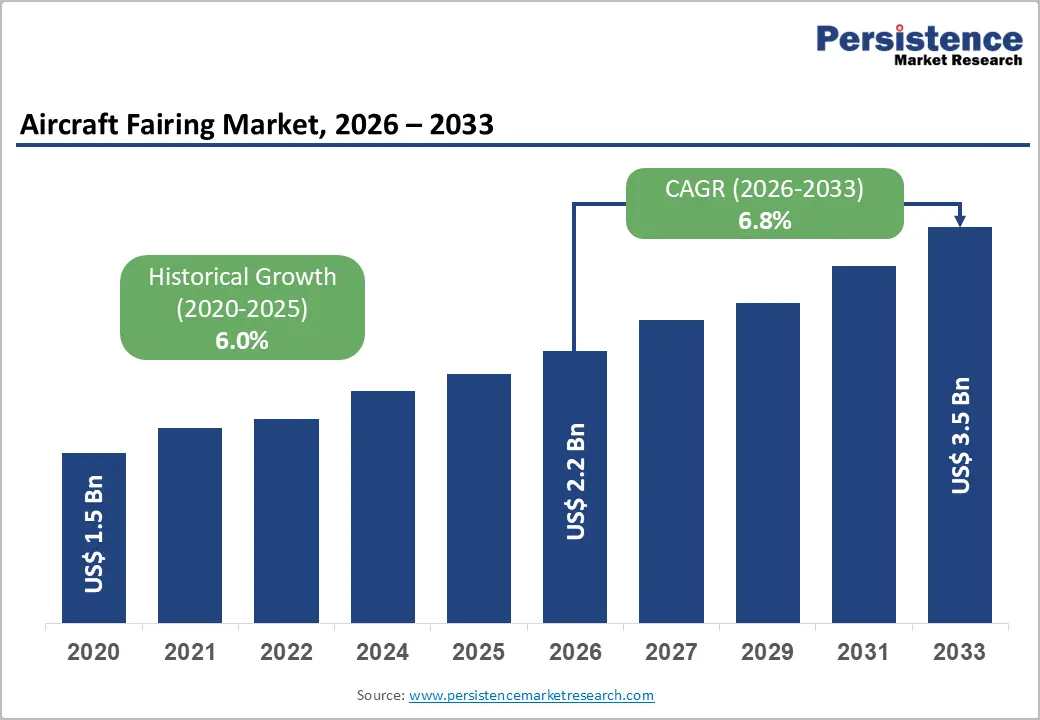
The global aircraft fairing market size is likely to be valued at US$2.2 billion in 2026 and is expected to reach US$3.5 billion by 2033, growing at a CAGR of 6.8% during the forecast period from 2026 to 2033, driven by rising commercial aircraft production, increasing adoption of lightweight composite materials, and growing emphasis on fuel efficiency and emission reduction across the aviation industry.
Aircraft fairings play a critical role in improving aerodynamics, reducing drag, and enhancing aircraft operational performance. According to the International Air Transport Association (IATA), global air passenger demand increased by 5.3% in 2025, while international traffic grew by 7.1%, highlighting a strong recovery and sustained aircraft utilization. Increasing use of carbon-fiber composites and thermoplastic materials in next-generation aircraft, alongside expanding defense aviation and unmanned aerial systems programs, continues to strengthen long-term market demand.
Key Industry Highlights:
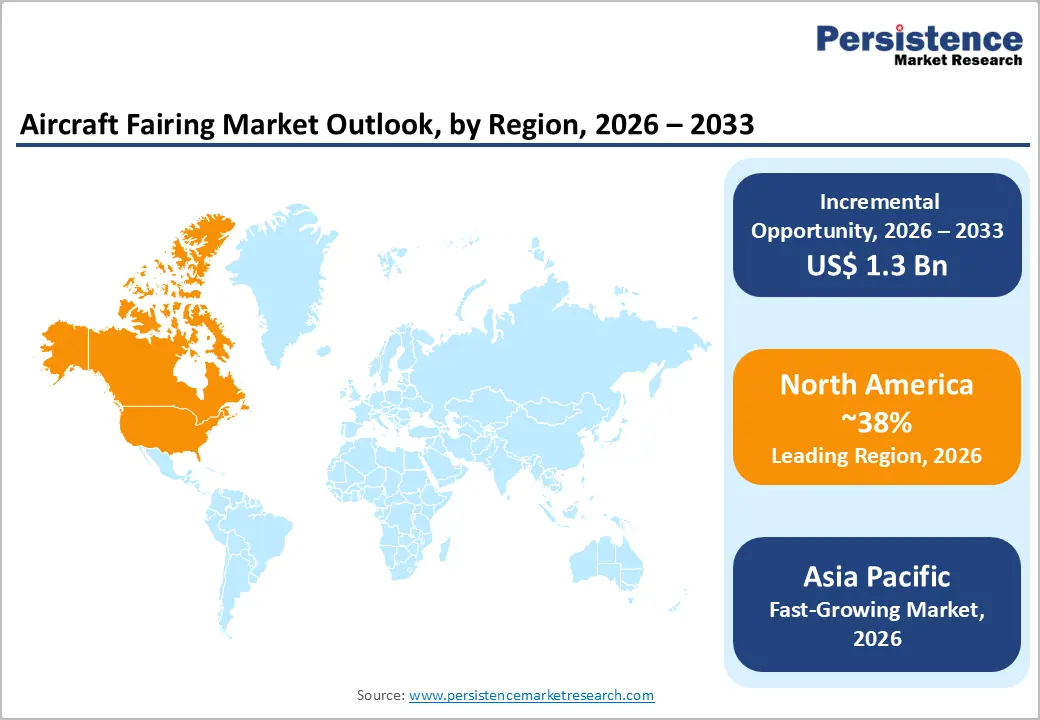
- Leading Region: North America is anticipated to be the leading region, accounting for a market share of 38% in 2026, driven by strong aerospace manufacturing capabilities, advanced composite material adoption, and extensive commercial and defense aircraft production.
- Fastest-growing Region: Asia Pacific is likely to be the fastest-growing region, supported by rapid aviation expansion, rising aircraft manufacturing activities, and increasing investments in regional aerospace infrastructure.
- Leading Aircraft Type: Commercial aircraft is projected to represent the leading aircraft type in 2026, accounting for 65% of the revenue share, driven by high production volumes and continuous fleet modernization programs.
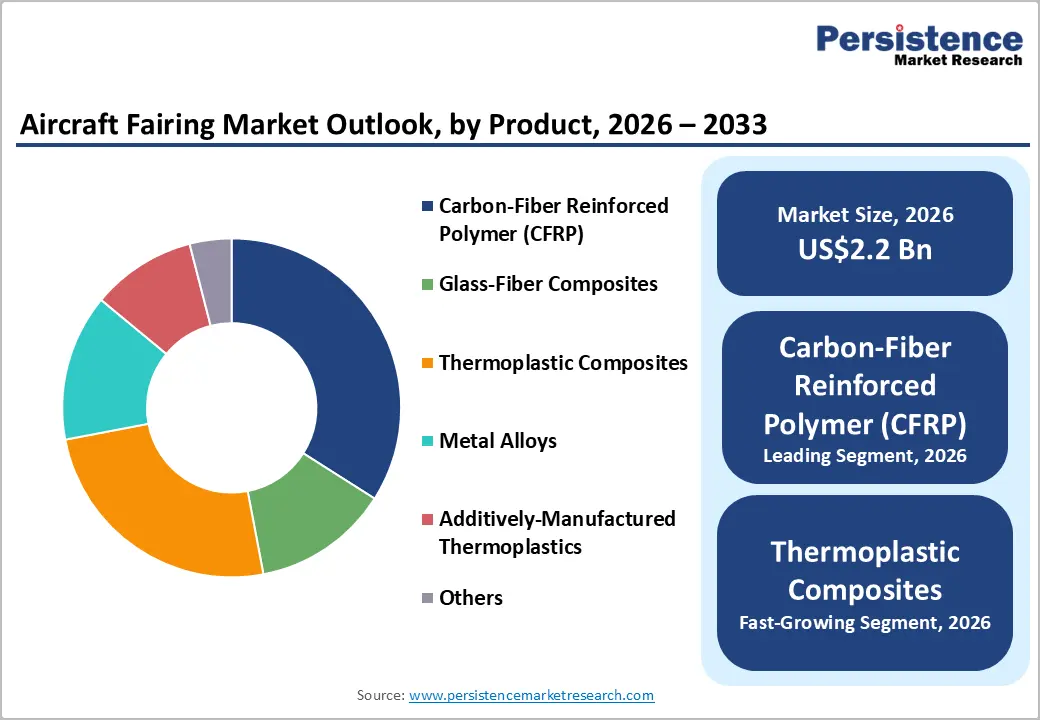
- Leading Material Type: Carbon-fiber reinforced polymer (CFRP) is anticipated to be the leading material type, accounting for over 50% of the revenue share in 2026, supported by its lightweight strength and superior fuel-efficiency benefits.
- Key Opportunity: The key market opportunity lies in the rapid shift toward lightweight composite and advanced aerodynamic technologies that support fuel-efficient, low-emission, and next-generation commercial and unmanned aircraft development.
DRO Analysis
Driver - Rising Demand for Fuel-Efficient and Aerodynamically Optimized Aircraft
Aircraft manufacturers increasingly prioritize fuel efficiency and aerodynamic performance, creating strong demand for advanced aircraft fairings across commercial, military, and emerging aviation platforms. Fairings reduce drag, improve airflow, and enhance operational efficiency, helping airlines lower fuel consumption and carbon emissions.
Rising air traffic, fleet modernization programs, and stricter environmental regulations from aviation authorities continue accelerating the adoption of lightweight composite fairings. Narrow-body aircraft production growth, particularly for fuel-efficient models. Airlines also seek maintenance-friendly fairing systems that improve aircraft reliability and reduce operating costs.
Commercial airlines increasingly invest in next-generation aircraft equipped with advanced aerodynamic structures to meet sustainability goals and improve route profitability. Aircraft fairings made from carbon fiber composites support weight reduction strategies, enabling better fuel economy and extended aircraft range. Defense aviation programs also require high-performance fairings for surveillance aircraft, fighter jets, and unmanned systems.
Restraint - Material and Technological Integration Challenges
Composite fairings require specialized manufacturing processes, precision engineering, and certification standards, increasing production complexity and development timelines. Compatibility issues between thermoplastic composites, metal alloys, and existing aircraft architectures can create operational limitations during installation and maintenance procedures. Fluctuating raw material costs and supply chain disruptions affect production stability for aerospace component suppliers.
The adoption of advanced aircraft fairings is also constrained by high maintenance requirements and technical repair complexities associated with composite materials. Damage detection, structural inspections, and replacement procedures often require specialized equipment and skilled aerospace technicians, increasing operational costs for airlines and defense operators. Small manufacturers struggle to invest in production technologies due to substantial capital requirements.
Opportunity - Adoption of Advanced Manufacturing and Lightweight Materials
Additive manufacturing, automated fiber placement, and digital engineering technologies enable the production of lightweight, durable, and aerodynamically optimized fairings with design flexibility. Aerospace manufacturers are investing heavily in thermoplastic composites and recyclable materials to meet sustainability targets and reduce aircraft emissions.
Rising development of electric aircraft, unmanned aerial vehicles, and mobility platforms expands application opportunities for next-generation fairing systems. Growing partnerships between aerospace companies and material innovators continue to accelerate the commercialization of advanced lightweight fairing technologies.
Lightweight composite materials present opportunities for aircraft fairing manufacturers seeking better performance and lower fuel consumption. Carbon fiber reinforced polymers and advanced thermoplastic composites allow manufacturers to produce complex aerodynamic shapes while minimizing structural weight and maintenance requirements. Increasing investments in sustainable aviation technologies and smart manufacturing facilities accelerate the commercialization of lightweight aerostructures and modular composite manufacturing.
Category-wise Analysis
Aircraft Type Insights
Commercial aircraft is expected to lead the aircraft fairing market, accounting for approximately 65% of revenue in 2026, driven by rising air passenger traffic, increasing aircraft production rates, and continuous airline fleet modernization programs. Aircraft manufacturers are heavily integrating lightweight fairings into narrow-body and wide-body aircraft to improve fuel efficiency, reduce aerodynamic drag, and support emission reduction targets. For example, Airbus continues using advanced composite fairings across its A320neo aircraft family to improve fuel efficiency and operational performance.
Unmanned systems are likely to represent the fastest-growing segment, supported by rising adoption of military drones, surveillance aircraft, unmanned combat systems, and emerging electric vertical takeoff platforms. Lightweight fairings are increasingly used in drones to improve aerodynamics, extend flight endurance, and reduce energy consumption during operations. A notable example includes General Atomics, which integrates advanced aerodynamic fairings into its MQ series unmanned aerial vehicles to enhance operational efficiency and flight stability.
Material Type Insights
Carbon-fiber reinforced polymer (CFRP) is projected to lead the market, capturing around 50% of the revenue share in 2026, supported by its superior strength-to-weight ratio, corrosion resistance, thermal stability, and aerodynamic efficiency advantages. Aerospace manufacturers increasingly prefer CFRP materials because they significantly reduce aircraft weight while maintaining structural durability under demanding flight conditions. For instance, Boeing extensively utilizes CFRP-based fairings in its 787 Dreamliner aircraft to enhance fuel efficiency and long-range operational capabilities across commercial aviation networks and fleets.
Thermoplastic composites are likely to be the fastest-growing material type, driven by increasing focus on sustainable aerospace manufacturing and rapid production technologies. These materials provide advantages, including recyclability, high impact resistance, shorter manufacturing cycles, and improved design flexibility for advanced aircraft components. A notable example includes Airbus, which has explored thermoplastic composite structures for next-generation aircraft components to support sustainability and manufacturing efficiency goals.
Application Insights
Fuselage fairings are expected to lead the aircraft fairing market, accounting for approximately 40% of revenue in 2026. They play a critical role in reducing aerodynamic drag and improving aircraft operational efficiency. These fairings cover joints, gaps, and structural transitions on aircraft bodies, helping optimize airflow and reduce fuel consumption during flight operations. For example, the Boeing 737 MAX incorporates advanced fuselage fairings designed to improve aerodynamic efficiency and support lower operating costs for airlines worldwide.
Wing fairings are likely to represent the fastest-growing segment, supported by increasing emphasis on aerodynamic optimization and fuel-efficient aircraft operations. These fairings improve airflow around wing structures, minimize turbulence, and support better lift-to-drag performance during takeoff, cruising, and landing operations. For instance, Airbus utilizes advanced wing fairings in the A350 aircraft program to enhance fuel efficiency and aerodynamic performance during long-haul operations.
Regional Insights
North America Aircraft Fairing Market Trends
North America is anticipated to be the leading region, accounting for a market share of 38% in 2026, driven by strong aerospace manufacturing infrastructure, high commercial aircraft production, and rising defense modernization programs. Aircraft manufacturers and suppliers increasingly focus on aerodynamic optimization to meet emission reduction targets and improve operational efficiency. A notable example includes Spirit AeroSystems expanded advanced composite aircraft fairing production to support lightweight and fuel-efficient commercial aircraft development.
U.S. Aircraft Fairing Market Trends
The U.S. dominates the regional market, driven by strong commercial aircraft manufacturing and rising investments in advanced aerospace technologies. The country benefits from large-scale aircraft production programs, increasing defense procurement activities, and strong research in lightweight composite materials. Aerospace manufacturers continue investing in advanced thermoplastic fairings and additive manufacturing capabilities to improve aircraft efficiency and reduce emissions.
Canada Aircraft Fairing Market Trends
Canada is a significant market for aircraft fairings, supported by expanding aerospace manufacturing capabilities. The country has a strong presence of aerostructure manufacturers specializing in lightweight aircraft components and composite technologies. Canadian aerospace companies increasingly focus on advanced materials research and sustainable aviation manufacturing processes.
Europe Aircraft Fairing Market Trends
Europe is likely to be a significant market, due to strong aerospace engineering capabilities, sustainability initiatives, and extensive aircraft manufacturing operations. The region benefits from increasing demand for lightweight composite structures and aerodynamic optimization technologies aimed at reducing aviation emissions. For example, GKN Aerospace invested in advanced composite technologies to develop lightweight next-generation aircraft fairing solutions.
U.K. Aircraft Fairing Market Trends
The U.K. is a significant market for aircraft fairings, supported by aerospace innovation, defense modernization, and advanced composite material development. The country has strong expertise in aerodynamic engineering and lightweight aerostructure manufacturing for commercial and military aviation platforms. British aerospace companies increasingly focus on sustainable aviation technologies and next-generation aircraft systems requiring advanced fairing solutions.
Germany Aircraft Fairing Market Trends
Germany is one of the leading markets in Europe, driven by its advanced aerospace engineering expertise and strong industrial manufacturing base. The country supports extensive aircraft component production and composite material innovation across commercial and defense aviation sectors. German aerospace companies increasingly invest in lightweight thermoplastic composites and automated manufacturing technologies to improve aircraft performance and sustainability.
Asia Pacific Aircraft Fairing Market Trends
The Asia Pacific region is likely to be the fastest-growing region, driven by rapid aviation expansion, increasing aircraft production, and rising investments in aerospace infrastructure. The region benefits from strong growth in commercial air travel, expanding low-cost airline networks, and increasing demand for fuel-efficient aircraft technologies. For instance, Strata Manufacturing collaborated with aerospace companies to manufacture advanced composite aircraft fairing components for lightweight aircraft programs.
China Aircraft Fairing Market Trends
China dominates the regional market, driven by strong domestic aircraft manufacturing programs and rapid aviation sector expansion. The country continues investing heavily in indigenous commercial aircraft development, aerospace materials research, and advanced manufacturing technologies. Rising aircraft production activities and increasing demand for fuel-efficient aviation systems are supporting fairing integration across commercial and defense aircraft platforms.
India Aircraft Fairing Market Trends
India is a significant market for aircraft fairings, supported by rising aviation demand, expanding aerospace manufacturing, and strong government initiatives supporting domestic aircraft production. The country is witnessing increasing investments in aircraft component manufacturing facilities and aerospace supply chain development. Indian aerospace companies are focusing on lightweight composite technologies and advanced aerostructure manufacturing to support fuel-efficient aviation platforms.
Competitive Landscape
The global aircraft fairing market exhibits a moderately fragmented structure, driven by the presence of major aerospace OEMs, specialized aerostructure manufacturers, and composite component suppliers competing across commercial, military, and unmanned aviation platforms. Rising aircraft production rates, increasing demand for lightweight composite materials, and growing focus on aerodynamic efficiency are intensifying competition throughout the industry.
With key leaders including Airbus, Boeing, Spirit AeroSystems, GKN Aerospace, FACC AG, and Strata Manufacturing, the industry continues witnessing strong technological advancements and strategic production expansion activities. These players compete through advanced composite material innovation, aerodynamic performance optimization, strategic aerospace partnerships, and expansion of manufacturing capabilities.
Key Industry Developments:
- In January 2026, Boeing finalized regulatory approvals for the Spirit AeroSystems acquisition to strengthen aircraft manufacturing quality control and aerospace supply chain integration.
- In May 2026, Airbus focused on resynchronizing aircraft production and delivery operations to address supply chain constraints and support growing commercial aircraft demand.
- In December 2025, Spirit AeroSystems completed major restructuring activities with Boeing and Airbus to improve commercial aircraft aerostructure and fairing production efficiency.
Companies Covered in Aircraft Fairing Market
- Airbus Aerostructures (Airbus SE)
- Boeing Aerostructures Australia (The Boeing Company)
- Collins Aerospace (RTX Corporation)
- FACC AG
- GKN Aerospace
- Spirit AeroSystems, Inc.
- Saab AB
- Strata Manufacturing PJSC
- LATECOERE S.A
- Kaman Corporation
- CTRM Sdn. Bhd.
Frequently Asked Questions
The global aircraft fairing market is projected to reach US$2.2 billion in 2026.
The aircraft fairing market is driven by rising demand for fuel-efficient aircraft, increasing adoption of lightweight composite materials, and growing commercial and defense aircraft production worldwide.
The aircraft fairing market is expected to grow at a CAGR of 6.8% from 2026 to 2033.
Key market opportunities in the aircraft fairing market include growing adoption of advanced composite materials, expansion of unmanned aerial systems, and increasing investments in sustainable and next-generation aircraft technologies.
Airbus, Boeing, Collins Aerospace, FACC AG, GKN Aerospace, and Spirit AeroSystems are the leading players.


