




- Medical Devices
- Global AI-powered X-ray Imaging Market
Global AI-powered X-ray Imaging Market Size, Share, Growth, and Regional Forecast, 2026 to 2033
AI-powered X-ray Imaging Market by Product (Software, Hardware), Mode of Deployment (Cloud-based, Web-based, On-premises), Workflow (Detection, Image Acquisition, Image Analysis, Diagnosis and Treatment Decision Support, Triage, Predictive Analysis and Risk Assessment, Reporting and Communication), and Regional Analysis from 2026 to 2033

AI-powered X-ray Imaging Market Share and Trends Analysis
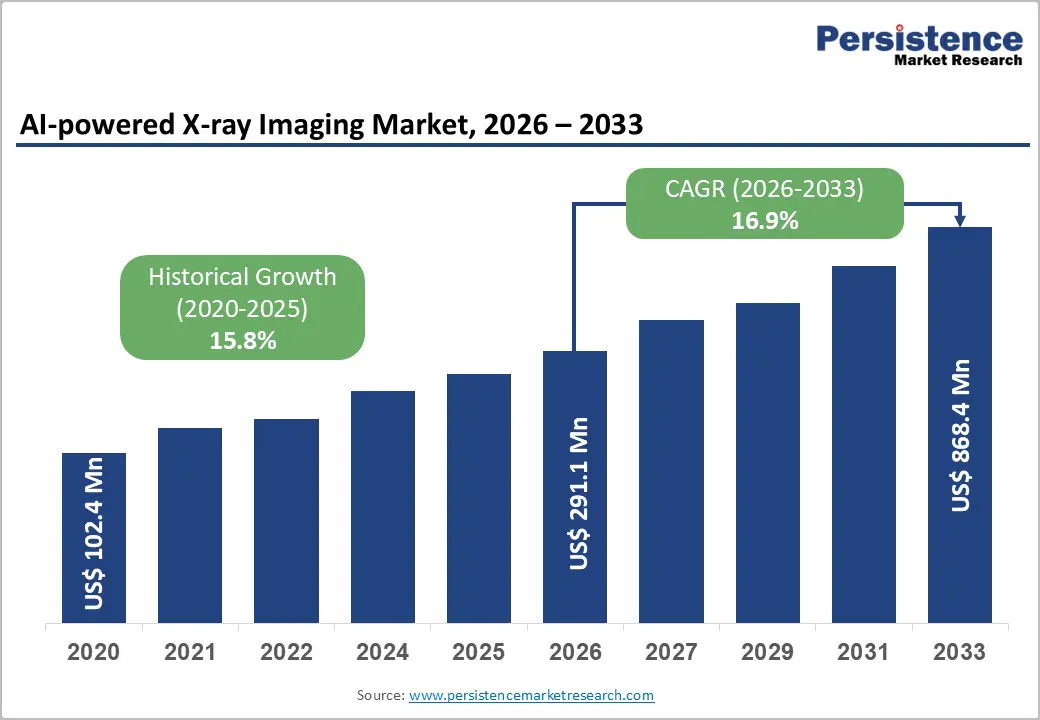
The global AI-powered X-ray Imaging Market is estimated to grow from US$ 291.1 Mn in 2026 to US$ 868.4 Mn by 2033. The market is projected to record a CAGR of 16.9% during the forecast period from 2026 to 2033.
The AI-powered X-ray Imaging Market is growing steadily, driven by rising use of cardiotoxic drugs, increasing oncology treatments, and emphasis on early cardiac risk detection. North America leads due to advanced healthcare infrastructure and strong regulations, while Asia-Pacific grows rapidly, supported by expanding healthcare access, rising cancer prevalence, and improved adoption of AI-based cardiac imaging solutions.
Key Industry Highlights
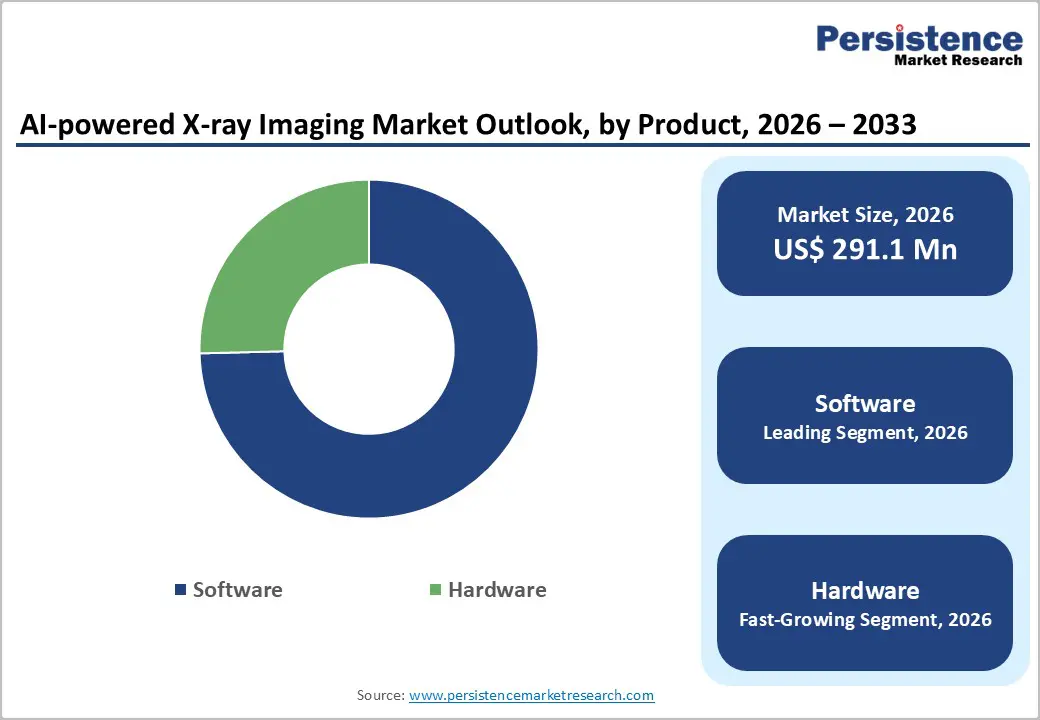
- Dominant Segment: AI software dominates the market with 74.6% share in 2025, driven by widespread adoption of algorithms for image analysis, detection, and diagnostic support. Advanced software platforms integrate with imaging workflows, enable predictive risk assessment, support early detection of cardiotoxicity and other abnormalities, and enhance decision-making across oncology, cardiology, and general radiology settings.
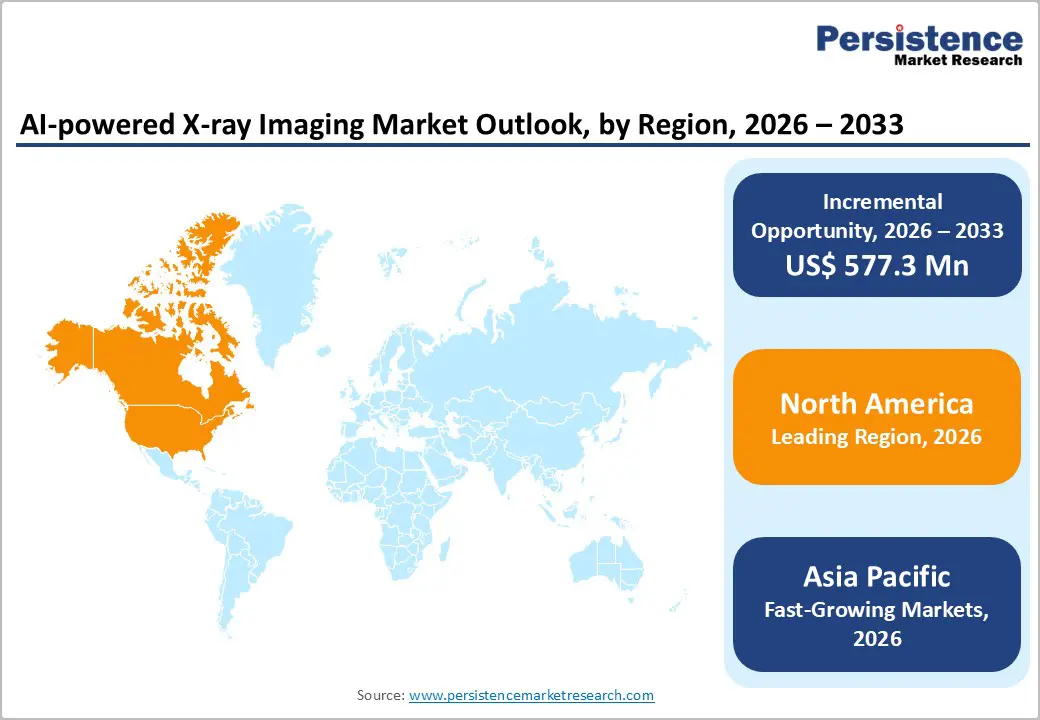
- Dominant Region: North America holds the largest market share, supported by advanced healthcare infrastructure, strong regulatory focus, and widespread AI implementation. Asia-Pacific is the fastest-growing region, driven by rising cancer prevalence, expanding access to healthcare, and increasing adoption of AI imaging technologies.
- Market Drivers: Growth is fueled by increasing use of cardiotoxic drugs, rising cancer incidence, greater awareness of treatment-related cardiac risks, adoption of AI-based imaging tools, and integration of AI into clinical decision-making.
- Market Opportunity: Key opportunities include AI-enabled risk prediction, advanced imaging solutions, integration with digital health platforms, expansion in emerging markets, and enhanced collaboration between radiology, oncology, and cardiology specialists.
| Global Market Attributes | Key Insights |
|---|---|
| Global AI-powered X-ray Imaging Market Size (2026E) | US$ 291.1 Mn |
| Market Value Forecast (2033F) | US$ 868.4 Mn |
| Projected Growth (CAGR 2026 to 2033) | 16.9% |
| Historical Market Growth (CAGR 2020 to 2025) | 15.8% |
Market Dynamics
Driver – Rising adoption of AI algorithms for early detection and risk assessment
The adoption of AI algorithms in X ray imaging is significantly enhancing early detection and risk assessment of critical diseases. Recent clinical research shows that deep learning–based AI systems can detect abnormalities on chest X rays with extremely high accuracy, achieving area under the receiver operating curve (AUC) values of approximately 0.976, indicating highly reliable classification of normal vs abnormal findings. Physicians aided by AI demonstrated a statistically significant improvement in abnormality detection performance compared to unaided readings, underscoring the value of AI support in clinical diagnosis.
Supporting this trend, large scale studies highlight substantial improvements in clinical outcomes with AI assistance. For instance, AI algorithms improved early lung cancer detection rates on chest radiographs by identifying 17.4% more lung cancers that would otherwise have been missed, particularly in early stages (stage1 and stage2), which are crucial for patient prognosis. These data illustrate how AI powered X-ray imaging contributes to earlier disease identification and more accurate risk stratification, driving broader adoption across radiology workflows.
Restraints – High cost of AI-enabled imaging solutions and software
The cost of implementing AI enabled imaging solutions remains a significant restraint on adoption across healthcare systems globally. Deploying advanced AI software and compatible imaging systems often requires substantial upfront investment, with commercial AI medical imaging licenses frequently ranging from $100,000 to $500,000 per year and custom built platforms costing $500,000 to $1.5 million or more depending on scale and functionality. Additionally, regulatory validation and compliance such as meeting FDA requirements can add $100,000 to $500,000 in expenses and extend deployment timelines, increasing the total cost burden for providers. Such expenditures deter smaller hospitals and clinics from adopting AI at scale.
Beyond licensing, ongoing operational costs further constrain adoption, especially in resource limited settings. Annual maintenance fees typically amount to 15–20 percent of the initial software cost, while data storage and secure archiving can cost hospitals $2,000 to $5,000 per month, imposing recurring expenses that facilities must absorb without dedicated reimbursement pathways. Integrating AI with legacy systems also increases IT labor costs and infrastructure upgrades, delaying return on investment and contributing to hesitancy among providers to invest in AI solutions despite clinical benefits.
Opportunity – Development of AI-based predictive risk scoring and decision support tools
The emergence of AI based predictive risk scoring tools represents a significant opportunity for the AI powered X-ray imaging market. Studies show that deep learning models applied to routine chest X-rays can estimate cardiovascular risk markers and predict future health outcomes, such as coronary artery calcium scores with an AUC near 0.87, demonstrating strong predictive value without invasive tests. These models also estimated 10 year cardiovascular mortality risk (AUC ~0.76) using chest radiographs alone, comparable to traditional clinical tools but requiring only imaging data. Such capabilities enable clinicians to stratify patients effectively and prioritize care based on quantified risk scores from standard X ray exams.
In addition, predictive AI tools enhance decision support by quantifying prognostic indicators directly from radiographs. For example, AI derived pneumonia severity scores improved outcome prediction when combined with clinical data, enhancing prognostic accuracy beyond conventional scoring systems. This demonstrates how imaging biomarkers extracted by AI can serve as quantitative risk predictors, enabling personalized treatment plans and proactive intervention. The feasibility of estimating long term respiratory mortality risk from a single chest X ray in large cohorts further underscores the clinical value of these tools for early risk stratification and tailored patient management.
Category-wise Analysis
By Product, Software Dominates the AI-powered X-ray Imaging Market
Software dominates with 74.6% share of the global market in 2025, because it delivers high clinical value, flexibility, and scalability without requiring replacement of existing hardware. AI algorithms integrated into software can analyze images with accuracy comparable to expert radiologists, improving early detection, diagnosis, and risk assessment. Studies show AI-assisted X ray interpretation increases detection rates of abnormalities by 10–20 percent and reduces reading time by up to 30 percent. Software solutions can be deployed across multiple facilities, integrate with PACS and electronic health records, automate repetitive tasks like triage and quantification, and support predictive analytics. Government-backed studies highlight that AI software enhances workflow efficiency and patient outcomes, making it more widely adopted and cost-effective than hardware-focused solutions.
By Mode of Deployment, Cloud-based dominates due to scalability, real-time access, interoperability, and reduced infrastructure costs
The cloud based deployment mode dominates the AI powered X ray imaging market because cloud platforms enable scalable storage, rapid collaboration, and real time access to imaging data essential for AI driven workflows. Cloud adoption in healthcare is widespread: surveys show up to 94 percent of U.S. healthcare organizations have embraced cloud computing, reflecting its foundational role in modern digital health infrastructures. Up to 63 percent of providers use or plan to use cloud based EHR systems, illustrating the shift from on site systems to internet hosted platforms for critical clinical data. Cloud solutions also support faster data recovery (up to 99.99 percent uptime) and enhanced interoperability between facilities, which are crucial when AI algorithms need large datasets for training and inference. This broad migration to cloud environments reduces local infrastructure costs, improves clinician access to imaging and analytics, and accelerates the deployment of AI enabled diagnostic tools, driving cloud’s dominance in the market.
Regional Insights
North America AI-powered X-ray Imaging Market Trends
North America dominates the AI-powered X-ray Imaging Market with 40.0% share in 2025, due to advanced healthcare infrastructure, high imaging utilization, and strong digital health investment. In the United States, medical imaging usage is among the highest globally, with over 40 radiographic exams per 100 persons annually, reflecting broad X-ray adoption. The U.S. also leads in health IT deployment, with 96 percent of acute care hospitals using certified electronic health records that facilitate AI integration. Federal initiatives such as the 21st Century Cures Act and HHS support interoperability and AI research, accelerating clinical AI deployment. Additionally, the region’s robust regulatory framework and large clinical datasets improve AI model development and validation. These factors create a receptive environment for AI enhanced imaging adoption, giving North America a sustained market lead.
Europe AI-powered X-ray Imaging Market Trends
Europe is an important region in the AI powered X-ray imaging market because it combines strong healthcare infrastructure, high diagnostic imaging utilization, and progressive digital health policy support. In the EU, more than 21.6 percent of the population was aged 65 years or older in 2024, creating greater demand for diagnostic imaging to manage age-related and chronic diseases. This ageing trend significantly increases the need for X-ray and AI assisted imaging to detect conditions early and monitor progression. Additionally, 45 million imaging tests were reported in England in one year (2022 23), with X ray the most common modality, underscoring imaging’s central role in European healthcare delivery. The region also benefits from robust digital health initiatives, facilitating AI integration, making Europe a key market for AI enhanced X ray imaging solutions.
Asia-Pacific AI-powered X-ray Imaging Market Trends
Asia Pacific is the fastest growing region in the AI powered X-ray imaging market due to expanding healthcare access, rising disease burden, and rapid digital adoption. The region accounts for more than half of the world’s population, with countries like China and India increasing annual healthcare spending by double digits year over year. In India, for example, the number of diagnostic imaging centers has grown markedly, and China performs tens of millions of radiology exams annually, creating huge demand for efficient imaging workflows. Aging populations in Japan and South Korea further drive imaging utilization for chronic and age related conditions. Simultaneously, government initiatives to expand electronic health records and telehealth infrastructure accelerate adoption of cloud based and AI enabled diagnostics, enabling hospitals and clinics to implement AI powered X-ray solutions more rapidly than in many developed markets. These factors support robust regional market growth.
Market Competitive Landscape
Leading applications in the AI-powered X-ray Imaging Market include early disease detection, risk assessment, and timely intervention. AI-enhanced imaging and biomarkers enable precise diagnosis, guide treatment decisions, and support patient monitoring. High adoption across hospitals, oncology centers, and cardiology clinics drives market growth, expanding acceptance of AI-powered diagnostic and cardiotoxicity assessment solutions worldwide.
Key Industry Developments:
- In March 2025, GE HealthCare and NVIDIA reimagined diagnostic imaging by launching autonomous X-ray and ultrasound solutions. The collaboration combined GE’s medical imaging expertise with NVIDIA’s AI computing capabilities to develop intelligent imaging systems capable of automating scans, improving workflow efficiency, and enhancing diagnostic accuracy in clinical settings. These solutions aimed to reduce manual intervention and accelerate patient care.
- In December 2024, AI transformed medical imaging as the FDA continued approving new AI-powered imaging solutions. These approvals enabled wider clinical adoption of AI algorithms for diagnostics, early disease detection, and workflow optimization, enhancing accuracy and efficiency in radiology practices across hospitals and imaging centers.
Companies Covered in Global AI-powered X-ray Imaging Market
- Arterys Inc.
- Behold.ai Technologies Limited
- Imagen Technologies Inc.
- Infervision Medical Technology Co. Ltd.
- Lunit Inc.
- Qure.ai Technologies Private Limited
- VUNO Inc.
- Others
Frequently Asked Questions
The global AI-powered X-ray Imaging Market is projected to be valued at US$ 291.1 Mn in 2026.
Rising AI adoption, early disease detection, cardiotoxicity monitoring, oncology growth, and advanced imaging integration drive growth.
The global AI-powered X-ray Imaging Market is poised to witness a CAGR of 16.9% between 2026 and 2033.
AI-based predictive tools, advanced imaging integration, digital health platforms, emerging markets, and cross-specialty collaborations offer opportunities.
Arterys Inc., Behold.ai Technologies Limited, Imagen Technologies Inc., Infervision Medical Technology Co. Ltd., Lunit Inc., Qure.ai Technologies Private Limited.


