




- Healthcare IT
- Acute Care Telemedicine Market
Acute Care Telemedicine Market Size, Share, and Growth Forecast 2026–2033
Acute Care Telemedicine Market by Delivery (Clinician-to-Patient, Clinician-to-Clinician), Application (Teleradiology, Telepsychiatry, Tele-ICU, Teleneurology, Telenephrology), and Regional Analysis, 2026–2033

Acute Care Telemedicine Market Size and Trend Analysis
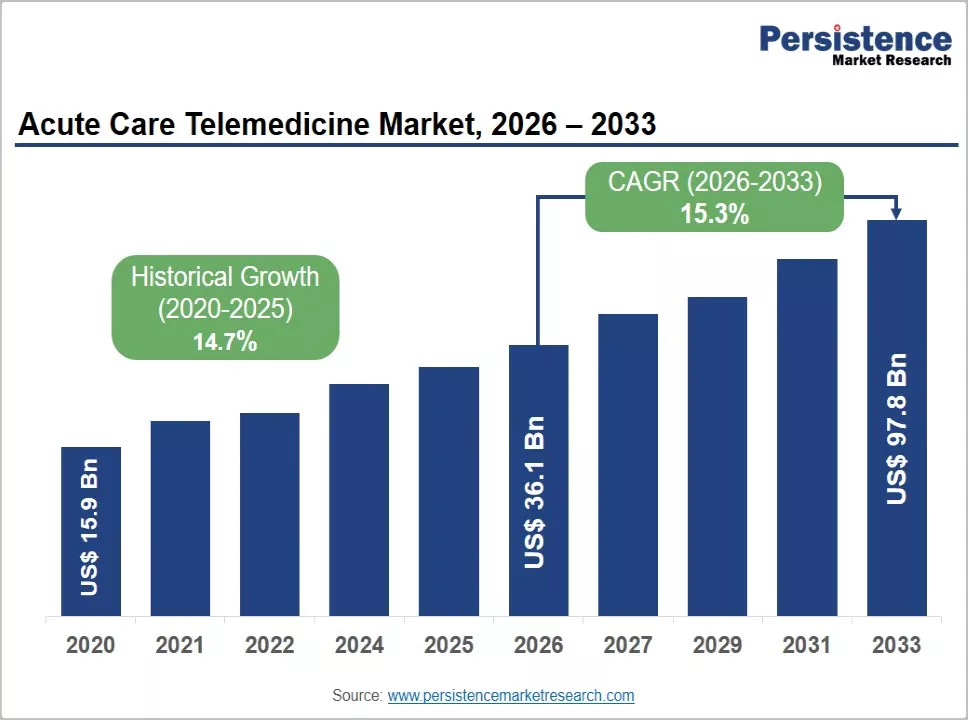
The global acute care telemedicine market size is likely to be valued at US$ 36.10 billion in 2026 and is projected to reach US$ 97.80 billion by 2033, growing at a CAGR of 15.3% during the forecast period between 2026 and 2033.
Workforce scarcity is reshaping how hospitals deliver time-critical specialty care. The Association of American Medical Colleges projects a shortage of up to 86,000 physicians in the U.S. by 2036, with neurology, critical care, and psychiatry among the specialties hardest to staff outside major academic centers.
Acute care telemedicine allows community and rural hospitals to access specialists within minutes, treating patients locally rather than transferring them. This trajectory reflects sustained demand from hospital systems under financial and staffing pressure, growing acceptance of virtual specialty consultation by clinicians and payers, and the integration of artificial intelligence into monitoring and triage, a dynamic that rewards providers with deep clinician networks and seamless electronic health record integration.
Key Industry Highlights
- Dominant Region: North America is forecast to dominate the regional market, holding about 46% market share in 2026. A large base of community and critical access hospitals, mature specialty telemedicine providers, and the extension of Medicare telehealth flexibilities through December 31, 2027 are collectively sustaining the region's leadership through 2033.
- Fastest-growing Region: Growing at a CAGR of 18.2%, Asia Pacific is outpacing every other region in the acute care telemedicine industry. China's expansion of internet hospitals and tiered care, Japan's relaxation of online consultation rules, and India's push to bring specialist care to underserved districts are jointly accelerating adoption of virtual acute care.
- Leading Delivery Type: Clinician-to-clinician models hold about 58% of market share in 2026, fueled by hospitals' need to connect on-site emergency and inpatient teams with remote stroke, radiology, and critical care specialists. Its dominance is structurally stable, as hospital-to-specialist consultation is embedded in transfer-avoidance and stroke-certification workflows.
- Fastest-growing Application: Tele-ICU is gaining share rapidly as hospitals seek to extend scarce intensivist and critical care nursing capacity. Programs in which the large majority of remote consultations avoid patient transfer, together with the incorporation of predictive analytics, signal that tele-ICU will capture a meaningfully larger share of the market by 2033.
- Key Market Opportunity: The convergence of persistent workforce shortages, rural hospital financial pressure, and multi-year Medicare telehealth policy stability creates a durable opportunity for providers that can bundle tele-neurology, tele-ICU, and virtual behavioral health into single enterprise agreements. Companies with native electronic health record workflows and rapid implementation timelines are best placed to capture recurring, multi-service contracts.
DRO Analysis
Driver- Physician Shortages and the Need to Reduce Avoidable Patient Transfers
Specialist availability is the binding constraint on acute care in community hospitals. According to the U.S. Centers for Disease Control and Prevention (CDC), about 795,000 people in the U.S. have a stroke each year, and rapid neurological assessment is essential to determine eligibility for time-sensitive treatment.
Acute care telemedicine closes this gap, allowing local emergency teams to treat, admit, or stabilize patients under remote specialist guidance. Access TeleCare reported that one of its hospital partners reduced patient transfers by up to 40% and raised its average daily ICU census by 30%, illustrating how virtual specialty coverage retains revenue locally while improving access, a combination that is driving enterprise adoption across health systems.
Restraint- Reimbursement Uncertainty and Fragmented Licensure Requirements
Policy continuity has been a persistent obstacle to long-term investment. Medicare telehealth flexibilities lapsed on October 1, 2025 during a federal shutdown and were restored retroactively weeks later, and they expired again briefly on January 31, 2026, before the Consolidated Appropriations Act of 2026 extended them through December 31, 2027.
Commercial payer and Medicaid coverage continues to vary by state, and clinicians must hold licenses in each state where patients are located, a requirement only partially eased by the Interstate Medical Licensure Compact. This patchwork raises administrative cost, slows the onboarding of specialists, and disadvantages smaller providers that lack dedicated credentialing and compliance teams. Cybersecurity and patient-data privacy obligations add a further compliance layer for platforms connecting multiple hospitals.
Opportunity- AI-Enabled Tele-ICU and Virtual Care Models Extending Scarce Clinical Capacity
Tele-ICU and hybrid virtual care represent the most compelling growth thesis in the market. Programs such as ECU Health's tele-ICU service in eastern North Carolina report that about 90% of consultations do not require a patient transfer, allowing critically ill patients to stay in local hospitals. Teladoc Health, Inc. is implementing its Teladoc One connected care model with early launch partners while expanding hybrid care and AI-enabled solutions, and continuous-monitoring analytics are increasingly used to flag deterioration before it escalates.
As hospitals face nursing shortages, solutions that extend each clinician's span of care create a commercial case beyond access alone. Hospital leaders evaluate these services on measurable outcomes, including avoided transfers, shorter lengths of stay, and retained ICU census, which positions providers with robust outcomes data to win larger, longer contracts.
Category-wise Analysis
Delivery Insights
Why Does Clinician-to-Clinician Delivery Dominate the Acute Care Telemedicine Market?
Clinician-to-clinician delivery is projected to hold nearly 58% of market share in 2026, propelled by hospitals' reliance on remote specialists to support emergency physicians, hospitalists, and bedside nurses. Stroke programs illustrate the model: Hendrick Health standardized a systemwide teleneurology program with Access TeleCare, reducing door-to-needle times and transfers. Because these consultations plug into established emergency, stroke-certification, and radiology workflows, they are purchased on multi-year contracts that generate predictable, recurring volumes. Hospitals also value the model for supporting stroke and trauma certification, since documented specialist response times and transfer-avoidance metrics feed directly into quality reporting and referral relationships.
Clinician-to-patient delivery is likely to be the fastest-growing delivery segment, gaining traction as hospitals extend virtual nursing, direct specialist encounters, and hospital-at-home models. Teladoc Health reports that its hybrid care and Teladoc One initiatives are being rolled out with early launch partners, signaling how direct virtual encounters are being integrated with in-person care. Staffing partners such as AMN Healthcare extend clinician capacity into these models, and the continued availability of Medicare coverage for virtual encounters through 2027 is reducing the reimbursement risk that previously limited hospital investment in direct-to-patient programs.
Application Insights
What Is Driving the Shift Toward Tele-ICU in the Acute Care Telemedicine Market?
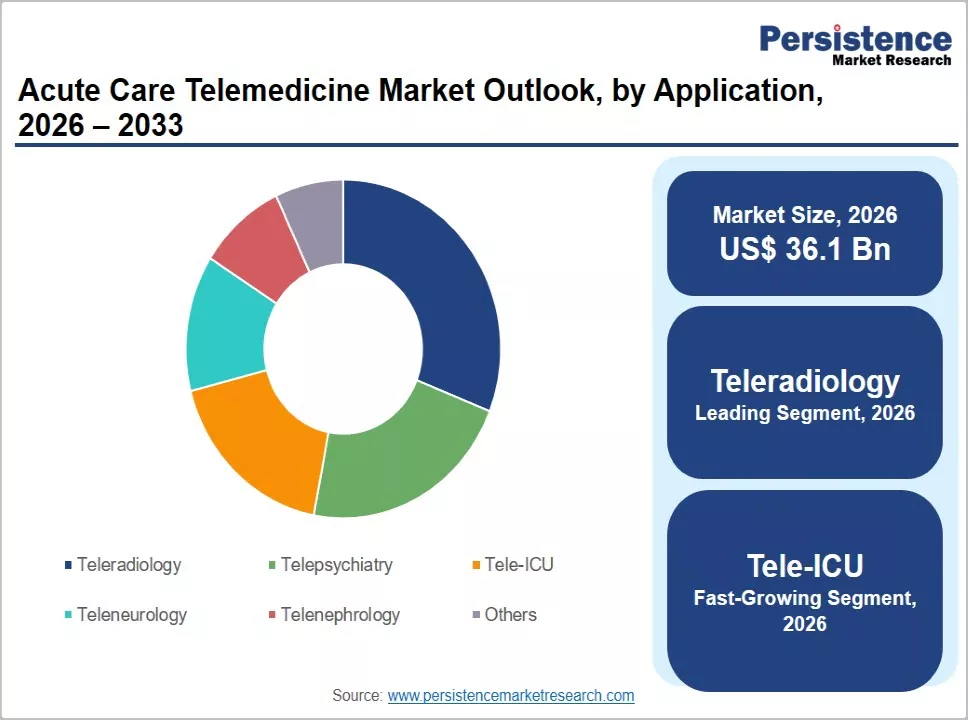
Teleradiology is expected to lead the application segment, holding around 31% of market share in 2026, fueled by persistent radiologist shortages, rising imaging volumes, and the maturity of digital image archiving and transmission standards. Hospitals use remote radiologists for overnight, weekend, and subspecialty reads, converting a fixed staffing cost into a flexible, volume-based service and shortening turnaround for emergency scans.
Tele-ICU is likely to be the fastest-growing application, propelled by intensivist scarcity and the clinical value of continuous remote monitoring. Access TeleCare's tele-pulmonary and critical care service, which provides board-certified specialists around the clock to hospitals such as NMC Health, and platforms from vendors such as AvaSure illustrate how tele-ICU is expanding from large academic networks into community hospitals. Telepsychiatry and teleneurology are also expanding rapidly in emergency departments, where psychiatric boarding and stroke triage place acute demands on limited specialist time, and where remote assessment shortens length of stay and speeds treatment decisions.
Regional Insights
North America Acute Care Telemedicine Market Trends and Insights
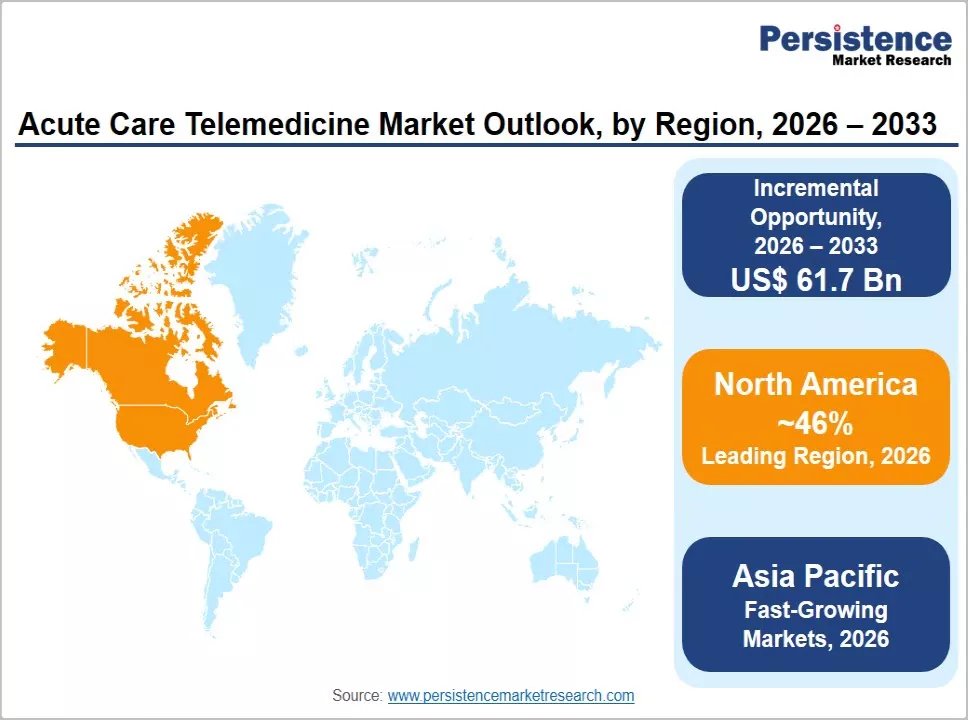
North America is forecast to dominate the regional market, capturing nearly 46% of market share in 2026, propelled by a large base of community and rural hospitals, established specialty telemedicine providers, and supportive federal policy. Access TeleCare states that it has launched more than 2,600 telemedicine programs and partners with one in five U.S. hospitals. Through 2033, growth will be driven by tele-ICU and teleneurology adoption, enterprise multi-service contracting, and hospital-at-home models.
U.S. Acute Care Telemedicine Market Size
The U.S. is projected to hold about 90% of the North America regional market in 2026. The Consolidated Appropriations Act of 2026, signed on February 3, 2026, extended Medicare telehealth flexibilities through December 31, 2027, giving health systems greater confidence to invest in virtual specialty programs. Rural hospital financial pressure continues to push demand for transfer-avoidance services through 2033.
Canada Acute Care Telemedicine Market Size
Canada is likely to command about 10% of the North America regional market in 2026. Vast distances between remote communities and tertiary centers make virtual acute care essential, and provincial networks such as Ontario Health's OTN connect rural hospitals with specialists. Provincial funding and national digital health investment support steady demand, particularly for tele-stroke and tele-psychiatry services that reduce costly air and road transfers from remote communities through 2033.
Europe Acute Care Telemedicine Market Trends and Insights
Europe is estimated to account for around 12% of market share in 2026, with fragmented national health systems shaping a gradual but steady adoption curve. Data protection requirements under the General Data Protection Regulation and the emerging European Health Data Space framework shape platform design and hosting choices. Hospital consolidation and clinician shortages are encouraging regional tele-consultation networks, particularly for stroke and radiology.
Germany Acute Care Telemedicine Market Size
Germany is projected to account for nearly 26% of the Europe regional market in 2026. The Hospital Future Act, which allocates about EUR 4.3 billion to hospital digitalization, is funding telemedicine and digital infrastructure upgrades across German hospitals. Regional stroke and intensive care telemedicine networks, combined with a strong hospital-based specialist community, support continued growth through 2033, although data residency expectations favor providers able to host data locally.
U.K. Acute Care Telemedicine Market Size
The U.K. is expected to command nearly 22% of the Europe regional market in 2026. NHS England's virtual wards and regional stroke and imaging networks are expanding remote monitoring and consultation, while workforce shortages in radiology and critical care sustain demand for external reporting and virtual coverage. Procurement frameworks favor interoperable, secure platforms, and integrated care systems are increasingly commissioning remote services to relieve pressure on emergency departments through 2033.
Which Region Will Drive the Fastest Acute Care Telemedicine Growth Through 2033?
Asia Pacific is likely to be the fastest growing region during the forecast period between 2026 and 2033, expanding at a CAGR of 18.2%. The primary acceleration force is the push to extend specialist expertise beyond major urban hospitals in populous markets with uneven physician distribution. Rapid smartphone penetration, government digital health programs, and growing private hospital investment are lowering barriers to tele-ICU, teleradiology, and teleneurology deployment.
China Acute Care Telemedicine Market Size
China is anticipated to hold around 40% of the Asia Pacific regional market in 2026. The National Health Commission has promoted tiered diagnosis and treatment, and more than 1,000 internet hospitals have been licensed, enabling remote consultation between county hospitals and urban centers. Investment in 5G-enabled tele-stroke and tele-ICU, alongside large hospital groups building their own virtual command centers, supports market growth through 2033.
Japan Acute Care Telemedicine Market Size
Japan is forecast to account for nearly 15% of the Asia Pacific regional market in 2026. One of the world's oldest populations and a pronounced uneven distribution of physicians between cities and rural areas create demand for remote specialist support. Revisions to online medical care guidelines have broadened permissible virtual care, supporting adoption in emergency and rural settings, while hospitals in depopulating regions now rely on remote support to sustain 24/7 acute coverage through 2033.
Competitive Landscape
The global acute care telemedicine market is moderately fragmented, with specialist-led providers including Access TeleCare, LLC and Eagle Telemedicine competing on clinician network depth, 24/7 coverage, and rapid implementation within hospital electronic health records. Teladoc Health, Inc. competes at enterprise scale with a broad virtual care platform spanning hospital and consumer settings, while Orbit Health GmbH focuses on behavioral health consultation.
Workforce and technology partners such as AMN Healthcare, Enghouse Video (Vidyo, Inc.), and ScienceSoft USA Corporation compete by supplying clinician capacity, video infrastructure, and custom software integration. Competitive differentiation increasingly turns on service-line breadth, clinical outcomes evidence, and the ability to deliver compliant, interoperable care across multiple states.
Key Industry Developments
- In June 2025, Prime Healthcare, a U.S.-based healthcare network operating 51 hospitals, reported significant improvements in patient care and hospital operational efficiency through the expansion of its acute care telemedicine services. The healthcare system collaborated with Equum Medical to provide on-demand access to specialist consultations across emergency departments and rural hospitals. The telemedicine platform supported psychiatric and neurological consultations, along with specialist services in pulmonology, critical care, infectious diseases, hematology, oncology, nephrology, and cardiology.
Companies Covered in Acute Care Telemedicine Market
- ScienceSoft USA Corporation
- AMN Healthcare
- Orbit Health GmbH
- Access TeleCare, LLC
- Eagle Telemedicine
- Enghouse Video (Vidyo, Inc.)
- Teladoc Health
Frequently Asked Questions
The global acute care telemedicine market is valued at US$ 36.10 billion in 2026.
Persistent physician shortages, with the Association of American Medical Colleges projecting a shortfall of up to 86,000 U.S. physicians by 2036, and the need to treat time-sensitive conditions such as stroke locally rather than through avoidable transfers. Extended Medicare telehealth flexibilities and growing hospital adoption of tele-ICU further support demand.
Clinician-to-clinician delivery holds the largest share of the acute care telemedicine market at 58% in 2026, primarily because hospitals rely on remote specialists to support emergency and inpatient teams within established stroke, radiology, and critical care workflows.
North America leads the market with a 46% share in 2026, supported by two structural factors: a large base of community and rural hospitals that depend on external specialists, and policy continuity through the extension of Medicare telehealth flexibilities.
The most significant opportunity lies in AI-enabled tele-ICU, hybrid virtual care, and enterprise multi-service contracts that bundle teleneurology, tele-ICU, and behavioral health to extend scarce clinical capacity.
Leading companies include Teladoc Health, Inc., Access TeleCare, LLC, Eagle Telemedicine, AMN Healthcare, and Orbit Health GmbH, competing on clinician network depth, service-line breadth, and interoperable technology.


