The India AI Impact Summit 2026 emerged as a global crossroads where policymakers, technologists, business leaders, and civil society converged to reframe the future of artificial intelligence around impact, inclusion, and governance. Hosted by the IndiaAI Mission in New Delhi at the Bharat Mandapam, the summit from 16 to 20 February 2026 positioned the Global South at the center of a conversation that had previously been dominated by Silicon Valley and a handful of Western capitals.
Event Overview - Purpose, Structure, and Key Themes
The summit’s purpose is to shape a human-centric, impact-driven AI ecosystem. It brought together governments from over 100 countries, major technology firms, startups, academic institutions, and multilateral organizations to debate policy, ethics, standards, and deployment pathways.
Organizers framed the event around three guiding Sutras: People, Planet, and Progress, along with seven working groups known as the Seven Chakras. These groups addressed cross-cutting challenges such as AI in healthcare, education, climate action, and governance.
The structure of the summit reflected both ambition and scale. Multi-track sessions and more than ten thematic pavilions provided space for dialogue and demonstration. Over 300 exhibitors showcased AI solutions, while a large startup program featuring more than 500 startups aimed to bridge innovation and real-world deployment. High-level dialogues culminated in a proposed Leaders’ Declaration intended to build political consensus around cooperation, standards, and shared investment commitments.
Key themes on the agenda included responsible AI governance and the development of global norms, democratizing access to compute and data to lower the cost of AI, expanding AI for public services such as healthcare, education, agriculture, and social protection, strengthening AI safety and interoperability standards, and investing in skilling strategies to accelerate inclusive economic growth.
What does the Summit Envision for the Future of AI?
- Across panels and announcements, several recurring future-focused themes emerged. One central idea was lowering barriers to AI at scale. Leaders emphasized that for AI to deliver global benefits, the cost and access barriers related to compute, data, and developer tools must decrease. Reduced infrastructure costs in the coming years are expected to unlock broader deployment, especially in education and healthcare.
- Another significant theme was responsible multilateral governance. The summit sought to move beyond theoretical discussions toward operational commitments, including standards for verification, model transparency, and cross-border data governance. The Leaders’ Declaration signaled political willingness to collaborate on shared governance frameworks that can be adopted by both governments and private sector actors.
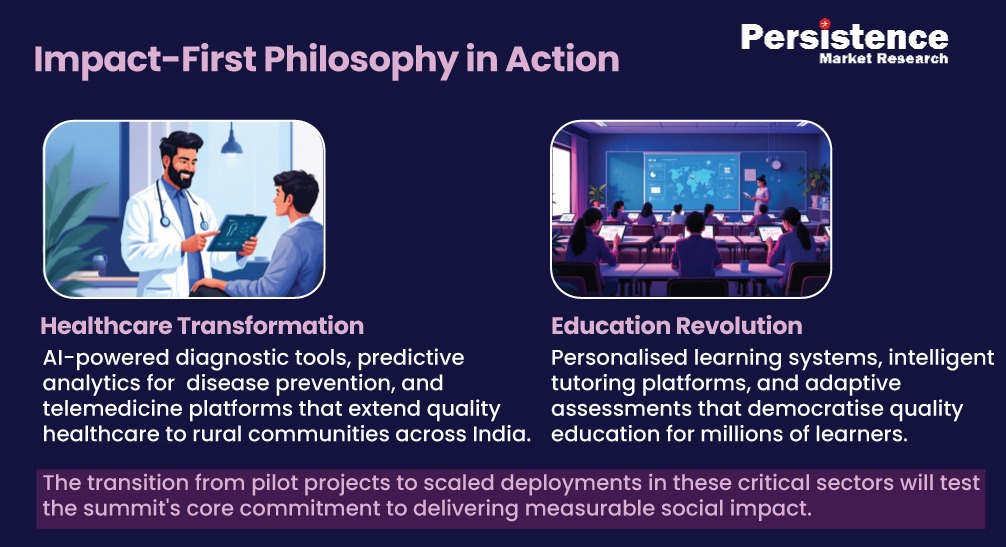
- The event also stressed on applied, impact-first AI. Exclusive discussions focused on model performance, centered on measurable social and economic outcomes. Examples include AI tutors to enhance learning outcomes, diagnostic tools to support clinicians, and climate-sensitive forecasting systems. The emphasis was on scaling successful pilots into national programs capable of reaching millions.
- Investment in skilling and research infrastructure formed another pillar of the summit’s vision. Announcements and memoranda of understanding highlighted workforce development, national AI centers of excellence, and industry-academia partnerships designed to build local research ecosystems and talent pipelines. Taken together, these discussions painted a near-term future in which AI becomes more widely usable and more carefully regulated, supported by strong public-private partnerships driving domain-specific implementation.
Benefits and Challenges: The Prelude
Technology and Industry
The global artificial intelligence in cybersecurity market is projected to grow to US$234.3 billion, advancing at a CAGR of 31.7% to 2032. For the tech and industry, the summit is expected to accelerate the democratization of development platforms and cloud resources. The creation of new research and development hubs in the Global South and expanded startup support through public procurement and industry collaboration could stimulate localized AI innovation. This environment may lead to faster commercialization of region-specific AI products and services.
At the same time, challenges remain significant. As more actors deploy AI systems, ensuring security, interoperability, and robust model audits becomes increasingly complex. Governments must guard against vendor lock-in within public services while also preventing excessive concentration of compute resources among a limited number of providers.
Healthcare
The global AI in medical imaging market is projected to grow from US$ 2.4 billion in 2026 to US$ 12.6 billion by 2033, expanding at a CAGR of 26.7%. In healthcare, the summit’s impact-driven focus may translate into scaled diagnostic support systems, AI-assisted triage in low-resource settings, and improved epidemic prediction models tailored to local contexts. Multilateral collaborations discussed during the summit could accelerate the validation and responsible rollout of such technologies.
Yet the challenges are equally critical. Data privacy concerns, clinical validation requirements, regulatory approval processes, and the risk of biased outcomes if models are trained on non-representative datasets all require careful management. The procurement and governance frameworks adopted after the summit will determine whether healthcare AI strengthens equity or deepens disparities.
Education
Education stands to benefit from national-level AI tutors and personalized learning systems capable of addressing teacher shortages and uneven learning outcomes. Adaptive curricula and localized content could reduce educational disparities across regions and socioeconomic groups. Partnerships between universities and technology firms are likely to speed up pilot implementations. The expansion of cloud-based AI solutions is closely reflected in the growth of the artificial intelligence as a service market, expected to be valued at US$ 17.5 billion in 2026 and is projected to reach US$ 136.5 billion by 2033, growing at a CAGR of 34.1%.
On contrary, the questions around measuring pedagogical effectiveness at scale, mitigating algorithmic bias in assessments, and ensuring equitable digital access remain pressing. Without inclusive infrastructure and oversight, the benefits of AI-driven education may not reach the most vulnerable learners.
Governance and Public Services
For governance and public services, AI augmented systems have the potential to improve efficiency and transparency in areas such as social welfare targeting, fraud detection, and citizen engagement platforms. Dialogues on multilateral frameworks may strengthen cross-border cooperation on AI standards and accountability mechanisms.
Nevertheless, the risks of opaque automated decision-making and expanded surveillance cannot be ignored. Legal frameworks must balance innovation with the protection of civil liberties and fundamental rights. Political consensus achieved during the summit represents only the starting point, and implementation will ultimately determine outcomes.
Insights and Notable Perspectives
The summit featured prominent voices from industry and academia whose perspectives shaped the tone of discussions.
- Sam Altman (OpenAI) highlighted the possibility that falling AI costs could unlock broader adoption across sectors, particularly in education and healthcare. His remarks reflected optimism about scaling advanced models to serve real-world needs.
- Yann LeCun (Meta) emphasized the importance of accessibility and cost reduction, while also stressing the need to align incentives to ensure safe and responsible deployment. His perspective underscored the balance between innovation and oversight.
- Sundar Pichai and Demis Hassabis (Alphabet & Google) contributed to discussions on responsible research and the infrastructure required to scale beneficial AI systems. Their participation signaled strong industry engagement with the summit’s multilateral approach.
- The summit was inaugurated by the Prime Minister of India, Shri Narendra Modi, reflecting a positive outlook on the development of the AI ecosystem in the Indian soil. The presence of national leaders and global executives reinforced the idea that AI governance and deployment are now central policy priorities rather than purely technical concerns.
Together, these voices presented a dual narrative of optimism about AI’s transformative potential and realism about governance, equity, and distributional challenges.
Takeaways-
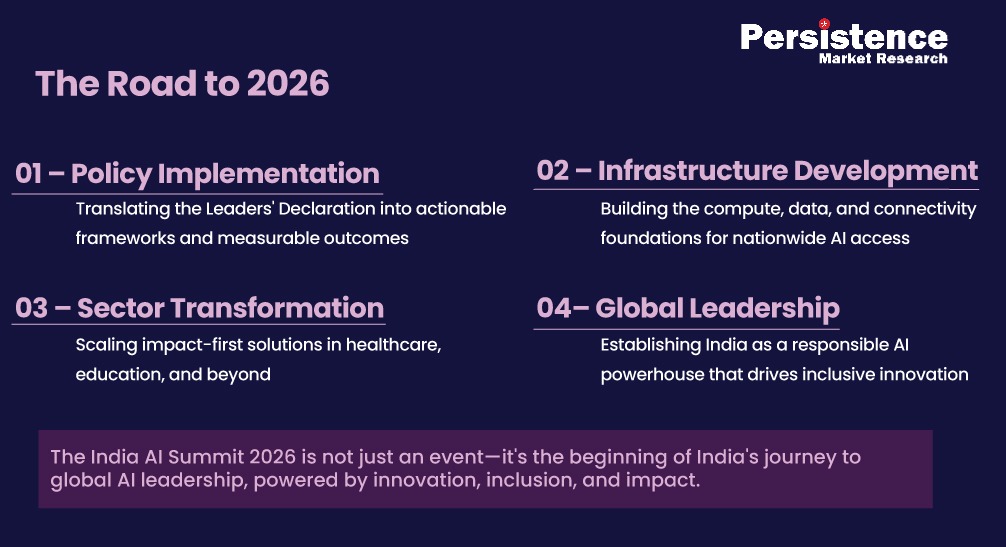
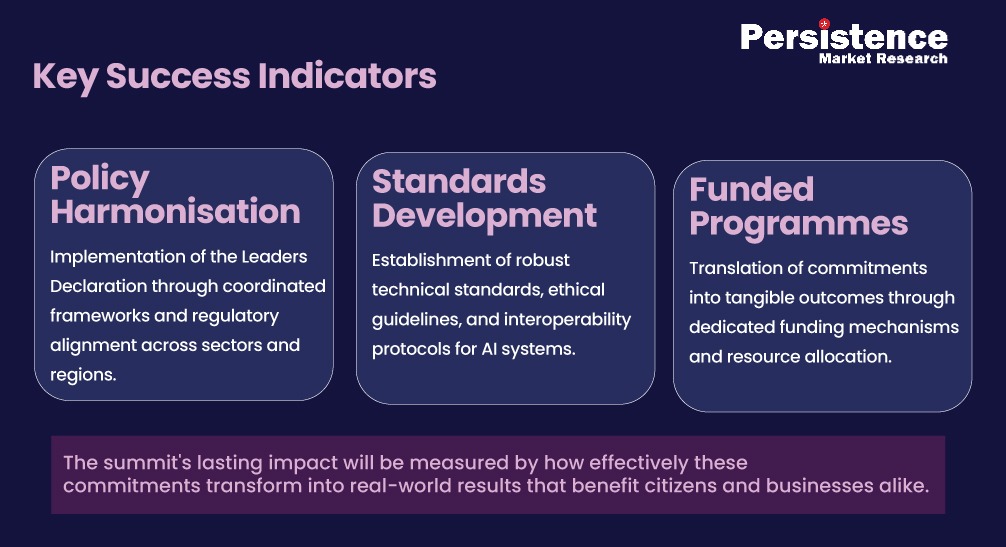
- The implementation of the Leaders’ Declaration will be a key indicator of the summit’s lasting impact. Policy harmonization, standards development, and funded programs will determine whether commitments translate into tangible outcomes. Working group outputs and bilateral memoranda of understanding merit close attention.
- Concrete announcements that reduce compute and data costs, such as cloud credits, regional data centers, or open model initiatives, will influence how rapidly AI adoption expands beyond large technology firms.
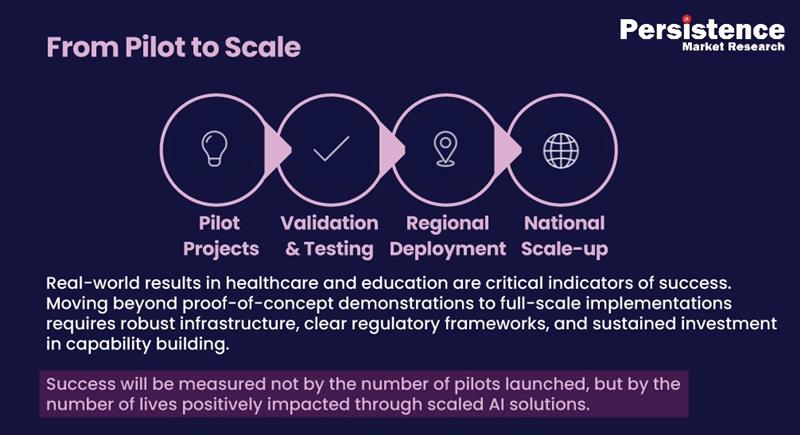
- Finally, the transition from pilot projects to scaled deployments in healthcare and education will test the summit’s impact-first philosophy. Real-world results in these sectors will serve as early indicators of success.
Conclusion
India AI Impact Summit 2026 reframed the global AI conversation by placing the Global South at its center and emphasizing impact and inclusion as core objectives. Its long-term significance will depend not on declarations alone but on the creation of open infrastructure, accountable governance systems, and scalable deployments that serve public interest goals. If its commitments lead to durable institutions and measurable societal benefits, the summit may mark a defining moment in the transition of AI from experimental innovation to widespread, responsible adoption.