

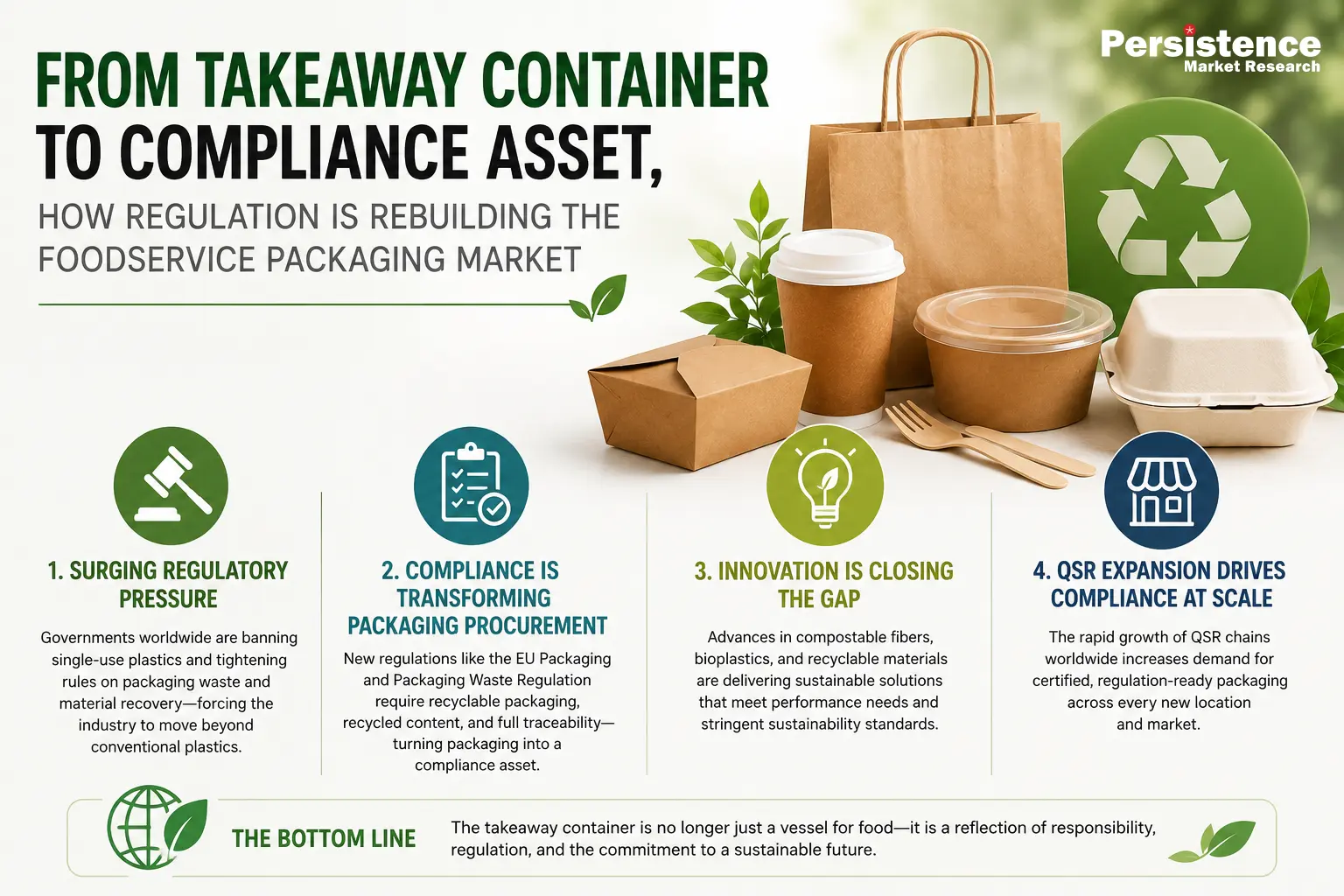
That scenario, however, has changed. Governments across three continents have rewritten what a foodservice container is legally permitted to be made of, how it must be labelled, and who is financially accountable for its end-of-life disposal. The object that was once the industry's afterthought has become one of its most scrutinized procurement decisions. The global foodservice packaging market, valued at an estimated US$126.1 billion in 2026, is projected to reach US$201.2 billion by 2033, growing at a compound annual growth rate (CAGR) of 6.9% during the forecast period.
Traditional Plastic Packaging is Facing Surging Regulatory Pressure
What was once considered a procurement decision is gradually becoming a boardroom discussion. Foodservice operators are facing growing pressure to balance cost efficiency with sustainability commitments, while governments are introducing strict rules around packaging waste and material recovery. The shift is particularly significant because conventional plastics have long been the foundation of the industry's packaging economics, offering a combination of low cost and durability.
Plastic currently holds approximately 49% of the global foodservice packaging market share by material type, a position accumulated over decades on the strength of that cost and performance advantage. The numbers reflect the scale of what is now being unwound. The EU's Single-Use Plastics Directive banned expanded polystyrene food and beverage containers across all 27 member states with effect from July 2021, removing one of the most widely used foodservice formats from Europe’s market in a single regulatory action. That ban was not an endpoint, but it was the first signal of what was coming next.
Compliance Requirements Are Transforming Packaging Procurement
For years, foodservice operators could switch packaging suppliers with relatively little consequence. If a container met performance requirements and fit within procurement budgets, the decision was largely straightforward. That assumption is becoming increasingly outdated. Packaging is no longer evaluated solely on cost, durability, or functionality. Regulators now expect businesses to understand what materials are being used, where they originate, and how they will be managed at the end of their lifecycle.
In February 2025, the European Union's Packaging and Packaging Waste Regulation (EU) 2025/40 entered into force, establishing new requirements around recyclability, recycled content, and packaging design. The regulation requires all packaging placed on the EU market to be recyclable by 2030, while also introducing minimum recycled-content thresholds for several plastic packaging categories. The move marks a transition from restrictions targeting specific materials toward a broad framework governing the entire packaging lifecycle. What began as efforts to reduce certain single-use plastic formats is now evolving into a system that dictates how packaging must be designed.
Plastic packaging used for contact-sensitive polyethylene terephthalate (PET) applications must contain at least 30% recycled content by 2030, with the requirement increasing to 50% by 2040. Single-use plastic cups, containers, and disposable plates used in hotels, restaurants, and cafés face category-level restrictions. Manufacturers must issue EU Declarations of Conformity confirming that every packaging type meets the applicable requirements.
The practical implications extend well beyond manufacturers. A container that was legally procurable in 2023 may require reformulation, recertification, or complete replacement by 2026. Packaging is no longer being sourced solely as a product. It is increasingly being evaluated as a compliance asset, supported by documentation, material traceability, and clearly defined end-of-life pathways.
Material Innovation is Closing the Gap Between Sustainability and Performance
A regulatory deadline is only effective if the market has a practical way to respond. For much of the past decade, that remained a challenge in foodservice packaging, where sustainable alternatives often struggled to match conventional plastics on durability, barrier performance, or cost. That gap is beginning to narrow. As compliance requirements become more demanding, innovation is moving from a competitive advantage to a business necessity.
The most instructive example of where that competition now stands is the August 2024 initiative between Starbucks and Finnish packaging specialist Huhtamaki. They introduced compostable molded fiber lids and double-walled paperboard cups with a bioplastic liner for cold beverages at 24 participating store locations in California and Minnesota. The locations were chosen specifically because of state-level extended producer responsibility mandates already in force in those markets. Cold beverage packaging has historically been among the most technically challenging categories for compostable formats, where condensation, structural load, and temperature differentials have complicated the development of fiber-based alternatives capable of meeting commercial performance expectations.
QSR Network Expansion is Multiplying the Expansion of Compliance Procurement
While regulations are changing what packaging must be made of, the rapid expansion of quick-service restaurant chains is increasing the volume of compliant packaging required worldwide. Every new restaurant opening creates recurring demand for certified foodservice packaging, making Quick-service restaurant (QSR) expansion a leading growth driver for the industry.. McDonald's, for example, has committed to opening 9,000 new locations by 2027. Starbucks also added 791 net new locations in fiscal year 2025 alone. Each new unit opening does not simply add volume to the packaging supply chain, but it also adds a compliance obligation. This is because every market these chains are entering now has, or is in the process of enacting packaging-specific regulatory requirements.
QSRs represent the largest end-user segment in foodservice packaging. Their standardized procurement systems and large-scale supply chains make it easier to adopt packaging that meets regulatory requirements across multiple markets. While small-scale operators face more challenges in transition, QSR expansion is effectively creating a high-volume channel for compliant packaging formats. This makes large restaurant chains a key driver in accelerating the shift toward certified and regulation-ready packaging solutions.
Foodservice Packaging to Move toward a Compliance-Led and Design-Driven Era Ahead
The foodservice packaging market is undergoing a foundational shift, as packaging is now evaluated not only for its functionality but also for its material composition, regulatory compliance, and end-of-life accountability. Across the EU, India, China, and a growing number of state-level jurisdictions in the U.S., the takeaway container has been transformed from an unregulated commodity into a tracked, certified, and accountable compliance asset.
It must now carry proof of its material composition, its recyclability credentials, and its manufacturer's identity. The industry's trajectory will likely be shaped not by those who produce the most packaging, but by those who can deliver formats that satisfy regulatory requirements, match the performance standards of conventional plastic, and scale at the speed that global QSR expansion demands.


