

Reports indicate that the multi-year agreement could be valued at approximately 10 trillion won, or around 6.8 billion US dollars, although the exact figure has not been formally confirmed by Samsung SDI. Regardless of the precise valuation, the agreement marks Samsung SDI’s first direct EV battery supply deal with Mercedes-Benz and reflects a growing alignment between premium automakers and advanced battery suppliers.
The timing reinforces its importance. According to the International Energy Agency, the global lithium-ion battery market exceeded 150 billion US dollars in 2025. Battery deployment has increased sixfold since 2020, with electric vehicles accounting for more than 70 percent of total demand. The EV battery segment is no longer a supporting industry. It has become a central pillar of global clean energy transformation.
The EV Battery Landscape: Scale, Chemistry, and Competitive Pressure
The rapid expansion of the EV battery market is directly linked to accelerating electric vehicle adoption. The International Energy Agency reports that global EV battery demand surpassed 950 GWh in 2024, reflecting a 25 percent increase from the previous year. Electric cars alone accounted for over 85 percent of this demand.
Sales momentum remains strong. More than 4 million electric vehicles were sold in the first quarter of 2025, and total annual sales are expected to exceed 20 million units. This would represent roughly one quarter of global car sales. Such scale places continuous pressure on battery manufacturers to secure long-term supply contracts, expand production capacity, and improve performance metrics such as energy density, charging speed, and safety.
At the same time, the market is becoming increasingly differentiated by battery chemistry and vehicle segment. High nickel nickel cobalt manganese batteries, often referred to as NCM batteries, are gaining preference in premium vehicles due to their ability to deliver longer driving range and higher energy output.
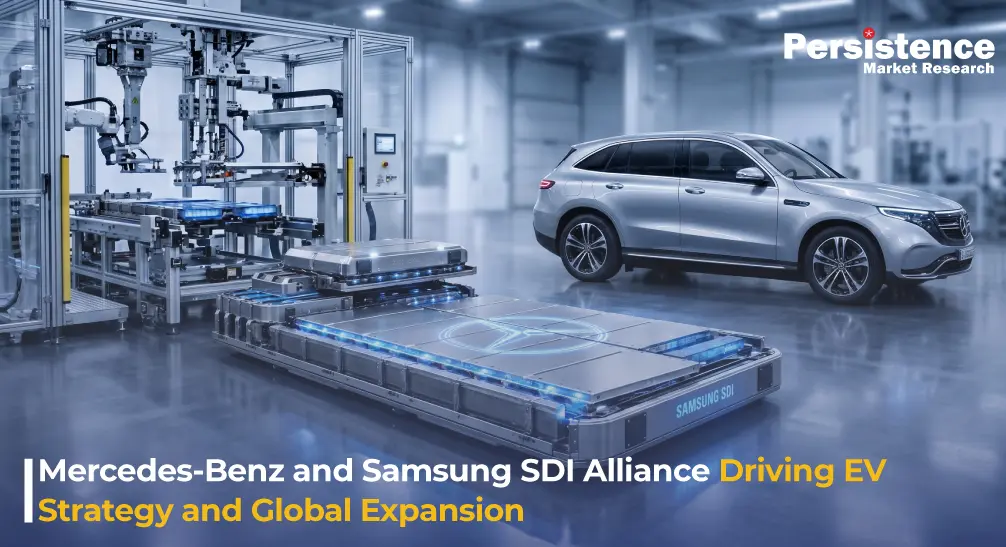
Samsung SDI’s batteries for Mercedes-Benz are expected to use high nickel NCM chemistry combined with proprietary safety technologies. These batteries will likely be deployed in upcoming compact and mid size electric SUVs and coupe models. This indicates that the agreement supports not just current production but also future vehicle platforms.
Why the Samsung SDI and Mercedes-Benz Deal Matters
This agreement represents a significant milestone for Samsung SDI. While the company has long been a major player in the battery industry, securing a partnership with Mercedes-Benz elevates its standing within the premium automotive segment. Brand association plays a crucial role in this category, where performance, reliability, and engineering excellence are closely scrutinized.
For Samsung SDI, the deal strengthens its global market position and opens the door to further collaborations with high-end automakers. The company has also indicated that the partnership will extend beyond supply, with both firms exploring joint development of next generation battery technologies.
For Mercedes-Benz, the deal addresses a critical operational challenge. As the company accelerates its transition toward electric mobility, securing a stable and high performance battery supply becomes essential. A multi-year agreement ensures production continuity and reduces exposure to supply chain disruptions.
The benefits extend to product development as well. Premium electric vehicles must deliver consistent performance across multiple dimensions, including range, acceleration, safety, and user experience. By partnering with a technologically advanced supplier, Mercedes-Benz gains greater control over these performance variables.
The collaboration also reflects a broader shift in industry dynamics. Battery suppliers are no longer interchangeable vendors. They are becoming strategic partners involved in technology development. This relationship can be compared to the way semiconductor companies collaborate with smartphone manufacturers, where both sides contribute to product innovation and long term roadmaps.
Market Impact and Strategic Implications
The Samsung SDI and Mercedes-Benz agreement highlights an important shift in the EV battery market. Scale alone is no longer sufficient to remain competitive. According to the International Energy Agency, battery prices declined by approximately 8 percent in 2025 due to manufacturing improvements and increased competition. While this trend supports EV affordability, it also compresses margins for battery producers.
As a result, differentiation is increasingly based on technology, reliability, and long term partnerships. A multi-year contract with a premium automaker serves as both a revenue stream and a validation of technical capability. It can enhance a supplier’s credibility and improve its ability to secure additional contracts.
For automakers, battery sourcing has become a strategic priority at the highest levels of decision making. Companies must evaluate not only performance characteristics but also production location, raw material sourcing, and scalability. These factors influence vehicle pricing, regulatory compliance, and time to market.
Consider the premium electric SUV segment as an example. Consumers in this category expect extended driving range, rapid acceleration, and high comfort levels. High nickel NCM batteries are well suited to these requirements, making them a logical choice for manufacturers targeting this segment. In this context, Mercedes-Benz is not simply procuring batteries. It is securing a performance foundation for its future vehicles.


