Sports Supplements Market Size, Share, Trends, Growth, and Forecasts for 2025 - 2032

Sports Supplements Market By Product Type (Protein, Non-protein), Nature (Organic, Conventional), Distribution Channel (Hypermarkets and Supermarkets, Pharmacy and Drug Stores, Specialty Stores, Online), and Regional Analysis for 2025 - 2032

ID: PMRREP3034
Calendar

September 2025

192 Pages

Author : Abhijeet Surwase

Market Factors - Growth, Barriers, and Opportunity Analysis

Rising Fitness Consciousness and Preventive Health

Global fitness awareness is surging, with more individuals engaged in sports, gymming, and active living. Health campaigns in regions such as the U.S. (Healthy People 2030) and India (Fit India Movement) have spurred demand for nutritional supplements, notably protein powders. According to industry estimates, gym memberships and organized sports participation rose by 18% in key markets from 2020 to 2025, positioning sports supplements as essential performance aids.

Alongside rising participation, North America continues to dominate the market, supported by superior purchasing power, novel fitness infrastructure, and a deep-rooted gym culture that promotes preventive health practices. In Asia Pacific, steady growth is evident as urbanization and rising disposable income encourage consumers to adopt healthy routines, from yoga and home workouts to structured gym training.

E-commerce Expansion and Digital Accessibility

Online retail platforms have lowered entry barriers and broadened product reach. The direct-to-consumer model allows brands to customize product lines and maintain robust consumer engagement. E-commerce ensures rapid expansion, with digital channels reporting a 22% annual increase in purchase frequency since 2022.

E-commerce has fundamentally transformed the sports supplements landscape beyond rapid expansion and increased purchase frequency. Leading online retailers such as Amazon, iHerb, and Flipkart Health+ now carry an extensive portfolio of certified products, increasing accessibility for both mainstream and niche consumer segments.

Clean-label Innovation and Product Transparency

Sustained growth is stimulated by consumer preferences for clean-label, organic, and plant-based ingredients. Regulatory bodies such as the U.S. Food and Drug Administration (FDA) and European Food Safety Authority as well as industry standards now emphasize transparency and ingredient traceability, fueling investments in product reformulation and certification. As per a new survey, companies allocating over 25% of research and development budgets to clean-label innovation outperformed competitors by 11 to 15% in market growth since 2021.

The shift is not limited to developed markets but is also gaining impetus in Asia Pacific and Latin America, where younger demographics are highly responsive to sustainable and ethical product positioning. Plant-based protein powders, collagen alternatives, and allergen-free formulations are now central to product pipelines, with various brands highlighting non-GMO, gluten-free, and soy-free claims to attract diverse consumer groups.

Market Restraints

Regulatory and Safety Challenges

Complex regulatory frameworks and stringent safety requirements delay product rollouts and raise compliance costs, particularly in Europe and North America. Adverse events linked to substandard ingredients continue to prompt scrutiny, leading to mandatory certifications and recall notices. Approximately 9% of supplement launches in 2024 were delayed based on regulatory findings or incomplete safety documentation.

Rising Raw Material and Supply Chain Costs

Sourcing high-quality protein, including dairy and plant-based, and specialty ingredients faces inflationary pressures, with input cost inflation averaging 6.8% annually since 2022. Geopolitical risks and disruptions in global logistics further constrain supply reliability, contributing to product shortages and price volatility. Competitive pricing pressures persist, especially from private labels and new market entrants targeting the budget segment.

Market Opportunities

Emergence of Personalized Nutrition

Innovations in digital health and wearables facilitate personalized supplement regimens, with over 30% of consumers indicating preference for customized sports nutrition solutions. Companies integrating AI-based recommendation engines and smart packaging are forecast to add US$ 2.1 Bn in revenue by 2028.

Policy Support and Government Initiatives

Government campaigns promoting physical education and preventive health catalyze market growth. Policy support for research and development grants, flexible import/export policies, and public-private partnerships are creating sustainable growth opportunities that could expand market access by 12 to 18% in target countries through 2028.

Technological Integration and Digital Channels

The integration of technology into fitness and nutrition is opening powerful new avenues for sports supplement manufacturers. Wearable devices, AI-based fitness apps, and DNA testing kits are increasingly being paired with supplement recommendations, enabling hyper-personalized regimens that strengthen consumer trust and adherence.

Category-wise Analysis

Product Type Insights

Protein supplements dominate the product type category with a share of nearly 67.4% in 2025. Growth is favored by athletes and fitness enthusiasts for their role in muscle building and repair. The segment enjoys robust consumer trust due to proven efficacy and support for both recreational and competitive sports. Key players invest in whey, casein, and plant protein to cater to specific consumer requirements.

Non-protein products such as amino acids, creatine, and mineral blends are increasingly popular with endurance athletes and broad demographic groups. Segment expansion is fueled by technological development and rising awareness of holistic performance support. It will likely record a CAGR of about 8.9% from 2025 to 2032.

Nature Insights

Organic products have surged in popularity, fueled by increasing demand for chemical-free nutritional sources and transparent labeling. Continuous product launches and regulatory endorsements consolidate their appeal and market share. Owing to the aforementioned factors, the segment is poised to account for approximately 58.3% of market share in 2025.

Despite organic’s dominance, conventional supplements retain a substantial segment owing to cost accessibility and evolving formulation improvements. Strategic price positioning by high-volume manufacturers supports their expansion. As per research analysts, the segment is predicted to exhibit nearly 9.2% CAGR through 2032.

Distribution Channel Insights

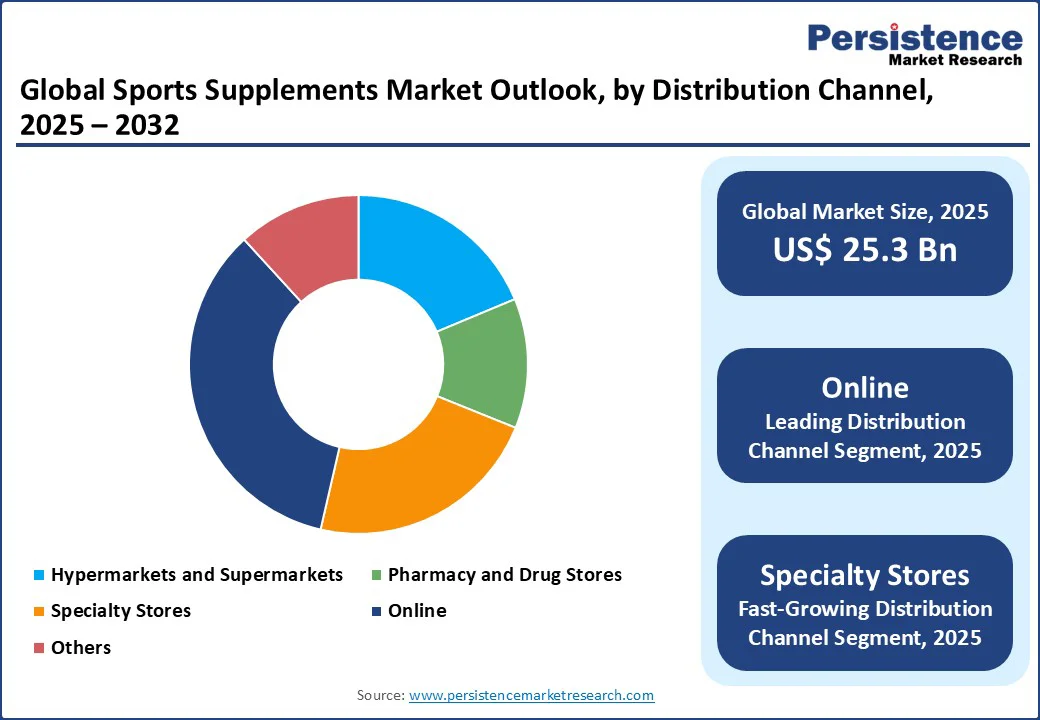
Digital or online channels have redefined consumer engagement, delivering product diversity, competitive pricing, and supply chain efficiency. The segment leads, supported by investments in omnichannel strategies and robust logistics. It is anticipated to account for about 34.6% of the global market share in 2025.

Specialty stores garner loyalty among informed consumers seeking expert advice and exclusive products. Improved store formats and targeted marketing fuel above-average segment expansion, particularly in urban centers. These factors are responsible for a CAGR of nearly 8.5% for the segment in the forecast period.
global-sports-supplements-market-outlook-by-distribution-channel-2025–2032

Regional Insights

North America Sports Supplements Market Trends

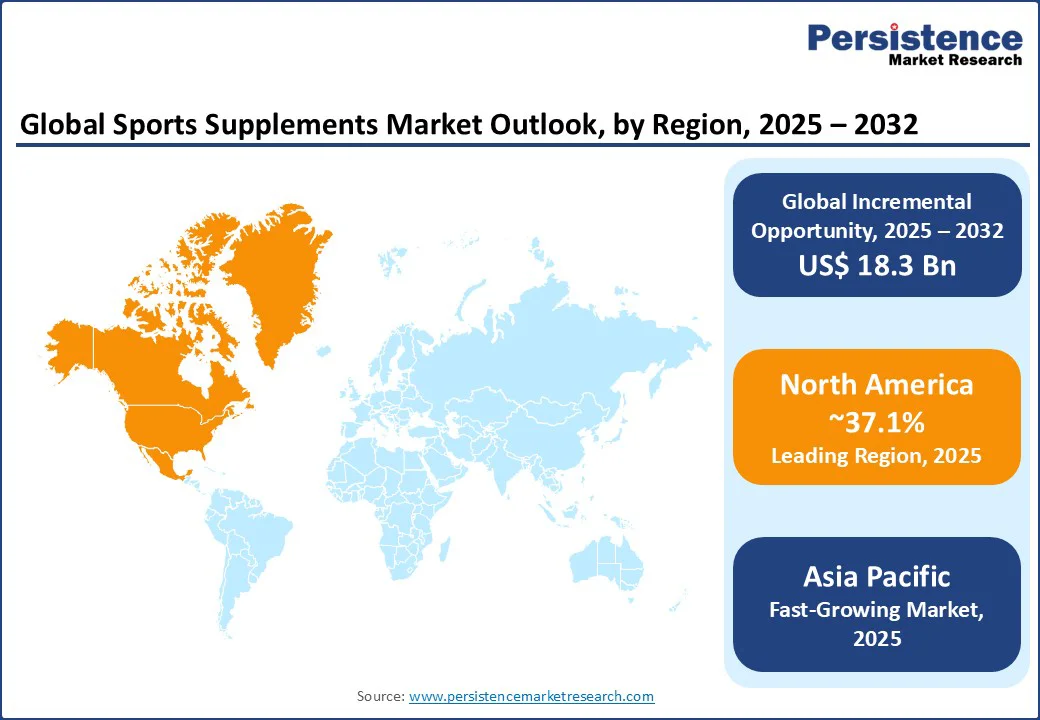
North America holds the most prominent share in the global market, with the U.S. accounting for the majority of revenue. It is due to high consumer awareness, government health campaigns, and unique product innovation ecosystems. The regional market is forecast to account for a market share of nearly 37.1% in 2025, propelled by constant product launches and strategic cross-industry partnerships.

Regulatory rigor by FDA and FTC ensures high standards for product safety and transparency, shaping competitive dynamics in compliance and public trust. Investment trends favor digital initiatives as well as research and development in plant-based and personalized nutrition, with leading companies allocating over 15% of annual budgets to these domains.

Asia Pacific Sports Supplements Market Trends

Asia Pacific, including China, Japan, India, and the ASEAN region, represents the fastest-growing market zone, propelled by manufacturing advantages, urbanization, and evolving consumer health priorities. The regional market is forecast to rise at a CAGR of 9.5% through 2032, outpacing global averages.

Government health initiatives, rising disposable income, and surging digital access support market formation and expansion. Competitive landscape is fragmented with local and international brands competing for high share through pricing, distribution, and product innovation. Investment flows are increasingly directed to infrastructure and localized branding, especially in China and India.

Europe Sports Supplements Market Trends

Europe, led by Germany, the U.K., France, and Spain, represents a mature market for sports supplements, marked by regulatory harmonization and proactive sustainability adoption. The market is distinguished by ongoing adoption of organic and clean-label products, supported by EU-wide policies and rigorous labeling requirements.

Market size is projected to surpass US$ 9.2 Bn by 2032, with competitive intensity propelled by multi-country launches and strategic alliances. Key players prioritize agility and compliance, responding to evolving consumer tastes with local production investments and certified supply chains.
global-sports-supplements-market-outlook-by-region-2025–2032

Competitive Landscape

The sports supplements market features a mix of global leaders and specialized niche players, exhibiting moderately consolidated characteristics. Top players collectively hold over 38% of the global market share, with constant portfolio expansion and vertical integration strengthening their positions.

Business Strategies

Market leaders prioritize innovation, clean-label transparency, and multi-channel distribution. Strategic elements center on ingredient traceability, cost leadership via supply chain optimization, and digital branding, with emerging trends in direct-to-consumer and subscription models.

Key Industry Developments

  • In September 2025, Primal Power Nutrition (PPN) announced that it is planning to debut its products in Hong Kong. Set up by Carl Marks, Harrison King, and Nonu Dadlani, the start-up will be launching products in the whey protein, electrolytes, and creatine categories.
  • In July 2025, Team Picnic PostNL and dsm-firmenich declared that their up4 Sports Nutrition range will be made available to the public for the first time. These have already been exclusively used by the team, and the launch comes ahead of the upcoming Tour de France.

Companies Covered in Sports Supplements Market

  • Glanbia plc
  • Abbott Nutrition (Abbott Laboratories)
  • PepsiCo, Inc.
  • Nestlé S.A.
  • Herbalife Nutrition
  • CytoSport, Inc.
  • Cellucor (Nutrabolt)
  • Myprotein (The Hut Group)
  • MusclePharm Corporation
  • The Bountiful Company
  • Others
Frequently Asked Questions

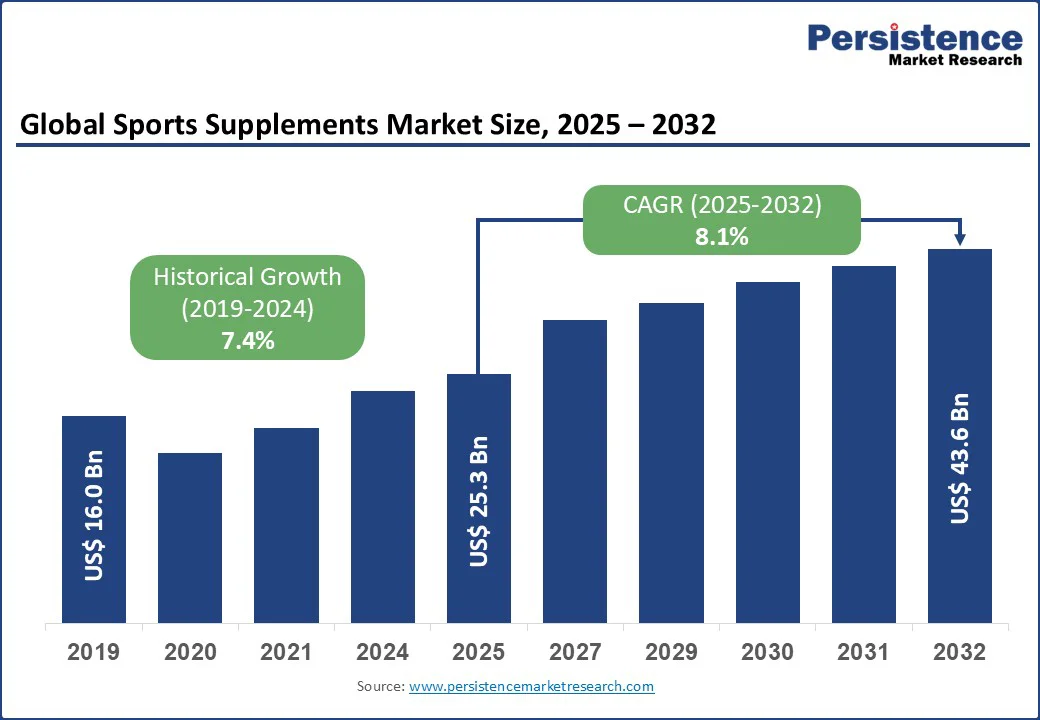
The sports supplements market is likely to value at US$ 25.3 Bn in 2025.

Rising health consciousness among millennials and growing participation in professional sports are the key market drivers.

The sports supplements market is poised to witness a CAGR of 8.1% from 2025 to 2032.

Transparency in ingredient sourcing and rising demand from emerging markets are the key market opportunities.

Glanbia plc, Abbott Nutrition (Abbott Laboratories), and PepsiCo, Inc. are a few key market players.

Global Sports Supplements Market Report Scope
Report Attribute Details

Historical Data/Actuals

2019 - 2024

Forecast Period

2025 - 2032

Market Analysis

Value: US$ Bn/Mn, Volume: As Applicable

Geographical Coverage

  • North America
  • Europe
  • East Asia
  • South Asia and Oceania
  • Latin America
  • Middle East and Africa

Segmental Coverage

  • Product Type
  • Nature
  • Distribution Channel
  • Region

Competitive Analysis

  • Glanbia plc
  • Abbott Nutrition (Abbott Laboratories)
  • PepsiCo, Inc.
  • Nestlé S.A.
  • Herbalife Nutrition
  • CytoSport, Inc.
  • Cellucor (Nutrabolt)
  • Myprotein (The Hut Group)
  • MusclePharm Corporation
  • The Bountiful Company
  • Others

Report Highlights

  • Market Forecast and Trends
  • Competitive Intelligence and Share Analysis
  • Growth Factors and Challenges
  • Strategic Growth Initiatives
  • Pricing Analysis
  • Future Opportunities and Revenue Pockets
  • Market Analysis Tools
Market Segmentation

By Product Type

  • Protein
  • Non-protein

By Nature

  • Organic
  • Conventional

By Distribution Channel

  • Hypermarkets and Supermarkets
  • Pharmacy and Drug Stores
  • Specialty Stores
  • Online
  • Others

By Region

  • North America
  • Europe
  • East Asia
  • South Asia and Oceania
  • Latin America
  • Middle East and Africa

Related Reports

  1. Executive Summary
    1. Global Sports Supplements Market Snapshot, 2025 and 2032
    2. Market Opportunity Assessment, 2025 - 2032, US$ Bn
    3. Key Market Trends
    4. Future Market Projections
    5. Premium Market Insights
    6. Industry Developments and Key Market Events
    7. PMR Analysis and Recommendations
  2. Market Overview
    1. Market Scope and Definition
    2. Market Dynamics
      1. Drivers
      2. Restraints
      3. Opportunity
      4. Challenges
      5. Key Trends
    3. COVID-19 Impact Analysis
    4. Forecast Factors - Relevance and Impact
  3. Value Chain Analysis
    1. Supply Chain Analysis
    2. List of Key Market Players
  4. Value Added Insights
    1. PESTLE Analysis
    2. Porter’s Five Force Analysis
  5. Price Trend Analysis, 2019 - 2032
    1. Pricing Analysis, By Product Type
    2. Key Factors Impacting Prices, By Nature
  6. Global Sports Supplements Market Outlook
      1. Market Size (US$ Bn) and Y-o-Y Growth
      2. Absolute $ Opportunity
    1. Market Size (US$ Bn) Analysis and Forecast
      1. Historical Market Size (US$ Bn) Analysis, 2019-2024
      2.  Market Size (US$ Bn) Analysis and Forecast, 2025-2032
    2. Global Sports Supplements Market Outlook: Product Type
      1. Historical Market Size (US$ Bn) Analysis, By Product Type, 2019-2024
      2.  Market Size (US$ Bn) Analysis and Forecast, By Product Type, 2025-2032
        1. Protein
        2. Non-protein
      3. Market Attractiveness Analysis: Product Type
    3. Global Sports Supplements Market Outlook: Nature
      1. Historical Market Size (US$ Bn) Analysis, By Nature, 2019-2024
      2.  Market Size (US$ Bn) Analysis and Forecast, By Nature, 2025-2032
        1. Organic
        2. Conventional
      3. Market Attractiveness Analysis: Nature
    4. Global Sports Supplements Market Outlook: Distribution Channel
      1. Historical Market Size (US$ Bn) Analysis, By Distribution Channel, 2019-2024
      2.  Market Size (US$ Bn) Analysis and Forecast, By Distribution Channel, 2025-2032
        1. Hypermarkets and Supermarkets
        2. Pharmacy and Drug Stores
        3. Specialty Stores
        4. Online
        5. Others
      3. Market Attractiveness Analysis: Distribution Channel
  7. Global Sports Supplements Market Outlook: Region
    1. Historical Market Size (US$ Bn) Analysis, By Region, 2019-2024
    2.  Market Size (US$ Bn) Analysis and Forecast, By Region, 2025-2032
      1. North America
      2. Europe
      3. East Asia
      4. South Asia and Oceania
      5. Latin America
      6. Middle East & Africa
    3. Market Attractiveness Analysis: Region
  8. North America Sports Supplements Market Outlook
    1. Historical Market Size (US$ Bn) Analysis, By Market, 2019-2024
      1. By Country
      2. By Product Type
      3. By Nature
      4. By Distribution Channel
    2.  Market Size (US$ Bn) Analysis and Forecast, By Country, 2025-2032
      1. U.S.
      2. Canada
    3.  Market Size (US$ Bn) Analysis and Forecast, By Product Type, 2025-2032
      1. Protein
      2. Non-protein
    4.  Market Size (US$ Bn) Analysis and Forecast, By Nature, 2025-2032
      1. Organic
      2. Conventional
    5.  Market Size (US$ Bn) Analysis and Forecast, By Distribution Channel, 2025-2032
      1. Hypermarkets and Supermarkets
      2. Pharmacy and Drug Stores
      3. Specialty Stores
      4. Online
      5. Others
    6. Market Attractiveness Analysis
  9. Europe Sports Supplements Market Outlook
    1. Historical Market Size (US$ Bn) Analysis, By Market, 2019-2024
      1. By Country
      2. By Product Type
      3. By Nature
      4. By Distribution Channel
    2.  Market Size (US$ Bn) Analysis and Forecast, By Country, 2025-2032
      1. Germany
      2. France
      3. U.K.
      4. Italy
      5. Spain
      6. Russia
      7. Türkiye
      8. Rest of Europe
    3.  Market Size (US$ Bn) Analysis and Forecast, By Product Type, 2025-2032
      1. Protein
      2. Non-protein
    4.  Market Size (US$ Bn) Analysis and Forecast, By Nature, 2025-2032
      1. Organic
      2. Conventional
    5.  Market Size (US$ Bn) Analysis and Forecast, By Distribution Channel, 2025-2032
      1. Hypermarkets and Supermarkets
      2. Pharmacy and Drug Stores
      3. Specialty Stores
      4. Online
      5. Others
    6. Market Attractiveness Analysis
  10. East Asia Sports Supplements Market Outlook
    1. Historical Market Size (US$ Bn) Analysis, By Market, 2019-2024
      1. By Country
      2. By Product Type
      3. By Nature
      4. By Distribution Channel
    2.  Market Size (US$ Bn) Analysis and Forecast, By Country, 2025-2032
      1. China
      2. Japan
      3. South Korea
    3.  Market Size (US$ Bn) Analysis and Forecast, By Product Type, 2025-2032
      1. Protein
      2. Non-protein
    4.  Market Size (US$ Bn) Analysis and Forecast, By Nature, 2025-2032
      1. Organic
      2. Conventional
    5.  Market Size (US$ Bn) Analysis and Forecast, By Distribution Channel, 2025-2032
      1. Hypermarkets and Supermarkets
      2. Pharmacy and Drug Stores
      3. Specialty Stores
      4. Online
      5. Others
    6. Market Attractiveness Analysis
  11. South Asia & Oceania Sports Supplements Market Outlook
    1. Historical Market Size (US$ Bn) Analysis, By Market, 2019-2024
      1. By Country
      2. By Product Type
      3. By Nature
      4. By Distribution Channel
    2.  Market Size (US$ Bn) Analysis and Forecast, By Country, 2025-2032
      1. India
      2. Southeast Asia
      3. ANZ
      4. Rest of South Asia & Oceania
    3.  Market Size (US$ Bn) Analysis and Forecast, By Product Type, 2025-2032
      1. Protein
      2. Non-protein
    4.  Market Size (US$ Bn) Analysis and Forecast, By Nature, 2025-2032
      1. Organic
      2. Conventional
    5.  Market Size (US$ Bn) Analysis and Forecast, By Distribution Channel, 2025-2032
      1. Hypermarkets and Supermarkets
      2. Pharmacy and Drug Stores
      3. Specialty Stores
      4. Online
      5. Others
    6. Market Attractiveness Analysis
  12. Latin America Sports Supplements Market Outlook
    1. Historical Market Size (US$ Bn) Analysis, By Market, 2019-2024
      1. By Country
      2. By Product Type
      3. By Nature
      4. By Distribution Channel
    2.  Market Size (US$ Bn) Analysis and Forecast, By Country, 2025-2032
      1. Brazil
      2. Mexico
      3. Rest of Latin America
    3.  Market Size (US$ Bn) Analysis and Forecast, By Product Type, 2025-2032
      1. Protein
      2. Non-protein
    4.  Market Size (US$ Bn) Analysis and Forecast, By Nature, 2025-2032
      1. Organic
      2. Conventional
    5.  Market Size (US$ Bn) Analysis and Forecast, By Distribution Channel, 2025-2032
      1. Hypermarkets and Supermarkets
      2. Pharmacy and Drug Stores
      3. Specialty Stores
      4. Online
      5. Others
    6. Market Attractiveness Analysis
  13. Middle East & Africa Sports Supplements Market Outlook
    1. Historical Market Size (US$ Bn) Analysis, By Market, 2019-2024
      1. By Country
      2. By Product Type
      3. By Nature
      4. By Distribution Channel
    2.  Market Size (US$ Bn) Analysis and Forecast, By Country, 2025-2032
      1. GCC Countries
      2. Egypt
      3. South Africa
      4. Northern Africa
      5. Rest of Middle East & Africa
    3.  Market Size (US$ Bn) Analysis and Forecast, By Product Type, 2025-2032
      1. Protein
      2. Non-protein
    4.  Market Size (US$ Bn) Analysis and Forecast, By Nature, 2025-2032
      1. Organic
      2. Conventional
    5.  Market Size (US$ Bn) Analysis and Forecast, By Distribution Channel, 2025-2032
      1. Hypermarkets and Supermarkets
      2. Pharmacy and Drug Stores
      3. Specialty Stores
      4. Online
      5. Others
    6. Market Attractiveness Analysis
  14. Competition Landscape
    1. Market Share Analysis, 2025
    2. Market Structure
      1. Competition Intensity Mapping By Market
      2. Competition Dashboard
    3. Company Profiles (Details - Overview, Financials, Strategy, Recent Developments)
      1. Glanbia plc
        1. Overview
        2. Segments and Product Type
        3. Key Financials
        4. Market Developments
        5. Market Strategy
      2. Abbott Nutrition (Abbott Laboratories)
      3. PepsiCo, Inc.
      4. Nestlé S.A.
      5. Herbalife Nutrition
      6. CytoSport, Inc.
      7. Cellucor (Nutrabolt)
      8. Myprotein (The Hut Group)
      9. MusclePharm Corporation
      10. The Bountiful Company
      11. Others
  15. Appendix
    1. Research Methodology
    2. Research Assumptions
    3. Acronyms and Abbreviations

Research Methodology Framework for Market Research Excellence

At Persistence Market Research, we implement a comprehensive, validated, and multi-dimensional approachto market analysis that delivers actionable insights across complex market landscapes. Our methodology combines the analytical rigor of leading consulting firms with innovative research techniques, ensuring robust market assessments that guide strategic decision-making with confidence.

Core Research Philosophy

Our methodology is built on four foundational pillars:

Research Philosophy Image

At Persistence Market Research, our methodology is designed to transcend conventional market studies by combining analytical rigor, multi-source validation, and future-focused insights.

We integrate advanced research frameworks, robust data collection strategies, cutting-edge analytics, and innovative technologies to deliver a 360-degree view of complex markets.

We integrate advanced research frameworks, robust data collection strategies, cutting-edge analytics, and innovative technologies to deliver a 360-degree view of complex markets.

Each stage spanning from strategic scoping and hypothesis-building to competitive intelligence, quality validation, and actionable recommendations is engineered to provide clients with unmatched clarity, precision, and confidence in decision-making.

By embedding innovation and technology at the core, our approach ensures that insights are not only comprehensive but also predictive, empowering businesses to seize opportunities, mitigate risks, and achieve sustainable growth

Research Philosophy Image

Capturing Key Information and Events

During this phase, key research objectives focus on essential information and data points for assessing the market, including:

Research Philosophy Image

TAM-SAM-SOM Framework Implementation

We employ both top-down and bottom-up approaches to ensure accurate market sizing.

Top-Down Market SizingBottom-Up Market Sizing
Universe Definition: Total global/regional market identificationUnit Economics: Average transaction values, purchase frequencies, customer lifecycle
Segmentation Filters: Geographic, demographic, and behavioral constraintsCustomer Segmentation: Detailed buyer persona development and sizing
Market Share Analysis: Competitive landscape assessment and share allocationPenetration Analysis: Market penetration rates by segment and geography
Growth Rate Application: Historical trends and forward-looking growth assumptionsScaling Methodology: Extrapolation techniques with confidence intervals

Validation & Cross-Verification

  • Triangulation: Comparing top-down and bottom-up results for consistency
  • Sensitivity Analysis: Testing key assumptions and parameter variations
  • Peer Benchmarking: Comparison with analogous markets and industry benchmarks
  • Expert Review: External validation through industry specialist consultation

Research Philosophy Image

Forecasting & Projection Modeling

Our proprietary forecasting models incorporate multiple variables and scenarios.

Forecasting Components

  • Historical Trend Analysis: 10-year historical growth patterns and cyclical variations
  • Driver-Based Modeling: Economic indicators, demographic shifts, technology adoption
  • Scenario Planning: Base case, optimistic, and conservative projections
  • Monte Carlo Simulations: Probability-weighted outcomes and risk assessments

Model Validation

  • Back-Testing: Historical accuracy assessment over 3–5-year periods
  • Cross-Validation: Multiple modeling approaches for result comparison
  • External Benchmarking: Comparison with established market forecasts
  • Continuous Calibration: Quarterly model updates based on new data

Comprehensive Data Collection Strategy

Our secondary research phase establishes a robust knowledge base utilizing diverse, credible sources.

Secondary Data Sourcess

  • Industry Publications & Reports
  • Government & Regulatory Data
  • Financial Intelligence (filings & reports)
  • Academic Research & Digital Intelligence

Quality Assurance Protocol

  • Source credibility assessment and publication date validation
  • Data consistency checks across multiple sources
  • Bias identification and neutralization techniques
  • Information gap tracking for primary research prioritization

Research Philosophy Image

Primary Research Excellence

Our primary research methodology employs best-in-class techniques to capture unique market insights.

Quantitative Research Methods

  • Large-Scale Surveys: Statistically representative samples with 95% confidence intervals
  • Survey Methodology: Multi-channel deployment (online, telephone, in-person)
  • Question Architecture and Response Optimization

Qualitative Research Methods

  • Executive Interviews
  • Focus Groups
  • Expert Consultations

Quality Assurance & Validation Framework

Multi-Stage Validation Process

  • Source Verification and Consistency Testing
  • Outlier Detection and Bias Assessment
  • Peer Review Process and External Validation
  • Sensitivity Analysis and Confidence Intervals

Research Philosophy Image

Methodology Validation & Credibility

Our research methodology has been extensively validated through:

  • Academic Partnerships: Collaborations with top-tier business schools and research institutions
  • Client Success Stories: Documented case studies demonstrating research impact and ROI
  • Continuous Benchmarking: Performance comparison with leading global research firms

This comprehensive methodology framework positions Persistence Market Research at the forefront of market intelligence, combining the analytical sophistication of top-tier consulting firms with innovative research techniques. Our approach ensures that every market assessment delivers precise, actionable, and strategically valuable insights that drive business success in competitive market environments.

Ready to unlock your market potential? Contact our research experts to discuss how our validated methodology can transform your strategic decision-making with data-driven market intelligence.

Copyright © 2026 Persistence Market Research. All Rights Reserved

Connect With Us -