




- Food Ingredients & Additives
- Organic Honey Market
Organic Honey Market Size, Share, Growth, and Regional Forecast, 2026 - 2033
Organic Honey Market by Product Type (Multifloral Organic Honey, Monofloral Organic Honey, and Others), Form (Raw Organic Honey, Processed Organic Honey, and Blended Organic Honey), Application (Food & Beverages, Nutraceuticals, Cosmetics & Personal Care, Pharmaceuticals, and Others) Distribution Channel (Supermarkets, Convenience Stores, Specialty Stores, Online Retail, and Others), and Regional Analysis from 2026 - 2033

Organic Honey Market Share and Trend Analysis
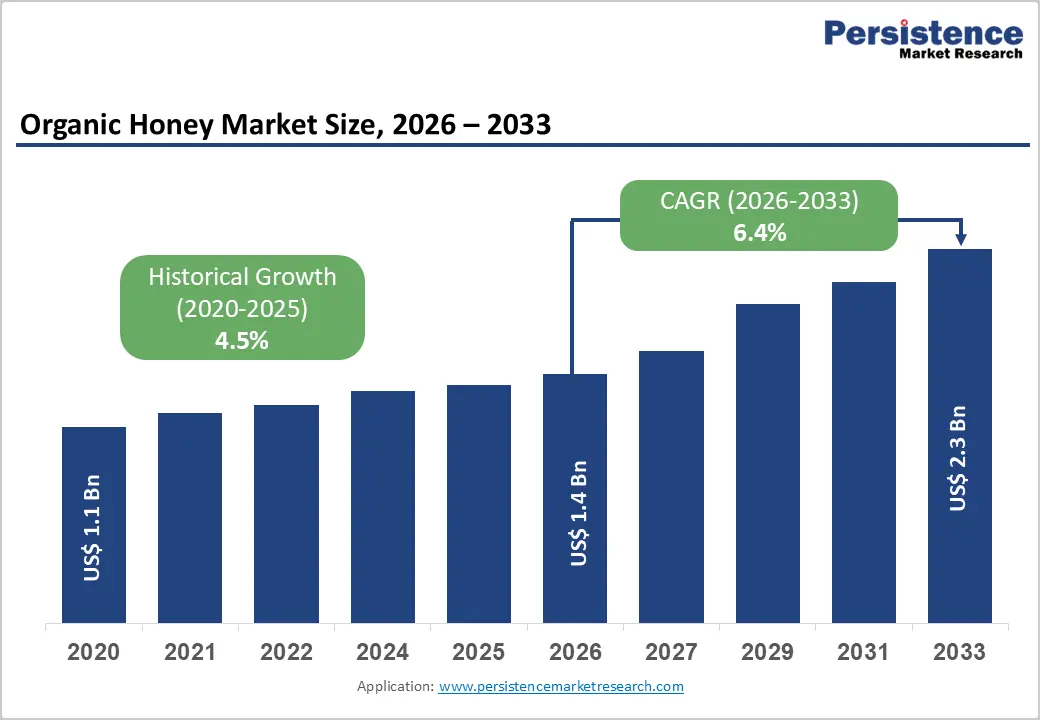
The global organic honey market size is estimated to grow from US$ 1.4 billion in 2026 to US$ 2.3 billion by 2033. The market is projected to grow at a CAGR of 6.4% from 2026 to 2033.
Increasing inclination toward naturally sourced sweetening ingredients is significantly strengthening the demand for organic honey across global food systems. Consumers are actively reducing intake of refined sugar and synthetic additives, encouraging manufacturers to integrate ingredients that deliver both functionality and nutritional value. Organic honey offers natural sugars, bioactive compounds, and a distinctive flavor profile, making it highly adaptable across bakery, beverages, dairy, and health-focused formulations. Its ability to enhance taste, texture, and product appearance further supports its widespread use.
Additionally, the growing emphasis on clean-label products is prompting food companies to adopt simple, recognizable ingredients that align with consumer expectations for transparency. Organic honey fits well within this framework due to its minimal processing and natural origin. Advancements in filtration, standardization of quality, and sustainable apiculture practices are improving product consistency, shelf life, and supply scalability. The expansion of premium and convenience food categories is also contributing to increased usage. Rising consumer awareness around wellness, immunity, and balanced nutrition continues to reinforce its positioning as a preferred natural sweetener in modern food manufacturing.
Key Industry Highlights:
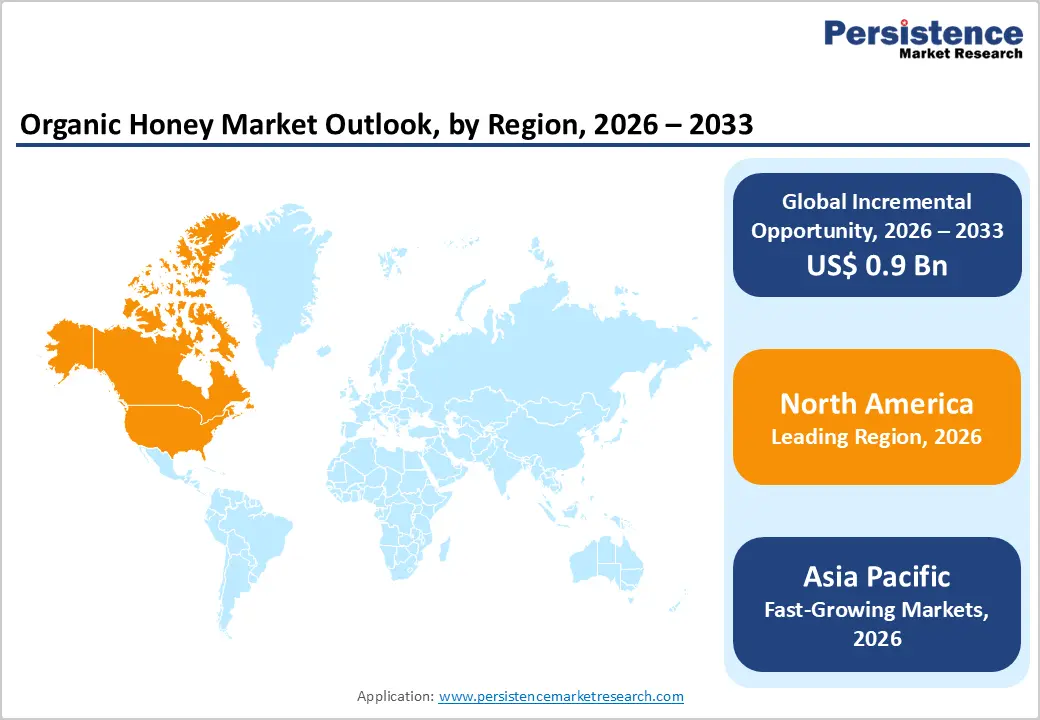
- Leading Region: North America holds 46.7% of the market, supported by strong demand for natural sweeteners, active product reformulation strategies, and a highly developed processed food sector.
- Fastest-Growing Region: Asia Pacific is witnessing rapid expansion, driven by urbanization, rising disposable incomes, and increasing adoption of healthier packaged food options.
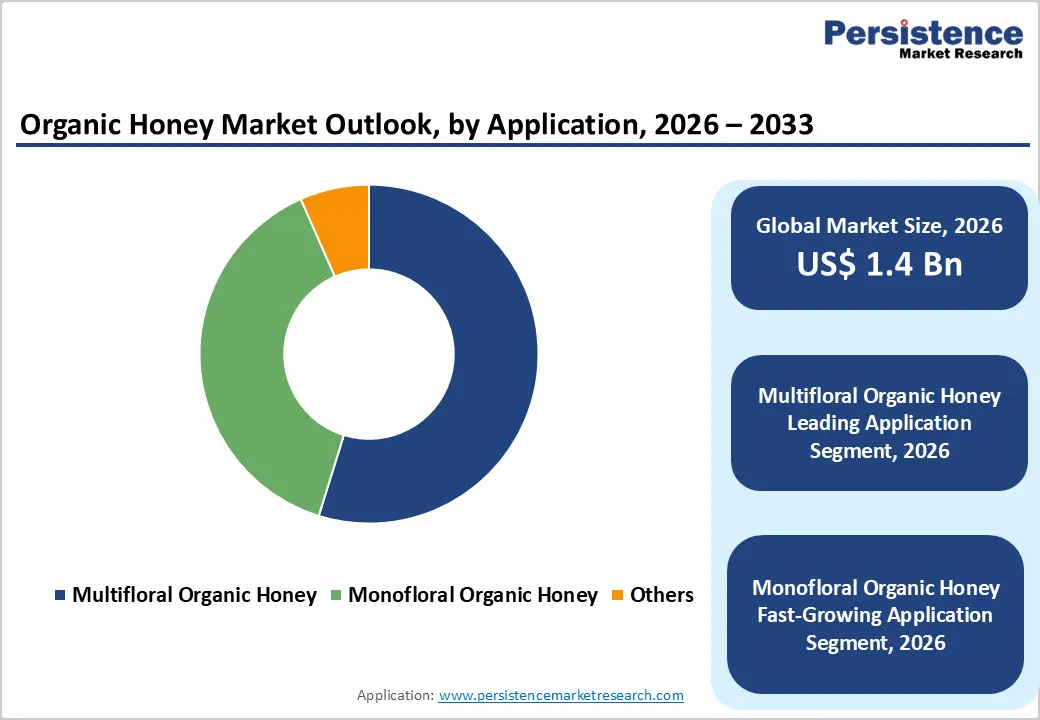
- Leading Product Type Segment: Multifloral organic honey leads due to its cost-effectiveness, consistent supply, and compatibility with large-scale food processing requirements.
- Fastest-Growing Product Type Segment: Monofloral organic honey is gaining traction as consumers show increasing preference for premium, origin-specific, and sustainably sourced varieties.
- Leading Application Segment: Food & beverages dominate with a 55.6% share, supported by extensive use as a natural alternative to refined sugar across multiple product categories.
- Fastest-Growing Application Segment: Pharmaceuticals are expanding steadily as demand rises for functional ingredients that offer therapeutic benefits and clean-label appeal.
| Key Insights | Details |
|---|---|
|
Organic Honey Market Size (2026E) |
US$ 465.4 Bn |
|
Market Value Forecast (2033F) |
US$ 764.5 Bn |
|
Projected Growth (CAGR 2026 to 2033) |
6.4% |
|
Historical Market Growth (CAGR 2020 to 2025) |
4.5% |
Market Dynamics
Driver - Increasing Preference for Natural, Functional Sweeteners Supporting Clean-Label Product Development
A major factor influencing demand is the accelerating consumer shift toward naturally derived sweeteners that combine health benefits with ingredient transparency. Growing concerns about excessive sugar consumption, artificial additives, and highly processed ingredients have prompted both consumers and manufacturers to adopt alternatives, such as organic honey. Rich in antioxidants, enzymes, and trace nutrients, organic honey aligns well with evolving dietary preferences focused on wellness and minimally processed foods. Its multifunctional properties—ranging from sweetness and flavor enhancement to moisture retention make it highly suitable for applications across bakery, dairy, beverages, and functional foods.
Additionally, regulatory emphasis on clean labeling and traceability in regions such as North America and Europe is reinforcing the adoption of organic-certified ingredients. Organic honey benefits from its single-ingredient positioning and absence of synthetic processing, enhancing consumer trust. Additionally, the rapid growth of organic and natural food categories is encouraging manufacturers to reformulate existing products, replacing refined sugar with honey. Technological advancements in filtration, quality control, and sustainable beekeeping practices are further improving supply consistency and scalability. Increasing awareness in emerging economies regarding healthier consumption patterns is also contributing to rising adoption, supporting long-term market expansion globally.
Restraints - High Pricing and Supply Variability Limiting Large-Scale Industrial Adoption
Cost considerations remain a significant barrier, as organic honey is typically priced higher than conventional sweeteners such as refined sugar and artificial syrups. This premium pricing is driven by labor-intensive beekeeping practices, certification requirements, and limited large-scale production capabilities. For high-volume food manufacturers operating in price-sensitive markets, this cost differential can impact product margins and restrict widespread substitution. Furthermore, organic honey production is highly dependent on environmental conditions, including climate variability, floral availability, and bee health, leading to fluctuations in supply and pricing.
From a formulation perspective, certain technical limitations can also restrict its application in complex industrial processes. Variability in color, flavor intensity, and moisture content across batches can affect product consistency, particularly in standardized food production systems. Additionally, organic honey may not always withstand high-temperature processing or extended shelf-life requirements without altering its functional properties. Incorporating it into existing product formulations often requires additional testing, process adjustments, and potential reformulation, increasing operational complexity. Limited standardization among suppliers further adds to quality inconsistencies, making it challenging for manufacturers to maintain uniformity. These factors collectively act as constraints, particularly for large-scale and cost-sensitive applications.
Opportunity - Expanding Use in Premium Foods, Functional Nutrition, and High-Growth Emerging Markets
Growth potential is strongly supported by the rising demand for premium, health-oriented, and functional food products where natural ingredients are a key differentiator. Organic honey is increasingly being incorporated into energy bars, immunity-boosting formulations, herbal beverages, and dietary supplements due to its natural bioactive properties. Its dual role as both a sweetener and a functional ingredient offers manufacturers an opportunity to enhance product value while addressing consumer demand for healthier alternatives. Premium segments, including organic, artisanal, and specialty foods, are also witnessing increased adoption as brands emphasize quality, origin, and sustainability.
Emerging economies offer substantial growth opportunities, driven by rapid urbanization, rising disposable incomes, and evolving dietary habits. Consumers in regions such as the Asia Pacific and the Middle East are gradually shifting toward packaged foods with clean-label and natural claims, creating favorable conditions for market expansion. Improvements in supply chain infrastructure, digital retail channels, and direct-to-consumer models are enhancing product accessibility. Additionally, advancements in sustainable apiculture and organic certification processes are enabling better scalability and traceability. Growing emphasis on environmental sustainability, pollinator protection, and ethical sourcing further strengthens the appeal of organic honey, positioning it as a high-potential ingredient across diverse global applications.
Category-wise Analysis
By Product Type Insights
Multifloral organic honey is projected to retain its leading position in the global organic honey market in 2026, accounting for 54.8% of total revenue. Its dominance is primarily supported by widespread floral availability, enabling consistent and large-scale production across geographies. Compared to monofloral variants, it offers a more economical pricing structure, making it highly suitable for bulk procurement by food manufacturers.
The balanced flavor profile and uniform texture enhance its adaptability across bakery, beverages, and processed food categories. Additionally, reduced dependency on a single nectar source minimizes supply volatility, ensuring year-round availability. While premium monofloral varieties such as Manuka continue to gain traction in niche, high-value applications, multifloral honey remains the preferred choice for industrial-scale usage due to its cost efficiency, functional consistency, and ability to meet increasing global demand for organic sweeteners.
By Application Insights
The food & beverages segment is expected to hold 57.8% of the global market share in 2026, maintaining its position as the primary application area. This leadership stems from the extensive incorporation of organic honey as a natural sugar substitute across diverse product categories, including baked goods, dairy products, cereals, and functional drinks. Its inherent nutritional properties, including antioxidants and trace enzymes, enhance product positioning in health-oriented segments.
Organic honey also contributes to improved taste, color, and moisture retention, making it a multifunctional ingredient in food processing. Growing consumer awareness of the benefits of refined sugar reduction and a preference for minimally processed ingredients are accelerating its inclusion in reformulated products. In contrast to relatively smaller segments such as cosmetics and pharmaceuticals, the food industry exhibits significantly higher consumption volumes, reinforcing its continued dominance within the global organic honey market landscape.
By Distribution Channel Insights
Supermarkets are expected to account for 36.4% of total market revenue in 2026, making them the leading distribution channel. Their strong position is attributed to extensive retail infrastructure, high consumer footfall, and the ability to offer a diverse range of organic honey products across price tiers. These outlets enable effective product comparison by origin, certification, and quality, which is particularly important for health-conscious buyers. Strategic shelf placement and in-store promotions further enhance product visibility and influence purchasing decisions. In addition, private-label offerings and bulk-stocking capabilities enable retailers to cater to both value-driven and premium consumer segments. Although online platforms are witnessing rapid growth, especially among urban populations, supermarkets continue to generate higher transaction volumes due to immediate product availability, established consumer confidence, and the expanding presence of dedicated organic and natural product sections.
Region-wise Insights
North America Organic Honey Market Trends
North America is projected to account for 46.7% of the global organic honey market value in 2026, with the United States serving as the primary growth engine. The region benefits from a highly developed food and beverage sector that is increasingly focused on replacing refined sugars with natural alternatives. Organic honey has gained strong traction due to its perceived health benefits, clean-label appeal, and compatibility with functional food formulations. Rising consumer inclination toward wellness-oriented diets has significantly boosted the incorporation of organic, gluten-free, and plant-based products. Regulatory frameworks emphasizing transparency and labeling accuracy further support market expansion by encouraging the use of certified organic ingredients.
Additionally, the presence of advanced retail networks, including premium supermarkets and specialty health stores, ensures widespread accessibility. Product innovation, such as infused and value-added honey variants, is further enhancing consumer engagement. The growing popularity of immunity-boosting ingredients and natural sweeteners continues to sustain long-term demand, positioning North America as a mature yet highly lucrative market.
Europe Organic Honey Market Trends
Europe represents a well-established market characterized by steady growth and strong consumer emphasis on quality and sustainability. Key countries, including Germany, France, the United Kingdom, Spain, and the Netherlands, are major contributors to regional demand. Strict regulatory frameworks governing food safety and ingredient sourcing have significantly encouraged the adoption of organic honey as a natural alternative to artificial sweeteners. Consumers across the region demonstrate a clear preference for certified organic, non-GMO, and ethically sourced products, prompting manufacturers to enhance traceability and adhere to rigorous certification standards.
Environmental considerations also play a crucial role in purchasing behavior, with increasing demand for sustainably produced and packaged honey. The food industry continues to incorporate organic honey into premium bakery, confectionery, and health-focused products to align with evolving consumer expectations. Furthermore, collaborations between beekeepers, ingredient suppliers, and food processors are driving innovation and ensuring a consistent supply. These factors collectively support the region’s stable growth trajectory and reinforce its importance in the global market.
Asia Pacific Organic Honey Market Trends
Asia Pacific is expected to be the fastest-growing region, registering a CAGR of approximately 8.4% between 2026 and 2033. Growth is largely driven by rapid urbanization, increasing disposable incomes, and shifting dietary patterns toward packaged and convenience foods. Countries such as China and India are at the forefront of this expansion, supported by growing consumer awareness regarding the health benefits of natural sweeteners. Organic honey is increasingly being adopted in both household consumption and food processing applications as a healthier alternative to conventional sugar.
The region is also witnessing significant investments in domestic production and processing capabilities, enabling improved supply chain efficiency and cost competitiveness. Expansion of organized retail and e-commerce platforms is enhancing product accessibility across urban and semi-urban areas. Additionally, multinational food companies are strengthening their regional presence to capitalize on the rising demand for clean-label and functional ingredients. Government initiatives aimed at improving food quality standards and supporting agricultural sustainability further contribute to long-term market development.
Competitive Landscape
The global organic honey market is highly competitive, with strong participation from Heavenly Organics, LLC, Y.S. Eco Bee Farms, Barkman Honey, LLC, Hilltop Honey Ltd., Manuka Health New Zealand Limited, and Comvita Ltd. These companies leverage advanced processing techniques, sustainable beekeeping practices, and robust sourcing networks to strengthen market positioning while maintaining purity, flavor profile, and nutritional integrity across applications. Rising demand for natural, minimally processed sweeteners is accelerating innovation, with manufacturers expanding production capacity, enhancing traceability, ensuring organic certification compliance, and investing in R&D to develop high-quality, functional organic honey products for food, nutraceutical, and personal care industries.
Key Industry Developments:
- In March 2026, Vedanta Aluminium, India’s leading aluminium producer, introduced ‘Vedamrit – 100% Pure Honey’ under its CSR initiative through the launch of Vedamrit Jibika Farmer Producer Company. This initiative aims to enhance farmer livelihoods while promoting sustainable agriculture and biodiversity. With this development, the company has also established the largest honey-focused Farmer Producer Organization (FPO) in Eastern India.
- In November 2025, Around 180 farmers in Pulwama, Kashmir, in collaboration with scientists, developed India’s first lavender honey, priced at around INR 12,000 per kilogram. Derived from lavender cultivation in the region’s distinctive purple fields, this premium product is enhancing farmer incomes while positioning Kashmir as an emerging player in the global specialty honey market.
- In January 2025, Country Delight, a well-known provider of premium natural essentials, launched its 100% Pure Farm Honey. The product is tested using Nuclear Magnetic Resonance (NMR) by a certified laboratory in Germany, ensuring high authenticity and reliability for consumers. Additionally, it undergoes comprehensive evaluation across 36 quality parameters in line with FSSAI standards, including physicochemical, antibiotic, and microbial tests, to ensure it is free from added sugars.
Companies Covered in Organic Honey Market
- Heavenly Organics, LLC
- Y.S. Eco Bee Farms
- Barkman Honey, LLC
- Hilltop Honey Ltd.
- Manuka Health New Zealand Limited
- Comvita Ltd.
- Under the Mango Tree Naturals and Organics Private Limited
- Rowse Honey Ltd.
- Capilano Honey Limited
- Dabur India Ltd.
- Dutch Gold Honey, Inc.
- New Zealand Honey Co.
- Bee Maid Honey Limited
- Savannah Bee Company
- Dutch Gold Honey, Inc.
- Others
Frequently Asked Questions
The global organic honey market is projected to be valued at US$ 1.4 Bn in 2026.
Rising consumer preference for natural sweeteners, clean-label foods, and functional health benefits is driving the global organic honey market.
The global organic honey market is poised to witness a CAGR of 6.4% between 2026 and 2033.
The global organic honey market is poised to witness a CAGR of 6.4% between 2026 and 2033.
Premiumization through monofloral varieties and expansion in e-commerce and nutraceutical applications present key growth opportunities.
Heavenly Organics, LLC, Y.S. Eco Bee Farms, Barkman Honey, LLC, Hilltop Honey Ltd., Manuka Health New Zealand Limited, and Comvita Ltd. are some of the key players in the organic honey market.


