Mineral Supplements Market Size, Share, Growth, and Regional Forecast, 2026 - 2033

Mineral Supplements Market by Product (Calcium, Magnesium, Iron, Potassium, Zinc, Chromium, Selenium, Others), Formulation (Tablets, Capsules / Softgel, Powders, Liquids / Gels, Gummies / Chewable Formats, Others), Application (General Health & Wellness, Bone & Joint Health, Gastrointestinal Health, Immunity Support, Cardiovascular Health, Others), Target Demographic (Adults, Geriatric, Pregnant Women, Children, Infants), and Regional Analysis from 2026 - 2033

ID: PMRREP2808
Calendar

March 2026

199 Pages

Author : Abhijeet Surwase

Key Industry Highlights:

  • Dominant Segment: Capsules/softgels held the largest share in 2025, driven by convenience, widespread consumer acceptance, cost-effectiveness, and strong manufacturing scalability in delivering essential minerals like calcium, magnesium, and iron.
  • Dominant Region: North America led the mineral supplements market with 43.4% share in 2025, supported by high health awareness, established retail and e-commerce channels, and strong adoption of preventive nutrition practices.
  • Drivers: Growth is fueled by rising health consciousness, increasing preventive nutrition adoption, demand for bioavailable and specialty formulations, and the expansion of fitness and wellness trends globally.
  • Opportunity: Opportunities exist in developing chelated and functional mineral formulations, gummies and liquid supplements for younger and elderly populations, multi-mineral blends, and expanding presence in fast-growing Asia-Pacific and emerging markets.
Key Insights Details

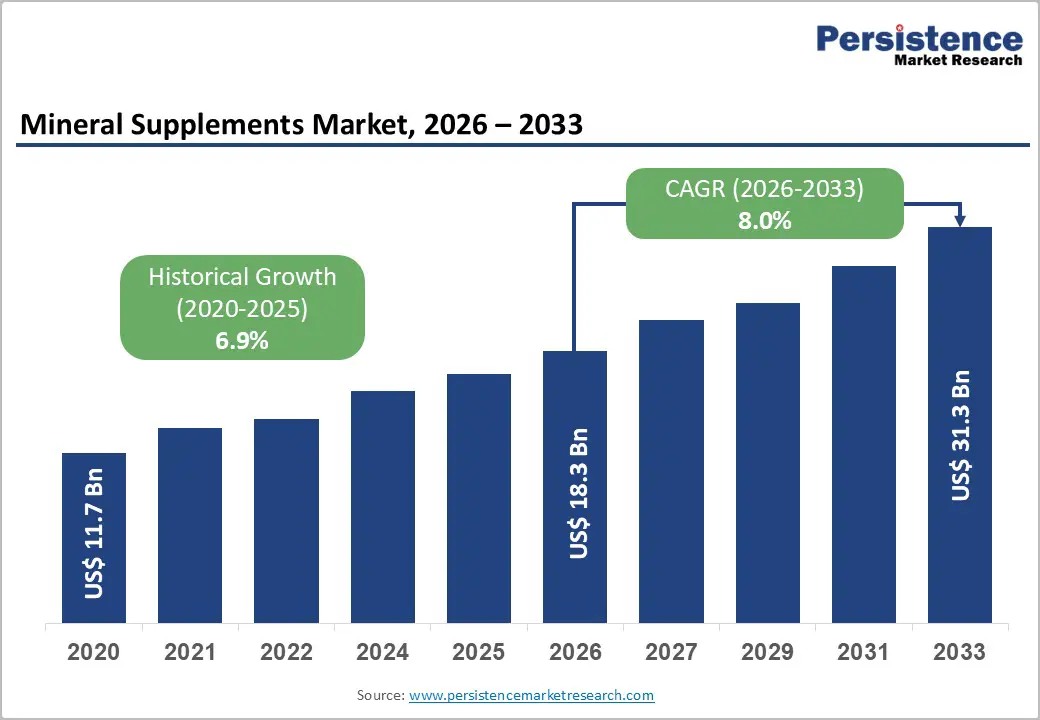
Mineral Supplements Market Size (2026E) 

US$ 18.3 Bn

Market Value Forecast (2033F) 

US$ 31.3 Bn

Projected Growth (CAGR 2026 to 2033) 

8.0%

Historical Market Growth (CAGR 2020 to 2025) 

6.9% 

mineral-supplements-market-2026-2033

Market Dynamics

Driver: Increasing prevalence of mineral deficiencies and lifestyle-related disorders

Mineral deficiencies remain a major public health issue worldwide. According to global nutritional estimates, over five billion people do not consume adequate levels of calcium, with similar high shortfalls in key minerals like iron and zinc, when dietary intakes are assessed without supplements or fortification, highlighting a global inadequacy for essential micronutrients. This widespread insufficient intake affects 66% of people globally for calcium and 65% for iron, underlining the scale of nutritional gaps that cannot be met by diet alone in many regions.

These deficiencies have direct links to lifestyle-related disorders and chronic health outcomes. For example, urban Indian schoolchildren showed ~60% calcium deficiency and ~49% iron deficiency in biochemical assessments, with selenium and zinc deficiencies also noted, indicating broad micronutrient shortfalls across populations. Mineral deficits influence bone health, immune function, and metabolic regulation, contributing to conditions such as osteoporosis, anemia, and weakened immunity. The rising prevalence of type 2 diabetes is also associated with hidden micronutrient deficiencies (e.g., magnesium and iron), with magnesium deficiency reaching up to 42% in some cohorts. These health burdens drive consumer interest in mineral supplements as preventive and corrective nutrition solutions, supporting market growth.

Restraint: Regulatory challenges and varying country-specific supplement guidelines

Regulation of mineral and dietary supplements is complex and inconsistent across jurisdictions, posing a significant market restraint. Products classified as supplements in one country may be treated as medicine in another, leading to divergent regulatory pathways. For instance, melatonin is a dietary supplement in the U.S. and EU but a prescription drug in Australia. These classification inconsistencies create barriers to global trade, compliance costs, and uncertainty for manufacturers.

In countries like India, regulatory hurdles further constrain product innovation and market entry. The Food Safety and Standards Authority of India (FSSAI) requires a long history of documented safe use (15–30 years) for novel nutraceutical ingredients, compared with the much shorter timeline for drug approval, which delays the introduction of new mineral formulations. Unclear boundaries between food supplements and pharmaceuticals also create ambiguity in enforcement and classification, leading to product reclassification to take advantage of less stringent regulatory regimes. Variability in permitted ingredient dosages, labeling requirements, and safety assessments across regions increases compliance complexity and costs. This regulatory heterogeneity can limit consumer access to certain mineral products and slow industry expansion, especially for companies aiming for cross-border distribution.

Opportunity: Development of gummies, liquids, and chewable supplements for better compliance

Emerging dosage forms like gummies, liquids, and chewable tablets present a high-potential opportunity in the mineral supplements market by enhancing consumer compliance and expanding appeal beyond traditional pills. These formats are particularly beneficial for children, the elderly, and adults who find swallowing tablets difficult, thereby improving the likelihood of regular intake. Consumer preference for more palatable and easy-to-consume forms has been increasingly noted in nutrition and health discussions, with flavored gummies and liquid supplements gaining traction in wellness segments due to taste and convenience.

Furthermore, as awareness of mineral deficiencies rises, reflected by global inadequacy estimates for essential nutrients like calcium (66%), iron (65%), and zinc there is greater demand for innovative delivery formats that integrate easily into daily routines. Such formats also support functional positioning, enabling brands to combine minerals with vitamins or botanical extracts to create multi-benefit products tailored to specific health goals (e.g., immunity, bone health, energy). This consumer-centric shift facilitates market differentiation and enables companies to reach segments that might otherwise skip supplementation due to product-form barriers. Regulatory frameworks in many markets now support such alternative formats under food-supplement categories, further easing introduction and adoption.

Category-wise Analysis

By Product Insights

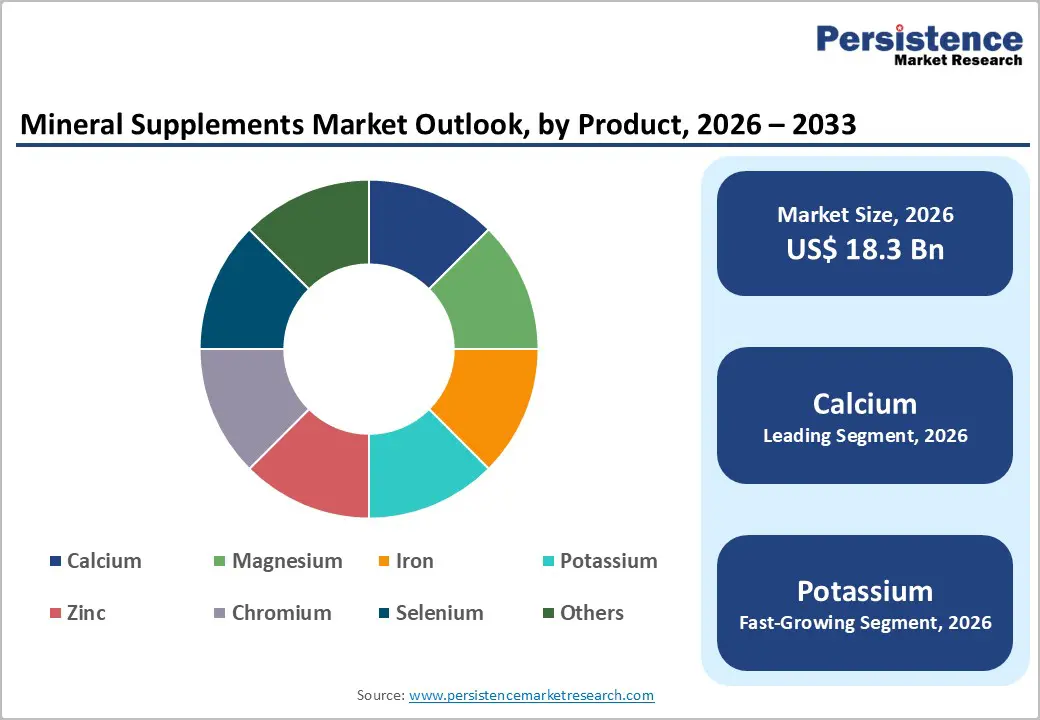
Calcium is the most widely consumed mineral supplement globally because inadequate dietary intake is extremely common, even in high-income countries. Nutritional evidence shows that about half of the world’s population does not consume enough calcium through diet, leaving a large proportion at risk of deficiency and related health issues such as osteoporosis, rickets, or poor bone health. Government-sourced intake surveys like NHANES in the U.S. demonstrate high rates of inadequacy up to ~48% in certain demographic groups when intake falls below recommended levels, further supporting demand for supplementation. Elderly populations are particularly at risk, as aging increases bone loss and fracture risk, driving consistent calcium supplement use. The widespread nutritional need and strong clinical linkage to bone health make calcium the dominant segment in mineral supplements.

By Formulation Insights

Capsules and softgels dominate supplement formulations because they align with consumer preferences and pharmaceutical delivery advantages. Analysis of the U.S. FDA’s Dietary Supplements Label Database shows that capsules are the most widely available supplement format, accounting for over 34% of products in dietary supplement databases, more than tablets, powders, liquids, or other forms. Consumers often prefer capsules and softgels because they are easier to swallow and perceived as cleaner-label products with minimal fillers, which improves adherence and repeat use—especially among elderly users or those with pill aversion. Softgels, in particular, protect sensitive oil-based nutrients from oxidation and enhance bioavailability, making them popular for a range of fat-soluble vitamins and mineral blends.
mineral-supplements-market-outlook-by-product-2026-2033

Regional Insights

North America Mineral Supplements Market Trends

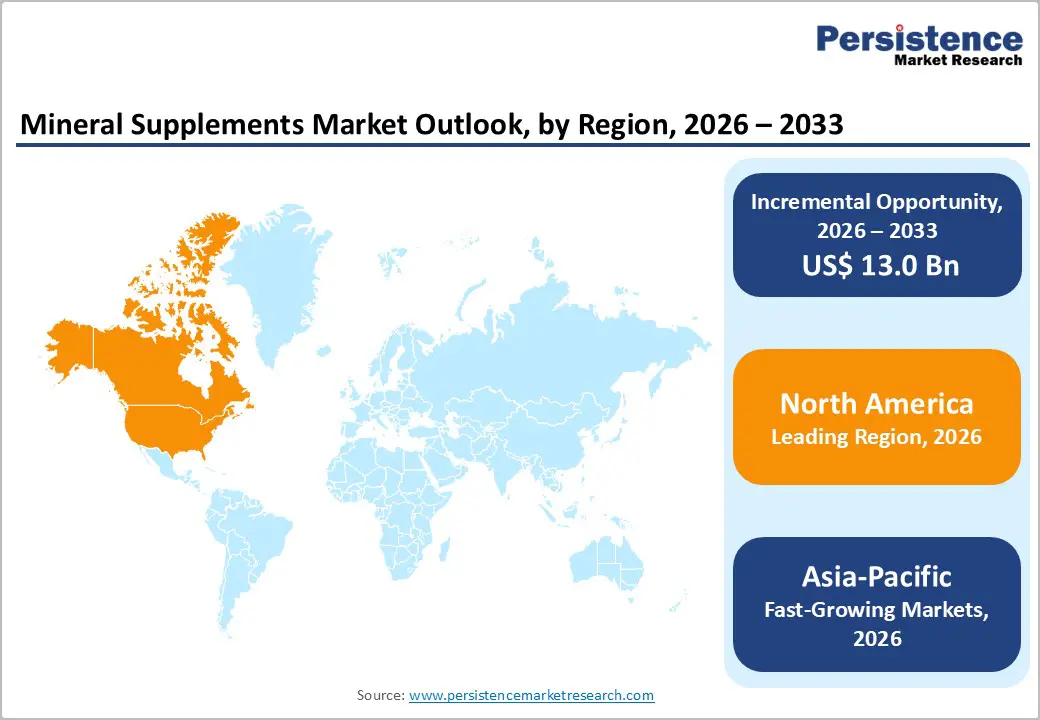
North America leads the global mineral supplements market largely due to high supplement usage and consumer health awareness. Surveys such as those by the Council for Responsible Nutrition (CRN) indicate that 58% of U.S. adults take at least one dietary supplement daily, with vitamins and minerals among the most commonly used categories. The region also has a large aging population with increased demand for bone and general health support, driving mineral supplement uptake. Advanced healthcare infrastructure and broad retail distribution (pharmacies, supermarkets, and online channels) increase accessibility. According to industry data, North America accounts for ~38–43% of global supplement consumption by volume, reflecting mature market penetration. High disposable income and strong preventive healthcare trends further reinforce the region’s dominance.

Europe Mineral Supplements Market Trends

Europe remains a significant market for mineral supplements due to high consumer health consciousness, strong regulatory oversight, and an aging population that prioritizes preventive nutrition. A 2024 survey indicated that a majority of Europeans regularly consume dietary supplements, with many seeking products for bone, joint, and immune health. Regulatory bodies such as the European Food Safety Authority (EFSA) enforce stringent safety standards, which increase consumer confidence in minerals and other supplements, even though health claims are carefully controlled. With high per-capita healthcare spending and widespread pharmacy distribution, Europe sustains strong demand and is critical to global market forecasts.

Asia-Pacific Mineral Supplements Market Trends

Asia Pacific is the fastest-growing regional market for mineral supplements, driven by rising health awareness, expanding middle-class incomes, and shifting consumer lifestyles. Industry sources indicate that APAC accounts for about 23.5% of global supplement consumption, with growth rates outpacing those in North America and Europe. Rapid urbanization in China, India, and Southeast Asia is accompanied by an increasing focus on preventive health and nutrition, with dietary supplements becoming more mainstream. China alone accounts for a large share of regional consumption, bolstered by both traditional health practices and the adoption of modern wellness. Younger demographics and expanding e-commerce channels further accelerate access and affordability. Additionally, government nutrition programs and public health initiatives in countries like India and China are raising awareness about micronutrient deficiencies, encouraging supplement use and future market expansion.
mineral-supplements-market-outlook-by-region-2026-2033

Competitive Landscape

The mineral supplements market is highly competitive, led by major companies such as Herbalife, Amway, Glanbia, Bayer, and DSM. These players focus on developing bioavailable formulations, expanding multi-mineral and functional product lines, investing in R&D for specialty supplements, and strengthening global distribution and e-commerce networks.

Key Industry Developments:

  • In December 2025, Nu Skin announced the launch of its Prysm iO wellness platform, a digital health tool designed to help users monitor antioxidant levels and support personalized wellness tracking. The platform was developed to provide insights into carotenoid levels in the skin, which serve as biomarkers for antioxidant status. By using optical sensing technology, the device enabled users to assess their nutritional health and make informed lifestyle and dietary choices
  • In August 2024, Herbalife announced that its scientists showcased recent advancements in ingredient safety and nutritional quality at the 2024 AOAC INTERNATIONAL Annual Meeting. The presentations highlighted the company’s efforts to enhance testing protocols, ensure product consistency, and strengthen quality assurance across its range of dietary supplements.

Companies Covered in Mineral Supplements Market

  • Herbalife, Ltd
  • Glanbia Plc
  • Nu Skin Enterprises, Inc.
  • E. I. du Pont de Nemours and Company
  • NBTY, Inc.
  • BASF SE
  • Bayer AG
  • Atrium Innovations, Inc.
  • Amway
  • Others
Frequently Asked Questions

The global mineral supplements market is projected to be valued at US$ 18.3 Bn in 2026.

Rising health awareness, nutrient deficiencies, preventive nutrition adoption, bioavailable formulations, aging population, and wellness trends.

The global mineral supplements market is poised to witness a CAGR of 8.0% between 2026 and 2033.

Development of gummies, liquids, multi-mineral blends, personalized nutrition, functional foods, and growth in Asia-Pacific markets.

Herbalife, Ltd, Glanbia Plc, Nu Skin Enterprises, Inc., E. I. du Pont de Nemours and Company, NBTY, Inc., BASF SE.

Global Mineral Supplements Market Report Scope
Report Attribute Details

Historical Data/Actuals

2020 - 2025

Forecast Period

2026 - 2033

Market Analysis

Value: US$ Bn  

Geographical Coverage 

  • North America 
  • Europe 
  • East Asia 
  • South Asia & Oceania 
  • Latin America 
  • Middle East and Africa 

Segmental Coverage 

  • Product
  • Formulation
  • Application
  • Target Demographic
  • Region 

Competitive Analysis 

  • Herbalife, Ltd
  • Glanbia Plc
  • Nu Skin Enterprises, Inc.
  • E. I. du Pont de Nemours and Company
  • NBTY, Inc.
  • BASF SE
  • Bayer AG
  • Atrium Innovations, Inc.
  • Amway
  • Others

Report Highlights 

  • Market Forecast and Trends
  • Competitive Intelligence & Share Analysis  
  • Growth Factors and Challenges 
  • Strategic Growth Initiatives 
  • Pricing Analysis
  • Future Opportunities and Revenue Pockets
  • Market Analysis Tools
Market Segmentation

By Product

  • Calcium
  • Magnesium
  • Iron
  • Potassium
  • Zinc
  • Chromium
  • Selenium
  • Others

By Formulation

  • Tablets
  • Capsules / Softgel
  • Powders
  • Liquids / Gels
  • Gummies / Chewable Formats
  • Others

By Application

  • General Health & Wellness
  • Bone & Joint Health
  • Gastrointestinal Health
  • Immunity Support
  • Cardiovascular Health
  • Others

By Target Demographic

  • Adults
  • Geriatric
  • Pregnant Women
  • Children
  • Infants

By Region 

  • North America 
  • Europe 
  • East Asia 
  • South Asia & Oceania 
  • Latin America
  • Middle East and Africa 

Related Reports

  1. Executive Summary
    1. Global Mineral Supplements Market Snapshot, 2026 and 2033
    2. Market Opportunity Assessment, 2026 - 2033, US$ Bn
    3. Key Market Trends
    4. Future Market Projections
    5. Premium Market Insights
    6. Industry Developments and Key Market Events
    7. PMR Analysis and Recommendations
  2. Market Overview
    1. Market Scope and Definition
    2. Market Dynamics
      1. Drivers
      2. Restraints
      3. Opportunity
      4. Challenges
      5. Key Trends
    3. Macro-Economic Factors
      1. Global Sectorial Outlook
      2. Global GDP Growth Outlook
    4. COVID-19 Impact Analysis
    5. Forecast Factors - Relevance and Impact
  3. Value Added Insights
    1. Product Adoption Analysis
    2. Regulatory Landscape
    3. Value Chain Analysis
    4. Key Deals and Mergers
    5. PESTLE Analysis
    6. Porter’s Five Force Analysis
  4. Global Mineral Supplements Market Outlook:
    1. Key Highlights
      1. Market Size (US$ Bn) and Y-o-Y Growth
      2. Absolute $ Opportunity
    2. Market Size (US$ Bn) Analysis and Forecast
      1. Historical Market Size (US$ Bn) Analysis, 2020-2025
      2. Market Size (US$ Bn) Analysis and Forecast, 2026-2033
    3. Global Mineral Supplements Market Outlook: Product
      1. Introduction / Key Findings
      2. Historical Market Size (US$ Bn) Analysis, By Product, 2020-2025
      3. Market Size (US$ Bn) Analysis and Forecast, By Product, 2026-2033
        1. Calcium
        2. Magnesium
        3. Iron
        4. Potassium
        5. Zinc
        6. Chromium
        7. Selenium
        8. Others
      4. Market Attractiveness Analysis: Product
    4. Global Mineral Supplements Market Outlook: Formulation
      1. Introduction / Key Findings
      2. Historical Market Size (US$ Bn) Analysis, By Formulation, 2020-2025
      3. Market Size (US$ Bn) Analysis and Forecast, By Formulation, 2026-2033
        1. Tablets
        2. Capsules / Softgel
        3. Powders
        4. Liquids / Gels
        5. Gummies / Chewable Formats
        6. Others
      4. Market Attractiveness Analysis: Formulation
    5. Global Mineral Supplements Market Outlook: Application
      1. Introduction / Key Findings
      2. Historical Market Size (US$ Bn) Analysis, By Application, 2020-2025
      3. Market Size (US$ Bn) Analysis and Forecast, By Application, 2026-2033
        1. General Health & Wellness
        2. Bone & Joint Health
        3. Gastrointestinal Health
        4. Immunity Support
        5. Cardiovascular Health
        6. Others
      4. Market Attractiveness Analysis: Application
    6. Global Mineral Supplements Market Outlook: Target Demographic
      1. Introduction / Key Findings
      2. Historical Market Size (US$ Bn) Analysis, By Target Demographic, 2020-2025
      3. Market Size (US$ Bn) Analysis and Forecast, By Target Demographic, 2026-2033
        1. Hospitals
        2. Clinical & Diagnostic Laboratories
        3. Specialty Cancer Centers
        4. Academic & Research Institutes
        5. Others
      4. Market Attractiveness Analysis: Target Demographic
  5. Global Mineral Supplements Market Outlook: Region
    1. Key Highlights
    2. Historical Market Size (US$ Bn) Analysis, By Region, 2020-2025
    3. Market Size (US$ Bn) Analysis and Forecast, By Region, 2026-2033
      1. North America
      2. Europe
      3. East Asia
      4. South Asia and Oceania
      5. Latin America
      6. Middle East & Africa
    4. Market Attractiveness Analysis: Region
  6. North America Mineral Supplements Market Outlook:
    1. Key Highlights
    2. Historical Market Size (US$ Bn) Analysis, By Market, 2020-2025
      1. By Country
      2. By Product
      3. By Formulation
      4. By Application
      5. By Target Demographic
    3. Market Size (US$ Bn) Analysis and Forecast, By Country, 2026-2033
      1. U.S.
      2. Canada
    4. Market Size (US$ Bn) Analysis and Forecast, By Product, 2026-2033
      1. Calcium
      2. Magnesium
      3. Iron
      4. Potassium
      5. Zinc
      6. Chromium
      7. Selenium
      8. Others
    5. Market Size (US$ Bn) Analysis and Forecast, By Formulation, 2026-2033
      1. Tablets
      2. Capsules / Softgel
      3. Powders
      4. Liquids / Gels
      5. Gummies / Chewable Formats
      6. Others
    6. Market Size (US$ Bn) Analysis and Forecast, By Application, 2026-2033
      1. General Health & Wellness
      2. Bone & Joint Health
      3. Gastrointestinal Health
      4. Immunity Support
      5. Cardiovascular Health
      6. Others
    7. Market Size (US$ Bn) Analysis and Forecast, By Target Demographic, 2026-2033
      1. Adults
      2. Geriatric
      3. Pregnant Women
      4. Children
      5. Infants
    8. Market Attractiveness Analysis
  7. Europe Mineral Supplements Market Outlook:
    1. Key Highlights
    2. Historical Market Size (US$ Bn) Analysis, By Market, 2020-2025
      1. By Country
      2. By Product
      3. By Formulation
      4. By Application
      5. By Target Demographic
    3. Market Size (US$ Bn) Analysis and Forecast, By Country, 2026-2033
      1. Germany
      2. France
      3. U.K.
      4. Italy
      5. Spain
      6. Russia
      7. Rest of Europe
    4. Market Size (US$ Bn) Analysis and Forecast, By Product, 2026-2033
      1. Calcium
      2. Magnesium
      3. Iron
      4. Potassium
      5. Zinc
      6. Chromium
      7. Selenium
      8. Others
    5. Market Size (US$ Bn) Analysis and Forecast, By Formulation, 2026-2033
      1. Tablets
      2. Capsules / Softgel
      3. Powders
      4. Liquids / Gels
      5. Gummies / Chewable Formats
      6. Others
    6. Market Size (US$ Bn) Analysis and Forecast, By Application, 2026-2033
      1. General Health & Wellness
      2. Bone & Joint Health
      3. Gastrointestinal Health
      4. Immunity Support
      5. Cardiovascular Health
      6. Others
    7. Market Size (US$ Bn) Analysis and Forecast, By Target Demographic, 2026-2033
      1. Adults
      2. Geriatric
      3. Pregnant Women
      4. Children
      5. Infants
    8. Market Attractiveness Analysis
  8. East Asia Mineral Supplements Market Outlook:
    1. Key Highlights
    2. Historical Market Size (US$ Bn) Analysis, By Market, 2020-2025
      1. By Country
      2. By Product
      3. By Formulation
      4. By Application
      5. By Target Demographic
    3. Market Size (US$ Bn) Analysis and Forecast, By Country, 2026-2033
      1. China
      2. Japan
      3. South Korea
    4. Market Size (US$ Bn) Analysis and Forecast, By Product, 2026-2033
      1. Calcium
      2. Magnesium
      3. Iron
      4. Potassium
      5. Zinc
      6. Chromium
      7. Selenium
      8. Others
    5. Market Size (US$ Bn) Analysis and Forecast, By Formulation, 2026-2033
      1. Tablets
      2. Capsules / Softgel
      3. Powders
      4. Liquids / Gels
      5. Gummies / Chewable Formats
      6. Others
    6. Market Size (US$ Bn) Analysis and Forecast, By Application, 2026-2033
      1. General Health & Wellness
      2. Bone & Joint Health
      3. Gastrointestinal Health
      4. Immunity Support
      5. Cardiovascular Health
      6. Others
    7. Market Size (US$ Bn) Analysis and Forecast, By Target Demographic, 2026-2033
      1. Adults
      2. Geriatric
      3. Pregnant Women
      4. Children
      5. Infants
    8. Market Attractiveness Analysis
  9. South Asia & Oceania Mineral Supplements Market Outlook:
    1. Key Highlights
    2. Historical Market Size (US$ Bn) Analysis, By Market, 2020-2025
      1. By Country
      2. By Product
      3. By Formulation
      4. By Application
      5. By Target Demographic
    3. Market Size (US$ Bn) Analysis and Forecast, By Country, 2026-2033
      1. India
      2. Southeast Asia
      3. ANZ
      4. Rest of South Asia & Oceania
    4. Market Size (US$ Bn) Analysis and Forecast, By Product, 2026-2033
      1. Calcium
      2. Magnesium
      3. Iron
      4. Potassium
      5. Zinc
      6. Chromium
      7. Selenium
      8. Others
    5. Market Size (US$ Bn) Analysis and Forecast, By Formulation, 2026-2033
      1. Tablets
      2. Capsules / Softgel
      3. Powders
      4. Liquids / Gels
      5. Gummies / Chewable Formats
      6. Others
    6. Market Size (US$ Bn) Analysis and Forecast, By Application, 2026-2033
      1. General Health & Wellness
      2. Bone & Joint Health
      3. Gastrointestinal Health
      4. Immunity Support
      5. Cardiovascular Health
      6. Others
    7. Market Size (US$ Bn) Analysis and Forecast, By Target Demographic, 2026-2033
      1. Adults
      2. Geriatric
      3. Pregnant Women
      4. Children
      5. Infants
    8. Market Attractiveness Analysis
  10. Latin America Mineral Supplements Market Outlook:
    1. Key Highlights
    2. Historical Market Size (US$ Bn) Analysis, By Market, 2020-2025
      1. By Country
      2. By Product
      3. By Formulation
      4. By Application
      5. By Target Demographic
    3. Market Size (US$ Bn) Analysis and Forecast, By Country, 2026-2033
      1. Brazil
      2. Mexico
      3. Rest of Latin America
    4. Market Size (US$ Bn) Analysis and Forecast, By Product, 2026-2033
      1. Calcium
      2. Magnesium
      3. Iron
      4. Potassium
      5. Zinc
      6. Chromium
      7. Selenium
      8. Others
    5. Market Size (US$ Bn) Analysis and Forecast, By Formulation, 2026-2033
      1. Tablets
      2. Capsules / Softgel
      3. Powders
      4. Liquids / Gels
      5. Gummies / Chewable Formats
      6. Others
    6. Market Size (US$ Bn) Analysis and Forecast, By Application, 2026-2033
      1. General Health & Wellness
      2. Bone & Joint Health
      3. Gastrointestinal Health
      4. Immunity Support
      5. Cardiovascular Health
      6. Others
    7. Market Size (US$ Bn) Analysis and Forecast, By Target Demographic, 2026-2033
      1. Adults
      2. Geriatric
      3. Pregnant Women
      4. Children
      5. Infants
    8. Market Attractiveness Analysis
  11. Middle East & Africa Mineral Supplements Market Outlook:
    1. Key Highlights
    2. Historical Market Size (US$ Bn) Analysis, By Market, 2020-2025
      1. By Country
      2. By Product
      3. By Formulation
      4. By Application
      5. By Target Demographic
    3. Market Size (US$ Bn) Analysis and Forecast, By Country, 2026-2033
      1. GCC Countries
      2. Egypt
      3. South Africa
      4. Northern Africa
      5. Rest of Middle East & Africa
    4. Market Size (US$ Bn) Analysis and Forecast, By Product, 2026-2033
      1. Calcium
      2. Magnesium
      3. Iron
      4. Potassium
      5. Zinc
      6. Chromium
      7. Selenium
      8. Others
    5. Market Size (US$ Bn) Analysis and Forecast, By Formulation, 2026-2033
      1. Tablets
      2. Capsules / Softgel
      3. Powders
      4. Liquids / Gels
      5. Gummies / Chewable Formats
      6. Others
    6. Market Size (US$ Bn) Analysis and Forecast, By Application, 2026-2033
      1. General Health & Wellness
      2. Bone & Joint Health
      3. Gastrointestinal Health
      4. Immunity Support
      5. Cardiovascular Health
      6. Others
    7. Market Size (US$ Bn) Analysis and Forecast, By Target Demographic, 2026-2033
      1. Adults
      2. Geriatric
      3. Pregnant Women
      4. Children
      5. Infants
    8. Market Attractiveness Analysis
  12. Competition Landscape
    1. Market Share Analysis, 2025
    2. Market Structure
      1. Competition Intensity Mapping By Market
      2. Competition Dashboard
    3. Company Profiles (Details - Overview, Financials, Strategy, Recent Developments)
      1. Herbalife, Ltd
        1. Overview
        2. Segments and Product Types
        3. Key Financials
        4. Market Developments
        5. Market Strategy
      2. Glanbia Plc
      3. Nu Skin Enterprises, Inc.
      4. E. I. du Pont de Nemours and Company
      5. NBTY, Inc.
      6. BASF SE
      7. Bayer AG
      8. Atrium Innovations, Inc.
      9. Amway
      10. Others
  13. Appendix
    1. Research Methodology
    2. Research Assumptions
    3. Acronyms and Abbreviations

Research Methodology Framework for Market Research Excellence

At Persistence Market Research, we implement a comprehensive, validated, and multi-dimensional approachto market analysis that delivers actionable insights across complex market landscapes. Our methodology combines the analytical rigor of leading consulting firms with innovative research techniques, ensuring robust market assessments that guide strategic decision-making with confidence.

Core Research Philosophy

Our methodology is built on four foundational pillars:

Research Philosophy Image

At Persistence Market Research, our methodology is designed to transcend conventional market studies by combining analytical rigor, multi-source validation, and future-focused insights.

We integrate advanced research frameworks, robust data collection strategies, cutting-edge analytics, and innovative technologies to deliver a 360-degree view of complex markets.

We integrate advanced research frameworks, robust data collection strategies, cutting-edge analytics, and innovative technologies to deliver a 360-degree view of complex markets.

Each stage spanning from strategic scoping and hypothesis-building to competitive intelligence, quality validation, and actionable recommendations is engineered to provide clients with unmatched clarity, precision, and confidence in decision-making.

By embedding innovation and technology at the core, our approach ensures that insights are not only comprehensive but also predictive, empowering businesses to seize opportunities, mitigate risks, and achieve sustainable growth

Research Philosophy Image

Capturing Key Information and Events

During this phase, key research objectives focus on essential information and data points for assessing the market, including:

Research Philosophy Image

TAM-SAM-SOM Framework Implementation

We employ both top-down and bottom-up approaches to ensure accurate market sizing.

Top-Down Market SizingBottom-Up Market Sizing
Universe Definition: Total global/regional market identificationUnit Economics: Average transaction values, purchase frequencies, customer lifecycle
Segmentation Filters: Geographic, demographic, and behavioral constraintsCustomer Segmentation: Detailed buyer persona development and sizing
Market Share Analysis: Competitive landscape assessment and share allocationPenetration Analysis: Market penetration rates by segment and geography
Growth Rate Application: Historical trends and forward-looking growth assumptionsScaling Methodology: Extrapolation techniques with confidence intervals

Validation & Cross-Verification

  • Triangulation: Comparing top-down and bottom-up results for consistency
  • Sensitivity Analysis: Testing key assumptions and parameter variations
  • Peer Benchmarking: Comparison with analogous markets and industry benchmarks
  • Expert Review: External validation through industry specialist consultation

Research Philosophy Image

Forecasting & Projection Modeling

Our proprietary forecasting models incorporate multiple variables and scenarios.

Forecasting Components

  • Historical Trend Analysis: 10-year historical growth patterns and cyclical variations
  • Driver-Based Modeling: Economic indicators, demographic shifts, technology adoption
  • Scenario Planning: Base case, optimistic, and conservative projections
  • Monte Carlo Simulations: Probability-weighted outcomes and risk assessments

Model Validation

  • Back-Testing: Historical accuracy assessment over 3–5-year periods
  • Cross-Validation: Multiple modeling approaches for result comparison
  • External Benchmarking: Comparison with established market forecasts
  • Continuous Calibration: Quarterly model updates based on new data

Comprehensive Data Collection Strategy

Our secondary research phase establishes a robust knowledge base utilizing diverse, credible sources.

Secondary Data Sourcess

  • Industry Publications & Reports
  • Government & Regulatory Data
  • Financial Intelligence (filings & reports)
  • Academic Research & Digital Intelligence

Quality Assurance Protocol

  • Source credibility assessment and publication date validation
  • Data consistency checks across multiple sources
  • Bias identification and neutralization techniques
  • Information gap tracking for primary research prioritization

Research Philosophy Image

Primary Research Excellence

Our primary research methodology employs best-in-class techniques to capture unique market insights.

Quantitative Research Methods

  • Large-Scale Surveys: Statistically representative samples with 95% confidence intervals
  • Survey Methodology: Multi-channel deployment (online, telephone, in-person)
  • Question Architecture and Response Optimization

Qualitative Research Methods

  • Executive Interviews
  • Focus Groups
  • Expert Consultations

Quality Assurance & Validation Framework

Multi-Stage Validation Process

  • Source Verification and Consistency Testing
  • Outlier Detection and Bias Assessment
  • Peer Review Process and External Validation
  • Sensitivity Analysis and Confidence Intervals

Research Philosophy Image

Methodology Validation & Credibility

Our research methodology has been extensively validated through:

  • Academic Partnerships: Collaborations with top-tier business schools and research institutions
  • Client Success Stories: Documented case studies demonstrating research impact and ROI
  • Continuous Benchmarking: Performance comparison with leading global research firms

This comprehensive methodology framework positions Persistence Market Research at the forefront of market intelligence, combining the analytical sophistication of top-tier consulting firms with innovative research techniques. Our approach ensures that every market assessment delivers precise, actionable, and strategically valuable insights that drive business success in competitive market environments.

Ready to unlock your market potential? Contact our research experts to discuss how our validated methodology can transform your strategic decision-making with data-driven market intelligence.

Copyright © 2026 Persistence Market Research. All Rights Reserved

Connect With Us -