Infectious Diseases Diagnostics Market Size, Share, Growth, and Regional Forecast, 2026 to 2033

Infectious Diseases Diagnostics Market by Product (Reagents, Kits & Consumables, Instruments, Software & Services), Technology (Immunodiagnostics, Molecular Diagnostics , Clinical Microbiology, Others), Disease Type (Respiratory Infections, HIV, Hepatitis, Hospital-Acquired Infections (HAIs), Sexually Transmitted Infections, Mosquito-Borne, Others), End User (Hospitals, Diagnostic Laboratories, Clinics / POC Settings  , Research Institutes, Others), and Regional Analysis from 2026 to 2033

ID: PMRREP11413
Calendar

January 2026

195 Pages

Author : Pravin Rewale

Infectious Diseases Diagnostics Market Size and Trend Analysis

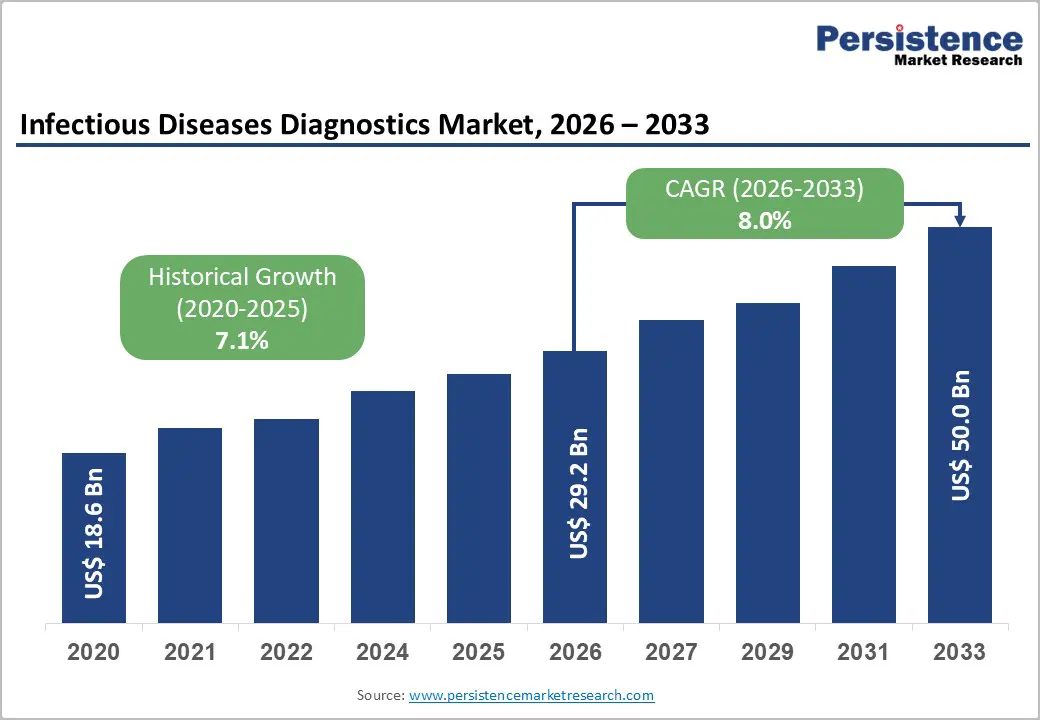
The global infectious diseases diagnostics market is estimated to grow from US$ 29.2 Bn in 2026 to US$ 50.0 Bn by 2033. The market is projected to record a CAGR of 8.0% during the forecast period from 2026 to 2033.

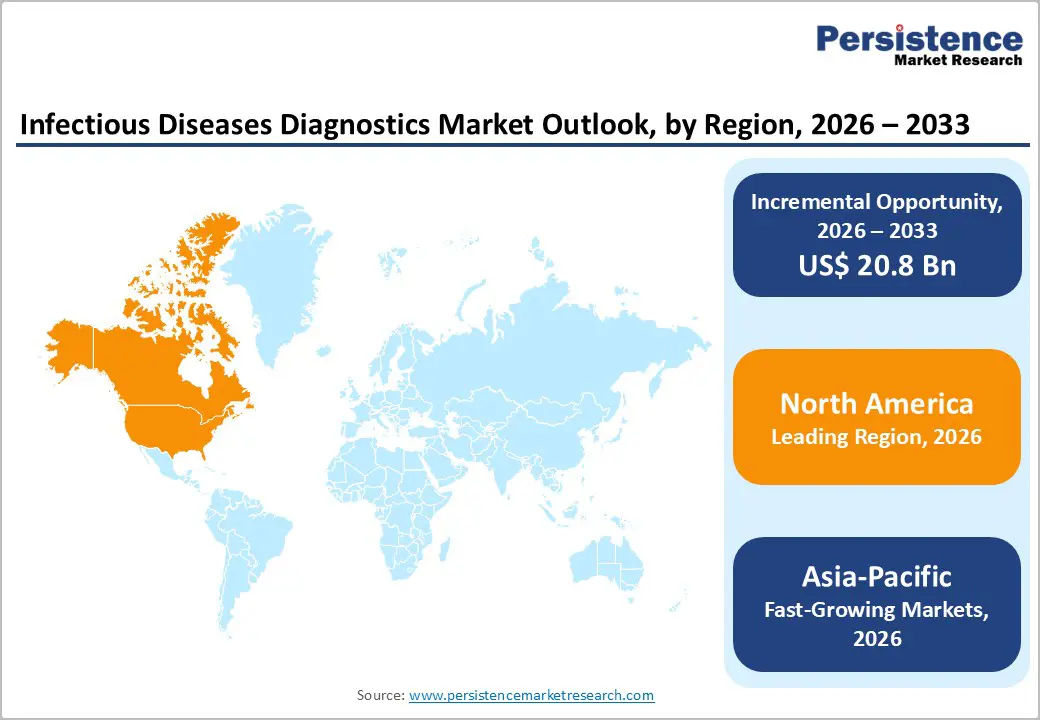
The global infectious diseases diagnostics market is growing steadily, fueled by rising disease prevalence, increasing demand for rapid and accurate testing, and expanding healthcare infrastructure. North America leads with advanced diagnostics infrastructure, strong regulations, and high R&D investment. Asia-Pacific is the fastest-growing region, driven by government initiatives, expanding laboratories, cost advantages, and rising patient awareness.

Size and Trend Analysis

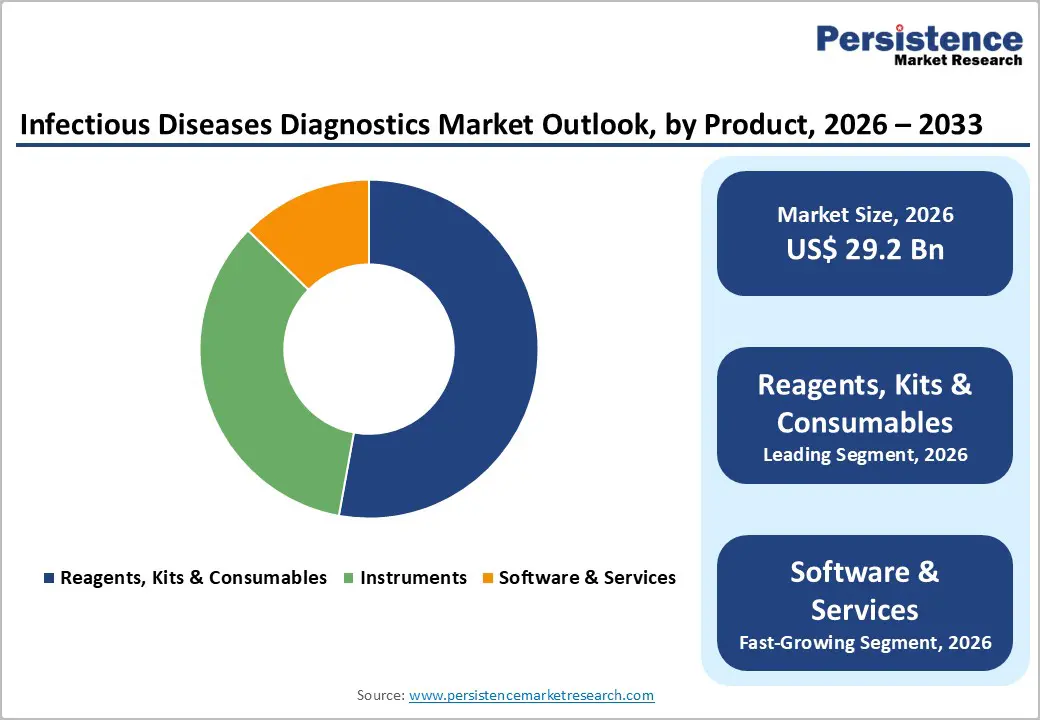
  • Dominant Segment: Reagents, Kits & Consumables dominated the Infectious Diseases Diagnostics Market with around 52.9% share in 2025, driven by high demand for rapid, accurate testing, routine laboratory use, recurring consumption, and integration with advanced molecular and immunodiagnostic platforms.
  • Dominant Region: North America led due to advanced diagnostic infrastructure, strict regulatory compliance, and high R&D investment. Asia-Pacific was the fastest-growing region, supported by cost-effective laboratory expansion, government initiatives, rising healthcare access, and growing disease awareness.
  • Market Drivers: Rising prevalence of infectious diseases, increasing demand for rapid diagnostics, government health programs, technological advancements, and adoption of point-of-care testing.
  • Market Opportunity: Opportunities include growth in molecular diagnostics, AI-enabled diagnostic platforms, expansion of point-of-care testing, integration of multiplex panels, and increasing demand from emerging healthcare markets.
Global Market Attributes  Key Insights 
Global Infectious Diseases Diagnostics Market Size (2026E)  US$ 29.2 Bn
Market Value Forecast (2033F)  US$ 50.0 Bn
Projected Growth (CAGR 2026 to 2033)  8.0%
Historical Market Growth (CAGR 2020 to 2025)  7.1% 

infectious-diseases-diagnostics-market-2026–2033

Market Dynamics

Driver: Growing demand for rapid and accurate diagnostics

Surgical site infections (SSIs) and other healthcare?associated infections remain persistent challenges worldwide, significantly driving demand for infectious disease diagnostics in surgical settings. A global meta?analysis found the pooled incidence of SSIs at approximately 2.5 percent among surgical patients, with some regions reporting rates as high as 7.2 percent, indicating substantial diagnostic needs for early detection and prevention. In the United States alone, hospital?acquired infections, including SSIs affect roughly 1.7 million patients annually, contributing to significant morbidity and mortality. Rapid, accurate diagnostics are therefore integral to surgical care pathways to mitigate complications and improve outcomes.

Heightened awareness of nosocomial infection burdens further amplifies diagnostic demand. Chronic and acute infectious risks underscore the need for reliable surveillance and pathogen identification, especially where infection control resources vary. For example, health?care settings in low? and middle?income countries report SSI rates as high as one?third of operated patients, far exceeding rates in high?income settings and underscoring inequities in infection prevention. This global infectious burden fuels investment in advanced surgical infectious disease diagnostics to support timely intervention, antimicrobial stewardship, and reduced postoperative complications.

Restraints: High cost of advanced diagnostic instruments and molecular tests

Advanced diagnostic instruments, especially molecular platforms used in surgical infection diagnostics, often carry high acquisition and operational costs that hinder widespread adoption. Credible market analysis notes that molecular point?of?care systems frequently require significant capital investment, with instrument costs ranging from $15,000 to $50,000, while individual test cartridges may cost $30–$100 each. These financial barriers are particularly impactful for smaller hospitals and clinics with constrained budgets, limiting the procurement of cutting?edge tools even where clinical need is high.

Beyond upfront costs, recurring expenses for consumables, maintenance, and calibration further strain healthcare facility resources, especially in resource?limited regions. Cost barriers also intersect with reimbursement limitations in many public health systems, where insurance coverage for advanced diagnostic testing is inadequate or restrictive. Consequently, facilities may defer adoption of higher?performance diagnostics in favor of cheaper, less accurate methods, slowing overall market penetration and innovation uptake within surgical infection diagnostics.

Opportunity: Expansion of point-of-care and home-based testing solutions

Expansion of point?of?care and at?home testing represents a significant opportunity within the surgical infectious diseases diagnostics landscape. The convergence of telemedicine, mobile health, and decentralized care has accelerated demand for rapid, accessible diagnostics that can be deployed outside centralized laboratories. For instance, point?of?care testing adoption has expanded notably in infectious disease screening and chronic care, with home?based solutions increasing accessibility and patient engagement. These technologies enable clinicians to identify postoperative infections earlier, potentially reducing readmissions and streamlining outpatient follow?up.

The growth of decentralized diagnostics also aligns with broader healthcare trends toward self?management and value?based care. With telehealth adoption rising and remote monitoring increasingly integrated into care pathways, there is a growing market for portable, user?friendly testing formats that support both clinical decision?making and patient?centric care delivery. Especially in regions where laboratory infrastructure is limited, point?of?care and home testing can bridge gaps in surgical infection surveillance, offering faster turnaround times and improved access to actionable results.

Category-wise Analysis

By Product, Reagents, Kits & Consumables Dominates the Infectious Diseases Diagnostics Market

Reagents, Kits & Consumables occupies 52.9% share of the global market in 2025, because they are essential for virtually every infectious disease test and are consumed repeatedly. These components account for a large portion of testing activity, with one sector analysis showing the reagents and consumables segment holding over 50 percent share due to constant usage in both laboratory and point?of?care settings. Unlike instruments that are one?time purchases, reagents and kits must be replenished for every test, sustaining demand as global testing volumes rise. Their compatibility with multiple technologies and cost?effective operation further reinforce their prevalence in daily diagnostic workflows.

By Technology, Molecular Diagnostics dominate due to high sensitivity, specificity, and rapid pathogen detection globally

Molecular diagnostics lead the market by technology because they provide superior sensitivity and specificity compared with conventional methods, detecting pathogen DNA or RNA even at very low levels. Techniques such as real?time PCR are now standard for many infectious diseases, enabling early and precise identification of viruses and bacteria, and supporting rapid clinical decisions. Global diagnostic practice has shifted markedly toward molecular methods; PCR is widely used in routine screening for conditions like HIV, tuberculosis, and COVID?19 due to its reliability and speed. Clinical adoption continues to grow as laboratories expand molecular testing capacity to meet increasing surveillance and outbreak response needs.
infectious-diseases-diagnostics-market-outlook-by-product-2026–2033

Regional Insights

North America Infectious Diseases Diagnostics Market Trends

North America dominates the infectious diseases diagnostics market with 38.0% share in 2025, due to its advanced healthcare infrastructure, high surgical volumes, and rigorous infection surveillance programs. In 2024, the region accounted for the largest share of the global market, supported by widespread adoption of cutting edge diagnostic technologies, including molecular and rapid tests, in hospitals and surgical centers. Robust regulatory oversight and infection prevention mandates facilitate consistent implementation of diagnostics to detect and manage surgical site and other healthcare?associated infections.

Furthermore, the United States reports high surgical activity and significant infection control efforts. For example, CDC data indicate that surgical site infections remain a key focus of national healthcare?associated infection reporting, with tens of thousands of cases monitored annually, underscoring the need for reliable diagnostics in surgical care pathways.

Europe Infectious Diseases Diagnostics Market Trends

Europe is an important region in the surgical infectious diseases diagnostics market because of its well established public healthcare systems, comprehensive infection control policies, and structured SSI surveillance programs. Across several EU member states, surgical site infection incidence data are regularly collected to inform clinical practices, with observed rates varying by procedure type and monitored through standardized reporting frameworks.

European healthcare facilities prioritize patient safety and evidence based infection prevention, which drives the adoption of diagnostic tools that support early detection and clinical decision making, particularly in pre and postoperative care. Strong regulatory environments and integration of diagnostic protocols in national health systems further bolster Europe’s role in shaping best practices for surgical infection diagnostics. Collectively, these factors sustain demand for advanced diagnostics across major European markets.

Asia-Pacific Infectious Diseases Diagnostics Market Trends

The Asia Pacific region is the fastest growing market for surgical infectious diseases diagnostics due to expanding healthcare infrastructure, rising healthcare expenditure, and increasing surgical procedure volumes in emerging economies such as China and India. Significant investments in hospital networks and modernization of diagnostic laboratories are improving access to advanced testing solutions, accelerating regional demand.

Population level factors also contribute: the region bears a substantial burden of healthcare associated infections and is intensifying infection surveillance and prevention efforts, encouraging wider adoption of surgical diagnostics. Additionally, rising medical tourism in parts of Asia Pacific increases demand for high quality surgical care and associated diagnostics. Together with supportive government policies and growing awareness of infection control practices, these trends underpin robust growth in surgical infectious diseases diagnostics across the region.
infectious-diseases-diagnostics-market-outlook-by-region-2026–2033

Market Competitive Landscape

Leading companies in the infectious diseases diagnostics market focus on scalable production, workflow optimization, and regulatory compliance. Investments in advanced diagnostic platforms, automation, and data analytics enhance accuracy, efficiency, and reliability. Strategic partnerships, integrated supply chains, and expanded laboratory capacity ensure consistent, high-quality testing solutions for hospitals, surgical centers, and public health programs worldwide.

Key Industry Developments:  

  • In October 2025, Sysmex Corporation signed an exclusive distribution and supply agreement with QIAGEN K.K., the Japanese subsidiary of QIAGEN N.V., for clinical diagnostic products in infectious diseases and oncology in Japan.
  • In September 2025, QIAGEN received U.S. Food and Drug Administration (FDA) clearance for its higher throughput QIAstat Dx Rise syndromic testing system, expanding rapid infectious disease testing access in the United States.

Companies Covered in Infectious Diseases Diagnostics Market

  • QIAGEN
  • Bio-Rad Laboratories
  • Roche Diagnostics
  • Thermo Fisher Scientific
  • Adaptive Biotechnologies
  • Siemens Healthineers
  • Grifols
  • Beckton Dickinson (BD)
  • PerkinElmer
  • Abbott Laboratories
  • Hologic
  • MedMira
  • Lucira Health
  • Seegene
  • Sherlock Biosciences
  • Danaher (e.g., Cepheid, Beckman Coulter)
  • Illumina
Frequently Asked Questions

The global infectious diseases diagnostics market is projected to be valued at US$ 29.2 Bn in 2026.

Rising infectious disease prevalence, demand for rapid testing, technological advances, and expanded healthcare infrastructure drive growth.

The global infectious diseases diagnostics market is poised to witness a CAGR of 8.0% between 2026 and 2033.

Opportunities include molecular diagnostics expansion, point-of-care testing, AI integration, multiplex panels, and emerging healthcare markets.

QIAGEN, Bio-Rad Laboratories, Roche Diagnostics, Thermo Fisher Scientific, Adaptive Biotechnologies, Siemens Healthineers.

Infectious Diseases Diagnostics Market Report Scope
Report Attributes  Details 
Historical Data/Actuals  2020 – 2025
Forecast Period  2026 – 2033
Market Analysis Value: US$ Bn  
Geographical Coverage 
  • North America 
  • Europe 
  • East Asia 
  • South Asia & Oceania 
  • Latin America 
  • Middle East and Africa 
Segmental Coverage 
  • Product
  • Technology
  • Disease Type
  • End User
  • Region 
Competitive Analysis 
  • QIAGEN
  • Bio-Rad Laboratories
  • Roche Diagnostics
  • Thermo Fisher Scientific
  • Adaptive Biotechnologies
  • Siemens Healthineers
  • Grifols
  • Beckton Dickinson (BD)
  • PerkinElmer
  • Abbott Laboratories
  • Hologic
  • MedMira
  • Lucira Health
  • Seegene
  • Sherlock Biosciences
  • Danaher (e.g., Cepheid, Beckman Coulter)
  • Illumina
  • Quest Diagnostics
  • Sysmex Corporation
  • Others
Report Highlights 
  • Market Forecast and Trends 
  • Competitive Intelligence & Share Analysis  
  • Growth Factors and Challenges 
  • Strategic Growth Initiatives 
  • Pricing Analysis
  • Future Opportunities and Revenue Pockets 
  • Industry Market Analysis Tools  ? 
Infectious Diseases Diagnostics Market Segmentation

By Product

  • Reagents, Kits & Consumables
  • Instruments
  • Software & Services

By Technology

  • Immunodiagnostics
  • Molecular Diagnostics
  • Clinical Microbiology
  • Others

By Disease Type

  • Respiratory Infections
  • HIV, Hepatitis
  • Hospital-Acquired Infections (HAIs)
  • Sexually Transmitted Infections
  • Mosquito-Borne
  • Others

By End User

  • Hospitals
  • Diagnostic Laboratories
  • Clinics / POC Settings? 
  • Research Institutes
  • Others

By Region 

  • North America 
  • Europe 
  • East Asia 
  • South Asia & Oceania 
  • Latin America
  • Middle East and Africa 

Related Reports

  1. Executive Summary
    1. Global Infectious Diseases Diagnostics Market Snapshot, 2026 and 2033
    2. Market Opportunity Assessment, 2026 – 2033, US$ Bn
    3. Key Market Trends
    4. Future Market Projections
    5. Premium Market Insights
    6. Industry Developments and Key Market Events
    7. PMR Analysis and Recommendations
  2. Market Overview
    1. Market Scope and Definition
    2. Market Dynamics
      1. Drivers
      2. Restraints
      3. Opportunity
      4. Challenges
      5. Key Trends
    3. Macro-Economic Factors
      1. Global Sectorial Outlook
      2. Global GDP Growth Outlook
    4. COVID-19 Impact Analysis
    5. Forecast Factors – Relevance and Impact
  3. Value Added Insights
    1. Regulatory Landscape
    2. Product Adoption Analysis
    3. Value Chain Analysis
    4. Key Deals and Mergers
    5. PESTLE Analysis
    6. Porter’s Five Force Analysis
  4. Global Infectious Diseases Diagnostics Market Outlook:
    1. Key Highlights
      1. Market Size (US$ Bn) and Y-o-Y Growth
      2. Absolute $ Opportunity
    2. Market Size (US$ Bn) Analysis and Forecast
      1. Historical Market Size (US$ Bn) Analysis, 2020-2025
      2. Market Size (US$ Bn) Analysis and Forecast, 2026–2033
    3. Global Infectious Diseases Diagnostics Market Outlook: Product
      1. Introduction / Key Findings
      2. Historical Market Size (US$ Bn) Analysis, By Product, 2020 – 2025
      3. Market Size (US$ Bn) Analysis and Forecast, By Product, 2026 – 2033
        1. Reagents, Kits & Consumables
        2. Instruments
        3. Software & Services
      4. Market Attractiveness Analysis: Product
    4. Global Infectious Diseases Diagnostics Market Outlook: Technology
      1. Introduction / Key Findings
      2. Historical Market Size (US$ Bn) Analysis, By Technology, 2020 – 2025
      3. Market Size (US$ Bn) Analysis and Forecast, By Technology, 2026 – 2033
        1. Immunodiagnostics
        2. Molecular Diagnostics
        3. Clinical Microbiology
        4. Others
      4. Market Attractiveness Analysis: Technology
    5. Global Infectious Diseases Diagnostics Market Outlook: Disease Type
      1. Introduction / Key Findings
      2. Historical Market Size (US$ Bn) Analysis, By Disease Type, 2020 – 2025
      3. Market Size (US$ Bn) Analysis and Forecast, By Disease Type, 2026 – 2033
        1. Respiratory Infections
        2. HIV, Hepatitis
        3. Hospital-Acquired Infections (HAIs)
        4. Sexually Transmitted Infections
        5. Mosquito-Borne
        6. Others
      4. Market Attractiveness Analysis: Disease Type
    6. Global Infectious Diseases Diagnostics Market Outlook: End User
      1. Introduction / Key Findings
      2. Historical Market Size (US$ Bn) Analysis, By End User, 2020 – 2025
      3. Market Size (US$ Bn) Analysis and Forecast, By End User, 2026 – 2033
        1. Hospitals
        2. Diagnostic Laboratories
        3. Clinics / POC Settings  
        4. Research Institutes
        5. Others
      4. Market Attractiveness Analysis: End User
  5. Global Infectious Diseases Diagnostics Market Outlook: Region
    1. Key Highlights
    2. Historical Market Size (US$ Bn) Analysis, By Region, 2020 – 2025
    3. Market Size (US$ Bn) Analysis and Forecast, By Region, 2026 – 2033
      1. North America
      2. Europe
      3. East Asia
      4. South Asia and Oceania
      5. Latin America
      6. Middle East & Africa
    4. Market Attractiveness Analysis: Region
  6. North America Infectious Diseases Diagnostics Market Outlook:
    1. Key Highlights
    2. Historical Market Size (US$ Bn) Analysis, By Market, 2020 – 2025
      1. By Country
      2. By Product
      3. By Technology
      4. By Disease Type
      5. By End User
    3. Market Size (US$ Bn) Analysis and Forecast, By Country, 2026 – 2033
      1. U.S.
      2. Canada
    4. Market Size (US$ Bn) Analysis and Forecast, By Product, 2026 – 2033
      1. Reagents, Kits & Consumables
      2. Instruments
      3. Software & Services
    5. Market Size (US$ Bn) Analysis and Forecast, By Technology, 2026 – 2033
      1. Immunodiagnostics
      2. Molecular Diagnostics
      3. Clinical Microbiology
      4. Others
    6. Market Size (US$ Bn) Analysis and Forecast, By Disease Type, 2026 – 2033
      1. Respiratory Infections
      2. HIV, Hepatitis
      3. Hospital-Acquired Infections (HAIs)
      4. Sexually Transmitted Infections
      5. Mosquito-Borne
      6. Others
    7. Market Size (US$ Bn) Analysis and Forecast, By End User, 2026 – 2033
      1. Hospitals
      2. Diagnostic Laboratories
      3. Clinics / POC Settings  
      4. Research Institutes
      5. Others
    8. Market Attractiveness Analysis
  7. Europe Infectious Diseases Diagnostics Market Outlook:
    1. Key Highlights
    2. Historical Market Size (US$ Bn) Analysis, By Market, 2020 – 2025
      1. By Country
      2. By Product
      3. By Technology
      4. By Disease Type
      5. By End User
    3. Market Size (US$ Bn) Analysis and Forecast, By Country, 2026 – 2033
      1. Germany
      2. France
      3. U.K.
      4. Italy
      5. Spain
      6. Russia
      7. Rest of Europe
    4. Market Size (US$ Bn) Analysis and Forecast, By Product, 2026 – 2033
      1. Reagents, Kits & Consumables
      2. Instruments
      3. Software & Services
    5. Market Size (US$ Bn) Analysis and Forecast, By Technology, 2026 – 2033
      1. Immunodiagnostics
      2. Molecular Diagnostics
      3. Clinical Microbiology
      4. Others
    6. Market Size (US$ Bn) Analysis and Forecast, By Disease Type, 2026 – 2033
      1. Respiratory Infections
      2. HIV, Hepatitis
      3. Hospital-Acquired Infections (HAIs)
      4. Sexually Transmitted Infections
      5. Mosquito-Borne
      6. Others
    7. Market Size (US$ Bn) Analysis and Forecast, By End User, 2026 – 2033
      1. Hospitals
      2. Diagnostic Laboratories
      3. Clinics / POC Settings  
      4. Research Institutes
      5. Others
    8. Market Attractiveness Analysis
  8. East Asia Infectious Diseases Diagnostics Market Outlook:
    1. Key Highlights
    2. Historical Market Size (US$ Bn) Analysis, By Market, 2020 – 2025
      1. By Country
      2. By Product
      3. By Technology
      4. By Disease Type
      5. By End User
    3. Market Size (US$ Bn) Analysis and Forecast, By Country, 2026 – 2033
      1. China
      2. Japan
      3. South Korea
    4. Market Size (US$ Bn) Analysis and Forecast, By Product, 2026 – 2033
      1. Reagents, Kits & Consumables
      2. Instruments
      3. Software & Services
    5. Market Size (US$ Bn) Analysis and Forecast, By Technology, 2026 – 2033
      1. Immunodiagnostics
      2. Molecular Diagnostics
      3. Clinical Microbiology
      4. Others
    6. Market Size (US$ Bn) Analysis and Forecast, By Disease Type, 2026 – 2033
      1. Respiratory Infections
      2. HIV, Hepatitis
      3. Hospital-Acquired Infections (HAIs)
      4. Sexually Transmitted Infections
      5. Mosquito-Borne
      6. Others
    7. Market Size (US$ Bn) Analysis and Forecast, By End User, 2026 – 2033
      1. Hospitals
      2. Diagnostic Laboratories
      3. Clinics / POC Settings  
      4. Research Institutes
      5. Others
    8. Market Attractiveness Analysis
  9. South Asia & Oceania Infectious Diseases Diagnostics Market Outlook:
    1. Key Highlights
    2. Historical Market Size (US$ Bn) Analysis, By Market, 2020 – 2025
      1. By Country
      2. By Product
      3. By Technology
      4. By Disease Type
      5. By End User
    3. Market Size (US$ Bn) Analysis and Forecast, By Country, 2026 – 2033
      1. India
      2. Southeast Asia
      3. ANZ
      4. Rest of South Asia & Oceania
    4. Market Size (US$ Bn) Analysis and Forecast, By Product, 2026 – 2033
      1. Reagents, Kits & Consumables
      2. Instruments
      3. Software & Services
    5. Market Size (US$ Bn) Analysis and Forecast, By Technology, 2026 – 2033
      1. Immunodiagnostics
      2. Molecular Diagnostics
      3. Clinical Microbiology
      4. Others
    6. Market Size (US$ Bn) Analysis and Forecast, By Disease Type, 2026 – 2033
      1. Respiratory Infections
      2. HIV, Hepatitis
      3. Hospital-Acquired Infections (HAIs)
      4. Sexually Transmitted Infections
      5. Mosquito-Borne
      6. Others
    7. Market Size (US$ Bn) Analysis and Forecast, By End User, 2026 – 2033
      1. Hospitals
      2. Diagnostic Laboratories
      3. Clinics / POC Settings  
      4. Research Institutes
      5. Others
    8. Market Attractiveness Analysis
  10. Latin America Infectious Diseases Diagnostics Market Outlook:
    1. Key Highlights
    2. Historical Market Size (US$ Bn) Analysis, By Market, 2020 – 2025
      1. By Country
      2. By Product
      3. By Technology
      4. By Disease Type
      5. By End User
    3. Market Size (US$ Bn) Analysis and Forecast, By Country, 2026 – 2033
      1. Brazil
      2. Mexico
      3. Rest of Latin America
    4. Market Size (US$ Bn) Analysis and Forecast, By Product, 2026 – 2033
      1. Reagents, Kits & Consumables
      2. Instruments
      3. Software & Services
    5. Market Size (US$ Bn) Analysis and Forecast, By Technology, 2026 – 2033
      1. Immunodiagnostics
      2. Molecular Diagnostics
      3. Clinical Microbiology
      4. Others
    6. Market Size (US$ Bn) Analysis and Forecast, By Disease Type, 2026 – 2033
      1. Respiratory Infections
      2. HIV, Hepatitis
      3. Hospital-Acquired Infections (HAIs)
      4. Sexually Transmitted Infections
      5. Mosquito-Borne
      6. Others
    7. Market Size (US$ Bn) Analysis and Forecast, By End User, 2026 – 2033
      1. Hospitals
      2. Diagnostic Laboratories
      3. Clinics / POC Settings  
      4. Research Institutes
      5. Others
    8. Market Attractiveness Analysis
  11. Middle East & Africa Infectious Diseases Diagnostics Market Outlook:
    1. Key Highlights
    2. Historical Market Size (US$ Bn) Analysis, By Market, 2020 – 2025
      1. By Country
      2. By Product
      3. By Technology
      4. By Disease Type
      5. By End User
    3. Market Size (US$ Bn) Analysis and Forecast, By Country, 2026 – 2033
      1. GCC Countries
      2. Egypt
      3. South Africa
      4. Northern Africa
      5. Rest of Middle East & Africa
    4. Market Size (US$ Bn) Analysis and Forecast, By Product, 2026 – 2033
      1. Reagents, Kits & Consumables
      2. Instruments
      3. Software & Services
    5. Market Size (US$ Bn) Analysis and Forecast, By Technology, 2026 – 2033
      1. Immunodiagnostics
      2. Molecular Diagnostics
      3. Clinical Microbiology
      4. Others
    6. Market Size (US$ Bn) Analysis and Forecast, By Disease Type, 2026 – 2033
      1. Respiratory Infections
      2. HIV, Hepatitis
      3. Hospital-Acquired Infections (HAIs)
      4. Sexually Transmitted Infections
      5. Mosquito-Borne
      6. Others
    7. Market Size (US$ Bn) Analysis and Forecast, By End User, 2026 – 2033
      1. Hospitals
      2. Diagnostic Laboratories
      3. Clinics / POC Settings  
      4. Research Institutes
      5. Others
    8. Market Attractiveness Analysis
  12. Competition Landscape
    1. Market Share Analysis, 2025
    2. Market Structure
      1. Competition Intensity Mapping By Market
      2. Competition Dashboard
    3. Company Profiles (Details – Overview, Financials, Strategy, Recent Developments)
      1. QIAGEN
        1. Overview
        2. Segments and Products
        3. Key Financials
        4. Market Developments
        5. Market Strategy
      2. Bio-Rad Laboratories
      3. Roche Diagnostics
      4. Thermo Fisher Scientific
      5. Adaptive Biotechnologies
      6. Siemens Healthineers
      7. Grifols
      8. Beckton Dickinson (BD)
      9. PerkinElmer
      10. Abbott Laboratories
      11. Hologic
      12. MedMira
      13. Lucira Health
      14. Seegene
      15. Sherlock Biosciences
      16. Danaher (e.g., Cepheid, Beckman Coulter)
      17. Illumina
      18. Quest Diagnostics
      19. Sysmex Corporation
      20. Others  
  13. Appendix
    1. Research Methodology
    2. Research Assumptions
    3. Acronyms and Abbreviations

Research Methodology Framework for Market Research Excellence

At Persistence Market Research, we implement a comprehensive, validated, and multi-dimensional approachto market analysis that delivers actionable insights across complex market landscapes. Our methodology combines the analytical rigor of leading consulting firms with innovative research techniques, ensuring robust market assessments that guide strategic decision-making with confidence.

Core Research Philosophy

Our methodology is built on four foundational pillars:

Research Philosophy Image

At Persistence Market Research, our methodology is designed to transcend conventional market studies by combining analytical rigor, multi-source validation, and future-focused insights.

We integrate advanced research frameworks, robust data collection strategies, cutting-edge analytics, and innovative technologies to deliver a 360-degree view of complex markets.

We integrate advanced research frameworks, robust data collection strategies, cutting-edge analytics, and innovative technologies to deliver a 360-degree view of complex markets.

Each stage spanning from strategic scoping and hypothesis-building to competitive intelligence, quality validation, and actionable recommendations is engineered to provide clients with unmatched clarity, precision, and confidence in decision-making.

By embedding innovation and technology at the core, our approach ensures that insights are not only comprehensive but also predictive, empowering businesses to seize opportunities, mitigate risks, and achieve sustainable growth

Research Philosophy Image

Capturing Key Information and Events

During this phase, key research objectives focus on essential information and data points for assessing the market, including:

Research Philosophy Image

TAM-SAM-SOM Framework Implementation

We employ both top-down and bottom-up approaches to ensure accurate market sizing.

Top-Down Market SizingBottom-Up Market Sizing
Universe Definition: Total global/regional market identificationUnit Economics: Average transaction values, purchase frequencies, customer lifecycle
Segmentation Filters: Geographic, demographic, and behavioral constraintsCustomer Segmentation: Detailed buyer persona development and sizing
Market Share Analysis: Competitive landscape assessment and share allocationPenetration Analysis: Market penetration rates by segment and geography
Growth Rate Application: Historical trends and forward-looking growth assumptionsScaling Methodology: Extrapolation techniques with confidence intervals

Validation & Cross-Verification

  • Triangulation: Comparing top-down and bottom-up results for consistency
  • Sensitivity Analysis: Testing key assumptions and parameter variations
  • Peer Benchmarking: Comparison with analogous markets and industry benchmarks
  • Expert Review: External validation through industry specialist consultation

Research Philosophy Image

Forecasting & Projection Modeling

Our proprietary forecasting models incorporate multiple variables and scenarios.

Forecasting Components

  • Historical Trend Analysis: 10-year historical growth patterns and cyclical variations
  • Driver-Based Modeling: Economic indicators, demographic shifts, technology adoption
  • Scenario Planning: Base case, optimistic, and conservative projections
  • Monte Carlo Simulations: Probability-weighted outcomes and risk assessments

Model Validation

  • Back-Testing: Historical accuracy assessment over 3–5-year periods
  • Cross-Validation: Multiple modeling approaches for result comparison
  • External Benchmarking: Comparison with established market forecasts
  • Continuous Calibration: Quarterly model updates based on new data

Comprehensive Data Collection Strategy

Our secondary research phase establishes a robust knowledge base utilizing diverse, credible sources.

Secondary Data Sourcess

  • Industry Publications & Reports
  • Government & Regulatory Data
  • Financial Intelligence (filings & reports)
  • Academic Research & Digital Intelligence

Quality Assurance Protocol

  • Source credibility assessment and publication date validation
  • Data consistency checks across multiple sources
  • Bias identification and neutralization techniques
  • Information gap tracking for primary research prioritization

Research Philosophy Image

Primary Research Excellence

Our primary research methodology employs best-in-class techniques to capture unique market insights.

Quantitative Research Methods

  • Large-Scale Surveys: Statistically representative samples with 95% confidence intervals
  • Survey Methodology: Multi-channel deployment (online, telephone, in-person)
  • Question Architecture and Response Optimization

Qualitative Research Methods

  • Executive Interviews
  • Focus Groups
  • Expert Consultations

Quality Assurance & Validation Framework

Multi-Stage Validation Process

  • Source Verification and Consistency Testing
  • Outlier Detection and Bias Assessment
  • Peer Review Process and External Validation
  • Sensitivity Analysis and Confidence Intervals

Research Philosophy Image

Methodology Validation & Credibility

Our research methodology has been extensively validated through:

  • Academic Partnerships: Collaborations with top-tier business schools and research institutions
  • Client Success Stories: Documented case studies demonstrating research impact and ROI
  • Continuous Benchmarking: Performance comparison with leading global research firms

This comprehensive methodology framework positions Persistence Market Research at the forefront of market intelligence, combining the analytical sophistication of top-tier consulting firms with innovative research techniques. Our approach ensures that every market assessment delivers precise, actionable, and strategically valuable insights that drive business success in competitive market environments.

Ready to unlock your market potential? Contact our research experts to discuss how our validated methodology can transform your strategic decision-making with data-driven market intelligence.

Copyright © 2026 Persistence Market Research. All Rights Reserved

Connect With Us -