Healthcare Information Systems Market Size, Share, and Growth Forecast for 2025 - 2032

Healthcare Information Systems Market by Components (Software, Hardware, Services), Deployment Mode (Web-based, On-premise, Cloud-based) Application (Hospital information systems, Pharmacy information systems, Laboratory information systems, Revenue Cycle Management Systems), and Regional Analysis

ID: PMRREP2886
Calendar

March 2025

198 Pages

Author : Abhijeet Surwase

Historical Growth and Course Ahead

Spur in Digital Healthcare Systems Aided Research and Development in Pandemic

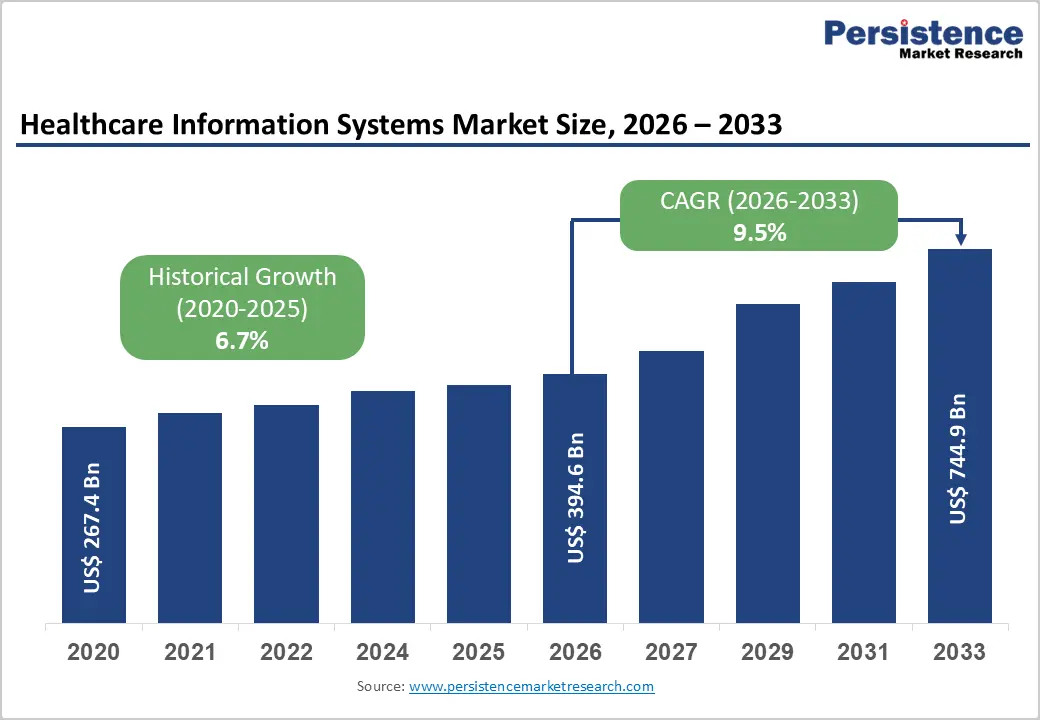
As per Persistence Market Research, the global HIS industry experienced a CAGR of 6.7% between 2019 and 2024, driven by the pandemic. Electronic health records and cloud-based data management are two examples of HIS systems that make it possible to follow patient symptoms and illness development in real-time. Additionally, they enabled effective triage, ensuring that oxygen supply, ventilators, and intensive care unit beds were distributed according to real-time data.

According to the National Institutes of Health, hospitals are using telehealth 500% more frequently, which lowers the risk of infection. Clinical decision support systems with AI capabilities enhanced COVID-19 diagnostic and treatment approaches. Additionally, by expediting scheduling and keeping an eye on adverse responses, HIS was essential to the delivery of vaccines.

Despite challenges like cybersecurity threats and interoperability issues, HIS advancements during the pandemic set the stage for digitized, AI-driven healthcare models, which will improve future emergency preparedness and patient care efficiency.

Improved Emphasis on Telehealth Services Presents Prospects for Growth 

In the estimated timeframe from 2025 to 2032, the global market for healthcare information systems is likely to showcase a CAGR of 9.5%. According to the National Institutes of Health, the need for digital transformation, interoperability, and AI-driven analytics has led to a spike in demand for EHRs and cloud-based platforms in the post-pandemic period. This has resulted in a predicted increase in the global healthcare IT sector, improving patient data management and clinical decision-making.

Studies highlight telemedicine advancements, with virtual consultations becoming a mainstream service. Hospitals are investing in remote patient monitoring and IoT-enabled medical devices to improve patient care. Several non-profit organizations note that cybersecurity concerns have led to stronger data protection regulations and blockchain-based health data storage.

The market study emphasizes automation in healthcare workflows, which reduces administrative burdens and improves patient outcomes. As a result, HIS adoption continues to rise, transforming healthcare delivery into a more efficient, data-driven ecosystem.

Market Dynamics

Growth Driver

Trend of Digitalization of Healthcare Sector Fuels with Novel Regulations

Since the digitalization of the healthcare sector, establishments working with electronic health records are increasingly integrating novel technologies, such as cloud-based databases and artificial intelligence, to streamline the implementation of healthcare information systems in hospitals. With these advancements in healthcare IT, governing authorities worldwide are mandating stringent regulations.

For example, regulatory mandates such as the U.S. 21st Century Cures Act require hospitals and clinics to ensure seamless patient data sharing. In Europe, the European Health Data Space (EHDS) initiative aims to standardize health data exchange across EU countries.

Furthermore, AI-powered clinical decision support systems are helping healthcare providers optimize treatment plans, reduce errors, and enhance patient outcomes. As hospitals make investments in IoT-based diagnostics, cybersecurity frameworks, and remote patient monitoring to enhance patient involvement and data security, the telemedicine industry is further propelling the use of healthcare information systems.

Market Restraining Factor

Data Security and Privacy Concerns in Healthcare Sector Limits the Adoption of Technology

In the healthcare industry, information systems are dealing with interoperability problems, data security threats, and poorly designed user interfaces. Potential medical mistakes can result from data input problems, patient identity mismatches, and accidental medicine choices caused by a lack of user-friendly design. Concerns regarding system usability, such as difficult navigation and sluggish processing speeds, lead to clinician annoyance and reduced productivity.

A smooth transmission of patient data is also hampered by technical errors such as data fragmentation, a lack of standardization, and trouble integrating outdated systems. The implementation of HIS is further complicated by security concerns, like cyberattacks and compromises of patient data. Liability and quality issues were brought to light in a 2019 National Institutes of Health study, which also emphasized the necessity of improved cybersecurity and system architecture.

Key Market Opportunity

Adoption of AI in Healthcare Sector Streamlines the Everyday Activities

As the healthcare sector moves towards digital implementation in everyday operations, the reliance on novel technologies is expected to increase with the integration of AI and ML in clinical decision support systems. By incorporating these technologies into healthcare, diagnostic accuracy, treatment planning, and patient management are likely to improve in the forthcoming years.

Organizations are enhancing AI integration in their activities owing to the ways AI-driven imaging technologies and predictive analytics are helping healthcare practitioners diagnose illnesses early and improve results. For instance,

  • The World Health Organization launched the MEDEVIS platform in July 2024, to expand global access to AI-powered medical devices, ensuring equitable healthcare solutions.

Healthcare organizations are partnering with technology firms to enhance operations, as seen with GE HealthCare and RadNet's strategic collaboration in November 2024, integrating SmartTechnology™ AI solutions into imaging systems.

The growing adoption of AI-based CDSS is projected to reduce diagnostic errors by up to 30% and enhance clinical efficiency by 40%. Such innovations not only improve patient safety but also streamline hospital operations, making AI a cornerstone of next-generation healthcare delivery.

Healthcare Information Systems Market Insights

Application Insights

Automation in Laboratory Information Systems Caters the Need for Personalized Medication

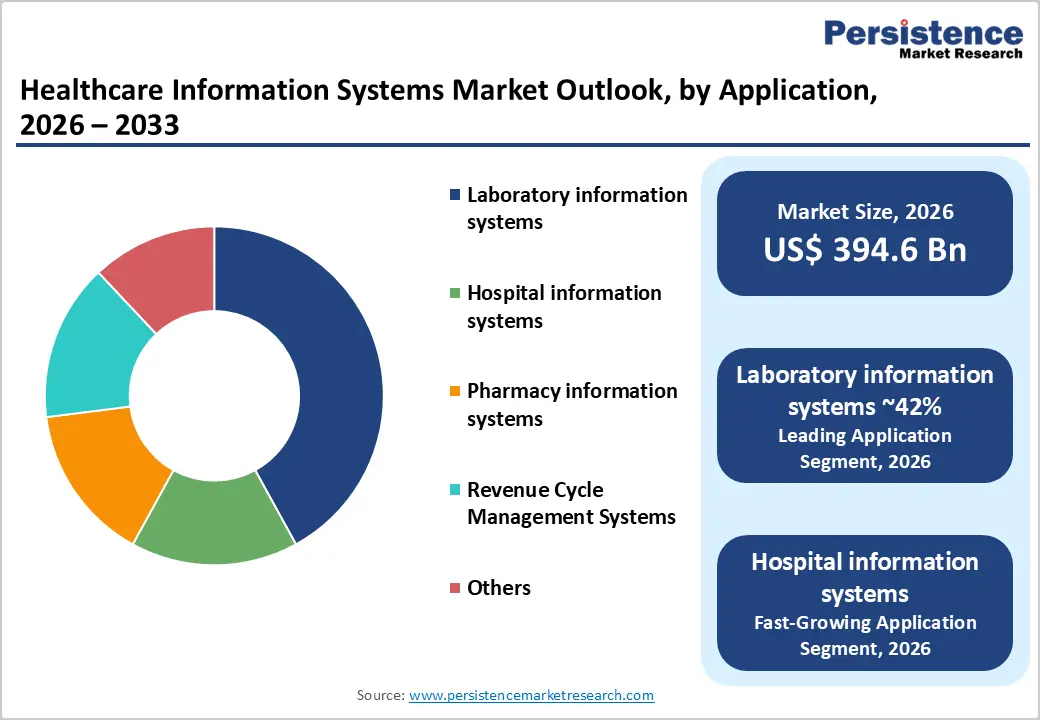
On the basis of the application, the growing need for automated diagnostic solutions and real-time patient data management is expected to propel the laboratory information systems market share to 42% in 2025. The implementation of LIS is being fueled by the growth of molecular diagnostics and personalized medication for chronic patients.

As hospitals continue to invest in electronic health records, AI-driven clinical decision support, and interoperability solutions, the hospital information systems (HIS) segment is predicted to account for 38% of the global healthcare information system market.

As e-prescriptions, medication tracking, and the integration of AI-driven drug management systems rise, pharmacy information systems (PIS) will take up 20% of the market. The future of healthcare information systems is envisioned to be shaped by advanced data analytics and AI-driven solutions as digital transformation picks up speed in the projected period.

Deployment Mode Insights

Scalability of the Cloud-based Deployment Showcases High Adoption Rates

Based on the Deployment mode, cloud-based systems are anticipated to account for 45% of the market in 2025. This is due to their cost-effectiveness, scalability, and remote accessibility. The acceleration of cloud migration is being driven by the growing use of telemedicine services, interoperability solutions, and analytics driven by AI. Companies such as Epic Systems, Cerner (Oracle Health), and GE HealthCare are extending their cloud-based capabilities with innovative features.

As healthcare providers look for secure online portals that allow real-time access to patient data, the web-based sector is anticipated to account for 35% of the market. Web-based solutions are popular in pharmacies and small clinics due to their cheaper IT infrastructure expenses.

Since big hospitals and research facilities want in-house servers for increased security and compliance with laws like HIPAA and GDPR, the on-premise category is expected to make up 20% of the market. Healthcare providers are, however, being pushed into cloud and web-based solutions due to the high maintenance expenditure.
healthcare information systems market insights and key trends

Regional Insights

North America Healthcare Information Systems Market

Rise in Adoption of EHR Systems in North America Promotes Digitalization of Healthcare Industry

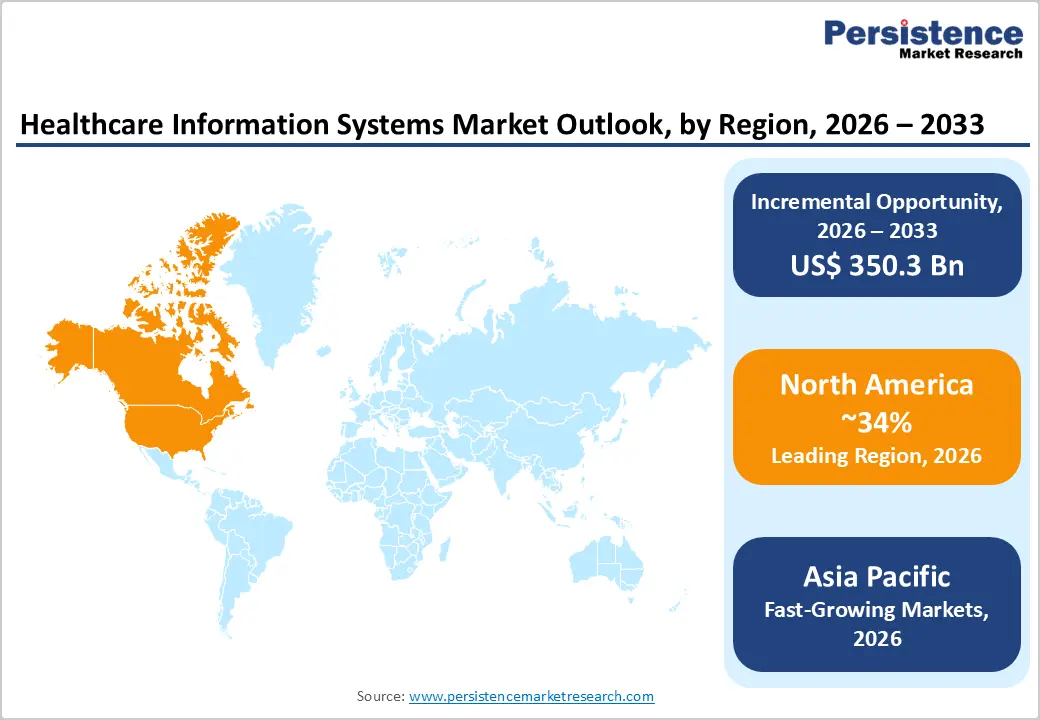
The healthcare information systems market in North America is projected to hold a 34% market share in 2025, driven by strong digital infrastructure, high EHR adoption rates, and government-backed healthcare IT initiatives. The U.S. leads the region, with nearly 90% of physicians having adopted EHR systems, according to the Office of the National Coordinator for Health Information Technology (ONC).

The Affordable Care Act (ACA) and HITECH Act have been pivotal in accelerating digital transformation in healthcare, providing financial incentives for hospitals and clinics to implement EHRs, CDSS, and remote patient monitoring. Canada is also witnessing rapid adoption, with the Canadian Institute for Health Information (CIHI) reporting over 80% of hospitals using digital records.

As digital healthcare expands, North America’s healthcare information systems market is forecasted to showcase a CAGR of 7.2% from 2025 to 2032, fueled by AI-powered analytics and cloud-based information systems.

Asia Pacific Healthcare Information Systems Market

Rise in Investment in Healthcare Technologies in Asia Pacific Shows Avenues

The healthcare information system market in Asia Pacific is expected to hold a market share of 25% in 2025, making it the fastest-growing region due to government investments in the digital transformation of efficient healthcare management. Japan leads the region, with its healthcare IT market dominating in 2025, driven by the adoption of AI-driven medical solutions and remote patient monitoring technologies.

Japan’s Robot for Interactive Body Assistance (RIBA) demonstrates the country’s commitment to digital elder care solutions, addressing its aging population. Fujitsu has been at the forefront of digital healthcare innovation in Japan, launching the Clinical Research Big Data Platform in March 2023, which integrates real-world hospital data for advanced medical research.

Government-supported programs like the Ayushman Bharat Digital Mission (ABDM) and the Integrated Health Information Platform (IHIP) are encouraging the use and interoperability of EHRs in India.  In a similar vein, to enhance patient outcomes, South Korea and Malaysia are growing their telemedicine and cloud-based hospital administration systems.

Europe Healthcare Information Systems Market

Robust Healthcare Initiatives in Europe Cultivates Progress in HIS Technology

In 2025, the healthcare information systems market in Europe is altering with government-led digital health initiatives, interoperability efforts, and AI-driven healthcare advancements. The WHO's 2024 progress report highlights how EU nations are accelerating digital transformation, integrating EHRs, and telehealth services to enhance patient care.

Countries like Germany and France have strengthened digital health laws to improve cross-border healthcare data exchange. The EU Digital Health Data Space initiative is expected to streamline medical records sharing and boost efficiency across healthcare networks.

Investments in AI-assisted diagnostics, cybersecurity, and cloud-based hospital management systems are reshaping Europe’s healthcare sector, ensuring improved data security, accessibility, and patient outcomes.

Healthcare Information Systems Market Competitive Landscape

The global healthcare information systems market exhibits a moderate level of fragmentation, characterized by the presence of numerous local companies that are actively competing for market share. These players are employing a variety of strategies to enhance their competitive edge, including significant investments in novel technology, forming strategic partnerships, and pursuing acquisitions and mergers.

In addition to trade tactics, companies are dedicating resources to the development of innovative and advanced products that meet the evolving needs of the healthcare industry. A key area of focus is on maintaining competitive pricing strategies to attract a wider customer base while ensuring the sustainability of their operations.

Moreover, many organizations within this market are looking to the future by incorporating cutting-edge technologies such as AI and ML into their systems. This adoption aims not only to improve operational efficiency but also to strengthen their market presence and relevance in a rapidly changing landscape. By harnessing these advanced technologies, companies strive to deliver better healthcare solutions and enhance the patient experience.

Key Industry Developments

  • In January 2025, the Healthcare Information and Management Systems Society (HIMSS) and the Association of Medical Directors of Information Systems (AMDIS) partnered to advance clinical innovation through education, digital transformation, and leadership networking for healthcare professionals, initially focusing on North America but expanding internationally.
  • In August 2024, Jarrard Inc. launched a health technology practice, led by SVP Alex Hunter, to assist health IT companies in regulatory environments, stakeholder engagement, and digital marketing strategies.
  • In July 2024, WHO launched MeDevIS, the first global open-access clearing house for medical device information, facilitating decision-making and improving access to life-saving technologies worldwide.
  • In April 2024, WHO launched S.A.R.A.H., an AI-powered digital health promoter, assisting users in understanding risk factors for leading causes of death, requiring further research for ethical considerations.

Companies Covered in Healthcare Information Systems Market

  • GE Healthcare
  • Philips Healthcare
  • McKesson Corporation
  • Nextgen healthcare Information System Inc.
  • Others
Frequently Asked Questions

The market is set to reach US$ 360.4 Bn in 2025.

Yes, health informatics is poised for a promising future due to advanced technologies and personalized medicine, making it crucial in the evolving healthcare sector.

Philips Healthcare, Nextgen healthcare Information System Inc., GE Healthcare and McKesson Corporation, are a few leading players.

The industry is estimated to rise at a CAGR of 9.5% through 2032.

North America is projected to hold the largest share of the industry in 2025.

Healthcare Information Systems Market Report Scope

Report Attributes

Details

Historical Data/Actuals

2019 - 2024

Forecast Period

2025 - 2032

Market Analysis Units

Value: US$ Bn/Mn, Volume: As applicable

Geographical Coverage

  • North America
  • Europe
  • East Asia
  • South Asia and Oceania
  • Middle East and Africa
  • Latin America

Segmental Coverage

  • Application
  • Deployment Mode
  • Components
  • Region

Competitive Analysis

  • GE Healthcare
  • Philips Healthcare
  • McKesson Corporation
  • Nextgen healthcare Information System Inc.
  • Others

Report Highlights

  • Market Forecast and Trends
  • Competitive Intelligence & Share Analysis
  • Growth Factors and Challenges
  • Strategic Growth Initiatives
  • Pricing Analysis & Technology Roadmap
  • Future Opportunities and Revenue Pockets
  • Industry Market Analysis Tools   

Customization and Pricing

Available upon request

Healthcare Information Systems Market Segmentation

By Application

  • Hospital information systems
  • Pharmacy information systems
  • Laboratory information systems
  • Revenue Cycle Management Systems
  • Others

By Deployment Mode

  • Web-based
  • On-premise
  • Cloud-based

By Components

  • Software
  • Hardware
  • Services

By Region

  • North America
  • Europe
  • East Asia
  • South Asia and Oceania
  • Middle East and Africa
  • Latin America

Related Reports

  1. Executive Summary
    1. Global Healthcare Information Systems Market Snapshot, 2025 and 2032
    2. Market Opportunity Assessment, 2025 - 2032, US$ Mn
    3. Key Market Trends
    4. Future Market Projections
    5. Premium Market Insights
    6. Application Developments and Key Market Events
    7. PMR Analysis and Recommendations
  2. Market Overview
    1. Market Scope and Definition
    2. Market Dynamics
      1. Drivers
      2. Restraints
      3. Opportunity
      4. Challenges
      5. Key Trends
    3. Macro-Economic Factors
      1. Global GDP Growth
      2. Healthcare Spending Outlook
      3. Economic Conditions and IT Budget Allocation
      4. Investment in R&D
      5. Aging Population & Chronic Disease Prevalence Outlook
    4. COVID-19 Impact Analysis
    5. Forecast Factors - Relevance and Impact
  3. Value Added Insights
    1. Regulatory Landscape
    2. Value Chain Analysis
    3. PESTLE Analysis
    4. Porter’s Five Force Analysis
  4. Price Trend Analysis
    1. Key Highlights
    2. Key Factors Impacting Healthcare Information Systems Prices
    3. Pricing Analysis, by Component
      1. Subscription Analysis
      2. Perceptual License
  5. Global Healthcare Information Systems Market Outlook: Historical (2019 - 2024) and Forecast (2025 - 2032)
    1. Global Healthcare Information Systems Market Outlook: Component
      1. Introduction / Key Findings
      2. Historical Market Size (US$ Mn) and Analysis, By Component, 2019 - 2024
      3. Current Market Size (US$ Mn) and Analysis and Forecast, By Component, 2025 - 2032
        1. Hardware
        2. Software
        3. Services
    2. Market Attractiveness Analysis: Component
    3. Global Healthcare Information Systems Market Outlook: Deployment
      1. Introduction / Key Findings
      2. Historical Market Size (US$ Mn) Analysis, By Deployment, 2019 - 2024
      3. Current Market Size (US$ Mn) Analysis and Forecast, By Deployment, 2025 - 2032
        1. Web-based
        2. On-premises
        3. Cloud-based
    4. Market Attractiveness Analysis: Deployment
    5. Global Healthcare Information Systems Market Outlook: Application
      1. Introduction / Key Findings
      2. Historical Market Size (US$ Mn) Analysis, By Application, 2019 - 2024
      3. Current Market Size (US$ Mn) Analysis and Forecast, By Application, 2025 - 2032
        1. Hospital Information Systems
        2. Pharmacy Information Systems
        3. Laboratory Information Systems
        4. Revenue Cycle Management Systems
        5. Others
    6. Market Attractiveness Analysis: Application
  6. Global Healthcare Information Systems Market Outlook: Region
    1. Key Highlights
    2. Historical Market Size (US$ Mn) and Analysis, By Region, 2019 - 2024
    3. Current Market Size (US$ Mn) Analysis and Forecast, By Region, 2025 - 2032
      1. North America
      2. Europe
      3. East Asia
      4. South Asia and Oceania
      5. Latin America
      6. Middle East & Africa
    4. Market Attractiveness Analysis: Region
  7. North America Healthcare Information Systems Market Outlook: Historical (2019 - 2024) and Forecast (2025 - 2032)
    1. Key Highlights
    2. Historical Market Size (US$ Mn) Analysis, By Market, 2019 - 2024
      1. By Country
      2. By Component
      3. By Deployment
      4. By Application
    3. Current Market Size (US$ Mn) Analysis and Forecast, By Country, 2025 - 2032
      1. U.S.
      2. Canada
    4. Current Market Size (US$ Mn) Analysis and Forecast, By Component, 2025 - 2032
      1. Hardware
      2. Software
      3. Services
    5. Current Market Size (US$ Mn) Analysis and Forecast, By Deployment, 2025 - 2032
      1. Web-based
      2. On-premises
      3. Cloud-based
    6. Current Market Size (US$ Mn) Analysis and Forecast, By Application, 2025 - 2032
      1. Hospital Information Systems
      2. Pharmacy Information Systems
      3. Laboratory Information Systems
      4. Revenue Cycle Management Systems
      5. Others
    7. Market Attractiveness Analysis
  8. Europe Healthcare Information Systems Market Outlook: Historical (2019 - 2024) and Forecast (2025 - 2032)
    1. Key Highlights
    2. Historical Market Size (US$ Mn) Analysis, By Market, 2019 - 2024
      1. By Country
      2. By Component
      3. By Deployment
      4. By Application
    3. Current Market Size (US$ Mn) Analysis and Forecast, By Country, 2025 - 2032
      1. Germany
      2. France
      3. U.K.
      4. Italy
      5. Spain
      6. Russia
      7. Türkiye
      8. Rest of Europe
    4. Current Market Size (US$ Mn) Analysis and Forecast, By Component, 2025 - 2032
      1. Hardware
      2. Software
      3. Services
    5. Current Market Size (US$ Mn) Analysis and Forecast, By Deployment, 2025 - 2032
      1. Web-based
      2. On-premises
      3. Cloud-based
    6. Current Market Size (US$ Mn) Analysis and Forecast, By Application, 2025 - 2032
      1. Hospital Information Systems
      2. Pharmacy Information Systems
      3. Laboratory Information Systems
      4. Revenue Cycle Management Systems
      5. Others
    7. Market Attractiveness Analysis
  9. East Asia Healthcare Information Systems Market Outlook: Historical (2019 - 2024) and Forecast (2025 - 2032)
    1. Key Highlights
    2. Historical Market Size (US$ Mn) Analysis, By Market, 2019 - 2024
      1. By Country
      2. By Component
      3. By Deployment
      4. By Application
    3. Current Market Size (US$ Mn) Analysis and Forecast, By Country, 2025 - 2032
      1. China
      2. Japan
      3. South Korea
    4. Current Market Size (US$ Mn) Analysis and Forecast, By Component, 2025 - 2032
      1. Hardware
      2. Software
      3. Services
    5. Current Market Size (US$ Mn) Analysis and Forecast, By Deployment, 2025 - 2032
      1. Web-based
      2. On-premises
      3. Cloud-based
    6. Current Market Size (US$ Mn) Analysis and Forecast, By Application, 2025 - 2032
      1. Hospital Information Systems
      2. Pharmacy Information Systems
      3. Laboratory Information Systems
      4. Revenue Cycle Management Systems
      5. Others
    7. Market Attractiveness Analysis
  10. South Asia & Oceania Healthcare Information Systems Market Outlook: Historical (2019 - 2024) and Forecast (2025 - 2032)
    1. Key Highlights
    2. Historical Market Size (US$ Mn) Analysis, By Market, 2019 - 2024
      1. By Country
      2. By Component
      3. By Deployment
      4. By Application
    3. Current Market Size (US$ Mn) Analysis and Forecast, By Country, 2025 - 2032
      1. India
      2. Southeast Asia
      3. ANZ
      4. Rest of South Asia & Oceania
    4. Current Market Size (US$ Mn) Analysis and Forecast, By Component, 2025 - 2032
      1. Hardware
      2. Software
      3. Services
    5. Current Market Size (US$ Mn) Analysis and Forecast, By Deployment, 2025 - 2032
      1. Web-based
      2. On-premises
      3. Cloud-based
    6. Current Market Size (US$ Mn) Analysis and Forecast, By Application, 2025 - 2032
      1. Hospital Information Systems
      2. Pharmacy Information Systems
      3. Laboratory Information Systems
      4. Revenue Cycle Management Systems
      5. Others
    7. Market Attractiveness Analysis
  11. Latin America Healthcare Information Systems Market Outlook: Historical (2019 - 2024) and Forecast (2025 - 2032)
    1. Key Highlights
    2. Historical Market Size (US$ Mn) Analysis, By Market, 2019 - 2024
      1. By Country
      2. By Component
      3. By Deployment
      4. By Application
    3. Current Market Size (US$ Mn) Analysis and Forecast, By Country, 2025 - 2032
      1. Brazil
      2. Mexico
      3. Rest of Latin America
    4. Current Market Size (US$ Mn) Analysis and Forecast, By Component, 2025 - 2032
      1. Hardware
      2. Software
      3. Services
    5. Current Market Size (US$ Mn) Analysis and Forecast, By Deployment, 2025 - 2032
      1. Web-based
      2. On-premises
      3. Cloud-based
    6. Current Market Size (US$ Mn) Analysis and Forecast, By Application, 2025 - 2032
      1. Hospital Information Systems
      2. Pharmacy Information Systems
      3. Laboratory Information Systems
      4. Revenue Cycle Management Systems
      5. Others
    7. Market Attractiveness Analysis
  12. Middle East & Africa Healthcare Information Systems Market Outlook: Historical (2019 - 2024) and Forecast (2025 - 2032)
    1. Key Highlights
    2. Historical Market Size (US$ Mn) Analysis, By Market, 2019 - 2024
      1. By Country
      2. By Component
      3. By Deployment
      4. By Application
    3. Current Market Size (US$ Mn) Analysis and Forecast, By Country, 2025 - 2032
      1. GCC Countries
      2. South Africa
      3. Northern Africa
      4. Rest of Middle East & Africa
    4. Current Market Size (US$ Mn) Analysis and Forecast, By Component, 2025 - 2032
      1. Hardware
      2. Software
      3. Services
    5. Current Market Size (US$ Mn) Analysis and Forecast, By Deployment, 2025 - 2032
      1. Web-based
      2. On-premises
      3. Cloud-based
    6. Current Market Size (US$ Mn) Analysis and Forecast, By Application, 2025 - 2032
      1. Hospital Information Systems
      2. Pharmacy Information Systems
      3. Laboratory Information Systems
      4. Revenue Cycle Management Systems
      5. Others
    7. Market Attractiveness Analysis
  13. Competition Landscape
    1. Market Share Analysis, 2024
    2. Market Structure
      1. Competition Intensity Mapping
      2. Competition Dashboard
    3. Company Profiles (Details - Overview, Financials, Strategy, Recent Developments)
      1. GE Healthcare
        1. Overview
        2. Solution Portfolio
        3. Key Financials
        4. Market Developments
        5. Market Strategy
      2. Philips Healthcare
      3. McKesson Corporation
      4. Nextgen healthcare Information System Inc.
      5. Epic Systems Corporation
      6. Oracle Health
      7. Meditech
      8. Allscripts Healthcare Solutions
      9. eClinicalWorks
      10. Napier Healthcare Solutions
      11. Telekom Healthcare Solutions
      12. Netsmart Technologies
  14. Appendix
    1. Research Methodology
    2. Research Assumptions
    3. Acronyms and Abbreviations

Research Methodology Framework for Market Research Excellence

At Persistence Market Research, we implement a comprehensive, validated, and multi-dimensional approachto market analysis that delivers actionable insights across complex market landscapes. Our methodology combines the analytical rigor of leading consulting firms with innovative research techniques, ensuring robust market assessments that guide strategic decision-making with confidence.

Core Research Philosophy

Our methodology is built on four foundational pillars:

Research Philosophy Image

At Persistence Market Research, our methodology is designed to transcend conventional market studies by combining analytical rigor, multi-source validation, and future-focused insights.

We integrate advanced research frameworks, robust data collection strategies, cutting-edge analytics, and innovative technologies to deliver a 360-degree view of complex markets.

We integrate advanced research frameworks, robust data collection strategies, cutting-edge analytics, and innovative technologies to deliver a 360-degree view of complex markets.

Each stage spanning from strategic scoping and hypothesis-building to competitive intelligence, quality validation, and actionable recommendations is engineered to provide clients with unmatched clarity, precision, and confidence in decision-making.

By embedding innovation and technology at the core, our approach ensures that insights are not only comprehensive but also predictive, empowering businesses to seize opportunities, mitigate risks, and achieve sustainable growth

Research Philosophy Image

Capturing Key Information and Events

During this phase, key research objectives focus on essential information and data points for assessing the market, including:

Research Philosophy Image

TAM-SAM-SOM Framework Implementation

We employ both top-down and bottom-up approaches to ensure accurate market sizing.

Top-Down Market SizingBottom-Up Market Sizing
Universe Definition: Total global/regional market identificationUnit Economics: Average transaction values, purchase frequencies, customer lifecycle
Segmentation Filters: Geographic, demographic, and behavioral constraintsCustomer Segmentation: Detailed buyer persona development and sizing
Market Share Analysis: Competitive landscape assessment and share allocationPenetration Analysis: Market penetration rates by segment and geography
Growth Rate Application: Historical trends and forward-looking growth assumptionsScaling Methodology: Extrapolation techniques with confidence intervals

Validation & Cross-Verification

  • Triangulation: Comparing top-down and bottom-up results for consistency
  • Sensitivity Analysis: Testing key assumptions and parameter variations
  • Peer Benchmarking: Comparison with analogous markets and industry benchmarks
  • Expert Review: External validation through industry specialist consultation

Research Philosophy Image

Forecasting & Projection Modeling

Our proprietary forecasting models incorporate multiple variables and scenarios.

Forecasting Components

  • Historical Trend Analysis: 10-year historical growth patterns and cyclical variations
  • Driver-Based Modeling: Economic indicators, demographic shifts, technology adoption
  • Scenario Planning: Base case, optimistic, and conservative projections
  • Monte Carlo Simulations: Probability-weighted outcomes and risk assessments

Model Validation

  • Back-Testing: Historical accuracy assessment over 3–5-year periods
  • Cross-Validation: Multiple modeling approaches for result comparison
  • External Benchmarking: Comparison with established market forecasts
  • Continuous Calibration: Quarterly model updates based on new data

Comprehensive Data Collection Strategy

Our secondary research phase establishes a robust knowledge base utilizing diverse, credible sources.

Secondary Data Sourcess

  • Industry Publications & Reports
  • Government & Regulatory Data
  • Financial Intelligence (filings & reports)
  • Academic Research & Digital Intelligence

Quality Assurance Protocol

  • Source credibility assessment and publication date validation
  • Data consistency checks across multiple sources
  • Bias identification and neutralization techniques
  • Information gap tracking for primary research prioritization

Research Philosophy Image

Primary Research Excellence

Our primary research methodology employs best-in-class techniques to capture unique market insights.

Quantitative Research Methods

  • Large-Scale Surveys: Statistically representative samples with 95% confidence intervals
  • Survey Methodology: Multi-channel deployment (online, telephone, in-person)
  • Question Architecture and Response Optimization

Qualitative Research Methods

  • Executive Interviews
  • Focus Groups
  • Expert Consultations

Quality Assurance & Validation Framework

Multi-Stage Validation Process

  • Source Verification and Consistency Testing
  • Outlier Detection and Bias Assessment
  • Peer Review Process and External Validation
  • Sensitivity Analysis and Confidence Intervals

Research Philosophy Image

Methodology Validation & Credibility

Our research methodology has been extensively validated through:

  • Academic Partnerships: Collaborations with top-tier business schools and research institutions
  • Client Success Stories: Documented case studies demonstrating research impact and ROI
  • Continuous Benchmarking: Performance comparison with leading global research firms

This comprehensive methodology framework positions Persistence Market Research at the forefront of market intelligence, combining the analytical sophistication of top-tier consulting firms with innovative research techniques. Our approach ensures that every market assessment delivers precise, actionable, and strategically valuable insights that drive business success in competitive market environments.

Ready to unlock your market potential? Contact our research experts to discuss how our validated methodology can transform your strategic decision-making with data-driven market intelligence.

Copyright © 2026 Persistence Market Research. All Rights Reserved

Connect With Us -