




- Animal Feed & Additives
- Feed Microbial Market
Feed Microbial Market Size, Share, and Growth Forecast 2026 - 2033
Feed Microbial Market by Form (Powders, Liquids / Gels, Tablets), Microbial Type (Bacteria (Lactobacillus, Other Bacteria), Yeast), Livestock (Poultry, Ruminants, Swine, Aquatic Animals, Others), and Regional Analysis, 2026 - 2033

Feed Microbial Market Size and Trend Analysis
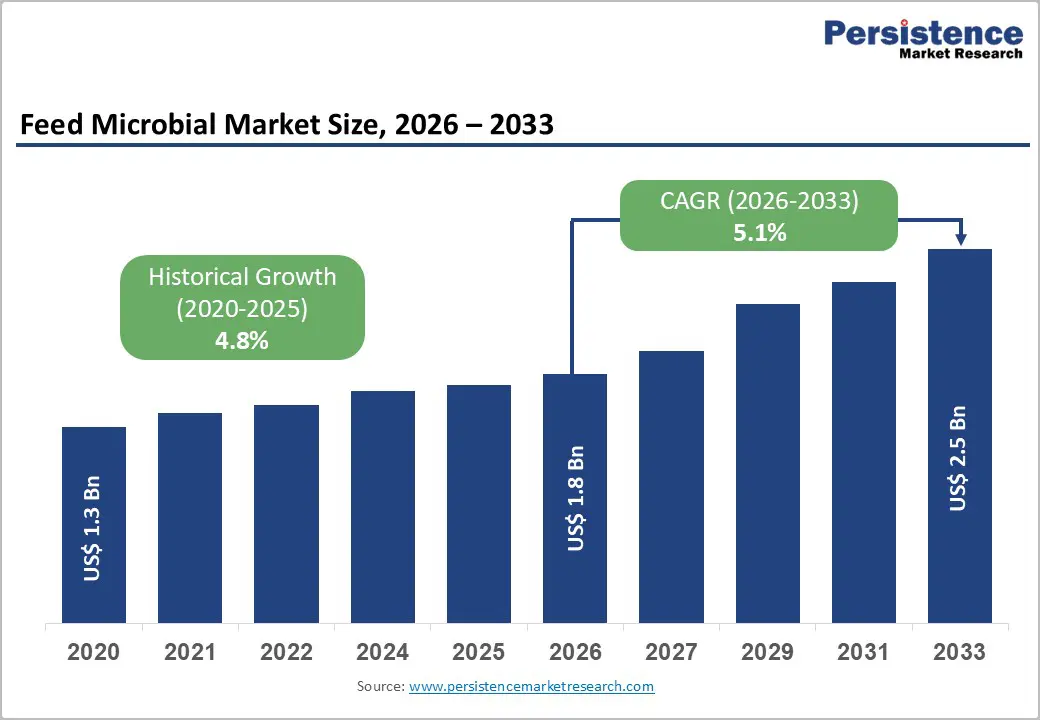
The global feed microbial market size is expected to be valued at US$ 1.8 billion in 2026 and projected to reach US$ 2.5 billion by 2033, growing at a CAGR of 5.1% between 2026 and 2033.
The direct feed microbial is an animal feed additive that contains live good micro-organisms which boost the animal gut environment, providing immunity and boosting the appetite of the animal. The micro-organisms include various strains of bacteria such as Lactobacillus, Bacillus Licheniformis, Bacillus subtilis, Bifidobacterium, and Enterococcus. Of these, the lactic acid bacteria are the most widely used strain. The direct feed microbial also includes yeast. The most used species of yeast are Saccharomyces cervisae, Aspergillus niger, and Aspergillus oryzae. The inclusion of the microbials is in CFUs or Colony Forming Units, as mentioned on the product labels. The direct feed microbial, also called probiotics developed for animals by some countries and manufacturers.
Key Industry Highlights:
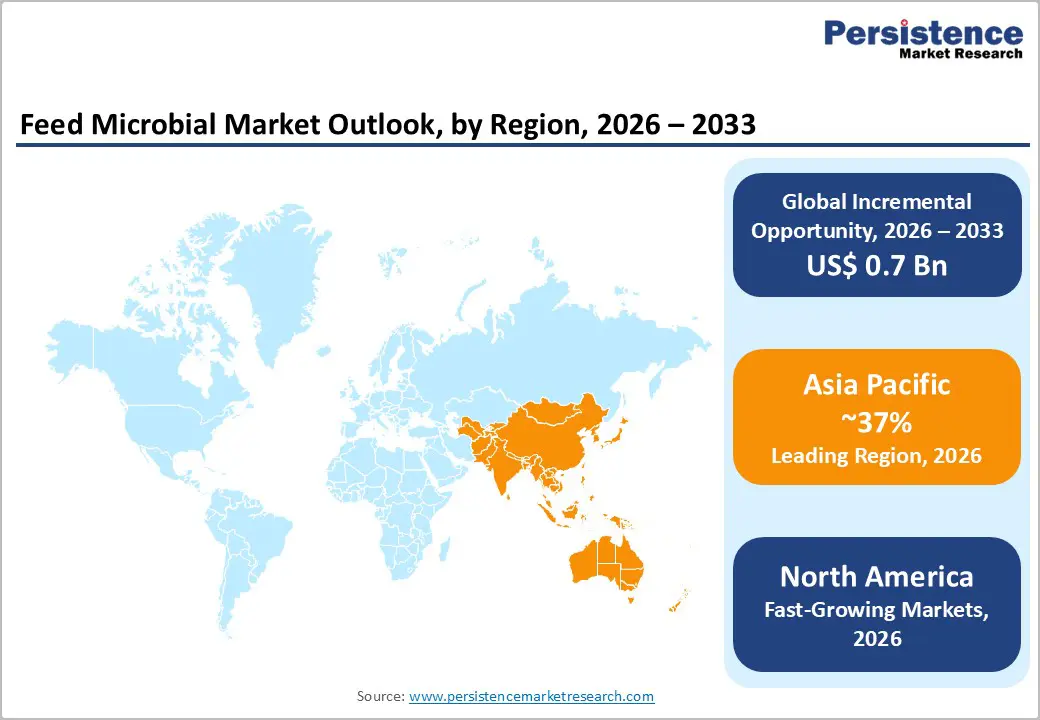
- Dominant Region: Asia Pacific dominated the landscape with a 37% market share in 2025, fueled by China's massive feed production and the regional transition toward antibiotic-free livestock management.
- Fast-growing Market: North America is projected to be the fastest-growing region through 2033, supported by heavy R&D investments and a rapidly expanding market for "raised without antibiotics" (RWA) meat products.
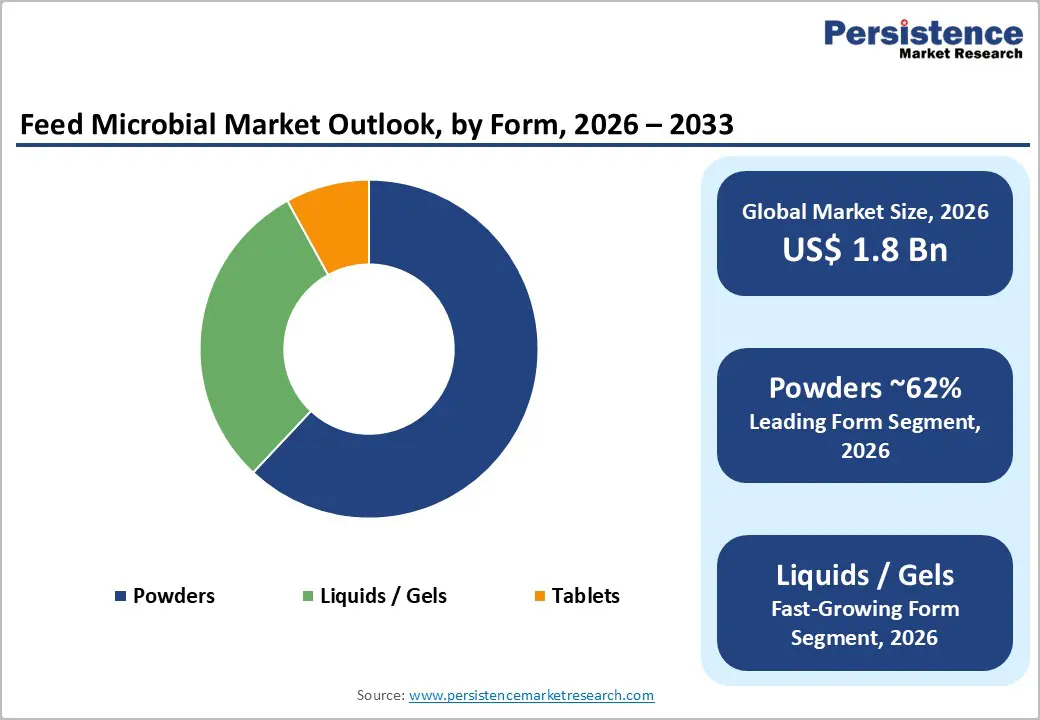
- Dominant Form Type: Powders remained the primary form for microbial delivery, capturing 62% of the market in 2025 due to their stability, ease of mixing, and cost-effective logistics in global trade.
- Fast-growing Form Type: Liquids /Gels are emerging as the fastest-growing form, as producers increasingly favor water-based delivery systems for rapid microbial intervention during periods of animal stress or disease.
- Opportunity: The expansion into aquatic animals represents a significant revenue pocket, as the aquaculture industry seeks sustainable microbial solutions to replace traditional chemicals and enhance yield in high-density systems.
| Key Insights | Details |
|---|---|
| Feed Microbial Market Size (2026E) | US$ 1.8 billion |
| Market Value Forecast (2033F) | US$ 2.5 billion |
| Projected Growth CAGR (2026 - 2033) | 5.1% |
| Historical Market Growth (2020 - 2025) | 4.8% |
DRO Analysis
Drivers - Rising Demand for Sustainable and Antibiotic-Free Meat Production
The primary driver for the Feed Microbial Market is the global movement toward sustainable animal husbandry and the phasing out of antibiotics in animal nutrition. Organizations such as the World Health Organization (WHO) and the World Organisation for Animal Health (WOAH) have highlighted the risks of antimicrobial resistance, prompting countries like China and Brazil to implement stricter feed additive regulations. Consequently, Direct-Fed Microbials (probiotics) are being integrated into standard diets to maintain intestinal microflora and bolster the immune systems of livestock. In 2025, the push for "green" labels in retail sectors has led to a 15% increase in the adoption of microbial-based solutions by large-scale poultry and swine integrators seeking to satisfy consumer preferences for natural food sources.
Advancements in Microbial Delivery and Encapsulation Technologies
Technological innovation in the processing of microbial cultures is significantly propelling market growth. Traditional probiotics often suffered from low viability when exposed to the high temperatures and pressures of feed extrusion. However, leading players like Lallemand Inc. and Archer Daniels Midland Company have developed advanced micro-encapsulation techniques that protect sensitive strains such as Lactobacillus and Bifidobacterium. These innovations allow microbials to remain stable throughout the supply chain and release effectively in the animal's gastrointestinal tract. According to recent industry reports from the International Feed Industry Federation (IFIF), the improved shelf-life and efficacy of these high-performance formulations have increased their penetration in the ruminant and aquaculture sectors, where specialized microbial blends are used to optimize rumen fermentation and water quality.
Restraint - High Production Costs and Stringent Regulatory Approval Processes
A significant barrier to the widespread adoption of Feed Microbials is the substantial cost associated with specialized fermentation and downstream processing. The production of pure, high-potency microbial cultures requires sterile environments and advanced biotechnology, which often results in a higher price point compared to synthetic additives. Furthermore, the regulatory landscape remains complex; in the European Union, every new microbial strain must undergo a rigorous safety assessment by the EFSA under Regulation (EC) No 1831/2003. This process can take several years and requires extensive clinical data to prove both safety and efficacy, often deterring smaller manufacturers from entering the market or launching innovative strains.
Variable Efficacy and Sensitivity to Environmental Factors
The biological nature of Feed Microbials makes them inherently susceptible to environmental stressors, which can limit their performance consistency. Unlike chemical additives, live microorganisms can be neutralized by moisture, oxygen, or interactions with other feed ingredients like minerals and organic acids. Farmers often report inconsistent results depending on the farm’s hygiene levels, animal age, and existing gut health status. This variability can lead to skepticism among traditional livestock producers regarding the return on investment (ROI). Without standardized global protocols for measuring the "active" colony-forming units (CFU) at the point of consumption, the market faces challenges in building universal trust across diverse agricultural regions.
Opportunities - Expansion into the High-Growth Aquaculture Sector
The Aquatic Animals segment presents a massive growth opportunity as the global aquaculture industry seeks alternatives to fishmeal and chemical treatments. With the Food and Agriculture Organization (FAO) projecting a continued rise in farmed seafood production, there is an urgent need for microbials that can improve water quality by reducing ammonia levels and enhancing the disease resistance of species like shrimp and salmon. Specific strains of Bacillus and Yeast are being developed to act as bioremediators in pond environments. Companies that can provide multi-strain microbial solutions tailored for high-density aquaculture systems stand to gain significant market share, especially in emerging hubs like Vietnam, Thailand, and Norway, where environmental sustainability is becoming a prerequisite for export.
Development of Precision Nutrition and Species-Specific Blends
There is a growing trend toward "Precision Livestock Farming," creating a demand for customized microbial formulations that target specific physiological stages of an animal's life. For instance, developing microbials specifically for post-weaning stress in piglets or for early-stage chick development offers high value-add potential. By utilizing metagenomics and gut microbiome mapping, companies can identify unique bacterial strains that optimize nutrient absorption for specific breeds. This shift from generic "one-size-fits-all" products to targeted solutions allows manufacturers to command premium pricing. The integration of digital monitoring tools with microbial supplementation regimes is expected to be a major revenue pocket, as it enables farmers to see real-time improvements in Feed Conversion Ratios (FCR).
Category-wise Analysis
Form Insights
The Powders segment is the dominant form in the Feed Microbial Market, accounting for a 62% market share in 2025. The leadership of this segment is primarily due to the ease of handling, superior shelf stability, and seamless integration into dry feed mixing processes at commercial feed mills. Powders allow for high concentrations of colony-forming units (CFU) to be delivered in a lightweight format, reducing transportation costs. According to the American Feed Industry Association (AFIA), most premix manufacturers prefer dry microbial formulations because they offer better homogeneity when blended with other micro-ingredients like vitamins and minerals. While Liquids / Gels are the fastest-growing segment due to their application in water-delivery systems, the established infrastructure of the global feed industry ensures that Powders remain the primary choice for large-scale livestock operations.
Livestock Insights
Poultry is the leading livestock category, capturing nearly 46% of the market share in 2025. The intensive nature of poultry farming, characterized by high bird density and short production cycles, makes these animals highly susceptible to enteric diseases, necessitating the use of Feed Microbials as a preventive health measure. The rapid growth of the global broiler industry, particularly in Asia Pacific and Latin America, has necessitated the adoption of microbials to improve Feed Conversion Ratios (FCR) and ensure uniform growth. Ruminants follow as the second-largest segment, where microbials are used to stabilize rumen pH and prevent metabolic disorders. The high volume of poultry production worldwide, combined with the sector's early adoption of antibiotic-free standards, reinforces its position as the primary revenue generator for microbial manufacturers.
Regional Insights
North America Feed Microbial Market Trends and Insights
The North America region is the fastest-growing market for feed microbials, driven by a sophisticated innovation ecosystem and a robust regulatory framework led by the U.S. Food and Drug Administration (FDA) and the Association of American Feed Control Officials (AAFCO). The United States maintains market leadership in this region due to the presence of major biotechnology firms and a high rate of R&D investment. There is a notable trend toward the use of "postbiotics" and stable microbial strains that can withstand the rigors of industrial feed processing.
In Canada and the U.S., the expansion of the organic and "raised without antibiotics" (RWA) meat sectors have pushed integrators to seek scientifically validated microbial solutions. According to the U.S. Department of Agriculture (USDA), the demand for natural feed additives has seen a steady increase as consumers prioritize animal welfare and food safety. The region's infrastructure for precision agriculture also allows for the integration of microbial additives into data-driven feeding programs, further accelerating market growth through technological adoption.
Europe Feed Microbial Market Trends and Insights
Europe remains a highly mature and strictly regulated market, with Germany, France, and the United Kingdom leading in microbial consumption. The region’s market dynamics are heavily influenced by the European Green Deal and the Farm to Fork Strategy, which aim to reduce nutrient losses and the use of antimicrobials in farming. Regulatory harmonization under the EFSA ensures that only safe and efficacious microbial strains are commercialized, fostering a market environment built on high-quality standards and consumer trust.
In Spain and Italy, the swine and poultry sectors are major consumers of Feed Microbials to comply with the ban on antibiotic growth promoters that has been in place since 2006. Recent trends in the region show an increased focus on sustainability, with companies developing microbials that can help reduce methane emissions in cattle, aligning with the EU's climate neutrality goals. The presence of established players like Lallemand Inc. and Biovet S.A. provides the region with a competitive edge in fermentation technology and specialty strain development.
Asia Pacific Feed Microbial Market Trends and Insights
The Asia Pacific region held the leading market share of 37% in 2025, primarily due to the massive livestock populations in China, India, and ASEAN countries. China is the world's largest producer of animal feed, and its recent ban on medicated feed additives has created a vacuum that is being rapidly filled by microbial-based alternatives. The region benefits from significant manufacturing advantages, including lower production costs and a rapidly expanding middle class that is driving the demand for high-quality meat and dairy products.
In India, the poultry and dairy sectors are witnessing a transformation as farmers shift from traditional practices to commercialized, nutrition-focused operations. The growth in the ASEAN aquaculture market, particularly in Vietnam and Indonesia, further bolsters the demand for water-stable microbials. The presence of local players like Neospark Drugs and Chemicals and Synbio Tech Inc. highlights the regional expertise in tailoring microbial solutions to tropical climates and local livestock breeds, making it a critical hub for global market volume.
Competitive Landscape
The global feed microbial Market is characterized by a semi-consolidated structure, where a few global giants coexist with specialized regional players. Large conglomerates like Archer Daniels Midland Company and E. I. du Pont de Nemours and Company dominate through extensive distribution networks and deep R&D pipelines. These market leaders focus on strategic acquisitions and partnerships to expand their strain libraries and geographic reach. Conversely, smaller firms like Synbio Tech Inc. and Biovet S.A. differentiate themselves through niche expertise in specific microbial types or livestock categories, such as proprietary Lactobacillus strains for poultry. Current trends indicate a shift toward integrated business models where companies provide not just the microbial product but also diagnostic services to monitor animal gut health, thereby creating high switching costs for customers.
Key Developments:
- In September 2025, Archer Daniels Midland Company (ADM) introduced Digest Carb at the SPACE 2025 trade show, a new microbial-based feed solution for dairy cows designed to maximize rumen fermentation efficiency and milk yield while managing feed costs.
- In January 2024, Biovet S.A. successfully renewed its FDA certifications, ensuring the continued compliance and safety of its natural premixes and microbial additives for the North American market.
Companies Covered in Feed Microbial Market
- Biovet S.A.
- Neospark Drugs and Chemicals Private Limited
- Synbio Tech Inc.
- PERFORMANCE PROBIOTICS, LLC
- Novoartis (Biocamp)
- Sci-Tech Premixes, Inc.
- Golden link.
- Tangerine Group Ltd
- Archer Daniels Midland Company
- E. I. du Pont de Nemours and Company
- Lallemand Inc.
- A/B Technologies International
- Diamond Mills Inc.
- ASAHI CALPIS WELLNESS CO., LTD
- Others
Frequently Asked Questions
The global feed microbial market size is expected to be valued at US$ 1.8 billion in 2026.
Key factors include rising meat consumption, demand for natural feed additives, and the ban on antibiotics in animal feed in regions like Europe.
The Asia Pacific region is the leader, holding a 37% market share as of 2025, largely due to the massive livestock sectors in China and India.
A major opportunity lies in the development of specialized microbial strains for Aquatic Animals, addressing the rising demand for sustainable and disease-resistant solutions in the global aquaculture industry.
Top players include ADM, Lallemand Animal Nutrition, Bentoli, and Chr Hansen, with major investments in R&D and global expansion.


