




- Hardware & Software IT Services
- Enterprise Customer Communications Management Market
Enterprise Customer Communications Management Market Size, Share, and Growth Forecast 2026 – 2033
Enterprise Customer Communications Management Market by Solution (Customer Communication Management (CCM) Platforms, Services), by Deployment (On-Premise, Cloud), by Enterprise Size (Small & Medium Enterprises, Large Enterprises), by End User (BFSI, IT & Telecom, Manufacturing, Retail, Energy & Utilities, Government, Others), by Regional Analysis, 2026–2033

Enterprise Customer Communications Management Market Size and Trend Analysis
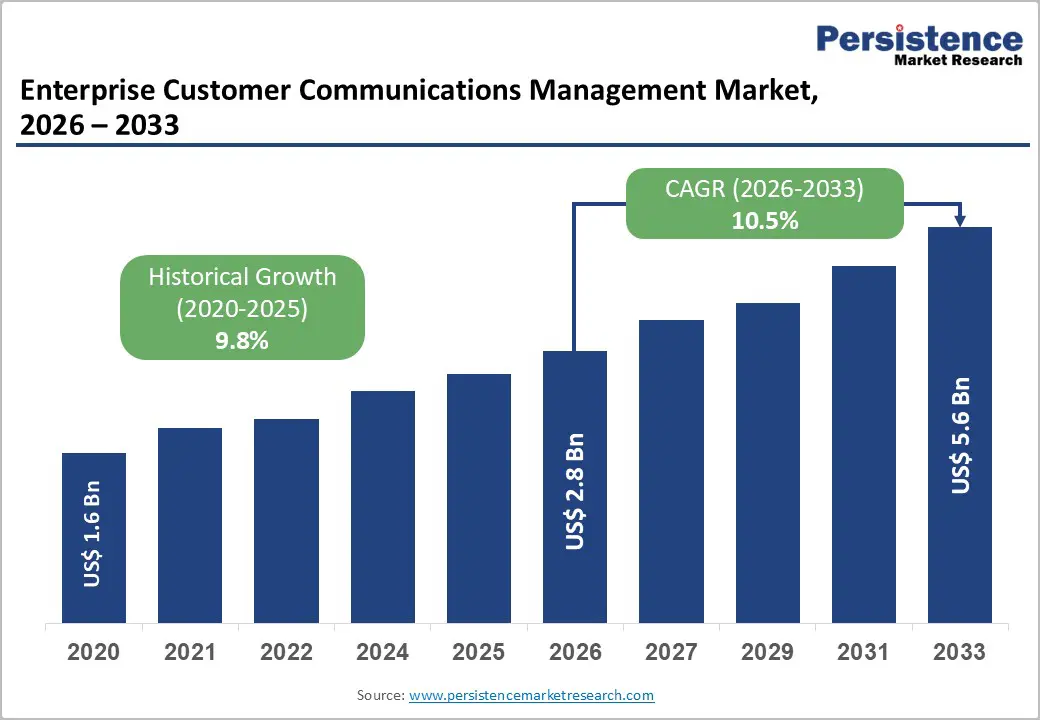
The global Enterprise Customer Communications Management Market size is likely to be valued at US$ 2.8 Billion in 2026 and is expected to reach US$ 5.6 Billion by 2033, growing at a CAGR of 10.5% during the forecast period from 2026 and 2033. The market's robust expansion is driven by organizations prioritizing customer-centric innovation, accelerating cloud infrastructure adoption, and embedding artificial intelligence into communication workflows to deliver hyper-personalized omnichannel experiences.
Key Market Highlights
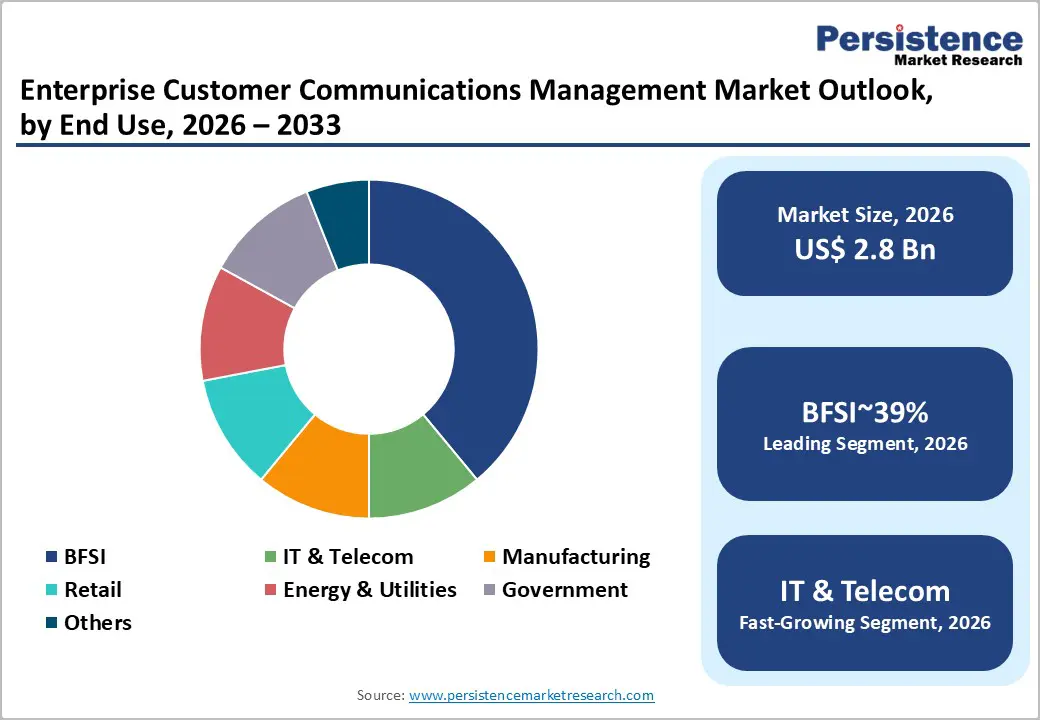
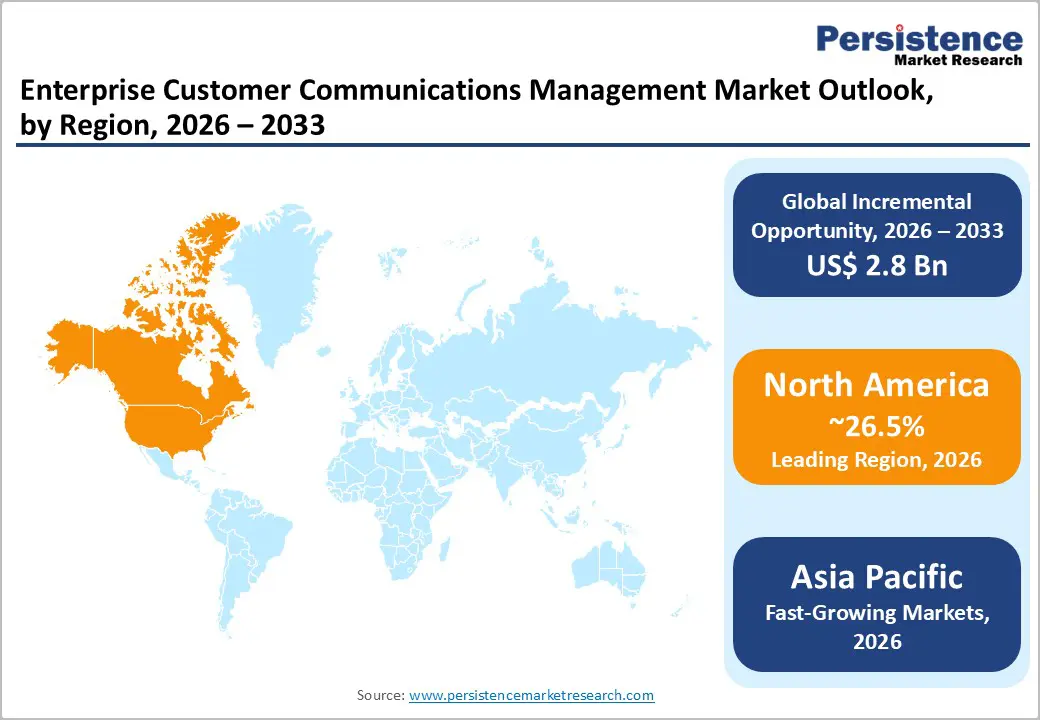
- Leading region: North America leads the Enterprise CCM market with 26.5% global value share in 2025, underpinned by mature cloud infrastructure, substantial enterprise IT spending, advanced regulatory frameworks, and dominant vendor ecosystem anchored by Adobe Systems Inc., OpenText Corporation, and Pitney Bowes Inc..
- Fastest-growing region: Asia Pacific is the fastest-growing regional market, driven by rapid digital transformation in China, India, Japan, accelerating BFSI adoption, government digitalization initiatives, cost-competitive data center infrastructure, and abundant IT workforce resources.
- Dominant segment: By End User, BFSI is the leading segment, leveraging CCM platforms for secure, compliant transaction communications, statement generation, policy notices, fraud alerts, and personalized financial product recommendations supporting regulatory compliance with PCI-DSS and SOX frameworks.
- Fastest-growing segment: Healthcare is the fastest-growing End User vertical, driven by telemedicine expansion, cloud-based electronic health records adoption, HIPAA compliance requirements, and increasing demand for secure, responsive patient communication workflows supporting remote care delivery.
- Key market opportunity: Healthcare industry digital transformation and expansion of conversational AI capabilities present substantial growth opportunities for vendors offering HIPAA-compliant, mobile-optimized CCM platforms integrated with EHR systems and intelligent AI-powered chatbots for patient engagement and real-time appointment/medication management.
| Key Insights | Details |
|---|---|
|
Enterprise Customer Communications Management Market Size (2026E) |
US$ 2.8 Billion |
|
Market Value Forecast (2033F) |
US$ 5.6 Billion |
|
Projected Growth CAGR (2026–2033) |
10.5% |
|
Historical Market Growth (2020–2025) |
9.8% |
Market Dynamics
Market Growth Drivers
Accelerating Cloud Migration and Omnichannel Communication Infrastructure Adoption
Organizations are rapidly transitioning from traditional on-premise CCM systems to cloud-native platforms, driven by substantial cost advantages and operational flexibility. McKinsey research demonstrates that financial institutions migrating core workloads to cloud realize infrastructure savings exceeding 30%, while IBM's 2024 Banking Cloud Study reports that 82% of major banks now have formal cloud strategies. Cloud-based CCM solutions eliminate expensive upfront capital expenditure, provide automatic scalability to accommodate fluctuating communication volumes, and deliver continuous security updates without manual IT intervention.
The shift toward SaaS consolidation enables enterprises to unify communications across email, SMS, web, mobile, and conversational channels from a single integrated platform. This infrastructure modernization trend is particularly pronounced in BFSI and healthcare sectors, where regulatory mandates and customer experience expectations drive adoption of sophisticated, multi-channel communication platforms that cloud-native architectures uniquely enable.
Artificial Intelligence Integration Driving Hyper-Personalization and Operational Efficiency
Generative AI capabilities are transforming how organizations create, manage, and deliver customer communications, enabling unprecedented personalization at enterprise scale. Leading vendors including Adobe Systems Inc., Quadient, and OpenText Corporation are embedding AI-powered document generation, intelligent template authoring, and real-time content personalization into their platforms. Quadient, recognized as the Most Valuable Pioneer in AI-Driven CCM in December 2025, offers AI-assisted authoring that accelerates content creation, improves readability through sentiment and tone analysis, and reduces manual rework cycles.
Organizations leverage AI to analyze customer behavior, automatically trigger personalized communications based on real-time events, and continuously optimize messaging effectiveness. Financial services institutions recognize that personalized communications drive customer retention, increase upsell opportunities, and strengthen competitive differentiation in crowded markets. The convergence of AI capabilities with omnichannel delivery infrastructure is creating powerful demand for next-generation CCM platforms that organizations view as essential for maintaining customer relevance and competitive advantage.
Market Restraints
Legacy System Integration Complexity and Organizational Change Management Challenges
Many enterprises operating established CCM infrastructure face substantial integration challenges when transitioning to modern cloud-native platforms, requiring careful data migration, template redesign, and workflow reengineering. Implementation complexity can extend timelines, increase project costs, and create organizational change management friction as employees adapt to redesigned communication processes.
Organizations with extensive customizations in legacy systems often struggle to justify investments in replacement platforms, particularly when initial business cases emphasize cost efficiency rather than transformational benefits. Additionally, organizations managing sensitive customer data face security and compliance validation challenges during migration, requiring comprehensive testing to ensure that cloud-based alternatives maintain stringent data protection and regulatory compliance standards prior to cutover.
Skill Gaps and Specialized Expertise Requirements in Cloud-Native and AI Implementation
Implementing advanced CCM platforms requires organizations to develop capabilities in cloud infrastructure management, AI-driven personalization configuration, API integration, and omnichannel orchestration, expertise that many traditional IT organizations lack. Vendors offer professional services and managed services to address skill gaps, yet these services increase total cost of ownership and extend implementation timelines.
Mid-market organizations with constrained IT budgets and limited cloud-native expertise often delay modernization initiatives until cost pressures or regulatory mandates force action. Additionally, attracting and retaining specialized talent in cloud-native development, GenAI integration, and enterprise communication architecture remains challenging across many markets.
Market Opportunities
Healthcare Industry Digital Transformation Driven by Telemedicine, EHR Adoption, and Regulatory Compliance
The healthcare sector represents an exceptional growth opportunity for CCM vendors, driven by telemedicine adoption, cloud-based electronic health records (EHRs) implementations, and stringent HIPAA compliance requirements. Healthcare organizations are rapidly modernizing patient communication workflows to support appointment reminders, medication adherence notifications, lab result delivery, and post-care follow-up across secure, HIPAA-compliant channels. Modern CCM platforms enable healthcare providers to deliver personalized patient communications that improve engagement while maintaining rigorous data protection standards.
Hospitals and health systems implementing cloud-based EHR systems recognize that integrated CCM platforms reduce manual communication efforts, improve patient experience consistency, and support regulatory compliance documentation. As telemedicine adoption accelerates and healthcare systems expand remote care delivery models, demand for secure, responsive communication infrastructure will generate substantial revenue opportunities for vendors offering healthcare-specialized CCM solutions with compliance features and clinical workflow integration.
Expansion of Conversational AI and Omnichannel Orchestration for Real-Time Customer Engagement
Conversational interfaces including chatbots, voice assistants, and intelligent SMS platforms are emerging as the fastest-growing communication channels, with market research projecting 13.30% CAGR for conversational AI-driven CCM capabilities. Customers increasingly expect immediate answers to inquiries without navigating complex phone menus, creating demand for CCM platforms that orchestrate intelligent conversations across voice, chat, and text channels. Organizations are deploying conversational AI for account inquiries, transaction assistance, complaint resolution, and proactive outreach, reducing operational costs while improving response times and customer satisfaction.
OpenText Corporation's recent Exstream releases demonstrate the market momentum, with PolicyCenter Accelerator for Guidewire Cloud enabling automated, personalized communication workflows integrated with claims processing systems. As natural language understanding accuracy improves, integration costs decline, and customer comfort with conversational interfaces increases, vendors offering comprehensive conversational AI capabilities bundled with traditional CCM document generation will capture substantial growth in high-volume, cost-sensitive use cases including insurance claims, banking transactions, and retail customer service.
Category-wise Insights
Solution Analysis
Customer Communication Management Platforms as the Dominant Solution Category
Within solutions, Customer Communication Management (CCM) Platforms constitute the dominant category, accounting for an estimated 62.30% of total market revenue and serving as the foundational infrastructure for enterprise customer communications strategies. CCM platforms provide comprehensive capabilities including document composition and design, template management, data integration, channel orchestration, and compliance automation—essential functions that drive platform adoption across all enterprise sizes and industries. Organizations select CCM platforms for their ability to integrate with core business systems such as CRM, ERP, and marketing automation software, with 58% of new platform releases in 2024 including pre-built connectors for enterprise applications.
The dominant position of CCM platforms reflects their proven ability to reduce communication costs, improve personalization at scale, and ensure regulatory compliance across complex, multi-channel environments. As organizations prioritize unified communication strategies and recognize that 85% of customers willingly pay premium prices for superior customer experience, investments in comprehensive CCM platforms continue to increase, reinforcing their leadership position within the solution category.
Deployment Analysis
On-Premise Deployment as the Established but Declining Market Segment
By deployment model, On-Premise implementations represent the largest installed base, commanding approximately 63.20% market share in 2025, but experiencing declining growth rates as organizations migrate toward cloud infrastructure. On-Premise deployments remain prevalent in highly regulated industries including BFSI and government, where organizations maintain physical control over infrastructure and sensitive customer data. However, the inherent constraints of on-premise architecture—including significant upfront capital investment, resource-intensive maintenance, limited scalability, and slower innovation cycles—are encouraging enterprises to transition toward cloud-native platforms.
On-Premise growth is moderating as organizations recognize that cloud alternatives deliver faster implementation timelines, reduced operational complexity, automatic security updates, and pay-as-you-go cost models that align with variable communication volumes. Leading vendors including OpenText Corporation and Quadient are strategically emphasizing cloud-native capabilities in product development, recognizing the long-term shift in enterprise infrastructure preferences.
Enterprise Size Analysis
Large Enterprises as the Primary Revenue Driver and Primary Customer Segment
By enterprise size, Large Enterprises represent the dominant customer segment, contributing an estimated 58.10% of overall market revenue in 2025, driven by their substantial CCM investments, complex multi-channel communication requirements, and capital availability for digital transformation initiatives. Large organizations operating global customer bases, managing regulatory compliance across multiple jurisdictions, and supporting diverse business units require sophisticated CCM platforms capable of supporting millions of personalized communications across multiple channels.
Large Enterprises are actively migrating to cloud-based CCM solutions, recognizing benefits including enhanced collaboration among distributed teams, faster time-to-value, and reduced infrastructure management burden. Small and mid-market enterprises represent the fastest-growing segment, as vendors introduce more affordable SaaS offerings, streamlined implementation methodologies, and managed services that lower barriers to CCM adoption for organizations with limited IT resources. This dual dynamic—continued large enterprise modernization combined with emerging SME adoption driven by accessible SaaS models—supports sustained market growth across both segments through the forecast period.
Regional Insights
North America Enterprise Customer Communications Management Trends
North America dominates the global Enterprise CCM market, commanding approximately 26.5% market value share in 2025, with the United States alone representing 18.20% of global market value. The region benefits from mature IT infrastructure, substantial enterprise technology spending, early adoption of cloud-native architectures, and a highly developed ecosystem of CCM vendors, systems integrators, and managed service providers. BFSI organizations across North America are aggressively modernizing communication strategies to improve customer experience and compete with fintech challengers, driving significant CCM investments alongside broader digital transformation initiatives.
Regulatory frameworks including GDPR compliance requirements for U.S. companies serving European customers, HIPAA mandates in healthcare, and PCI-DSS standards in financial services create strong incentives for enterprises to deploy compliant, auditable CCM infrastructure. The innovation ecosystem in North America, anchored by major vendors including Adobe Systems Inc., OpenText Corporation, and Pitney Bowes Inc., drives continuous product innovation and ensures that cutting-edge capabilities in AI, personalization, and omnichannel orchestration are available to regional enterprises.
Europe Enterprise Customer Communications Management Trends
Europe's Enterprise CCM market holds 23.40% global value share in 2025 and is characterized by stringent data protection regulations and growing emphasis on digital sovereignty that influence enterprise communication strategy. GDPR compliance requirements create mandatory demand for CCM platforms incorporating data protection, consent management, audit trails, and secure data handling capabilities—features that vendors increasingly build into baseline offerings. Organizations across Germany, the United Kingdom, France, and Spain are modernizing legacy communication systems to meet GDPR obligations while simultaneously improving customer engagement.
European enterprises leverage CCM platforms to achieve compliant multi-channel communications, particularly in BFSI where customer financial data must meet stringent security and privacy standards. Sector-specific regulatory frameworks in healthcare, insurance, and public administration drive CCM adoption as organizations recognize that centralized, auditable communication systems provide competitive advantages while ensuring regulatory compliance. The region's mature digitalization levels and strong commitment to data protection standards position Europe as a stable, growth-oriented market for CCM solutions emphasizing compliance and security.
Asia Pacific Enterprise Customer Communications Management Trends
Asia Pacific represents the fastest-growing regional market, with India expanding at 11.20% CAGR and China at 9.80% CAGR through 2035, driven by rapid digital transformation, expanding financial services adoption, and growing e-commerce and fintech sectors. China's large banking ecosystem and aggressive digital innovation initiatives are generating substantial CCM demand, while India's growing IT services industry, burgeoning fintech ecosystem, and expanding BFSI sector are driving rapid platform adoption.
Financial institutions across Asia Pacific, including banks in Japan and India, are deploying cloud-based CCM platforms to support digital payment services, mobile banking, and customer engagement at scale. The region's favorable economics for data center construction, abundance of skilled IT workforce resources, and government digital transformation initiatives create compelling value propositions for CCM vendors establishing regional capabilities. Organizations across ASEAN nations are modernizing communication infrastructure to support smart city projects, digital government services, and private sector digital transformation, creating sustained demand growth for CCM solutions tailored to high-volume, cost-sensitive deployment scenarios.
Competitive Landscape
Market Structure Analysis
The Enterprise CCM market exhibits moderate consolidation with established enterprise software vendors including OpenText Corporation, Adobe Systems Inc., and Oracle Corporation competing alongside specialized pure-play CCM vendors such as Quadient, Newgen Software Technologies Limited, and Pitney Bowes Inc. Competition centers on platform capabilities including AI-driven personalization, omnichannel orchestration, cloud-native architecture, compliance automation, and ecosystem integration depth. Major vendors emphasize strategic acquisitions to accelerate AI capabilities—OpenText Corporation acquired a CCM startup in 2024 to integrate advanced AI-driven personalization features—reflecting market recognition that AI represents the primary innovation battleground.
Newgen Software Technologies Limited, recognized in the Forrester Wave: Content Platforms Q1 2025 for advanced automation and AI capabilities, exemplifies the competitive emphasis on next-generation technology. Emerging business models include consumption-based pricing that aligns costs with communication volumes, managed services offerings that address customer skill gaps, and industry-specific solution bundles combining platforms with vertical-specialized templates and workflow automation. Strategic partnerships between vendors and systems integrators, cloud infrastructure providers, and complementary software companies are reshaping competitive dynamics, with partnerships enabling more rapid market coverage and enhanced customer value delivery.
Key Market Developments
- In October, 2025: OpenText Corporation released Exstream Communications CE 25.4, featuring PolicyCenter Accelerator for Guidewire Cloud enabling automated, personalized insurance communications integrated with claims processing, alongside enhanced design flexibility with opacity, rounded corners, and advanced asset management capabilities.
- In December, 2025: Quadient was named Most Valuable Pioneer (MVP) in the QKS AI Maturity Matrix for CCM 2025, positioned as the market leader in AI-driven customer communications management, with AI-assisted authoring accelerating content creation and improving readability through automated sentiment and grammar analysis.
- In April, 2025: Quadient and Saudi Xerox announced the renewal of their strategic partnership to deliver integrated, customer-centric CCM solutions supporting digital transformation initiatives aligned with the Kingdom of Saudi Arabia's Vision 2030 digital objectives, emphasizing joint training, marketing, and customer support investments.
Companies Covered in Enterprise Customer Communications Management Market
- Newgen Software Technologies Limited
- Adobe Systems, Inc.
- Cincom Systems, Inc.
- Doxee S.p.A.
- OpenText Corp.
- Oracle Corporation
- Pitney Bowes, Inc.
- Xerox Corporation
- ISIS Papyrus Europe AG
- Crawford Technologies
- Zendesk
- Precisely
- Quadient
- Sefas Innovation, Inc.
Frequently Asked Questions
The global Enterprise CCM market is projected to grow from US$ 2.8 Billion in 2026 to approximately US$ 5.6 Billion by 2033, expanding at a compound annual growth rate of 10.5% during the forecast period, representing a doubling of market value within seven years.
Key demand drivers include accelerating cloud infrastructure migration delivering 30%+ infrastructure cost savings, artificial intelligence integration enabling hyper-personalized communications, stringent regulatory compliance requirements in GDPR, HIPAA, and PCI-DSS frameworks, omnichannel customer experience optimization driven by consumer willingness to switch competitors after poor experiences, and organizational recognition that 85% of customers pay premium prices for superior customer experience.
BFSI is the leading End-User segment, leveraging CCM platforms for secure, compliant statement delivery, transaction confirmations, fraud alerts, policy notices, and personalized product recommendations, with regulatory compliance obligations in PCI-DSS and financial sector frameworks driving continued substantial investment in advanced communication infrastructure.
North America leads with 26.5% global market value share in 2025, benefiting from mature IT infrastructure, high enterprise technology spending, strong vendor ecosystem including Adobe Systems Inc., OpenText Corporation, and Pitney Bowes Inc., and early adoption of cloud-native CCM architectures supporting regulatory compliance and customer experience optimization.
Key market players include Newgen Software Technologies Limited, Adobe Systems, Inc., OpenText Corporation, Oracle Corporation, Pitney Bowes, Inc., Xerox Corporation, Quadient, Cincom Systems, Inc., Doxee S.p.A., ISIS Papyrus Europe AG, Crawford Technologies, Zendesk, Precisely, Sefas Innovation, Inc., and emerging vendors including Smart Communications Inc. and Intense Technologies.


