Alopecia Treatment Market Size, Share, and Growth Forecast for 2025 - 2032

Alopecia Treatment Market by Treatment Type (Topical Drugs, Oral Drugs, Injectable, Hair Transplant Services, Low-level Laser Therapy), End User (Hospitals, Dermatologic and Trichology Clinics), and Regional Analysis from 2025 to 2032

ID: PMRREP9677
Calendar

January 2025

196 Pages

Author : Abhijeet Surwase

Alopecia Treatment Market Size and Share Analysis

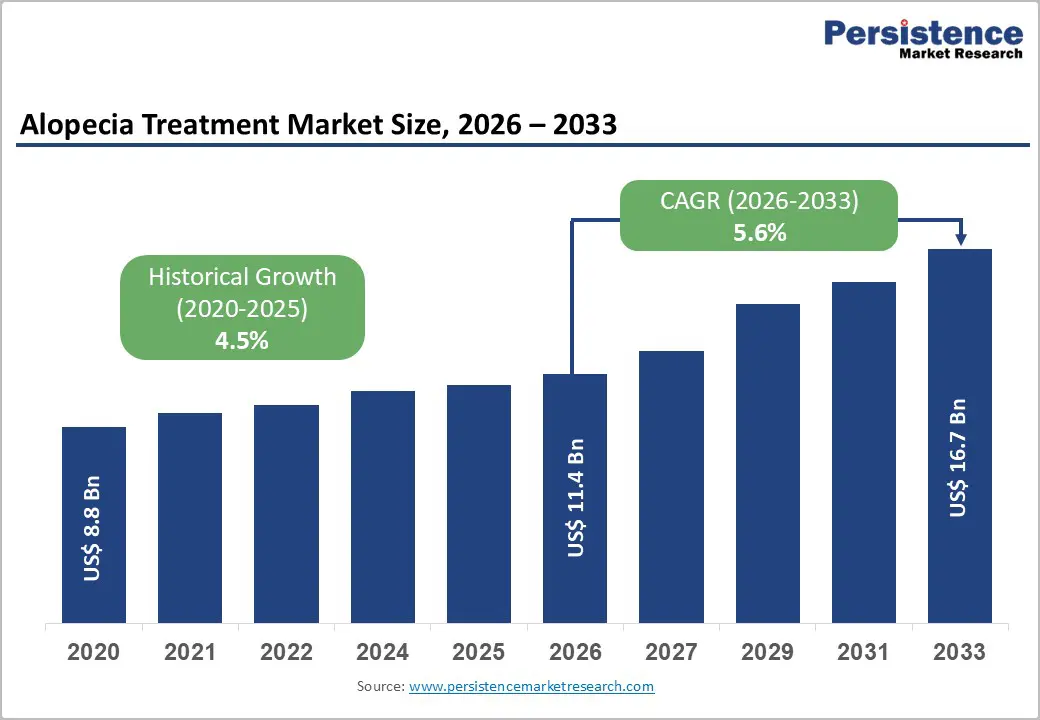
The global alopecia treatment market is projected to witness a CAGR of 5.6% during the forecast period from 2025 to 2032. It is anticipated to increase from US$ 10.8 Bn recorded in 2025 to a decent US$ 15.8 Bn by 2032.

Demand for alopecia treatment is driven by increasing awareness of treatment options and the high prevalence of hair loss. Over 95% of hair loss in men is caused by androgenetic alopecia, with nearly 40% of men experiencing some degree of hair loss by 35 years of age.

The need for treatment for androgenetic alopecia is expected to grow in revenue. Around 60% of the global population has hair thinning problems, with pattern hair loss being the most common form.

Healthcare expenditure is driving the industry due to rising consumer disposable income and a focus on aesthetic appearance in major countries. Organizations like the National Alopecia Areata Foundation and the American Hair Loss Association are promoting hair regrowth treatments, boosting healthcare expenditure, and driving market growth due to minimal side effects.

alopecia treatment market outlook, 2019-2032

Key Highlights of the Market

  • Growing prevalence of hair loss conditions worldwide is driving treatment innovations for alopecia.
  • Increasing psychological impact of alopecia is driving the need for advanced treatment solutions.
  • Research investments in regenerative medicine and hair restoration technologies are on the rise.
  • Innovations in stem cell and gene therapy are paving the way for new market opportunities.
  • In 2025, Europe is estimated to hold 29% of the global market share with surging investments in hair care research.
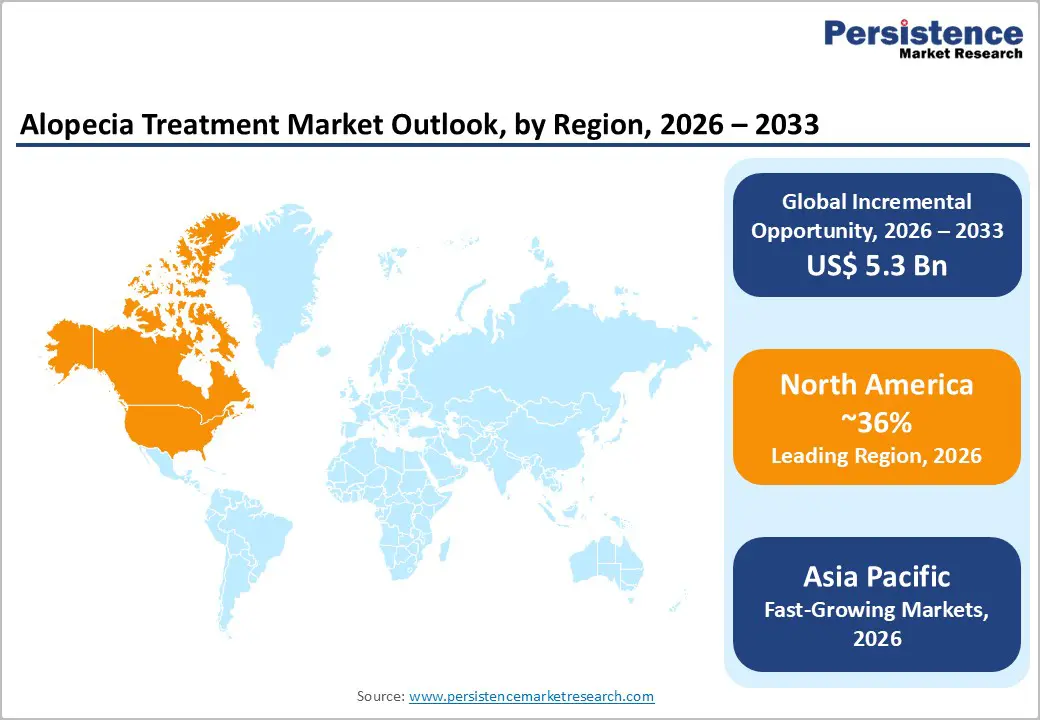
  • North America is projected to account for 37% of the global market share in 2025 owing to its robust healthcare infrastructure and government support.
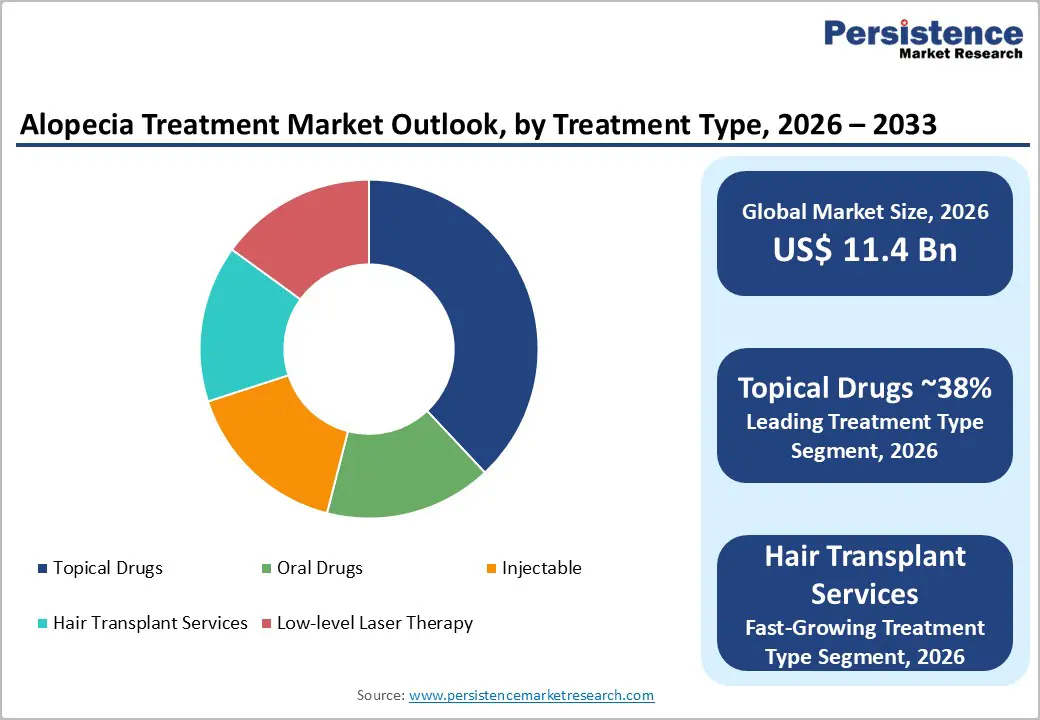
  • In terms of treatment type, oral drugs are anticipated to generate a share of 38% in 2025 due to their easy to consume formulation.
  • Dermatologic and trichology clinics are estimated to hold 42% of share in 2025 due to easy access to unique technologies, personalized treatments, and rising patient trust.

Market Attributes

Key Insights

Alopecia Treatment Market Size (2025E)

US$ 10.8 Bn

Projected Market Value (2032F)

US$ 15.8 Bn

Global Market Growth Rate (CAGR 2025 to 2032)

5.6%

Historical Market Growth Rate (CAGR 2019 to 2023)

4.5%

North America Supports Innovative Therapies for Hair Care

North America is significant in the alopecia therapy industry, accounting for 37% of the total share in 2025. This is attributed to the high prevalence of the disease, government measures, and healthcare infrastructure improvements. North America is projected to report a CAGR of 5.2% from 2025 to 2032.

Government and non-profit organizations like the National Alopecia Areata Foundation and the Canadian Alopecia Areata Foundation are also contributing to the market. For example,

  • Alopecia areata, a common symptom of the autoimmune disease, affects an estimated 6.8 million patients in the U.S., affecting men and women of any ethnic origin. Alopecia areata is the second most prevalent type after androgenetic alopecia, with one in 500 to one in 1,000 Americans affected.
  • Big players like Eli Lilly are developing new drugs and therapies, such as baricitinib oral pills, which were approved by the FDA in October 2022.

Europe Shows Growth Potential for Hair Restoration Solutions

In 2025, the market for hair restoration and transfiguration in Europe is estimated to hold a share of 29%. The EU's second-largest producer of active biopharmaceutical drugs is seeing growth, with a forecast CAGR of 5.9% by 2032.

The need for hair restoration and transfiguration products has increased due to urban residents in Europe using 30% more hair care products than they did five years ago. In Germany, platelet-rich plasma treatment is likewise being utilized as a secure and efficient substitute for finasteride and minoxidil.

The growing number of cases of hair loss brought on by unhealthy eating habits, smoking, high levels of stress, and lifestyle choices is propelling the alopecia treatment industry in Europe. Europe's alopecia treatment market is thriving due to Germany's established healthcare system, public awareness, top pharmaceutical corporations, and advanced research.  

Development of Oral Drugs Paves the Way for Better Formulations

The need for the discovery and production of biological products, as well as the growing number of biotechnology and life science firms, are predicted to drive demand for oral drugs to 38% of market share in 2025. Patients who are having fast hair loss are advised to take oral corticosteroids; these drugs are inexpensive but may have side effects. The most often recommended medication for androgenetic alopecia, or systemic hair loss, is finasteride.

Compared to topical or non-invasive remedies, oral formulations are more readily available and offer consistent dosages. Their usage is also being encouraged by innovative compounds with improved safety profiles and new advancements in oral formulations. Oral formulations are becoming more and more popular in the global alopecia therapy market due to patient awareness and dermatologists' evolving views.

Dermatologic and Trichology Clinics Provide Specialized Treatment for Patients

Clinics that specialize in trichology and dermatology are becoming well-known because of their cutting-edge technology, individualized care, and rising patient confidence. Dermatologic and trichology clinics are anticipated to account for 42% of the market share in 2025.

The comfort and seclusion of these clinics are the main reasons for their appeal, especially in nations like China, South Korea, Japan, and Malaysia. Demand for hair loss treatments and service provider prices have benefited from the expansion of private clinics. Personalized alopecia therapy prediction systems were introduced by genetic testing firms in 2024, and these showed 70% accuracy in determining treatment response.

Market Introduction and Trend Analysis

The alopecia treatment market is growing due to the rising prevalence of hair loss, psychological effects, and investments in regenerative medicine. Consumer knowledge and a decrease in stigma also increase investments in medical and cosmetic hair restoration.

Regenerative medicine has demonstrated 65% hair follicle regeneration potential, with leading pharmaceutical companies investing US$ 380 Mn in unique hair restoration technologies. The FDA accelerated approval processes for novel alopecia treatments, with Pfizer and Johnson & Johnson launching advanced topical and oral medications.

Mental health research has highlighted the psychological impacts of hair loss, leading to increased insurance coverage for comprehensive alopecia treatment programs. Personalized medicine and solutions have emerged, with genetic testing companies launching personalized alopecia treatment prediction platforms with 70% accuracy.

Unique laser and light therapy technologies have shown 55% improvement in hair follicle stimulation, and non-invasive treatment options gained market traction. Research shows that worldwide, people are 80% more interested in all-inclusive treatments for alopecia. These options include new non-invasive techniques, customized genetic approaches, help with psychological support, and stem cell regeneration technology.

alopecia treatment market insights and key trends

Historical Growth and Course Ahead

The global alopecia treatment market recorded a decent CAGR of 4.5% in the historical period from 2019 to 2023. Based on the post-pandemic research, Alopecia affects more than 50 million U.S. citizens, including 30 million women and 50 million men.

Rising incidence of the ailment is driving the market for alopecia therapies. About 60% of people experience pattern hair loss, with gender-specific differences in severity. For instance,

  • The good outcomes of Phase 2b 3 ALLEGRO, an oral Ritlecitinib medication used once daily, were reported by Pfizer Inc. in August 2021. The medication is intended to treat alopecia areata, an autoimmune disorder that causes hair loss on the scalp.
  • The first systemic treatment for alopecia, baricitinib (Olumiant), was authorized by the FDA in June 2022 to treat severe instances of alopecia areata. This medicine has been approved for Elli Lilly and Company.
  • Baricitinib is the first medication of its kind to be approved by the FDA for the treatment of body-wide hair loss.

Market Growth Drivers

Prevalence of Hair Loss Conditions Boosts Demand for Hair Care Solutions

Rising prevalence of hair loss conditions, such as androgenetic alopecia and alopecia areata, is driving growth in hair loss treatments. Increasing stress, hormonal imbalances, and aging have contributed to higher incidences of hair loss, with around 50 million men and 30 million women affected in the U.S. alone. For example,

  • Companies like Pfizer and Concert Pharmaceuticals are at the forefront of innovation, with Pfizer's ritlecitinib receiving FDA approval in June 2023 as a first-of-its-kind oral treatment for alopecia areata.
  • Johnson & Johnson's Rogaine remains a trusted option for androgenetic alopecia.

Unique treatments like PRP therapy and stem cell-based solutions are gaining popularity due to the global demand for non-invasive, effective alopecia treatments.

Alopecia's Psychological Impact Drives Demand for Stigma-free Treatments

The psychological impact of alopecia is driving demand for novel treatment solutions, with research investments in regenerative medicine and hair restoration technologies increasing. For example,

  • Mental health research has led to a 45% increase in insurance coverage for comprehensive alopecia treatment programs.
  • Advanced laser and light therapy technologies have shown a 55% improvement in hair follicle stimulation, and non-invasive treatment options have gained market traction.
  • International market research revealed an 80% increased interest in comprehensive alopecia treatment solutions across diverse demographics.

Genetic research is revolutionizing treatment by using personalized medicine based on individual genetic makeup. Pharmacogenomics enables clinicians to identify hair loss mutations, enabling targeted treatments and creating drugs that align with a patient's genetic characteristics, promoting efficacy and minimizing side effects.

Market Restraining Factors

Limited Efficacy of Hair Loss Solutions Affects Industry

The global market for hair loss treatments is hindered by a lack of data on their therapeutic efficacy. Topical treatments like minoxidil are considered moderately effective, but not 100% effective against alopecia.

Laser treatments are often unaffordable, especially across countries in Asia Pacific and Middle East and Africa. High treatment costs, including novel treatments like PRP therapy and hair transplant surgeries, limit accessibility for many patients. For instance,

  • Treatment variability also affects success rates, with success rates ranging between 40 to 60% depending on the type and individual patient factors.

Insurance coverage disparities hinder treatment access, disproportionately affecting middle- and low-income populations. To address this, initiatives to make advanced therapies more affordable through subsidies, insurance inclusion, or cost-effective innovations are needed.

Key Market Opportunities

Innovation in Stem Cell and Gene Therapy Shows High Potential

Stem cell and gene therapy are reshaping hair loss treatment by giving regenerative remedies to underlying causes and enormous growth potential. Stem cell therapy, for example, has demonstrated the potential to stimulate hair follicle growth, with companies like Stemson Therapeutics developing unique cell-based regenerative treatments.

  • In October 2023, Stemson received US$ 15 Mn in funding to boost its preclinical research. Similarly, gene therapy innovations are addressing genetic predispositions to hair loss.
  • Researchers at Harvard University launched gene-editing techniques using CRISPR to manipulate hair follicle regeneration, marking a breakthrough in personalized treatments.

Such novel technologies provide long-term, minimally invasive solutions to meet the high health-conscious and aesthetics-driven consumer base.

Rising Investments in Research on Hair Treatment Present Growth Prospects

Demand for alopecia treatment solutions is anticipated to rise because of more investments in research and development with modern medications and formulations. For instance,

  • Clinical research using JAK inhibitors, which have demonstrated efficacy in regrowing hair in alopecia areata patients, has received US$ 1.65 Mn from the National Alopecia Areata Foundation (NAAF).

The market will also be driven by the foundation's calculated investments in immunogenetic research and a mouse model. The demand for hair fall treatments will increase even more thanks to strategic alliances with public and private institutions.

  • Unique topical and oral treatments from Pfizer and Johnson & Johnson are examples of pharmaceutical advances that have demonstrated 55% enhanced hair regeneration rates.
  • Genetic testing businesses' personalized medicine platforms have shown 70% accuracy in determining therapy response.
  • The stimulation of hair follicles has improved by 55% due to advanced laser and light treatment technology.

Competitive Landscape for the Alopecia Treatment Market

The alopecia treatment market is extremely competitive, with established and emerging players competing for positions in the global market. Because of their cost-effectiveness and broad patient acceptability, prominent firms are concentrating on oral formulations and creating innovative medicines.

Companies are collaborating strategically with industry leaders to remain ahead of the curve by utilizing their knowledge of formulation science, medication delivery technologies, and regulatory clearances. Pharmaceutical companies are spending money on the research and development of innovative oral formulations with enhanced bioavailability and precise distribution. To improve their alopecia treatment services, key rivals are extending business partnerships and combining through mergers and acquisitions.

?Recent Industry Developments

  • In October 2024, Dr. Batra's Group introduced XOGEN, a treatment for hereditary hair loss using exosomes for targeted growth, requiring four to five sessions and a simple hair care routine.
  • In September 2024, Eli Lilly and EVA Pharma agreed to extend baricitinib's access to 20,000 people in 49 low- to middle-income African countries by 2030, treating rheumatoid arthritis, alopecia areata, atopic dermatitis, and COVID-19.
  • In September 2024, Amplifica Holdings Group conducted its first-in-human trial of AMP-303, a new injectable treatment for androgenetic alopecia. The study found no severe adverse events and showed significant non-vellus hair count increases.
  • In July 2024, Aveda introduced the Invati Ultra Advanced Collection, a five-step anti-hair loss system combining Ayurvedic remedies and vegan ingredients, including shampoo, conditioner, serum, and foam.
  • In July 2024, Kintor Pharmaceutical planned to commercialize its hair-loss product, KX-826, as an over-the-counter drug after disappointing clinical trials. The move could provide Kintor's first recurring revenue, though it may struggle to compete with regulator-approved products like Rogaine.
  • In June 2024, Lumenis Be. Ltd. introduced FoLix, the first FDA-cleared proprietary fractional laser for hair loss treatment, targeting 85% of men and 50% of women. It offers 4-6 monthly sessions without chemicals, needles, anesthesia, surgery, or downtime.
  • In May 2024, Researchers at MIT, Brigham and Women's Hospital, and Harvard Medical School developed a microneedle patch for alopecia areata, an autoimmune disorder causing hair loss. The treatment reduces inflammation and allows hair growth.
  • In June 2023, Cipla Limited expanded its alopecia treatment portfolio by launching a generic formulation of minoxidil as a topical hair loss treatment.

Companies Covered in Alopecia Treatment Market

  • Elli Lilly and Company
  • Teva Pharmaceutical Industries Ltd.
  • Merck & Co., Inc.
  • Johnson & Johnson, Inc.
  • Dr. Reddy’s Laboratories Ltd.
  • Cipla Ltd.
  • Cellmid Ltd.
  • The Himalaya Drug Company
  • Taisho Pharmaceutical Holdings Co., Ltd
  • Shiseido Co., Ltd.
  • Zhangguang 101 Science & Technology Co., Ltd.
  • Pfizer
  • Thera dome
  • LUTRONIC
  • Curallux
  • Sun Pharmaceutical Industries Ltd.
  • GlaxoSmithKline plc
  • Fagron
  • Apple Therapeutics Private Limited
  • Aclaris Therapeutics, Inc.
  • RepliCel Life Sciences Inc.
Frequently Asked Questions

The market size is set to reach US$ 15.8 Bn by 2032.

Researchers have developed a new treatment for alopecia areata, an autoimmune disorder causing hair loss, using a microneedle patch to deliver immune-regulating molecules.

In 2025, North America is set to attain a market share of 37%.

In 2025, the market is estimated to be valued at US$ 10.8 Bn.

Elli Lilly and Company, Teva Pharmaceutical Industries Ltd., Merck & Co., Inc., Johnson & Johnson, Inc., and Dr. Reddy’s Laboratories Ltd. are considered the leading players.

Alopecia Treatment Market Report Scope

Attributes

Details

Forecast Period

2025 to 2032

Historical Data Available for

2019 to 2023

Market Analysis

US$ Billion for Value

Key Countries Covered

  • North America
  • Europe
  • East Asia
  • South Asia and Oceania
  • Latin America
  • Middle East and Africa

Key Market Segments Covered

  • Treatment Type
  • End User
  • Region

Key Companies Profiled in the Report

  • Elli Lilly and Company
  • Teva Pharmaceutical Industries Ltd.
  • Merck & Co., Inc.
  • Johnson & Johnson, Inc.
  • Dr. Reddy’s Laboratories Ltd.
  • Cipla Ltd.
  • Cellmid Ltd.
  • The Himalaya Drug Company
  • Taisho Pharmaceutical Holdings Co., Ltd
  • Shiseido Co., Ltd.
  • Zhangguang 101 Science & Technology Co., Ltd.
  • Pfizer
  • Thera dome
  • LUTRONIC
  • Curallux
  • Sun Pharmaceutical Industries Ltd.
  • GlaxoSmithKline plc
  • Fagron
  • Apple Therapeutics Private Limited
  • Aclaris Therapeutics, Inc.
  • RepliCel Life Sciences Inc.

Report Coverage

  • Market Forecast and Trends
  • Company Share Analysis
  • Competitive Intelligence
  • DROT Analysis
  • Market Dynamics and Challenges
  • Strategic Growth Initiatives  

Customization and Pricing

Available upon request

Alopecia Treatment Market Segmentation

By Treatment Type

  • Topical Drugs
    • Creams
    • Oils
    • Gels
    • Shampoo
    • Lotion
    • Foam
  • Oral Drugs
  • Injectable
    • Platelet Rich Plasma
    • Steroid Injections
    • Injectable Filler
  • Hair Transplant Services
  • Low-level Laser Therapy

By End User

  • Hospitals
  • Dermatologic and Trichology Clinics
  • Home Care Settings
  • Aesthetic Clinics

By Region

  • North America
  • Europe
  • East Asia
  • South Asia and Oceania
  • Latin America
  • Middle East and Africa

Related Reports

1. Executive Summary
1.1. Global Alopecia Treatment Market Snapshot, 2025 and 2032
1.2. Market Opportunity Assessment, 2025 – 2032, US$ Bn
1.3. Key Market Trends
1.4. Future Market Projections
1.5. Premium Market Insights
1.6. Industry Developments and Key Market Events
1.7. PMR Analysis and Recommendations
2. Market Overview
2.1. Market Scope and Definition
2.2. Market Dynamics
2.2.1. Drivers
2.2.2. Restraints
2.2.3. Opportunity
2.2.4. Challenges
2.2.5. Key Trends
2.3. Macro-Economic Factors
2.3.1. Global Sectorial Outlook
2.3.2. Global GDP Growth Outlook
2.4. COVID-19 Impact Analysis
2.5. Forecast Factors – Relevance and Impact
3. Value Added Insights
3.1. Regulatory Landscape
3.2. Product Adoption Analysis
3.3. Value Chain Analysis
3.4. Key Deals and Mergers
3.5. PESTLE Analysis
3.6. Porter’s Five Force Analysis
4. Global Alopecia Treatment Market Outlook:
4.1. Key Highlights
4.1.1. Market Size (US$ Bn) and Y-o-Y Growth
4.1.2. Absolute $ Opportunity
4.2. Market Size (US$ Bn) Analysis and Forecast
4.2.1. Historical Market Size (US$ Bn) Analysis, 2019-2023
4.2.2. Current Market Size (US$ Bn) Analysis and Forecast, 2025–2032
4.3. Global Alopecia Treatment Market Outlook: Treatment Type
4.3.1. Introduction / Key Findings
4.3.2. Historical Market Size (US$ Bn) Analysis, By Treatment Type, 2019 – 2023
4.3.3. Current Market Size (US$ Bn) Analysis and Forecast, By Treatment Type, 2025 – 2032
4.3.3.1. Topical Drugs
4.3.3.1.1. Creams
4.3.3.1.2. Oils
4.3.3.1.3. Gels
4.3.3.1.4. Shampoo
4.3.3.1.5. Lotion
4.3.3.1.6. Foam
4.3.3.2. Oral Drugs
4.3.3.3. Injectable
4.3.3.3.1. Platelet Rich Plasma
4.3.3.3.2. Steroid Injections
4.3.3.3.3. Injectable Filler
4.3.3.4. Hair Transplant Services
4.3.3.5. Low-Level Laser Therapy
4.3.4. Market Attractiveness Analysis: Treatment Type
4.4. Global Alopecia Treatment Market Outlook: End User
4.4.1. Introduction / Key Findings
4.4.2. Historical Market Size (US$ Bn) Analysis, By End User, 2019 – 2023
4.4.3. Current Market Size (US$ Bn) Analysis and Forecast, By End User, 2025 – 2032
4.4.3.1. Hospitals
4.4.3.2. Dermatologic and Trichology Clinics
4.4.3.3. Home Care Settings
4.4.3.4. Aesthetic Clinics
4.4.4. Market Attractiveness Analysis: End User
5. Global Alopecia Treatment Market Outlook: Region
5.1. Key Highlights
5.2. Historical Market Size (US$ Bn) Analysis, By Region, 2019 – 2023
5.3. Current Market Size (US$ Bn) Analysis and Forecast, By Region, 2025 – 2032
5.3.1. North America
5.3.2. Europe
5.3.3. East Asia
5.3.4. South Asia and Oceania
5.3.5. Latin America
5.3.6. Middle East & Africa
5.4. Market Attractiveness Analysis: Region
6. North America Alopecia Treatment Market Outlook:
6.1. Key Highlights
6.2. Historical Market Size (US$ Bn) Analysis, By Market, 2019 – 2023
6.2.1. By Country
6.2.2. By Treatment Type
6.2.3. By End User
6.3. Current Market Size (US$ Bn) Analysis and Forecast, By Country, 2025 – 2032
6.3.1. U.S.
6.3.2. Canada
6.4. Current Market Size (US$ Bn) Analysis and Forecast, By Treatment Type, 2025 – 2032
6.4.1. Topical Drugs
6.4.1.1. Creams
6.4.1.2. Oils
6.4.1.3. Gels
6.4.1.4. Shampoo
6.4.1.5. Lotion
6.4.1.6. Foam
6.4.2. Oral Drugs
6.4.3. Injectable
6.4.3.1. Platelet Rich Plasma
6.4.3.2. Steroid Injections
6.4.3.3. Injectable Filler
6.4.4. Hair Transplant Services
6.4.5. Low-Level Laser Therapy
6.5. Current Market Size (US$ Bn) Analysis and Forecast, By End User, 2025 – 2032
6.5.1. Hospitals
6.5.2. Dermatologic and Trichology Clinics
6.5.3. Home care settings
6.5.4. Aesthetic Clinics
6.6. Market Attractiveness Analysis
7. Europe Alopecia Treatment Market Outlook:
7.1. Key Highlights
7.2. Historical Market Size (US$ Bn) Analysis, By Market, 2019 – 2023
7.2.1. By Country
7.2.2. By Treatment Type
7.2.3. By End User
7.3. Current Market Size (US$ Bn) Analysis and Forecast, By Country, 2025 – 2032
7.3.1. Germany
7.3.2. France
7.3.3. U.K.
7.3.4. Italy
7.3.5. Spain
7.3.6. Russia
7.3.7. Türkiye
7.3.8. Rest of Europe
7.4. Current Market Size (US$ Bn) Analysis and Forecast, By Treatment Type, 2025 – 2032
7.4.1. Topical Drugs
7.4.1.1. Creams
7.4.1.2. Oils
7.4.1.3. Gels
7.4.1.4. Shampoo
7.4.1.5. Lotion
7.4.1.6. Foam
7.4.2. Oral Drugs
7.4.3. Injectable
7.4.3.1. Platelet Rich Plasma
7.4.3.2. Steroid Injections
7.4.3.3. Injectable Filler
7.4.4. Hair Transplant Services
7.4.5. Low-Level Laser Therapy
7.5. Current Market Size (US$ Bn) Analysis and Forecast, By End User, 2025 – 2032
7.5.1. Hospitals
7.5.2. Dermatologic and Trichology Clinics
7.5.3. Home care settings
7.5.4. Aesthetic Clinics
7.6. Market Attractiveness Analysis
8. East Asia Alopecia Treatment Market Outlook:
8.1. Key Highlights
8.2. Historical Market Size (US$ Bn) Analysis, By Market, 2019 – 2023
8.2.1. By Country
8.2.2. By Treatment Type
8.2.3. By End User
8.3. Current Market Size (US$ Bn) Analysis and Forecast, By Country, 2025 – 2032
8.3.1. China
8.3.2. Japan
8.3.3. South Korea
8.4. Current Market Size (US$ Bn) Analysis and Forecast, By Treatment Type, 2025 – 2032
8.4.1. Topical Drugs
8.4.1.1. Creams
8.4.1.2. Oils
8.4.1.3. Gels
8.4.1.4. Shampoo
8.4.1.5. Lotion
8.4.1.6. Foam
8.4.2. Oral Drugs
8.4.3. Injectable
8.4.3.1. Platelet Rich Plasma
8.4.3.2. Steroid Injections
8.4.3.3. Injectable Filler
8.4.4. Hair Transplant Services
8.4.5. Low-Level Laser Therapy
8.5. Current Market Size (US$ Bn) Analysis and Forecast, By End User, 2025 – 2032
8.5.1. Hospitals
8.5.2. Dermatologic and Trichology Clinics
8.5.3. Home care settings
8.5.4. Aesthetic Clinics
8.6. Market Attractiveness Analysis
9. South Asia & Oceania Alopecia Treatment Market Outlook:
9.1. Key Highlights
9.2. Historical Market Size (US$ Bn) Analysis, By Market, 2019 – 2023
9.2.1. By Country
9.2.2. By Treatment Type
9.2.3. By End User
9.3. Current Market Size (US$ Bn) Analysis and Forecast, By Country, 2025 – 2032
9.3.1. India
9.3.2. Southeast Asia
9.3.3. ANZ
9.3.4. Rest of South Asia & Oceania
9.4. Current Market Size (US$ Bn) Analysis and Forecast, By Treatment Type, 2025 – 2032
9.4.1. Topical Drugs
9.4.1.1. Creams
9.4.1.2. Oils
9.4.1.3. Gels
9.4.1.4. Shampoo
9.4.1.5. Lotion
9.4.1.6. Foam
9.4.2. Oral Drugs
9.4.3. Injectable
9.4.3.1. Platelet Rich Plasma
9.4.3.2. Steroid Injections
9.4.3.3. Injectable Filler
9.4.4. Hair Transplant Services
9.4.5. Low-Level Laser Therapy
9.5. Current Market Size (US$ Bn) Analysis and Forecast, By End User, 2025 – 2032
9.5.1. Hospitals
9.5.2. Dermatologic and Trichology Clinics
9.5.3. Home care settings
9.5.4. Aesthetic Clinics
9.6. Market Attractiveness Analysis
10. Latin America Alopecia Treatment Market Outlook:
10.1. Key Highlights
10.2. Historical Market Size (US$ Bn) Analysis, By Market, 2019 – 2023
10.2.1. By Country
10.2.2. By Treatment Type
10.2.3. By End User
10.3. Current Market Size (US$ Bn) Analysis and Forecast, By Country, 2025 – 2032
10.3.1. Brazil
10.3.2. Mexico
10.3.3. Rest of Latin America
10.4. Current Market Size (US$ Bn) Analysis and Forecast, By Treatment Type, 2025 – 2032
10.4.1. Topical Drugs
10.4.1.1. Creams
10.4.1.2. Oils
10.4.1.3. Gels
10.4.1.4. Shampoo
10.4.1.5. Lotion
10.4.1.6. Foam
10.4.2. Oral Drugs
10.4.3. Injectable
10.4.3.1. Platelet Rich Plasma
10.4.3.2. Steroid Injections
10.4.3.3. Injectable Filler
10.4.4. Hair Transplant Services
10.4.5. Low-Level Laser Therapy
10.5. Current Market Size (US$ Bn) Analysis and Forecast, By End User, 2025 – 2032
10.5.1. Hospitals
10.5.2. Dermatologic and Trichology Clinics
10.5.3. Home care settings
10.5.4. Aesthetic Clinics
10.6. Market Attractiveness Analysis
11. Middle East & Africa Alopecia Treatment Market Outlook:
11.1. Key Highlights
11.2. Historical Market Size (US$ Bn) Analysis, By Market, 2019 – 2023
11.2.1. By Country
11.2.2. By Treatment Type
11.2.3. By End User
11.3. Current Market Size (US$ Bn) Analysis and Forecast, By Country, 2025 – 2032
11.3.1. GCC Countries
11.3.2. Egypt
11.3.3. South Africa
11.3.4. Northern Africa
11.3.5. Rest of Middle East & Africa
11.4. Current Market Size (US$ Bn) Analysis and Forecast, By Treatment Type, 2025 – 2032
11.4.1. Topical Drugs
11.4.1.1. Creams
11.4.1.2. Oils
11.4.1.3. Gels
11.4.1.4. Shampoo
11.4.1.5. Lotion
11.4.1.6. Foam
11.4.2. Oral Drugs
11.4.3. Injectable
11.4.3.1. Platelet Rich Plasma
11.4.3.2. Steroid Injections
11.4.3.3. Injectable Filler
11.4.4. Hair Transplant Services
11.4.5. Low-Level Laser Therapy
11.5. Current Market Size (US$ Bn) Analysis and Forecast, By End User, 2025 – 2032
11.5.1. Hospitals
11.5.2. Dermatologic and Trichology Clinics
11.5.3. Home care settings
11.5.4. Aesthetic Clinics
11.6. Market Attractiveness Analysis
12. Competition Landscape
12.1. Market Share Analysis, 2025
12.2. Market Structure
12.2.1. Competition Intensity Mapping By Market
12.2.2. Competition Dashboard
12.3. Company Profiles (Details – Overview, Financials, Strategy, Recent Developments)
12.3.1. Elli Lilly and Company
12.3.1.1. Overview
12.3.1.2. Segments and Products
12.3.1.3. Key Financials
12.3.1.4. Market Developments
12.3.1.5. Market Strategy
12.3.2. Teva Pharmaceutical Industries Ltd.
12.3.3. Merck & Co., Inc.
12.3.4. Johnson & Johnson, Inc.
12.3.5. Dr. Reddy’s Laboratories Ltd.
12.3.6. Cipla Ltd.
12.3.7. Cellmid Ltd.
12.3.8. The Himalaya Drug Company
12.3.9. Taisho Pharmaceutical Holdings Co., Ltd
12.3.10. Shiseido Co., Ltd.
12.3.11. Zhangguang 101 Science & Technology Co., Ltd.
12.3.12. Pfizer
12.3.13. Thera dome
12.3.14. LUTRONIC
12.3.15. Curallux
12.3.16. Sun Pharmaceutical Industries Ltd.
12.3.17. GlaxoSmithKline plc
12.3.18. Fagron
12.3.19. Apple Therapeutics Private Limited
12.3.20. Aclaris Therapeutics, Inc.
12.3.21. RepliCel Life Sciences Inc.
13. Appendix
13.1. Research Methodology
13.2. Research Assumptions
13.3. Acronyms and Abbreviations

Research Methodology Framework for Market Research Excellence

At Persistence Market Research, we implement a comprehensive, validated, and multi-dimensional approachto market analysis that delivers actionable insights across complex market landscapes. Our methodology combines the analytical rigor of leading consulting firms with innovative research techniques, ensuring robust market assessments that guide strategic decision-making with confidence.

Core Research Philosophy

Our methodology is built on four foundational pillars:

Research Philosophy Image

At Persistence Market Research, our methodology is designed to transcend conventional market studies by combining analytical rigor, multi-source validation, and future-focused insights.

We integrate advanced research frameworks, robust data collection strategies, cutting-edge analytics, and innovative technologies to deliver a 360-degree view of complex markets.

We integrate advanced research frameworks, robust data collection strategies, cutting-edge analytics, and innovative technologies to deliver a 360-degree view of complex markets.

Each stage spanning from strategic scoping and hypothesis-building to competitive intelligence, quality validation, and actionable recommendations is engineered to provide clients with unmatched clarity, precision, and confidence in decision-making.

By embedding innovation and technology at the core, our approach ensures that insights are not only comprehensive but also predictive, empowering businesses to seize opportunities, mitigate risks, and achieve sustainable growth

Research Philosophy Image

Capturing Key Information and Events

During this phase, key research objectives focus on essential information and data points for assessing the market, including:

Research Philosophy Image

TAM-SAM-SOM Framework Implementation

We employ both top-down and bottom-up approaches to ensure accurate market sizing.

Top-Down Market SizingBottom-Up Market Sizing
Universe Definition: Total global/regional market identificationUnit Economics: Average transaction values, purchase frequencies, customer lifecycle
Segmentation Filters: Geographic, demographic, and behavioral constraintsCustomer Segmentation: Detailed buyer persona development and sizing
Market Share Analysis: Competitive landscape assessment and share allocationPenetration Analysis: Market penetration rates by segment and geography
Growth Rate Application: Historical trends and forward-looking growth assumptionsScaling Methodology: Extrapolation techniques with confidence intervals

Validation & Cross-Verification

  • Triangulation: Comparing top-down and bottom-up results for consistency
  • Sensitivity Analysis: Testing key assumptions and parameter variations
  • Peer Benchmarking: Comparison with analogous markets and industry benchmarks
  • Expert Review: External validation through industry specialist consultation

Research Philosophy Image

Forecasting & Projection Modeling

Our proprietary forecasting models incorporate multiple variables and scenarios.

Forecasting Components

  • Historical Trend Analysis: 10-year historical growth patterns and cyclical variations
  • Driver-Based Modeling: Economic indicators, demographic shifts, technology adoption
  • Scenario Planning: Base case, optimistic, and conservative projections
  • Monte Carlo Simulations: Probability-weighted outcomes and risk assessments

Model Validation

  • Back-Testing: Historical accuracy assessment over 3–5-year periods
  • Cross-Validation: Multiple modeling approaches for result comparison
  • External Benchmarking: Comparison with established market forecasts
  • Continuous Calibration: Quarterly model updates based on new data

Comprehensive Data Collection Strategy

Our secondary research phase establishes a robust knowledge base utilizing diverse, credible sources.

Secondary Data Sourcess

  • Industry Publications & Reports
  • Government & Regulatory Data
  • Financial Intelligence (filings & reports)
  • Academic Research & Digital Intelligence

Quality Assurance Protocol

  • Source credibility assessment and publication date validation
  • Data consistency checks across multiple sources
  • Bias identification and neutralization techniques
  • Information gap tracking for primary research prioritization

Research Philosophy Image

Primary Research Excellence

Our primary research methodology employs best-in-class techniques to capture unique market insights.

Quantitative Research Methods

  • Large-Scale Surveys: Statistically representative samples with 95% confidence intervals
  • Survey Methodology: Multi-channel deployment (online, telephone, in-person)
  • Question Architecture and Response Optimization

Qualitative Research Methods

  • Executive Interviews
  • Focus Groups
  • Expert Consultations

Quality Assurance & Validation Framework

Multi-Stage Validation Process

  • Source Verification and Consistency Testing
  • Outlier Detection and Bias Assessment
  • Peer Review Process and External Validation
  • Sensitivity Analysis and Confidence Intervals

Research Philosophy Image

Methodology Validation & Credibility

Our research methodology has been extensively validated through:

  • Academic Partnerships: Collaborations with top-tier business schools and research institutions
  • Client Success Stories: Documented case studies demonstrating research impact and ROI
  • Continuous Benchmarking: Performance comparison with leading global research firms

This comprehensive methodology framework positions Persistence Market Research at the forefront of market intelligence, combining the analytical sophistication of top-tier consulting firms with innovative research techniques. Our approach ensures that every market assessment delivers precise, actionable, and strategically valuable insights that drive business success in competitive market environments.

Ready to unlock your market potential? Contact our research experts to discuss how our validated methodology can transform your strategic decision-making with data-driven market intelligence.

Copyright © 2026 Persistence Market Research. All Rights Reserved

Connect With Us -