


1. Executive Summary
1.1. Global Women Apparel Market Snapshot 2025 and 2032
1.2. Market Opportunity Assessment, 2025-2032, US$ Bn
1.3. Key Market Trends
1.4. Industry Developments and Key Market Events
1.5. Demand Side and Supply Side Analysis
1.6. PMR Analysis and Recommendations
2. Market Overview
2.1. Market Scope and Definitions
2.2. Value Chain Analysis
2.3. Macro-Economic Factors
2.3.1. Global GDP Outlook
2.3.2. Global Fashion Industry Growth Overview
2.3.3. Global Apparel Market Outlook
2.3.4. Global Per Capita Spending on Apparel by Country
2.3.5. Global Urbanization Outlook
2.4. Forecast Factors – Relevance and Impact
2.5. COVID-19 Impact Assessment
2.6. PESTLE Analysis
2.7. Porter's Five Forces Analysis
2.8. Geopolitical Tensions: Market Impact
2.9. Regulatory and Technology Landscape
3. Market Dynamics
3.1. Drivers
3.2. Restraints
3.3. Opportunities
3.4. Trends
4. Price Trend Analysis, 2019 – 2032
4.1. Region-wise Price Analysis
4.2. Price by Segments
4.3. Price Impact Factors
5. Global Women Apparel Market Outlook:
5.1. Key Highlights
5.2. Global Women Apparel Market Outlook: Product Type
5.2.1. Introduction/Key Findings
5.2.2. Historical Market Size (US$ Bn) Analysis by Product Type, 2019-2023
5.2.3. Current Market Size (US$ Bn) Analysis and Forecast, by Product Type, 2025-2032
5.2.3.1. Casual Wear
5.2.3.2. Formal Wear
5.2.3.3. Sportswear
5.2.3.4. Night Wear
5.2.3.5. Inner Wear
5.2.3.6. Ethnic Wear
5.2.3.7. Footwear
5.2.3.8. Accessories
5.2.3.9. Others
5.2.4. Market Attractiveness Analysis: Product Type
5.3. Global Women Apparel Market Outlook: Distribution Channel
5.3.1. Introduction/Key Findings
5.3.2. Historical Market Size (US$ Bn) Analysis by Distribution Channel, 2019-2023
5.3.3. Current Market Size (US$ Bn) Analysis and Forecast, by Distribution Channel, 2025-2032
5.3.3.1. Online
5.3.3.2. Offline
5.3.3.2.1. Hypermarkets and Supermarkets
5.3.3.2.2. Clothing Stores
5.3.3.2.3. Others
5.3.4. Market Attractiveness Analysis: Distribution Channel
5.4. Global Women Apparel Market Outlook: Category
5.4.1. Introduction/Key Findings
5.4.2. Historical Market Size (US$ Bn) Analysis by Category, 2019-2023
5.4.3. Current Market Size (US$ Bn) Analysis and Forecast, by Category, 2025-2032
5.4.3.1. Mass
5.4.3.2. Premium
5.4.3.3. Luxury
5.4.4. Market Attractiveness Analysis: Category
6. Global Women Apparel Market Outlook: Region
6.1. Key Highlights
6.2. Historical Market Size (US$ Bn) Analysis by Region, 2019-2023
6.3. Current Market Size (US$ Bn) Analysis and Forecast, by Region, 2025-2032
6.3.1. North America
6.3.2. Europe
6.3.3. East Asia
6.3.4. South Asia & Oceania
6.3.5. Latin America
6.3.6. Middle East & Africa
6.4. Market Attractiveness Analysis: Region
7. North America Women Apparel Market Outlook:
7.1. Key Highlights
7.2. Pricing Analysis
7.3. North America Market Size (US$ Bn) Analysis and Forecast, by Country, 2025-2032
7.3.1. U.S.
7.3.2. Canada
7.4. North America Market Size (US$ Bn) Analysis and Forecast, by Product Type, 2025-2032
7.4.1. Casual Wear
7.4.2. Formal Wear
7.4.3. Sportswear
7.4.4. Night Wear
7.4.5. Inner Wear
7.4.6. Ethnic Wear
7.4.7. Footwear
7.4.8. Accessories
7.4.9. Others
7.5. North America Market Size (US$ Bn) Analysis and Forecast, by Distribution Channel, 2025-2032
7.5.1. Online
7.5.2. Offline
7.5.2.1. Hypermarkets and Supermarkets
7.5.2.2. Clothing Stores
7.5.2.3. Others
7.6. North America Market Size (US$ Bn) Analysis and Forecast, by Category, 2025-2032
7.6.1. Mass
7.6.2. Premium
7.6.3. Luxury
8. Europe Women Apparel Market Outlook:
8.1. Key Highlights
8.2. Pricing Analysis
8.3. Europe Market Size (US$ Bn) Analysis and Forecast, by Country, 2025-2032
8.3.1. Germany
8.3.2. Italy
8.3.3. France
8.3.4. U.K.
8.3.5. Spain
8.3.6. Russia
8.3.7. Rest of Europe
8.4. Europe Market Size (US$ Bn) Analysis and Forecast, by Product Type, 2025-2032
8.4.1. Casual Wear
8.4.2. Formal Wear
8.4.3. Sportswear
8.4.4. Night Wear
8.4.5. Inner Wear
8.4.6. Ethnic Wear
8.4.7. Footwear
8.4.8. Accessories
8.4.9. Others
8.5. Europe Market Size (US$ Bn) Analysis and Forecast, by Distribution Channel, 2025-2032
8.5.1. Online
8.5.2. Offline
8.5.2.1. Hypermarkets and Supermarkets
8.5.2.2. Clothing Stores
8.5.2.3. Others
8.6. Europe Market Size (US$ Bn) Analysis and Forecast, by Category, 2025-2032
8.6.1. Mass
8.6.2. Premium
8.6.3. Luxury
9. East Asia Women Apparel Market Outlook:
9.1. Key Highlights
9.2. Pricing Analysis
9.3. East Asia Market Size (US$ Bn) Analysis and Forecast, by Country, 2025-2032
9.3.1. China
9.3.2. Japan
9.3.3. South Korea
9.4. East Asia Market Size (US$ Bn) Analysis and Forecast, by Product Type, 2025-2032
9.4.1. Casual Wear
9.4.2. Formal Wear
9.4.3. Sportswear
9.4.4. Night Wear
9.4.5. Inner Wear
9.4.6. Ethnic Wear
9.4.7. Footwear
9.4.8. Accessories
9.4.9. Others
9.5. East Asia Market Size (US$ Bn) Analysis and Forecast, by Distribution Channel, 2025-2032
9.5.1. Online
9.5.2. Offline
9.5.2.1. Hypermarkets and Supermarkets
9.5.2.2. Clothing Stores
9.5.2.3. Others
9.6. East Asia Market Size (US$ Bn) Analysis and Forecast, by Category, 2025-2032
9.6.1. Mass
9.6.2. Premium
9.6.3. Luxury
10. South Asia & Oceania Women Apparel Market Outlook:
10.1. Key Highlights
10.2. Pricing Analysis
10.3. South Asia & Oceania Market Size (US$ Bn) Analysis and Forecast, by Country, 2025-2032
10.3.1. India
10.3.2. Southeast Asia
10.3.3. ANZ
10.3.4. Rest of SAO
10.4. South Asia & Oceania Market Size (US$ Bn) Analysis and Forecast, by Product Type, 2025-2032
10.4.1. Casual Wear
10.4.2. Formal Wear
10.4.3. Sportswear
10.4.4. Night Wear
10.4.5. Inner Wear
10.4.6. Ethnic Wear
10.4.7. Footwear
10.4.8. Accessories
10.4.9. Others
10.5. South Asia & Oceania Market Size (US$ Bn) Analysis and Forecast, by Distribution Channel, 2025-2032
10.5.1. Online
10.5.2. Offline
10.5.2.1. Hypermarkets and Supermarkets
10.5.2.2. Clothing Stores
10.5.2.3. Others
10.6. South Asia & Oceania Market Size (US$ Bn) Analysis and Forecast, by Category, 2025-2032
10.6.1. Mass
10.6.2. Premium
10.6.3. Luxury
11. Latin America Women Apparel Market Outlook:
11.1. Key Highlights
11.2. Pricing Analysis
11.3. Latin America Market Size (US$ Bn) Analysis and Forecast, by Country, 2025-2032
11.3.1. Brazil
11.3.2. Mexico
11.3.3. Rest of LATAM
11.4. Latin America Market Size (US$ Bn) Analysis and Forecast, by Product Type, 2025-2032
11.4.1. Casual Wear
11.4.2. Formal Wear
11.4.3. Sportswear
11.4.4. Night Wear
11.4.5. Inner Wear
11.4.6. Ethnic Wear
11.4.7. Footwear
11.4.8. Accessories
11.4.9. Others
11.5. Latin America Market Size (US$ Bn) Analysis and Forecast, by Distribution Channel, 2025-2032
11.5.1. Online
11.5.2. Offline
11.5.2.1. Hypermarkets and Supermarkets
11.5.2.2. Clothing Stores
11.5.2.3. Others
11.6. Latin America Market Size (US$ Bn) Analysis and Forecast, by Category, 2025-2032
11.6.1. Mass
11.6.2. Premium
11.6.3. Luxury
12. Middle East & Africa Women Apparel Market Outlook:
12.1. Key Highlights
12.2. Pricing Analysis
12.3. Middle East & Africa Market Size (US$ Bn) Analysis and Forecast, by Country, 2025-2032
12.3.1. GCC Countries
12.3.2. South Africa
12.3.3. Northern Africa
12.3.4. Rest of MEA
12.4. Middle East & Africa Market Size (US$ Bn) Analysis and Forecast, by Product Type, 2025-2032
12.4.1. Casual Wear
12.4.2. Formal Wear
12.4.3. Sportswear
12.4.4. Night Wear
12.4.5. Inner Wear
12.4.6. Ethnic Wear
12.4.7. Footwear
12.4.8. Accessories
12.4.9. Others
12.5. Middle East & Africa Market Size (US$ Bn) Analysis and Forecast, by Distribution Channel, 2025-2032
12.5.1. Online
12.5.2. Offline
12.5.2.1. Hypermarkets and Supermarkets
12.5.2.2. Clothing Stores
12.5.2.3. Others
12.6. Middle East & Africa Market Size (US$ Bn) Analysis and Forecast, by Category, 2025-2032
12.6.1. Mass
12.6.2. Premium
12.6.3. Luxury
13. Competition Landscape
13.1. Market Share Analysis, 2025
13.2. Market Structure
13.2.1. Competition Intensity Mapping
13.2.2. Competition Dashboard
13.3. Company Profiles
13.3.1. Benetton Group
13.3.1.1. Company Overview
13.3.1.2. Product Portfolio/Offerings
13.3.1.3. Key Financials
13.3.1.4. SWOT Analysis
13.3.1.5. Company Strategy and Key Developments
13.3.2. Giorgio Armani S.p.A.
13.3.3. Hanes Australasia Limited
13.3.4. MANOLO BAHNIK
13.3.5. The TJX Companies Inc.
13.3.6. DIOR
13.3.7. Esprit Holdings Limited
13.3.8. LOUIS VUITTON
13.3.9. Marks & Spencer Group plc
13.3.10. Burberry
13.3.11. Etam Development
13.3.12. DOLCE & GABBANA S.R.L
13.3.13. H&M Hennes & Mauritz AB
13.3.14. Guccio Gucci S.p.A.
13.3.15. Eroglu Holding
14. Appendix
14.1. Research Methodology
14.2. Research Assumptions
14.3. Acronyms and Abbreviations


- Clothing, Footwear, & Accessories
- Women’s Apparel Market
Women’s Apparel Market Size, Share, and Growth Forecast from 2025 - 2032
Women’s Apparel Market by Type (Casual, Formal, Sportswear, Night, Inner, Ethnic, Footwear, Accessories), Category (Mass, Premium, Luxury), Distribution Channel (Online, Offline), and Regional Analysis from 2025 to 2032
Women’s Apparel Market Size and Share Analysis
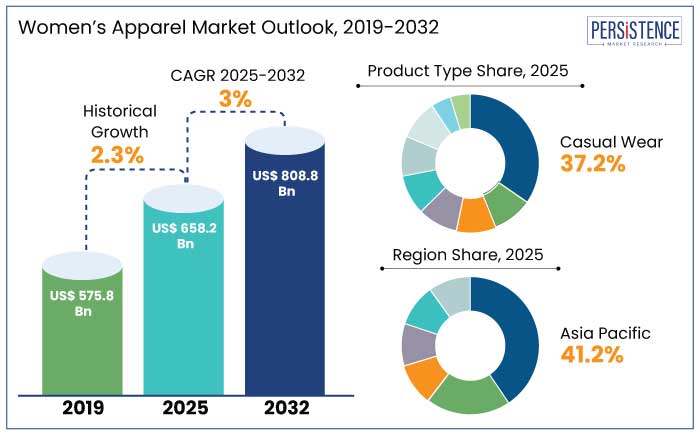
The global women’s apparel market is estimated to reach a size of US$ 658.2 Bn by 2025. It is anticipated to showcase a CAGR of 3% during the forecast period to attain a value of US$ 808.8 Bn by 2032.
By 2030, over 3.5 billion middle-class consumers will be concentrated in Asia Pacific, significantly contributing to apparel demand. Online sales of women’s apparel are set to account for 50% of the market by 2032. Consumers are increasingly seeking tailored clothing options, driving demand for tech-enabled customization.
Demand for sustainable fabrics like organic cotton, hemp, and recycled polyester is projected to witness exponential growth during the assessment period. Brands are likely to focus on recycling, upcycling, and take-back programs, appealing to eco-conscious consumers.
By 2030, 50% of global apparel companies are projected to adopt circular fashion practices. Leading brands aim to achieve net-zero emissions by 2030, further driving innovations in green manufacturing.
Key Highlights of the Industry
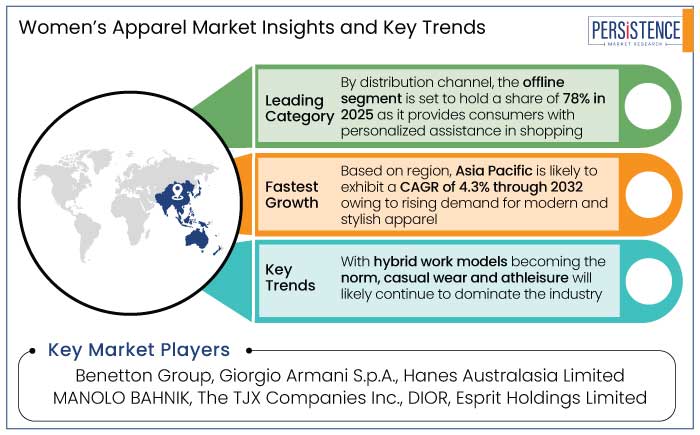
- With hybrid work models becoming the norm, casual wear and athleisure will likely continue to dominate the industry.
- Functional and stylish clothing, such as moisture-wicking and wrinkle-free materials are predicted to gain traction.
- Brands are estimated to broaden size ranges, catering to diverse body types, ethnicities, and cultural preferences.
- Clothing designed for differently abled individuals and the elderly are set to become a significant subsegment.
- AI-driven tools are anticipated to enable brands to predict trends and offer personalized recommendations.
- Integration of IoT-enabled clothing, such as temperature-regulating and fitness-tracking apparel, is projected to witness considerable demand.
- By product type, the casual wear segment is anticipated to hold a share of 37.2% in 2025 owing to increasing demand for comfortable wear.
- Based on distribution channel, the offline segment is predicted to hold a share of 78% in 2025 as it provides personalized assistance in shopping.
- Asia Pacific women’s apparel industry is set to exhibit a CAGR of 4.3% through 2032 owing to rising demand for modern and stylish apparel.
|
Market Attributes |
Key Insights |
|
Women’s Apparel Market Size (2025E) |
US$ 658.2 Bn |
|
Projected Market Value (2032F) |
US$ 808.8 Bn |
|
Global Market Growth Rate (CAGR 2025 to 2032) |
3% |
|
Historical Market Growth Rate (CAGR 2019 to 2023) |
2.3% |
Asia Pacific to See Steady Growth Owing to its E-commerce Prowess
Asia Pacific is set to account for a share of 41.2% in 2025. The region is home to over 4.6 billion people with women comprising a significant portion of this demographic. Rapid urbanization is driving demand for modern and stylish apparel as urban women increasingly adopt global fashion trends.
Countries like China, India, and Southeast Asia’s nations are witnessing strong economic growth and increasing purchasing power. These are enabling women to spend on premium and branded apparel. With more women entering the workforce, there is a rising demand for professional attire, athleisure, and multifunctional clothing. In Southeast Asia, working women represent 40% of the total workforce in leading urban centers.
Asia Pacific is the most prominent e-commerce market globally, with countries like China and India leading online retail sales. The region has a high proportion of young consumers, especially in India and Southeast Asia, who are more inclined to experiment with fashion trends.
- Over 65% of India’s population is under the age of 35, making it a significant market for trendy women’s apparel.
- Brands like Uniqlo, Zara, and H&M are aggressively extending in the region to cater to the high demand for affordable yet stylish apparel.
Casual Wear is Preferred by Women Owing to its Comfort and Practicality
Casual wear is projected to hold a share of 37.2% in 2025. The rise of remote work and hybrid work models has led to a decreased demand for formal wear and an increased preference for comfortable yet stylish clothing. As more people prioritize comfort and practicality in their daily lives, casual wear like jeans, t-shirts, and athleisure has become a wardrobe staple.
Athleisure has witnessed significant growth due to its dual functionality for casual and active use. Brands like Lululemon, Nike, and Adidas have reported double-digit growth in their women’s casual and athleisure lines. Consumers seek multi-functional apparel that suits various occasions, right from running errands to social gatherings.
Casual wear caters to this need by being stylish yet adaptable. For instance,
- A 2022 survey revealed that 60% of women prefer casual apparel for daily activities due to its ease of wear and practicality.
Online platforms have made casual wear more accessible, offering a vast array of styles and price points. Casual wear is the most searched apparel category online. In 2023, casual wear accounted for nearly 45% of online women’s apparel sales.
Consumers Prefer Offline Stores as these Give a Sense of Reliability
Offline segment is anticipated to generate a share of 78% in 2025. Despite the rapid growth of e-commerce, offline channels remain a dominant force in the women's apparel market. Women often prefer to see, feel, and try on clothes before purchasing, especially for items like dresses, blouses, or fitted garments where texture, fit, and quality matter.
- A 2023 report found that 60% of women prefer in-store shopping for clothing to evaluate the product physically.
Offline shopping allows customers to purchase and take home items immediately without waiting for delivery. This is especially appealing for last-minute shopping needs or special occasions.
- A study revealed that over 50% of women shoppers prefer offline stores for urgent clothing needs.
In-store staff provide personalized assistance, helping customers choose items based on their preferences and needs. A survey conducted in 2022 revealed that 75% of consumers value personalized in-store experiences when shopping for apparel.
Offline stores give a sense of reliability, particularly in regions where online fraud or delivery issues are prevalent. Several women view shopping as a leisure activity to enjoy with friends or family. Visiting malls or boutiques offers a complete experience that extends beyond just buying clothes. A survey revealed that 68% of women prefer in-person shopping for the social and recreational aspect.
Women’s Apparel Market Introduction and Trend Analysis
Potential growth in the global women’s apparel industry is predicted to be driven by increasing demand for sustainable clothing and unique materials. By 2030, online channels are projected to contribute 50% of global women’s apparel sales.
Brands are predicted to integrate the latest technologies like AI, AR, and ML to improve consumer experiences. Leading apparel labels are progressively extending their offerings to cater to diverse consumer requirements, thereby driving growth.
Historical Growth and Course Ahead
The women’s apparel market growth was average at a CAGR of 2.3% during the historical period from 2019 to 2023. Key drivers of growth during this period were rapid urbanization and rising middle-class populations, especially in emerging markets. Fast fashion and celebrity endorsements were prominent influences in the industry.
Growth of online retail platforms offered convenience and competitive pricing, further spurring growth. For instance,
- Online sales accounted for over 30% of women’s apparel purchases in 2020 as consumers embraced digital shopping.
The COVID-19 pandemic increased focus on loungewear and casual wear, leading to a surge in women athleisure sales. Brands focused on inclusivity, offering diverse size ranges and styles to women across the globe.
The forecast period is predicted to witness an increasing penetration of hybrid retail models, blending offline and online shopping experiences. Significant investments in technology, such as virtual fitting rooms and AI-driven personalization are predicted to see increased adoption.
Market Growth Drivers
Increasing Shift toward Sustainability and Ethical Fashion to Spur Demand
Over 60% of millennials and 70% of Gen Z consumers consider sustainability as a key factor in their purchasing decisions. Consumers now expect brands to disclose supply chain details, with 73% of consumers stating they prefer brands with transparent and ethical practices. Producing a single cotton T-shirt requires 2,700 liters of water, prompting a shift toward recycled and organic materials.
The EU Green Deal and initiatives like the Fashion Pact aim to make the industry more sustainable by 2030. Innovations in plant-based and biodegradable materials like Tencel and Piñatex, made from pineapple fibers, offer eco-friendly alternatives and are hence gaining traction in the women’s apparel industry.
Brands like Patagonia and H&M are adopting take-back programs to recycle old clothing into new garments. Consumers are increasingly attracted to unique and upcycled products, thereby offering a way to decrease waste while creating value. Adidas and Nike are investing in low-impact production technologies to reduce carbon footprints.
Trends for Inclusivity and Adaptive Fashion to Augment Sales
Consumers increasingly demand clothing that celebrates diversity, including extended sizing and diverse fits. For example,
- Around 70% of global consumers feel brands should cater to individuals of all body types, abilities, and cultural backgrounds.
- The World Health Organization (WHO) estimates that 15% of the global population lives with some form of disability, creating a vast market for adaptive apparel.
Brands increasingly recognize the importance of catering to cultural and religious needs, such as modest fashion or traditional wear for specific communities. Brands like Torrid, Universal Standard, and Good American are leading the charge by offering stylish and functional options in larger sizes for women.
Specialized sizing for shorter and taller consumers is an underexplored market with significant growth potential. Adaptive apparel includes designs that cater to physical limitations, such as Velcro closures, magnetic fastenings, or adjustable waists. A few notable examples of these are Tommy Hilfiger’s adaptive line and Zappos Adaptive collection.
Market Restraining Factors
Intense Competition in the Market to Hinder Sales
Rapid growth of e-commerce has levelled the global field, enabling online-only brands to challenge established players. Consumers now have access to a vast array of fashion choices at the click of a button, making it easier for new and niche brands to hold market share.
Online-only retailers like Shein, Boohoo, and ASOS have emerged as leading competitors to traditional stores like H&M and Zara. This is due to their ability to offer lower prices, faster fashion cycles, and direct-to-consumer models.
Fast fashion brands such as Zara, H&M, Forever 21, and Shein have intensified competition by offering low-cost, high-turnover products that reflect the latest trends. Shein, a fast-fashion giant, became the largest global fashion retailer by sales volume in 2023, surpassing brands like Zara and H&M. The business model of fast fashion enables companies to release new designs on a bi-weekly or monthly basis, often outpacing traditional fashion cycles.
Market Growth Opportunities
Companies to Focus on Modest and Cultural Fashion to Gain Profit
Various communities prioritize traditional and modest clothing as part of their cultural identity. Extending diaspora populations in Western countries are driving demand for cultural and fusion wear. Social media platforms like Instagram, TikTok, and Pinterest have amplified the visibility of modest and cultural fashion, creating a global community of consumers and influencers.
Fusion wear, combining traditional elements with contemporary designs, is a surging trend across the globe. Brands offering custom options for weddings, festivals, and cultural celebrations can capture high-value markets. Luxury brands like Dolce & Gabbana and Oscar de la Renta have launched modest fashion lines, targeting affluent consumers in emerging markets.
Cultural and modest fashion brands are incorporating sustainable practices, appealing to environmentally conscious consumers. Online platforms dedicated to modest and cultural fashion are rising, offering worldwide shipping. E-commerce leaders like ASOS and Net-a-Porter have introduced modest sections on their websites.
Increasing Shift toward Events and Experiential Marketing to Spur Avenues
Consumers are increasingly seeking memorable and personalized experiences rather than just transactional interactions. For example,
- Around 72% of millennials prefer to spend money on experiences over material goods, which has led fashion brands to focus more on events and engagement over product-based campaigns.
Events often generate significant buzz on social media, amplifying brand exposure through user-generated content. Event-based content on platforms like Instagram, TikTok, and Facebook has been shown to boost engagement by 30% to 40%.
Consumers are increasingly looking for personalized experiences and events, enabling brands to cater to this demand through bespoke services or limited-edition offerings. Around 55% of consumers are more likely to make a purchase when their experience is personalized.
Hosting events creates an opportunity for brands to foster emotional connections with their target audience, leading to higher levels of brand loyalty. According to Event Marketer, 70% of consumers feel more connected to a brand after participating in an in-person or virtual event.
Competitive Landscape for the Women’s Apparel Market
Companies in the women’s apparel market are leveraging data analytics to understand customer preferences, purchasing habits, and emerging trends. They are offering a wide range of sizes, styles, and designs to cater to diverse body types and demographics.
Businesses are using sustainable fabrics such as organic cotton, recycled polyester, and biodegradable textiles. They are also highlighting ethical production processes to appeal to environmentally conscious consumers.
Organizations are further offering personalized apparel or made-to-order options. They are progressively incorporating features like wrinkle-free materials, moisture-wicking fabrics, or multi-use clothing.
Brands are defining and communicating what makes their brand unique, such as affordability, luxury, or durability. They are also partnering with causes that resonate with their target audience, such as women’s empowerment.
Recent Industry Developments
- In January 2025, Milwaukee brought women centric clothing items to its workwear lineup.
- In November 2024, Qua launched a line dedicated to women cricketers.
- In October 2024, Sun Day RED launched a range of essentials blending golf and activewear.
- In October 2024, Lidl launched cozy outdoor women’s thermal wear range.
- In October 2024, NIYARA India announced the launch of online store offering premium fashion apparel for women.
- In October 2024, DSG Outerwear launched its latest women’s hunting clothing collection in select Rural King stores and online.
- In October 2024, Royal Enfield launched exclusive apparel line for women in Hyderabad.
Companies Covered in Women’s Apparel Market
- Benetton Group
- Giorgio Armani S.p.A.
- Hanes Australasia Limited
- MANOLO BAHNIK
- The TJX Companies Inc.
- DIOR
- Esprit Holdings Limited
- LOUIS VUITTON
- Marks & Spencer Group plc
- Burberry
- Etam Development
- DOLCE & GABBANA S.R.L
- H&M Hennes & Mauritz AB
- Guccio Gucci S.p.A.
- Eroglu Holding
- PRADA
- Gap Inc.
- Chanel
- Arcadia Group
- Gianni Versace S.r.l.
Frequently Asked Questions
The market is anticipated to reach a value of US$ 658.2 Bn by 2025.
Casual wear is projected to hold a share of 37.2% in 2025.
Asia Pacific is predicted to hold a share of 41.2% in 2025.
Prominent players in the market include Benetton Group, Giorgio Armani S.p.A., and Hanes Australasia Limited.
The market is predicted to witness a CAGR of 3% through the forecast period.


