




- Sensors & Controls
- Wireless Occupancy Sensors Market
Wireless Occupancy Sensors Market Size, Share, and Growth Forecast 2026–2033
Wireless Occupancy Sensors Market by Application (Lighting Control, Heating Ventilation and Air Conditioning), Technology (Passive Infrared, Ultrasonic Sensors), End Use (Residential, Commercial, Industrial, Institutional, Healthcare), and Regional Analysis, 2026–2033

Wireless Occupancy Sensors Market Size and Trend Analysis
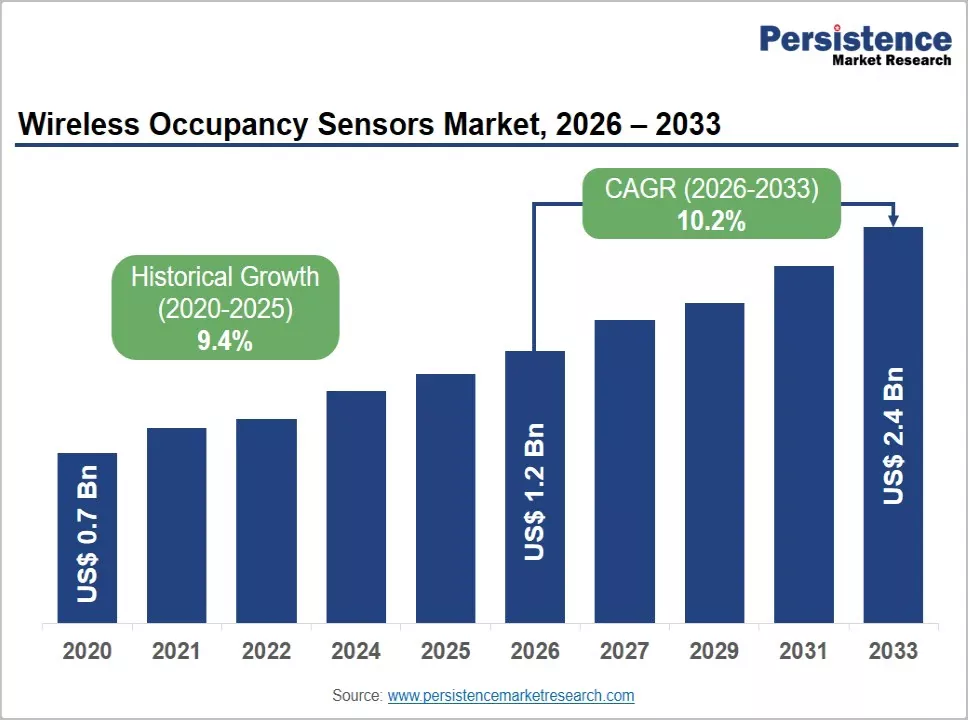
The global wireless occupancy sensors market size is likely to be valued at US$ 1.2 billion in 2026, and is estimated to reach US$ 2.4 billion by 2033, growing at a CAGR of 10.2% during the forecast period 2026–2033. Growth is underpinned by tightening building energy codes, the rapid retrofit of existing commercial buildings, and rising demand for space utilization data in hybrid workplaces.
The market has been experiencing steady growth, reflecting the gradual replacement of wired controls and the cost barriers of large-scale retrofits. However, the forecast period anticipates stronger acceleration as battery-free and low-power wireless protocols mature, smart home adoption widens, and building owners prioritize energy savings, occupant comfort, and decarbonization targets.
Key Industry Highlights• Dominant Application: Lighting control is set to command around 36% of the revenue share in 2026, while energy management is likely to grow the fastest at 11.9% CAGR through 2033, as building performance standards and electricity
- Dominant Application: Lighting control is set to command around 36% of the revenue share in 2026, while energy management is likely to grow the fastest at 11.9% CAGR through 2033, as building performance standards and electricity costs intensify.
- Leading Technology: Passive infrared sensors are expected to lead with 39% in 2026, while dual technology sensors are likely to be the fastest-growing at about 11.6% CAGR during 2026–2033, reflecting demand for fewer false triggers and reliable detection of minor motion.
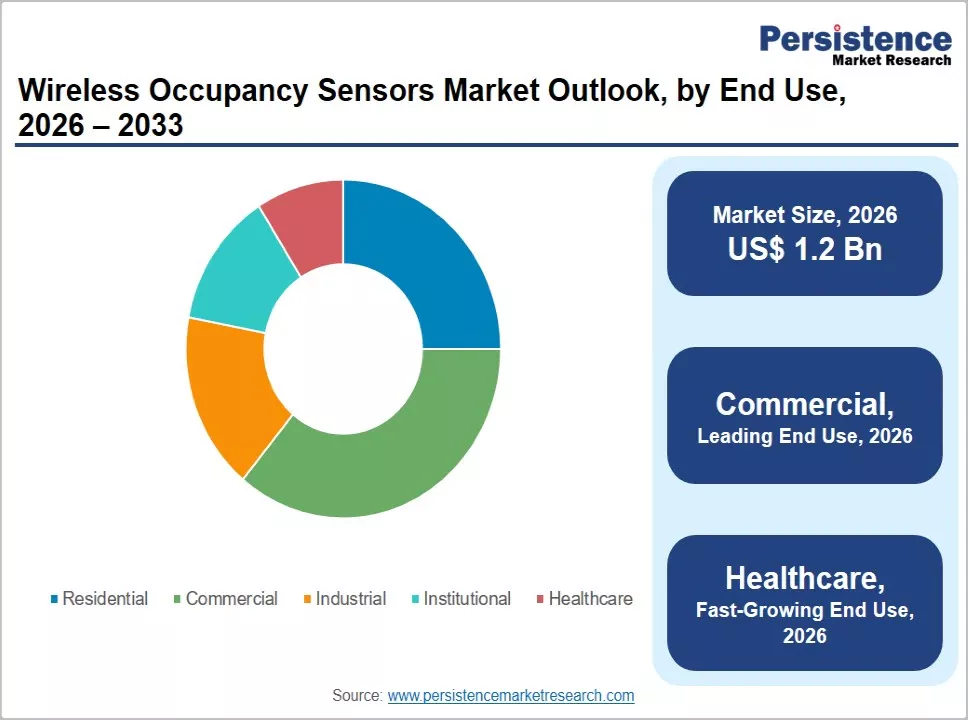
- Dominant End Use: Commercial buildings are anticipated to lead with an estimated 43% share in 2026, while healthcare facilities are slated to represent the fastest-growing end-use segment at 11.7% CAGR from 2026 to 2033.
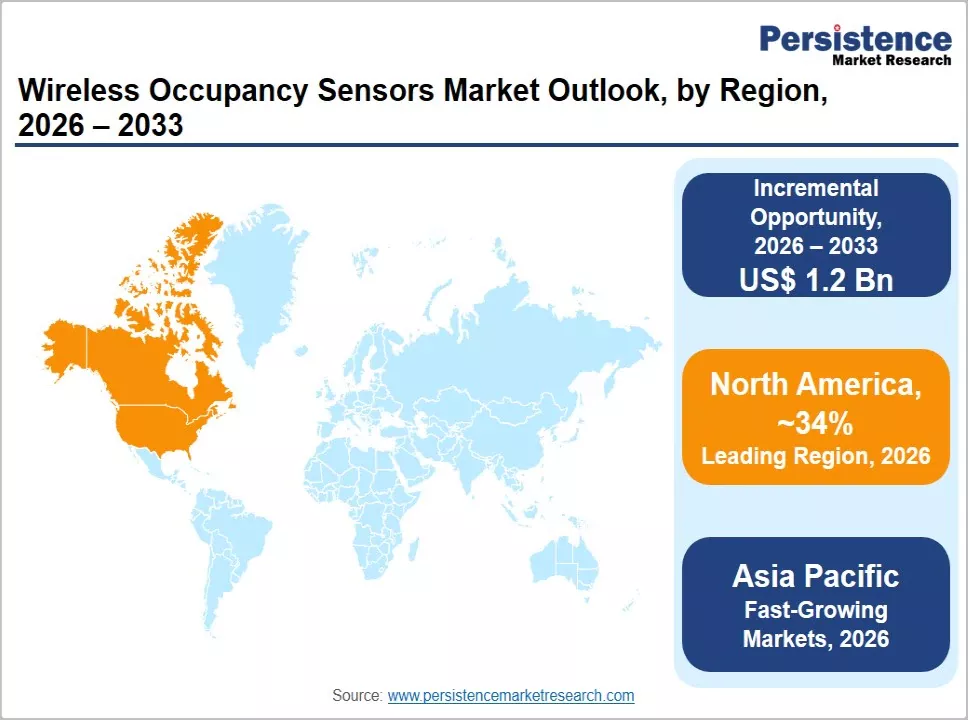
- Regional Leadership: North America is poised to dominate with an estimated 34% share in 2026, while Asia Pacific is expected to register the fastest growth at 12.1% CAGR through 2033, led by green building mandates in China and India.
- Competitive Environment: Competitive dynamics include self-powered sensor launches, interoperable wireless platforms, and the entry of smart home brands with low-cost presence sensors targeting residential and light commercial spaces.
DRO Analysis
Drivers: Energy Efficiency Mandates and Building Retrofit Programs as Primary Growth Catalyst
Energy efficiency regulation is the leading force driving the wireless occupancy sensors market growth, as governments and building owners seek to reduce the operating energy consumption of commercial and public buildings. Energy codes in North America and Europe require automatic lighting shutoff and demand-controlled ventilation in many space types, making occupancy sensing a baseline specification.
Wireless sensors lower installation cost and disruption by removing control wiring, which makes them particularly attractive for retrofits, where wiring a ceiling can account for a large share of project cost. Building performance standards in major cities are adding penalties for inefficient buildings, accelerating adoption of sensors that provide measurable savings in lighting and HVAC energy.
Hybrid Work Analytics and Smart Building Integration
Hybrid work patterns have shifted attention from simple on-off lighting control to space utilization analytics, desk and room booking, and cleaning optimization. Wireless occupancy sensors that integrate with building management systems through BACnet, Zigbee, Bluetooth Low Energy, and Matter provide real-time occupancy data at lower cost than camera-based systems. This convergence of regulatory compliance, workplace analytics, and interoperability ensures sustained growth in the coming years.
Restraints: Battery Maintenance and Interoperability and Reliability Concerns
Battery maintenance remains a persistent challenge for the wireless occupancy sensors market. Although sensors are designed for multi-year battery life, facility managers in large buildings must track and replace thousands of batteries, creating hidden lifecycle costs and potential coverage gaps when devices fail unnoticed. Radio interference in dense urban offices, signal attenuation in concrete structures, and mesh network configuration issues can also reduce reliability, causing delays in commissioning and reluctance among conservative specifiers who prefer proven wired systems.
Fragmented Protocols and Privacy Considerations
A wide range of wireless standards, including EnOcean, Zigbee, Thread, Bluetooth Low Energy, Z-Wave, and proprietary protocols, forces integrators to manage multiple gateways and hampers cross-vendor compatibility. Sensors that identify precise occupancy patterns also raise privacy and data-governance concerns among employees and healthcare providers, requiring clear policies and secure data handling. These factors collectively slow procurement cycles, particularly among smaller facility operators with limited technical expertise. Cybersecurity of connected devices is also becoming a procurement criterion for enterprise and healthcare buyers.
Opportunities: Energy-Harvesting Sensors and Smart Home Expansion
Energy-harvesting and battery-free sensors powered by indoor light, motion, or thermal differences are opening new opportunities by eliminating battery replacement and enabling truly maintenance-free installations. Recent product launches of self-powered motion and light sensors with new generation transceivers are strengthening the case for wireless solutions in offices, hotels, and educational buildings. At the same time, the growth of smart homes is expanding the addressable market for low-cost presence sensors that trigger lighting, climate, and security routines, with dual-sensor devices now priced under US$ 50.
Emerging Economy Construction and Retrofit Financing
Rapid urbanization and commercial real estate development in India, Southeast Asia, the Middle East, and Latin America are creating demand for energy-efficient controls in new buildings, supported by updated energy conservation codes. Utility rebate programs, green financing, and energy performance contracting also reduce upfront costs for end users, creating opportunities for sensor manufacturers, lighting makers, and controls integrators to offer bundled solutions and recurring analytics services.
Category-wise Insights
Application Analysis
Why Does Lighting Control Lead the Wireless Occupancy Sensors Market?
Lighting control is the leading application segment, expected to hold about 36% of the wireless occupancy sensors market revenue share in 2026. Lighting typically represents a significant portion of commercial building electricity use, and occupancy-based switching and dimming deliver immediate, measurable savings. Energy codes in many regions require automatic lighting shutoff in offices, classrooms, restrooms, and storage areas, giving the segment regulatory support. Wireless sensors also connect easily with LED fixtures and networked lighting controls, enabling daylight harvesting, zoning, and scene control. Because lighting upgrades are often part of broader LED retrofit programs, demand for sensors is stable and tied to replacement cycles rather than discretionary spending.
Energy management is likely to grow the fastest through 2033. Occupancy data increasingly feeds energy management platforms that coordinate lighting, HVAC, and plug load, adjusting setpoints based on actual space use rather than schedules. Rising electricity prices, building performance standards, and corporate net-zero targets are encouraging owners to monitor and optimize consumption at room level. Analytics platforms that combine occupancy with energy metering allow facility teams to identify wasted energy in underused areas, supporting measurable returns on investment and wider adoption across portfolios. Integration with demand response programs allows buildings to reduce load during peak periods, adding further value to occupancy data.
Technology Analysis
Which Technology Dominates Wireless Occupancy Sensors?
Passive infrared sensors dominate the technology segment, projected to capture about 39% of the revenue share in 2026. These sensors detect changes in infrared radiation caused by body heat and movement, offering low power consumption, low cost, and simple installation, which are ideal for battery-powered and energy-harvesting wireless designs. PIR sensors are widely specified for private offices, corridors, and residential rooms, and their maturity has produced standardized components and predictable pricing. Limitations include line-of-sight requirements and reduced sensitivity to minimal movement, which sustain demand for complementary technologies.
Dual technology sensors represent the fastest-growing technology segment, anticipated to achieve 11.6% CAGR during the 2026–2033 period. By combining PIR with ultrasonic or microwave detection, these sensors reduce false offs in spaces where occupants remain still, such as open offices, classrooms, and meeting rooms, while also reducing false ons from air movement or heat sources. Advances in low-power processing and sensor fusion algorithms are making dual technology models viable for wireless deployment. Ultrasonic, optical, and microwave sensors serve specialized needs, including restrooms, high-bay industrial spaces, and presence counting, supporting steady niche growth.
End-Use Analysis
Why Do Commercial Buildings Lead the End-Use Segment?
Commercial buildings are the leading end-use segment, expected to account for about 43% of the wireless occupancy sensors market in 2026. Offices, retail stores, hotels, and mixed-use developments represent large floor areas subject to energy codes and sustainability certification requirements such as LEED and WELL. Owners and tenants use occupancy data to reduce energy costs, optimize leased space, and support employee experience. Retrofit activity is strong, as wireless sensors can be installed in occupied buildings without rewiring. Large property portfolios also standardize on specific platforms, creating recurring purchases and service relationships.
Healthcare is the fastest-growing end-use segment, expected to register about 11.7% CAGR through 2033. Hospitals and care facilities use occupancy sensing to automate lighting in patient rooms and corridors, support touchless operation to limit contact surfaces, monitor room availability, and improve cleaning workflows. Wireless sensors suit ongoing renovations where construction disruption must be minimized. Residential demand is rising alongside smart home adoption, while institutional users such as schools and universities adopt sensors to meet energy targets, and industrial facilities use them in warehouses and plants for lighting and safety control.
Regional Insights
North America Wireless Occupancy Sensors Market Trends and Insights
North America is anticipated to account for an estimated 34% of the global wireless occupancy sensors market in 2026. The region's market is likely to benefit from stringent energy codes such as ASHRAE 90.1 and California's Title 24, widespread LED retrofit programs, and high adoption of building automation platforms. City-level building performance standards in the U.S. are expected to increase the need for measurable energy savings, while hybrid work is driving demand for space utilization data. Competition among established controls suppliers such as Honeywell, Johnson Controls, and Legrand and emerging smart home brands is also expected to intensify through 2033.
U.S. Wireless Occupancy Sensors Market Size
The U.S. is estimated to account for approximately 82% of the North America wireless occupancy sensors market in 2026. Market growth is likely to be supported by commercial building retrofits, state energy codes mandating occupancy-based controls, and federal tax incentives for energy-efficient commercial buildings. Large office portfolios, universities, and healthcare systems are anticipated to expand wireless deployments to cut energy costs without major construction. The growing smart home segment, supported by interoperability through Matter and Thread, is also expected to raise demand for low-cost presence sensors through 2033. Cloud-based space analytics subscriptions are also expected to create recurring revenue for sensor providers.
Canada Wireless Occupancy Sensors Market Size
Canada is projected to represent approximately 18% of the North America wireless occupancy sensors market in 2026. Market expansion is expected to be driven by the National Energy Code of Canada for Buildings, provincial utility incentive programs, and federal financing for commercial building retrofits. Cold climates make heating and ventilation efficiency a priority, increasing interest in occupancy-based HVAC control. Institutional buildings across Ontario, Quebec, and British Columbia, including schools, universities, and hospitals, are anticipated to adopt wireless sensors to reduce emissions in existing facilities through 2033. Utility-backed rebates for lighting and controls upgrades are expected to improve payback periods for building owners.
Europe Wireless Occupancy Sensors Market Trends and Insights
Europe is estimated to account for approximately 18% of the global wireless occupancy sensors market in 2026. The region's market is expected to benefit from the recast Energy Performance of Buildings Directive, which strengthens requirements for building automation and control in non-residential buildings and sets a path toward zero-emission buildings. The May 2026 deadline for member states to transpose the directive is likely to encourage owners to upgrade controls. European suppliers are also advancing energy-harvesting and secure wireless technologies, supported by strong building automation expertise and a large stock of older buildings suitable for retrofit. National renovation programs are also expected to channel public funds toward efficient lighting and controls in schools and municipal buildings.
Germany Wireless Occupancy Sensors Market Size
Germany is anticipated to account for approximately 25% of the Europe wireless occupancy sensors market in 2026. Demand is expected to be supported by national building energy legislation, high energy prices, and a large base of office and public buildings undergoing efficiency renovation. German manufacturers and lighting trade fairs showcase new self-powered sensors and wireless transceivers, reinforcing the country's role in product innovation. Utilities, municipalities, and corporate real estate owners are projected to expand wireless occupancy sensing for lighting, HVAC, and space management through 2033. Integration with building automation standards such as KNX is also expected to remain a key requirement for specifiers.
Why Is Asia Pacific Expected to Register the Fastest Growth in the Wireless Occupancy Sensors Market?
Asia Pacific is projected to account for approximately 27% of the global wireless occupancy sensors market in 2026, and is anticipated to register the fastest growth, expanding at an estimated CAGR of 12.1% through 2033. Market expansion is likely to be driven by rapid urbanization, large volumes of new commercial construction, and green building regulations. China and India are expected to remain the primary growth centres, while Japan, South Korea, Australia, and Southeast Asia are also increasing adoption of smart building and smart home technologies.
China Wireless Occupancy Sensors Market Size
China is estimated to represent approximately 38% of the Asia Pacific wireless occupancy sensors market in 2026. The country's market is expected to benefit from dual carbon goals, mandatory building energy efficiency standards, and extensive smart city and smart home deployments. Domestic manufacturers offer competitively priced wireless sensors integrated into large ecosystems of connected appliances and lighting, supporting rapid residential and commercial uptake. Continued expansion of green-certified offices, hotels, and public buildings is projected to sustain China's regional leadership through 2033.
India Wireless Occupancy Sensors Market Size
India is projected to account for approximately 17% of the Asia Pacific wireless occupancy sensors market in 2026. The market is expected to witness strong expansion, supported by the Energy Conservation and Sustainable Building Code, rapid growth of Grade A office space, and the Smart Cities Mission. Demand from data centres, hospitals, and corporate campuses is likely to encourage wireless retrofits in occupied buildings. Rising consumer interest in connected homes and lighting is also expected to support sales of affordable presence sensors through online and retail channels.
Competitive Landscape
The global wireless occupancy sensors market structure is moderately fragmented, with building automation and electrical majors including Schneider Electric, Siemens, Honeywell, and Johnson Controls controlling about 40% of the revenue share. These established players have been leveraging extensive channel networks, building management system integration, and broad portfolios that combine sensors, controllers, and software. They are also known to invest in R&D to improve battery life, wireless range, cybersecurity, and analytics capabilities.
Lighting and controls specialists such as Legrand, Lutron, Acuity Brands, Signify, and Leviton are focusing on lighting-centric and residential applications, while EnOcean and other technology providers supply energy-harvesting platforms to multiple OEMs. Barriers such as product certification, protocol interoperability, and the need for distributor relationships limit new entrants, although consumer smart home brands are expanding in the low-cost segment. Market consolidation is expected to increase gradually as larger players acquire sensor and analytics start-ups, while interoperability alliances continue to broaden cross-vendor compatibility. Distributors and electrical wholesalers also play a major role in specification and replacement sales, particularly for retrofit projects.
Key Market Developments
- In July 2026, GL.iNet announced its Lafaer LWR02 all-in-one wireless presence sensor, combining dual-sensor presence detection with a local-first automation approach and a launch price of US$ 49.99.
- In March 2026, EnOcean presented its TCM 600 programmable transceiver and an updated family of energy-autonomous EMDC motion and light sensors at Light + Building 2026, with the sensors available from the second quarter.
- In May 2026, the deadline for European Union member states to transpose the recast Energy Performance of Buildings Directive fell due, strengthening requirements for building automation and control.
Companies Covered in Wireless Occupancy Sensors Market
- Schneider Electric SE
- Siemens AG
- Honeywell International Inc.
- Johnson Controls International plc
- Legrand SA
- Lutron Electronics Co., Inc.
- Eaton Corporation plc
- Acuity Brands, Inc.
- Signify N.V.
- Leviton Manufacturing Co., Inc.
- EnOcean GmbH
Frequently Asked Questions
The global wireless occupancy sensors market is valued at US$ 1.2 billion in 2026 and is projected to reach US$ 2.4 billion by 2033, expanding at a CAGR of 10.2% during 2026–2033.
Tightening building energy codes, the rapid retrofit of existing commercial buildings, and rising demand for space utilization data in hybrid workplaces are driving the market.
Lighting control leads applications with about 36% share, passive infrared sensors lead technologies with about 39%, and commercial buildings lead end uses with an estimated 43% in 2026.
North America dominates the market with an estimated 34% share in 2026, supported by stringent energy codes and retrofit programs, while Asia Pacific is projected to grow fastest at 12.1% CAGR through 2033.
Energy-harvesting sensors, smart home expansion, space utilization analytics, and building construction in emerging economies are key market opportunities.


