




- Biotechnology
- Vibrational Circular Dichroism (VCD) Spectrometer Market
Vibrational Circular Dichroism (VCD) Spectrometer Market Size, Share, and Growth Forecast, 2026 – 2033
Vibrational Circular Dichroism (VCD) Spectrometer Market by Product Type (Benchtop VCD Spectrometers, Portable VCD Spectrometers, Research-grade VCD Spectrometers, Industrial VCD Spectrometers), Technology Type (Fourier Transform Infrared (FTIR) Based VCD Spectrometers, Dispersive VCD), End-User (Pharmaceutical Companies, Academic & Government Research Laboratories, Biotechnology Firms, CROs, Chemical Industry, Food & Beverage Industry), and Regional Analysis for 2026-2033

Vibrational Circular Dichroism (VCD) Spectrometer Market Share and Trends Analysis
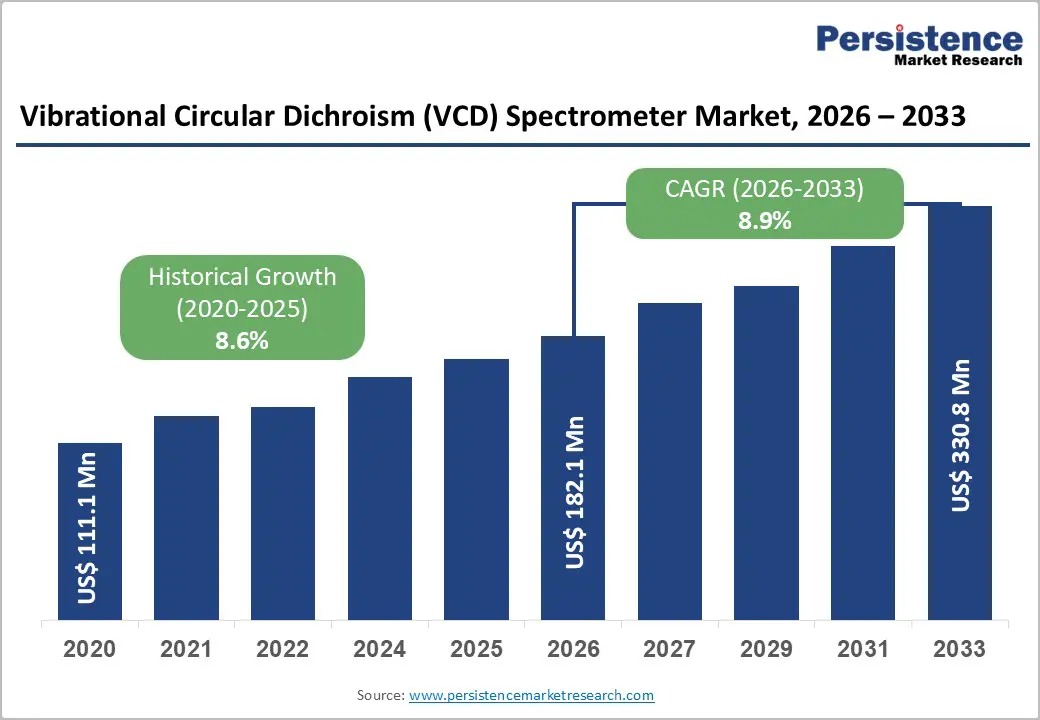
The global vibrational circular dichroism (VCD) spectrometer market size is likely to be valued at US$ 182.1 million in 2026, and is projected to reach US$ 330.8 million by 2033, growing at a CAGR of 8.9% during the forecast period 2026−2033. Market expansion is primarily driven by rising demand for advanced chiral analysis across pharmaceutical development, biotechnology research, and regulatory-validated analytical testing. Increasing molecular complexity of drug candidates has intensified reliance on stereochemical characterization tools capable of absolute configuration determination, positioning VCD spectrometers as essential instrumentation within regulated research environments.
Growth in pharmaceutical pipelines focused on complex small molecules, peptides, and biologically active chiral compounds has reinforced adoption across both discovery and quality validation workflows. Technological integration with Fourier transform infrared (FTIR) platforms and quantum chemical modeling software has enhanced analytical precision and interpretive confidence. This convergence has reduced analytical ambiguity, accelerated regulatory acceptance, and expanded applicability beyond academic research into industrial and contract research settings. Continuous improvements in detector sensitivity, signal-processing algorithms, and automation have reduced operational complexity, thereby enabling broader institutional deployment.
Key Industry Highlights
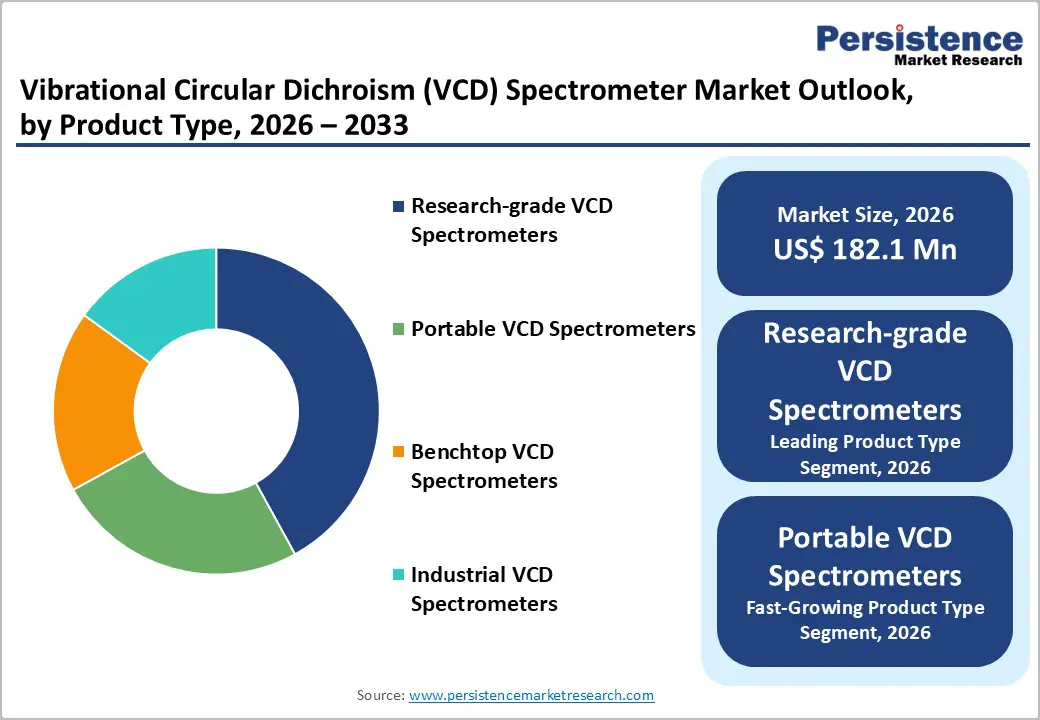
- Product Type Dominance: Research-grade VCD spectrometers are poised to dominate, with an estimated 42% revenue share in 2026, driven by their multi-application analytical reliability.
- Fastest-growing Product Type: Portable VCD spectrometers are anticipated to be the fastest-growing through 2033, propelled by decentralized testing, flexible workflows, and miniaturized optics.
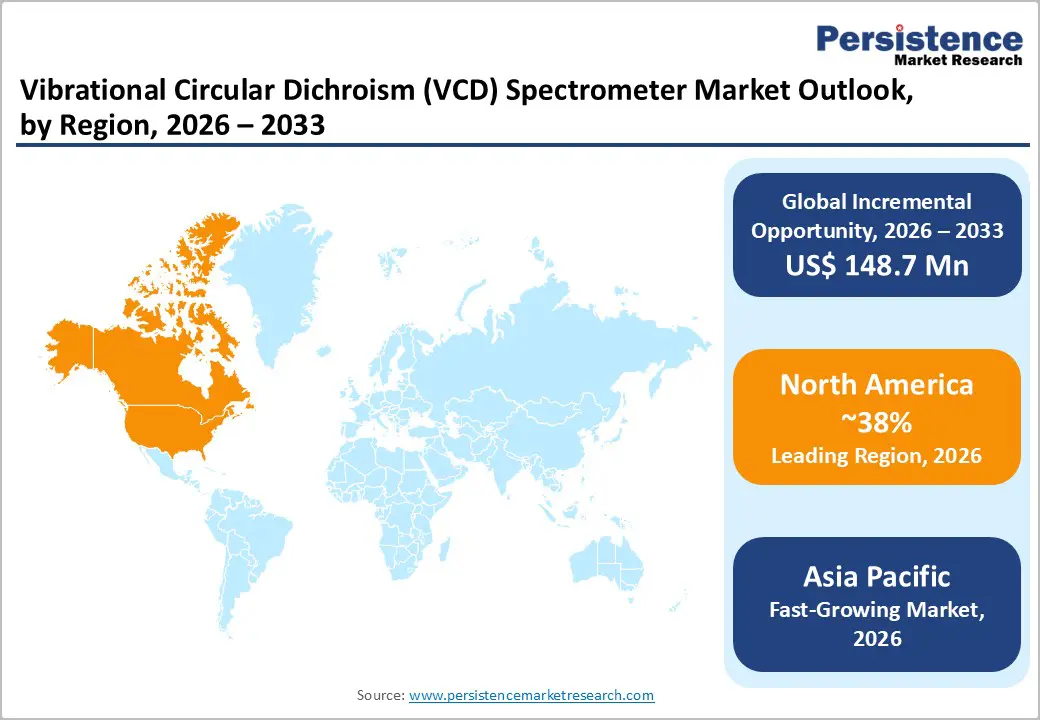
- Leading Region: North America is expected to lead with approximately 38% market share in 2026, driven by pharmaceutical R&D concentration and regulatory emphasis on stereochemical validation.
- Fastest-growing Market: Asia Pacific is forecasted to be the fastest-growing market through 2033, stimulated by expanding pharmaceutical manufacturing and chiral drug development.
| Key Insights | Details |
|---|---|
|
Vibrational Circular Dichroism (VCD) Spectrometer Market Size (2026E) |
US$ 182.1 Mn |
|
Market Value Forecast (2033F) |
US$ 330.8 Mn |
|
Projected Growth (CAGR 2026 to 2033) |
8.9% |
|
Historical Market Growth (CAGR 2020 to 2025) |
8.6% |
Market Factors – Growth, Barriers, and Opportunity Analysis
Advancements in Pharmaceutical Research and Drug Discovery
Pharmaceutical research and drug discovery significantly increase demand for advanced spectroscopic tools due to the critical role of stereochemistry in therapeutic efficacy and safety. A large proportion of modern drugs are chiral, meaning they exist in non-superimposable mirror-image forms known as enantiomers, and these can exhibit markedly different pharmacological effects in biological systems. Determining the absolute configuration and three-dimensional structure of chiral drug candidates is essential at multiple stages of the discovery pipeline to ensure that the desired enantiomer progresses toward development and that potential toxic forms are identified early. Traditional high-resolution structural methods, such as X-ray crystallography, are limited by the requirement for crystalline samples, whereas chiroptical techniques, such as vibrational circular dichroism, enable solution-phase analysis, allowing stereochemical assignments without crystallization and supporting high-throughput screening workflows.
Researchers and development teams increasingly adopt methods that provide reliable stereochemical insights early in lead optimization and candidate selection, thereby improving decision quality and time-to-market. The capacity to analyze both small molecules and larger biomolecules such as peptides or oligonucleotides in their native environments enhances the interpretability of structure–activity relationships and supports safer, more effective therapeutic design. Furthermore, VCD's ability to provide detailed conformational and stereochemical data complements other analytical techniques, reducing reliance on sequential workflows and accelerating iterative medicinal chemistry cycles.
Limited Awareness and Competition from Alternative Analytical Techniques
Limited awareness among applied research and industrial quality functions continues to constrain adoption. Decision-makers in pharmaceutical development, contract research, and specialty chemicals often prioritize analytical platforms with long-established validation histories and broad internal familiarity. This dynamic reduces the evaluation bandwidth for advanced chiroptical techniques that require specialized expertise in interpretation. Educational exposure remains concentrated within niche academic circles, limiting downstream transfer into commercial laboratories. Training gaps elevate perceived operational risk, extend onboarding timelines, and increase reliance on external specialists, which weakens internal return-on-investment justification. Procurement teams frequently classify the technology as non-essential when alternative tools already meet regulatory requirements, thereby reinforcing conservative capital-allocation behavior. Marketing reach from instrument vendors remains narrow, further slowing diffusion beyond early adopters.
Strong competition from alternative analytical techniques reinforces this restraint through advantages in cost, speed, and workflow integration. Nuclear magnetic resonance (NMR) spectroscopy, X-ray crystallography, Raman optical activity spectroscopy, and chiral chromatography benefit from entrenched infrastructure, standardized protocols, and broader regulatory acceptance. These methods often deliver faster turnaround times or multi-parameter outputs aligned with existing laboratory workflows, reducing incentives to introduce complementary platforms. Budget holders favor instruments with higher utilization rates across diverse applications, while this technique addresses highly specific structural questions. Software ecosystems for competing methods also provide mature automation and data interpretation frameworks, reducing dependence on expert judgment.
Emerging Applications in Solid-State Analysis and Polymorph Characterization
Growing emphasis on solid-form understanding across pharmaceuticals, specialty chemicals, and advanced materials has intensified demand for analytical tools capable of capturing chiral information outside solution-phase conditions. Solid matrices, such as crystalline, semi-crystalline, and amorphous forms, directly influence stability, solubility, bioavailability, and process performance, thereby elevating structural insight to a strategic priority. Traditional techniques, including X-ray diffraction and infrared spectroscopy, have limitations in resolving subtle stereochemical differences in complex solids. Vibrational circular dichroism enables direct observation of chiral vibrational signatures, offering a differentiated perspective on molecular arrangement and conformational integrity in solid environments. This analytical depth supports structured development models focused on early risk mitigation, reduced reformulation cycles, and improved transition from laboratory to commercial manufacturing.
Rising focus on polymorphic control has further strengthened demand for advanced chiroptical characterization. Distinct polymorphs can alter therapeutic outcomes, regulatory pathways, and intellectual property positioning, creating strong incentives for precise differentiation. Vibrational circular dichroism provides sensitivity to subtle variations in molecular packing and intermolecular interactions that are undetectable by conventional vibrational or thermal methods. Recent progress in solid-state sampling accessories, signal amplification, and computational correlation has enhanced practicality and reproducibility, enabling broader integration into development and quality workflows. The expansion of solid-state research into co-crystals, chiral salts, and functional hybrid materials continues to broaden the scope of applications, reinforcing this domain as a durable catalyst for instrument adoption.
Category-wise Analysis
Product Type Insights
Research-grade VCD spectrometers are poised to lead with a forecasted 42% share in 2026, owing to deep integration within pharmaceutical research, academic laboratories, and regulatory science institutions. These systems offer high spectral resolution, advanced sensitivity, and compatibility with computational chemistry platforms, aligning with complex molecular characterization requirements. Preference among research institutions stems from validation credibility, methodological flexibility, and long-term analytical reliability. Investment patterns favor research-grade systems due to multi-application utility across drug discovery, stereochemical confirmation, and method development. Institutional procurement policies prioritize analytical depth and future-proofing, reinforcing sustained demand. This segment benefits from alignment with regulatory expectations and grant-funded research priorities, securing leadership position.
Portable VCD spectrometers are anticipated to be the fastest-growing segment between 2026 and 2033, fueled by decentralization of analytical testing and demand for flexible laboratory workflows. Advancements in miniaturized optics and digital signal processing have improved performance reliability, enabling use in contract research, field laboratories, and distributed innovation centers. Accessibility and reduced dependence on infrastructure enhance adoption among emerging laboratories and industrial compliance units. Innovation in portability supports broader application scope without compromising analytical integrity, driving an accelerated growth trajectory relative to traditional benchtop systems.
Technology Type Insights
FTIR-based VCD spectrometers are likely to be the leading segment, with a projected 68% market share in 2026, owing to superior signal-to-noise performance, faster spectral acquisition, and established integration within laboratory environments. This segment benefits from mature hardware architecture and well-validated interferometer designs that support high spectral resolution and repeatability. Compatibility with existing Fourier transform infrared infrastructure reduces incremental investment requirements, supporting procurement decisions across pharmaceutical, chemical, and academic laboratories. Standardized data-processing software and the broad availability of trained professionals further strengthen the momentum for adoption. Longstanding regulatory familiarity with Fourier transform infrared methodologies enhances confidence during method validation and compliance activities. Continuous incremental upgrades in detectors, sources, and computational analysis sustain performance leadership while preserving operational continuity within established analytical environments.
Dispersive VCD is expected to witness the fastest growth between 2026 and 2033, powered by targeted application development and cost-optimized system designs. This growth trajectory reflects rising demand for application-specific solutions, in which compact design, wavelength selectivity, and lower system complexity confer practical advantages. Advances in optical component efficiency and detector sensitivity have improved measurement reliability, enabling broader experimental scope. Adoption is supported by focused use cases in stereochemical research, materials science, and emerging solid-state studies. Modular instrument configurations allow scalable deployment, aligning with budget-sensitive research programs. The expansion of digital commerce channels and supplier-led customization options further lowers access barriers, thereby supporting accelerated uptake across diverse laboratory settings.
End-User Insights
Pharmaceutical companies are projected to hold a dominant position, accounting for an anticipated 39% of the VCD spectrometer market revenue in 2026, driven by regulatory-mandated stereochemical validation and increasing reliance on chiral drug candidates. Strong internal demand encompasses early discovery screening, solid-form selection, formulation optimization, and commercial quality control. Vibrational circular dichroism systems enable consistent stereochemical confirmation, supporting regulatory submissions and lifecycle management strategies. Alignment with good manufacturing practice (GMP) frameworks and validated analytical protocols strengthens operational reliability. Capital availability supports acquisition of advanced instrumentation and long-term method development programs. In-house expertise and cross-functional analytical integration reinforce recurring utilization, positioning pharmaceutical organizations as anchor customers with stable replacement and upgrade cycles over extended planning horizons.
Contract research organizations (CROs) are forecasted to be the fastest-growing end-user segment between 2026 and 2033, boosted by the outsourcing of complex analytical services and the demand for specialized stereochemical expertise. Expanding drug development pipelines and capacity constraints within sponsor organizations have elevated reliance on external analytical partners. Vibrational circular dichroism capabilities allow service providers to offer differentiated chiral characterization, strengthening competitive positioning. Centralized laboratories equipped with advanced spectroscopy platforms improve throughput and consistency across client projects. Digital workflow management and data-sharing frameworks enhance responsiveness and scalability. Shared instrument utilization models reduce capital burden per project, enabling rapid technology adoption and supporting sustained revenue growth within service-oriented operating structures.
Regional Insights
North America Vibrational Circular Dichroism (VCD) Spectrometer Market Trends
North America is expected to dominate the vibrational circular dichroism spectrometer market, with an estimated 38% market share in 2026, reflecting the concentration of high-value pharmaceutical research, advanced analytical laboratories, and capital-intensive innovation environments. A strong reliance on chiral drug pipelines increases the routine demand for stereochemical validation across the discovery, development, and commercialization stages. Regulatory frameworks emphasize enantiomeric integrity, data reproducibility, and method robustness, reinforcing the adoption of high-precision chiroptical instrumentation. Procurement strategies favor platforms with proven analytical depth, long operational lifecycles, and compatibility with established Fourier transform infrared infrastructure. Close collaboration between instrument developers and end users supports rapid application refinement, customized system configurations, and long-term service engagement, sustaining leadership through structural demand rather than volume expansion.
Market strength is further reinforced by early institutionalization of vibrational circular dichroism within standardized analytical workflows and computational modeling environments. The availability of specialized spectroscopic expertise enables broader application, extending its use to solid-state chirality, polymorph screening, and advanced materials research. Academic and industrial integration accelerates method acceptance and reduces validation timelines for emerging applications. Investment priorities focus on data integrity, audit preparedness, and interoperability across regulated laboratory systems, favoring technologically mature solutions. Strong intellectual property activity and lifecycle optimization strategies increase dependence on precise stereochemical differentiation, maintaining high utilization intensity and limiting substitution risk.
Europe Vibrational Circular Dichroism (VCD) Spectrometer Market Trends
Europe hosts a robust analytical instrumentation ecosystem, supported by deep-rooted pharmaceutical innovation, advanced chemical research, and well-established regulatory frameworks that emphasize stereochemical precision. Focus on enantiomeric purity, solid-form control, and data reproducibility reinforces integration of high-resolution chiroptical techniques into discovery, development, and quality assurance workflows. The concentration of specialty pharmaceutical manufacturers and fine chemical producers generates consistent demand for detailed molecular characterization, particularly for complex or high-value compounds. Robust academic research output and publicly funded scientific institutions contribute to continuous method refinement and the development of a skilled workforce, enabling the sophisticated application of vibrational circular dichroism in both industrial and research settings.
Adoption is further strengthened by emphasis on sustainable manufacturing practices, lifecycle management, and intellectual property protection strategies. Polymorph screening, co-crystal analysis, and solid-state chirality assessment are increasingly applied to extend product differentiation and maintain competitive advantage. Collaboration among academic institutions, contract research providers, and instrument suppliers accelerates translation of advanced analytical methodologies into routine laboratory practice. Investment decisions prioritize long-term reliability, interoperability with existing spectroscopy infrastructure, and regulatory compliance readiness. The expansion of cross-border research initiatives and the harmonization of quality standards ensure consistent use across multinational operations, supporting stable growth, high equipment utilization, and the continued relevance of advanced chiroptical instruments in regulated and innovation-driven sectors.
Asia Pacific Vibrational Circular Dichroism (VCD) Spectrometer Market Trends
Asia Pacific is forecasted to be the fastest-growing market for vibrational circular dichroism spectrometers from 2026 to 2033, stimulated by the rapid expansion of pharmaceutical manufacturing, custom synthesis, and contract research activities that require advanced stereochemical validation aligned with global regulatory expectations. The increasing prevalence of chiral active pharmaceutical ingredients in development pipelines increases reliance on high-sensitivity chiroptical techniques for molecular confirmation and solid-form differentiation. Export-driven drug development strategies prioritize analytical rigor, traceability, and data credibility, strengthening integration of vibrational circular dichroism into regulated laboratory workflows. Growth in academic research intensity across chemistry, life sciences, and materials science expands early-stage usage and develops a technically skilled user base. Public and private investment in laboratory modernization accelerates the procurement of advanced spectroscopy platforms, while cost-efficient infrastructure enables faster scaling of analytical capacity compared with that in mature economies.
Growth momentum is reinforced by the rise of integrated contract research and manufacturing service models that emphasize analytical depth as a competitive differentiator. Centralized analytical centers deploy vibrational circular dichroism systems across multiple client programs, improving utilization efficiency and return on capital investment. Progressive alignment with international quality standards increases demand for stereochemical precision throughout development and commercialization cycles. The expansion of solid-state research, polymorph control initiatives, and complex formulation engineering broadens the scope of applications. Flexible procurement structures, modular system architectures, and expanding local technical support networks lower adoption barriers.
Competitive Landscape
The global vibrational circular dichroism spectrometer market structure exhibits moderate concentration, characterized by the presence of both established analytical instrument manufacturers and specialized spectroscopy firms. Leading players collectively generate approximately 60% of total revenue, reflecting a balance between dominant incumbents and innovative niche providers. Competitive advantage in this market is largely determined by technological sophistication, precision, and reliability of instrumentation. Platforms that integrate Fourier transform infrared capabilities, support solid-state and polymorph analysis, and offer high signal-to-noise performance are particularly valued. Regulatory compliance and method validation support adoption in highly controlled environments, such as pharmaceutical and fine chemical laboratories, where data integrity and reproducibility are critical. Service support, including installation, training, and maintenance, plays a significant role in sustaining long-term client relationships and reinforces trust in premium instruments.
Key players such as Bruker, JASCO, BioTools Inc., Thermo Fisher, ABB, HORIBA Group, and JEOL Ltd. leverage global distribution networks, strong R&D investment, and established client bases to maintain competitive advantage. Collaboration with academic institutions and contract research organizations supports method development, knowledge transfer, and expansion into emerging applications such as solid-state chirality and polymorph differentiation. Focused efforts on modular instrumentation, software integration, and workflow compatibility improve user adoption and operational efficiency. Strategic emphasis on technological innovation, combined with extensive after-sales support and service capabilities, allows these companies to capture high-value segments, sustain leadership, and navigate a moderately concentrated market while accommodating growth opportunities across research, development, and quality assurance environments.
Key Industry Developments
- In January 2026, researchers at the University of California, Davis (UC Davis) developed a compact spectrometer-on-a-chip that integrates surface-enhanced silicon photodiodes with AI-augmented spectral reconstruction to deliver lab-grade hyperspectral sensing performance in a device no larger than a grain of sand.
- In January 2026, a research team led by Virginia Tech University successfully extended an origin-invariant length gauge approach to vibrational circular dichroism spectroscopy, eliminating dependence on gauge-including atomic orbitals and enabling more efficient, reliable prediction of VCD spectra for diverse chiral molecules.
- In January 2025, at SPIE Photonics West 2025, keynote sessions highlighted advances in vibrational circular dichroism spectroscopy using novel quantum cascade laser (QCL) sources that improve sensitivity and speed for protein analysis, alongside other cutting-edge developments in mid-infrared laser technologies and optical sensing.
Companies Covered in Vibrational Circular Dichroism (VCD) Spectrometer Market
- Bruker
- JASCO.
- BioTools Inc.
- Thermo Fisher
- ABB
- HORIBA Group
- JEOL Ltd.
Frequently Asked Questions
The global vibrational circular dichroism (VCD) spectrometer market is projected to reach US$ 182.1 million in 2026.
Rising demand for stereochemical analysis in pharmaceutical, biotechnology, and regulatory-compliant research are driving the market.
The market is poised to witness a CAGR of 8.9% from 2026 to 2033.
Expansion into industrial quality control and emerging research ecosystems presents key opportunities for market players.
Some of the key market players include Bruker, JASCO, BioTools Inc., Thermo Fisher, ABB, HORIBA Group, and JEOL Ltd.


