




- Pharmaceuticals
- Varicose Veins Treatment Market
Varicose Veins Treatment Market Size, Share, Growth, and Regional Forecast, 2026 to 2033
Varicose Veins Treatment Market by Treatment (Endovenous Ablation, Sclerotherapy, Surgical Ligation), End-user (Vein Clinics, Hospitals, Ambulatory Care Unit), and Regional Analysis, from 2026 - 2033

Varicose Veins Treatment Market Share and Trends Analysis
The global varicose veins treatment market size is expected to be valued at US$ 946.9 million in 2026 and projected to reach US$ 1,510.6 million by 2033, growing at a CAGR of 6.9% between 2026 and 2033. The transition to minimally invasive treatment methods, the accessibility of modern varicose vein treatment technologies, and the high prevalence of varicose veins in North America and Europe are driving market expansion. Additional growth factors include improved patient compliance and reliability, rising healthcare expenditures, and the rapid expansion of the aging population.
The scarcity of training for vascular surgeons, the elevated costs associated with varicose vein treatment, and the enactment of healthcare reforms in the U.S. are additional factors that further inhibit market growth.
Constraints related to uneven reimbursement for varicose vein treatment and the sustainability of participants in the intensely competitive industry restrain market growth. The increasing prevalence of varicose veins globally is attributed to causes such as an aging population, sedentary lifestyles, obesity, and genetic predisposition. Consequently, intensifying the demand for better treatment alternatives. A variety of therapeutic techniques are available, including minimally invasive procedures such as endogenous laser ablation, sclerotherapy, and radiofrequency ablation.
Key Industry Highlights:
- Growing demand for minimally invasive procedures such as EVLT, RFA, and sclerotherapy drives the market growth.
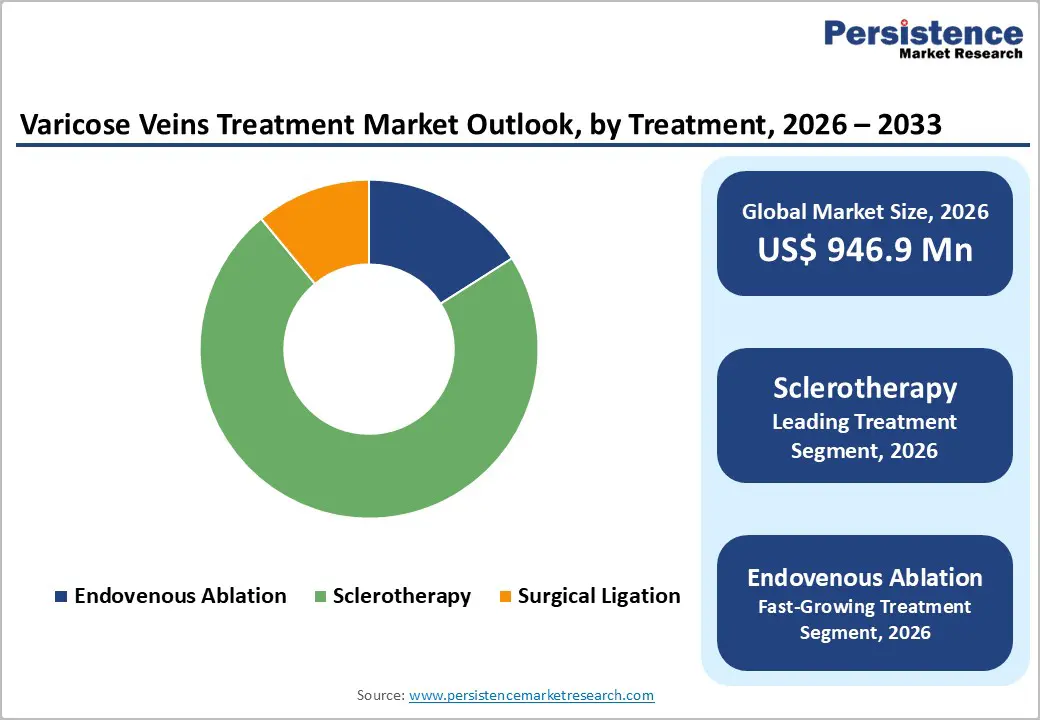
- Based on treatment, sclerotherapy varicose veins treatment accounts for the highest market share of 73%.
- Aging populations are contributing to a rising incidence of varicose veins globally.
- By end user, hospitals are expected to dominate the market, accounting for 60% of the market share in 2026.
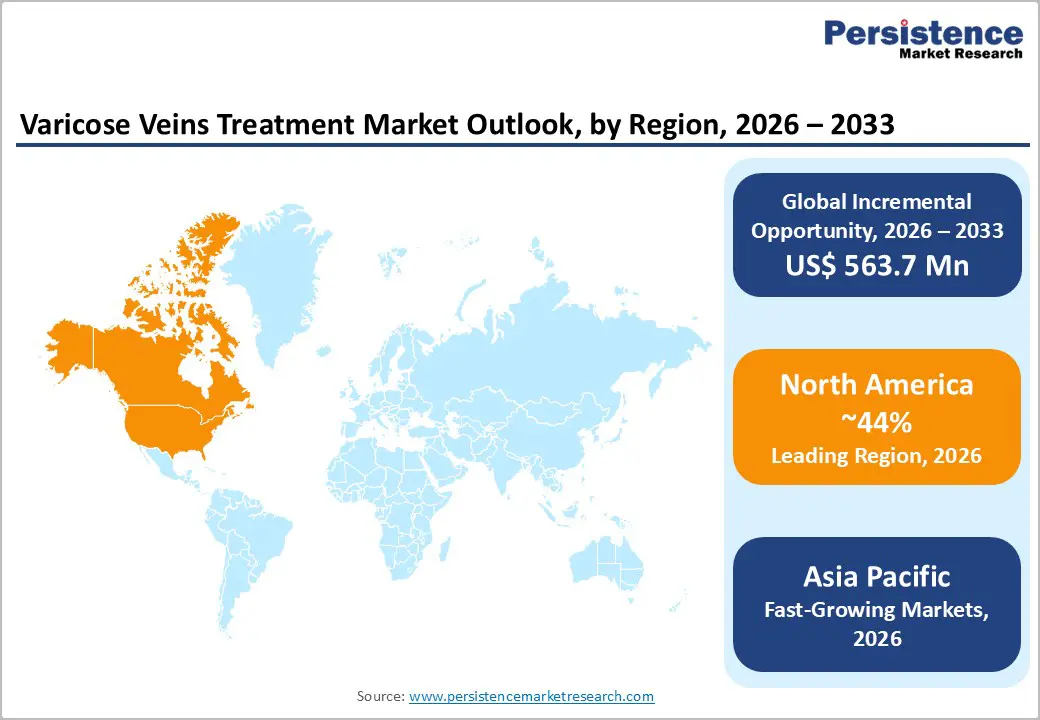
- North America holds the largest market share due to the region's advanced healthcare infrastructure.
- The rising focus on cosmetic treatments and early-stage varicose vein interventions is a key market driver.
| Key Insights | Details |
|---|---|
| Varicose Veins Treatment Market Size (2026E) | US$ 946.9 Mn |
| Market Value Forecast (2033F) | US$ 1,510.6 Mn |
| Projected Growth (CAGR 2026 to 2033) | 6.9% |
| Historical Market Growth (CAGR 2020 to 2024) | 6.0% |


Market Dynamics
Driver - Rising Prevalence of Lifestyle-Related Risk Factors
The increasing prevalence of lifestyle-related risk factors such as sedentary behaviour, obesity, and prolonged standing or sitting is a significant driver for the varicose veins treatment market. Modern work environments where individuals spend extended hours sitting at desks or standing for long periods contribute to poor blood circulation, leading to venous insufficiency. Additionally, rising obesity rates exert extra pressure on veins, exacerbating the risk of varicose veins.
With an aging global population, these risk factors are compounded by the natural weakening of venous walls, making the condition more common. As awareness of varicose veins increases, more patients are seeking treatment earlier in the disease progression. This growing patient pool, combined with the emphasis on lifestyle management and preventive care, continues to drive demand for both minimally invasive and surgical interventions in the market.
Advancements in Minimally Invasive Treatments
Technological advancements in minimally invasive procedures have revolutionized the varicose veins treatment market. Treatments such as endovenous laser therapy (EVLT), radiofrequency ablation (RFA), and foam sclerotherapy are increasingly common. Their popularity is due to their effectiveness, short recovery times, and lower risk compared with traditional surgeries such as vein stripping. These non-surgical options are performed in outpatient settings, which makes them convenient for patients and lowers healthcare costs.
As these treatments become more refined, their success rates are improving further encouraging their adoption. Patients are increasingly drawn to these options due to their minimal scarring, quick recovery, and few complications. Physicians and healthcare providers also prefer these methods for their precision, ease of use, and ability to treat a larger number of patients efficiently.
The shift toward advanced minimally invasive procedures is a key growth driver attracting both patients and healthcare systems to adopt new technologies in the varicose veins treatment landscape.
Restraints - High Treatment Costs and Limited Reimbursement
One of the primary restraints on the varicose veins treatment market is the high cost of treatments, particularly for minimally invasive procedures such as endovenous laser therapy (EVLT) and radiofrequency ablation (RFA). These advanced treatments can be expensive and are not always covered by insurance.
In many cases, insurance providers classify varicose vein treatments as cosmetic, limiting reimbursement options for patients unless the condition is deemed medically necessary due to complications like ulcers or severe pain. The cost barrier reduces accessibility especially for patients in lower-income brackets or in regions with inadequate insurance coverage.
The financial burden discourages some patients from seeking early intervention, leading to untreated cases or reliance on cheap, less effective treatments. As a result, the high out-of-pocket costs for patients remain a significant factor limiting the market growth particularly in developing regions.
Lack of Awareness in Emerging Markets
Another significant growth restraint is the limited awareness of varicose veins and their potential complications in emerging markets. In many developing countries, varicose veins are often perceived as a purely cosmetic issue rather than a medical condition requiring treatment. As a result, patients may delay seeking care leading to more advanced stages of venous disease that require complex and costly interventions.
There is often a shortage of specialized healthcare providers and clinics equipped to diagnose and treat varicose veins in these regions. This lack of medical infrastructure and knowledge about modern treatment options hampers market growth further. The gap in education and infrastructure significantly limits the adoption of varicose vein treatments in emerging markets posing a challenge to global market expansion.
Opportunity - Expansion of Non-Invasive and Outpatient Procedures
One of the most transformative opportunities in the varicose veins treatment market is the expansion of non-invasive and outpatient procedures. With advances in technologies such as endovenous laser therapy (EVLT), radiofrequency ablation (RFA), and sclerotherapy, patients can now undergo treatments with minimal recovery time and fewer complications. The above procedures can often be performed in outpatient settings such as vein clinics or ambulatory care centers, thereby increasing accessibility and convenience. This
Shift away from traditional surgeries, which were often invasive and required hospitalization, represents a key opportunity for both healthcare providers and patients. The growth of these outpatient procedures opens new markets in regions where access to hospital-based care is limited or where patients prefer fast and cost-effective treatments.
As technology continues to improve, the success rates and efficiency of non-invasive methods are expected to attract more patients, driving market growth and expanding treatment options globally.
Category-wise Analysis
By Treatment Insights
The global varicose veins treatment market is segmented into endovenous ablation, sclerotherapy, and surgical ligation. Among these, sclerotherapy holds the leading market share and remains the most widely adopted treatment option. Its dominance is attributed to several clinical and procedural advantages, including minimal bruising and scarring, no requirement for general anesthesia or sedation, shorter recovery periods, and simple follow-up procedures. These benefits make sclerotherapy particularly suitable for outpatient settings and early-stage varicose vein management. In the U.S., Medicare coverage for sclerotherapy procedures further supports its high adoption rate, increasing patient accessibility and affordability.
Additionally, various professional organizations, such as the British Association of Sclerotherapies (BAS), actively promote awareness and education initiatives, helping improve acceptance among both physicians and patients. Market growth is also supported by increasing regulatory approvals for innovative sclerotherapy-related products. For instance, VB Devices received CE mark approval for the Varixio Pod Air, a Class I medical device designed to automate foam preparation, thereby enhancing procedural efficiency and treatment outcomes. These factors collectively reinforce sclerotherapy’s dominant position in the global market.
By End-user Insights
By end user, the global varicose veins treatment market is segmented into hospitals, vein clinics, and ambulatory care units. Hospitals dominate the market, accounting for approximately 60% of the total market share in 2025. This dominance is primarily driven by the availability of advanced medical infrastructure, including sophisticated diagnostic tools such as Doppler ultrasound, MRI, and CT imaging, which enable accurate disease assessment. Hospitals also offer a wide range of treatment options, covering both surgical and minimally invasive procedures such as endovenous laser treatment (EVLT), radiofrequency ablation (RFA), and sclerotherapy. The presence of experienced vascular surgeons, interventional radiologists, and multidisciplinary care teams allows hospitals to manage complex and high-risk cases effectively.
Additionally, hospitals provide integrated pre- and post-treatment care, emergency services, and long-term follow-up, making them a preferred choice for comprehensive treatment. While vein clinics and ambulatory care centers are increasingly used for mild and moderate cases, hospitals continue to lead due to their ability to deliver complete and advanced varicose vein care.
Region-wise Insights
North America Varicose Veins Treatment Market Trends
North America is estimated to account for approximately 44% of the global varicose veins treatment market, driven by a large, health-conscious population with strong awareness of both medical and cosmetic outcomes. High demand for aesthetically effective and clinically safe procedures has increased the adoption of minimally invasive treatments such as laser ablation and sclerotherapy. In the United States, standardized clinical guidelines developed by the Society for Vascular Surgery in collaboration with the American Venous Forum have strengthened treatment consistency and physician confidence. These guidelines follow established grading systems to classify chronic venous disease severity, improving diagnostic accuracy and reimbursement communication with insurers. Structured severity assessment also enables efficient referrals from primary care physicians to vein specialists. Technological validation of laser-based therapies has reduced the perception of varicose vein treatment as purely cosmetic, increasing acceptance across broader patient groups, including men.
Additionally, strong insurance coverage, widespread availability of advanced healthcare infrastructure, and the presence of specialized vein centers further support market growth across the region.
Europe Varicose Veins Treatment Market Trends
The Europe varicose veins treatment market is shaped by a growing elderly population, high prevalence of chronic venous disorders, and well-established public healthcare systems. Countries such as Germany, the UK, France, and Italy show strong demand due to increased diagnosis rates and access to specialist vascular care. National healthcare programs emphasize early detection and treatment to reduce long-term complications, supporting steady procedure volumes. Adoption of endovenous thermal ablation and foam sclerotherapy is expanding, driven by clinical preference for less invasive alternatives to surgery. Europe also benefits from a robust regulatory framework, enabling the timely approval of innovative medical devices and treatment technologies. Medical societies and professional associations actively conduct training programs and conferences, improving physician expertise and standardizing treatment practices.
Additionally, rising workplace-related risk factors such as prolonged standing and sedentary lifestyles contribute to disease incidence. The combination of strong clinical awareness, government-supported healthcare access, and technological innovation positions Europe as a mature yet steadily expanding market.
Asia Pacific Varicose Veins Treatment Market Trends
Asia Pacific varicose veins treatment market is witnessing rapid growth due to increasing urbanization, changing lifestyles, and rising healthcare expenditure. Countries such as China, India, Japan, and South Korea are experiencing a higher incidence of venous disorders driven by long working hours, reduced physical activity, and aging populations. Historically low treatment rates are improving as awareness regarding varicose vein complications increases among patients and healthcare providers. Expansion of private hospitals and specialty clinics is improving access to advanced diagnostic and treatment options. Cost-effective minimally invasive procedures are gaining popularity, particularly among working-age populations seeking shorter recovery times.
Governments across the region are investing in healthcare infrastructure and promoting medical tourism, further supporting market expansion. Local manufacturing and availability of affordable treatment devices are also improving adoption rates. While access disparities still exist between urban and rural areas, ongoing healthcare reforms and increasing physician training are expected to drive sustained market growth in the Asia Pacific.
Competitive Landscape
The competitive landscape of the varicose veins treatment market is characterized by a mix of established medical device companies and specialized vein treatment providers. Key players operating in the market are Medtronic, AngioDynamics, Biolitec AG, Merit Medical Systems, and Alma Lasers. Leading players dominate the market with advanced technologies like endovenous laser therapy (EVLT), radiofrequency ablation (RFA), and sclerotherapy systems. Also, specialized vein clinics, such as USA Vein Clinics and Vein Clinics of America, are gaining significant market share by offering outpatient treatments with high patient satisfaction.
Market competition is driven by technological innovations, product launches, and expanding treatment offerings. Regional players are also growing particularly in emerging markets, as healthcare access improves and awareness of varicose vein treatments increases globally.
Key Industry Developments:
- In September 2025, THERACLION announced top-line results from its VEINRESET pivotal U.S. clinical trial for Sonovein®, a non-invasive HIFU-based varicose vein treatment platform.
- In June 2022, VVT Medical entered a distribution arrangement with Getz Healthcare, a medical technology distributor in Asia Pacific region.
- In April 2022, I-VASC, an Italian medical device firm, secured a EUR 1.8 million Series A investment for the introduction of its VELEX device.
Companies Covered in Varicose Veins Treatment Market
- Angio Dynamics
- Medtronic
- Teleflex Incorporated
- Sciton, Inc.
- Dornier Medtech
- Merit Medical Systems
- Alma Lasers
- Biolitec AG
- Boston Scientific Corporation
- Others
Frequently Asked Questions
The global varicose veins treatment market is projected to be valued at US$ 946.9 Mn in 2026.
Rising aging population, increasing varicose vein prevalence, growing awareness, technological advancements, minimally invasive procedures, and favorable reimbursement policies globally.
The global market is expected to witness a CAGR of 6.9% between 2026 and 2033.
Expansion of minimally invasive therapies, emerging market penetration, technological innovation, growing outpatient care, increased healthcare access, and supportive regulatory approvals.


