


- Executive Summary
- U.S. Private Banking Market Snapshot 2026 and 2033
- Market Opportunity Assessment, 2026-2033, US$ Mn
- Key Market Trends
- Industry Developments and Key Market Events
- Demand Side and Supply Side Analysis
- PMR Analysis and Recommendations
- Market Overview
- Market Scope and Definitions
- Value Chain Analysis
- Macro-Economic Factors
- GDP Outlook
- Digital Transformation and ICT Penetration
- Wealth Creation & HNWI Growth
- Fiscal Deficit & Government Spending
- Real Estate Market Conditions
- Labor Market Outlook
- Forecast Factors – Relevance and Impact
- COVID-19 Impact Assessment
- PESTLE Analysis
- Porter's Five Forces Analysis
- Geopolitical Tensions: Market Impact
- Regulatory and End User Landscape
- Market Dynamics
- Drivers
- Restraints
- Opportunities
- Trends
- Price Trend Analysis
- Price by Offerings
- Price Impact Factors
- U.S. Private Banking Market Outlook: Historical (2020 – 2025) and Forecast (2026 – 2033)
- Key Highlights
- U.S. Private Banking Market Outlook: Offerings
- Introduction/Key Findings
- Historical Market Size (US$ Mn) Analysis by Offerings, 2020-2024
- Current Market Size (US$ Mn) Forecast, by Offerings, 2025-2033
- Investment / Asset Management
- Credit & Lending Services
- Deposit & Cash Management
- Wealth Planning, Trust & Tax Advisory
- Insurance & Risk Management
- Others
- Market Attractiveness Analysis: Offerings
- U.S. Private Banking Market Outlook: End User
- Introduction/Key Findings
- Historical Market Size (US$ Mn) Analysis by End User, 2020-2024
- Current Market Size (US$ Mn) Forecast, by End User, 2025-2033
- Individual Clients
- Family Offices
- Entrepreneurs / Business Owners
- Others
- Market Attractiveness Analysis: End User
- Competition Landscape
- Market Share Analysis, 2025
- Market Structure
- Competition Intensity Mapping
- Competition Dashboard
- Company Profiles
- JPMorgan Chase & Co.
- Company Overview
- Solution Portfolio/Offerings
- Key Financials
- SWOT Analysis
- Company Strategy and Key Developments
- Morgan Stanley
- Bank of America Corporation
- The Goldman Sachs Group, Inc.
- Citigroup Inc.
- Northern Trust Corporation
- Wells Fargo & Company
- The Charles Schwab Corporation
- Fifth Third Bancorp
- Raymond James Financial, Inc.
- Edward D. Jones & Co., L.P.
- U.S. Bancorp
- Others
- JPMorgan Chase & Co.
- Appendix
- Research Methodology
- Research Assumptions
- Acronyms and Abbreviations


- Retail
- U.S. Private Banking Market
U.S. Private Banking Market Size, Share, and Growth Forecast, 2026 - 2033
U.S. Private Banking Market by Offerings (Investment / Asset Management, Credit & Lending Services, Deposit & Cash Management, Wealth Planning, Trust & Tax Advisory, Insurance & Risk Management, Others), End-user (Individual Clients, Family Offices, Entrepreneurs / Business Owners, Others) Analysis for 2026 - 2033
U.S. Private Banking Market Size and Trends Analysis
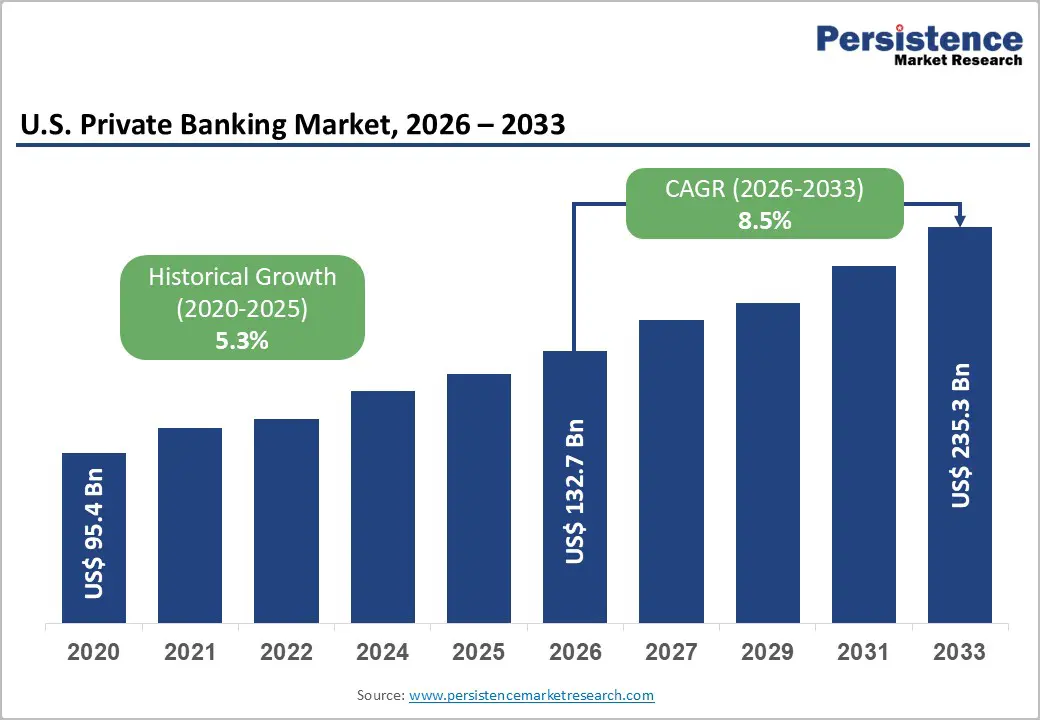
The U.S. Private Banking Market size is projected to rise from US$132.7 billion in 2026 to US$235.3 billion by 2033. It is anticipated to grow at a CAGR of 8.5% from 2026 to 2033.
The market is expanding due to rising wealth accumulation among high-net-worth individuals, increased adoption of digital banking solutions, and expanding demand for customized investment and wealth management services. Favorable regulatory frameworks, coupled with innovation in financial technology platforms, are enabling private banks to offer personalized advisory, trust, and tax planning services, further stimulating market expansion.
Key Industry Highlights:
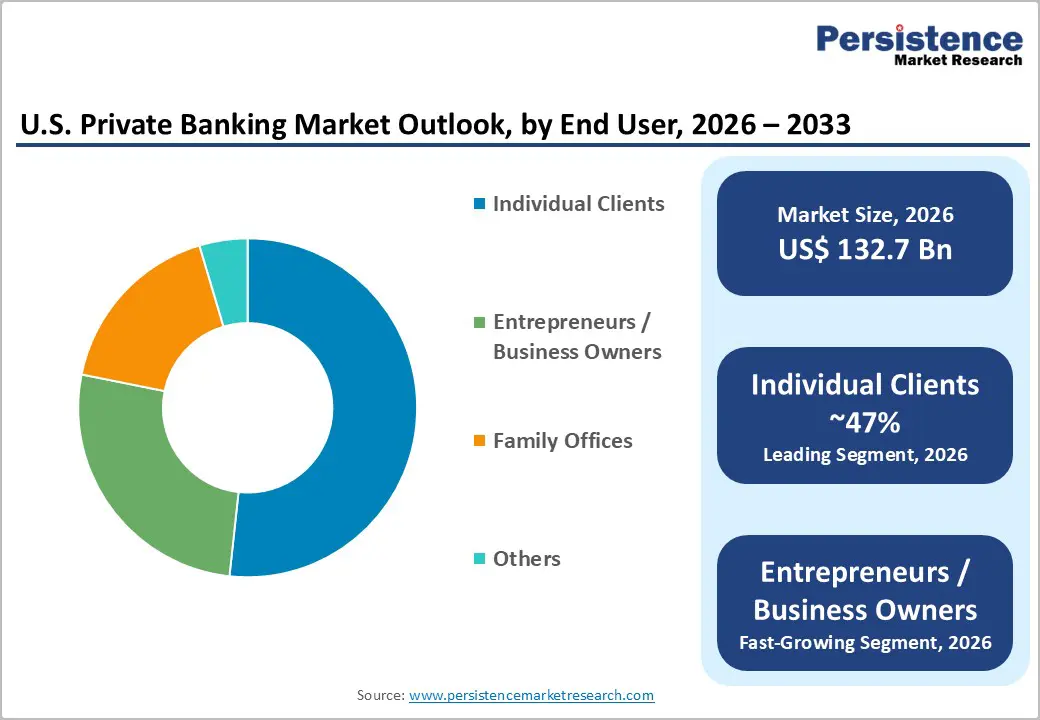
- Leading End User: Individual clients hold the largest share at over 47% in 2026, exceeding US$ 62.4 Bn, as affluent individuals seek customized investment management, estate structuring, and integrated digital advisory solutions. Entrepreneurs/business owners represent the fastest-growing segment, expanding at a CAGR of 12.1%, fueled by liquidity events, startup exits, and the need for integrated personal and business wealth solutions.
- Dominant Offering Type: Investment/asset management captures over 36% market share in 2026, valued at more than US$ 47.8 Bn, driven by rising demand for personalized portfolio strategies, alternative investments, and tax-optimized wealth preservation solutions. Wealth planning, trust & tax advisory services are witnessing strong growth due to increasing intergenerational wealth transfers and evolving tax regulations.
- Growth Indicator: The United States accounts for 34% of global liquid private wealth and 37% of the world’s millionaire population, with over 6 million HNWIs holding investable assets above US$ 1 million, significantly expanding the addressable market for private banks. Rising IPO activity, entrepreneurial wealth creation, and ultra-high-net-worth expansion continue to accelerate growth in assets under management.
- Technology Investment Leadership: Major institutions such as JPMorgan Chase invest nearly US$ 18 billion annually in technology and cybersecurity, supporting close to 20% AUM growth in 2025. AI-driven portfolio analytics, predictive risk management, and hyper-personalized advisory tools are enhancing operational efficiency and long-term client engagement.
| Key Insights | Details |
|---|---|
|
U.S. Private Banking Market Size (2026E) |
US$132.7 Bn |
|
Market Value Forecast (2033F) |
US$235.3 Bn |
|
Projected Growth (CAGR 2026 to 2033) |
8.5% |
|
Historical Market Growth (CAGR 2020 to 2025) |
5.3% |
Market Dynamics
Driver - Rising HNWI Population and Expanding Investable Wealth Base
The rising concentration of high-net-worth individuals (HNWIs) in the United States is a major growth driver for the U.S. private banking market, as affluent clients demand sophisticated wealth preservation and expansion strategies. With over six million HNWIs holding investable assets above USD 1 million, the U.S. accounts for 34% of global liquid private wealth and 37% of the world’s millionaire population, according to the USA Wealth Report 2025. Increasing entrepreneurial success, IPO activity, and liquidity events are further expanding the ultra-high-net-worth segment. This growing wealth base fuels demand for customized portfolio management, estate planning, tax optimization, and alternative investments. As wealth tiers deepen, private banks benefit from higher assets under management and long-term advisory relationships.
Integration of Digital Banking and Fintech Solutions
Digital transformation is reshaping the U.S. market by enabling real-time portfolio monitoring, AI-driven investment recommendations, and secure omnichannel banking platforms. By 2025, more than 60% of private banks in the U.S. had adopted digital advisory platforms, reflecting a structural shift toward technology-enabled service delivery. These digital capabilities enhance client engagement, improve transparency, and significantly optimize operational efficiency while reducing servicing costs. The integration of fintech partnerships and AI-based analytics further enables hyper-personalized credit, lending, and wealth planning solutions, strengthening client retention and acquisition. For instance, Bank of America reported that 55% of its total sales in 2024 were completed through digital channels, underscoring the accelerating shift toward digital-first wealth management models.
Restraint - Stringent Regulatory Compliance
Regulatory oversight from the Financial Industry Regulatory Authority (FINRA), the U.S. Securities and Exchange Commission (SEC), and the Office of the Comptroller of the Currency (OCC) imposes strict compliance, reporting, and risk management requirements on private banks. While these rules enhance transparency and investor protection, they significantly increase operational costs and slow product innovation.
Extensive AML and KYC obligations require heavy investments in monitoring systems and compliance infrastructure, creating entry barriers for smaller institutions. Rulings such as Cantero v. Bank of America by the Supreme Court of the United States expose banks to varying state-level regulations, increasing legal and operational complexity across markets.
Intense Competition from Fintech and Nonbanks
Fintech platforms provide streamlined digital wealth management, AI-driven investment advisory services, and cost-efficient lending solutions, often at more competitive pricing than traditional private banks. Nonbank entities, including boutique investment firms and digital asset managers, are attracting high-net-worth clients through innovative service models, highly personalized digital experiences, and faster execution timelines. This competitive shift pressures conventional banks to accelerate technology investments and modernize legacy infrastructure. The resulting increase in operational and compliance costs constrains profitability.
Opportunity - Expansion into Digital and AI-Enabled Services
The rapid adoption of digital platforms and AI-powered wealth solutions presents a strong growth opportunity. Leading institutions such as JPMorgan Chase are investing nearly $18 billion annually in technology and cybersecurity, supporting close to 20% AUM growth in 2025. AI-driven portfolio management, predictive analytics, and personalized advisory tools enable real-time insights and customized investment strategies for high-net-worth individuals. These technologies enhance operational efficiency, lower cost-to-serve, and improve risk management. As next-generation HNWIs demand seamless, digital-first experiences, banks accelerating AI integration and fintech partnerships are positioned for sustained competitive advantage and long-term growth.
Adoption of ESG and Sustainable Investment Portfolios
Sustainable and responsible investing is gaining significant traction among high-net-worth individuals (HNWIs) and private banking clients. According to a study, in 2024, more than 50% of U.S. private banking clients expressed interest in ESG-aligned investment solutions, reflecting a structural shift in wealth management preferences. This rising demand presents a substantial opportunity for private banks to expand their offerings through specialized ESG funds, green bonds, impact investing vehicles, and socially responsible portfolios. By integrating advanced ESG analytics and sustainability reporting into private banking platforms, institutions enhance portfolio transparency, strengthen client engagement, and differentiate their advisory capabilities. As regulatory focus and generational wealth transfer accelerate sustainability priorities, ESG-driven advisory and asset management services are expected to contribute meaningfully to long-term revenue growth.
Category-wise Analysis
Offering Insights
Investment/asset management is capturing more than 36% market share in 2026 with a value exceeding US$ 47.8 Bn, as high-net-worth individuals seek personalized strategies to grow and preserve their wealth amid volatile markets. Tailored portfolio management, access to alternative investments, and tax-optimized solutions meet the complex financial needs of clients. The demand for estate planning, retirement structuring, and multi-generational wealth transfer services underscores the reliance on private banks for comprehensive investment guidance.
Wealth planning, trust & tax advisory demonstrate significant growth due to rising intergenerational wealth transfers and increasing financial complexity among high-net-worth families. With evolving tax regulations from authorities such as the Internal Revenue Service, clients require proactive estate structuring, trust formation, and tax-efficient investment strategies to preserve capital. Growing cross-border assets and family office structures further increase the need for fiduciary planning and succession management. Aging baby boomers and business owners seeking structured wealth transition solutions are accelerating demand.
End-user Insights
Individual clients hold over 47% market share in 2026, with a value exceeding US$ 62.4 Bn, due to their growing demand for personalized wealth management solutions tailored to complex financial goals. They seek customized investment strategies, tax-efficient planning, and estate services that go beyond traditional banking. Rising affluence and a desire for bespoke advisory support also drive deeper engagement with private banking. Individual clients value integrated digital tools paired with high-touch human guidance to manage multi-asset portfolios effectively.
Entrepreneurs/business owners are expected to grow at the highest rate, with a CAGR of 12.1%, due to their increasing need for integrated personal and business financial management. As founders scale ventures, exit startups, or raise capital, they require sophisticated services such as liquidity management, tax optimization, succession planning, and cross-border wealth structuring. The rise of innovation hubs like Silicon Valley and Austin has created a new generation of high-net-worth founders with complex equity-linked wealth. Entrepreneurs seek customized credit solutions, investment diversification beyond their core businesses, and strategic advisory support to preserve and transfer intergenerational wealth.
Competitive Landscape
The U.S. private banking market is highly consolidated, dominated by major financial institutions offering full-service wealth management solutions. Key players emphasize strategic acquisitions, digital platform development, and niche service offerings to differentiate themselves. Market leaders leverage AI analytics, sustainable investment portfolios, and family office advisory to enhance client retention. Emerging business models include integrated digital banking with automated portfolio management, allowing mid-sized institutions to compete with established banks. The concentration of wealth and client trust in leading institutions maintains a competitive landscape shaped by technology adoption and service innovation.
Key Industry Developments
- In January 2026, BlackRock and Partners Group launched a first-of-its-kind multi-alternatives Separately Managed Account (SMA) solution, offering three outcome-aligned strategies: income, balanced, and growth to simplify access to private markets. Available on the Morgan Stanley wealth platform, the SMAs provide diversified exposure to private equity, private credit, and real assets through seven evergreen funds, helping advisors efficiently scale private market allocations in a single account.
- In September 2025, JPMorgan Chase is overhauling its operations with AI, deploying agentic tools through its LLM Suite platform powered by OpenAI and Anthropic. The system completes complex tasks like creating an investment banking deck in 30 seconds, advancing the bank’s vision of becoming a fully AI-driven enterprise.
Companies Covered in U.S. Private Banking Market
- JPMorgan Chase & Co.
- Morgan Stanley
- Bank of America Corporation
- The Goldman Sachs Group, Inc.
- Citigroup Inc.
- Northern Trust Corporation
- Wells Fargo & Company
- The Charles Schwab Corporation
- Fifth Third Bancorp
- Raymond James Financial, Inc.
- Edward D. Jones & Co., L.P.
- U.S. Bancorp
- Others
Frequently Asked Questions
The U.S. market is projected to be valued at US$132.7 Bn in 2026.
Rising financial complexity, alternative investments, and cross-border assets are the key drivers.
The U.S. private banking market is expected to witness a CAGR of 8.5% from 2026 to 2033.
Expanding AI-driven advisory platforms, customized alternative investment access, and ESG-focused portfolio solutions are creating strong growth opportunities.
JPMorgan Chase & Co., Morgan Stanley, Bank of America Corporation, The Goldman Sachs Group, Inc., Citigroup Inc., Northern Trust Corporation are among the leading key players.


