




- Telecommunications
- Telephony Application Server Market
Telephony Application Server Market Size, Share, and Growth Forecast, 2026 - 2033
Telephony Application Server Market by Component (Software, Services) Deployment Mode (Cloud / On-Premises), Application (Unified Communications (UC), Voice Over Internet Protocol (VoIP), Internet Protocol (IP) Telephony, Cloud Communications, Business Phone Systems, Contact Center Solutions, Misc.), End Use Industry (BFSI (Banking, Financial Services, Insurance), IT & Telecom, Healthcare, Retail & E-Commerce, Manufacturing, Government & Defense, Miscellaneous) and Regional Analysis for 2026 - 2033

Telephony Application Server Market Size and Trends Analysis
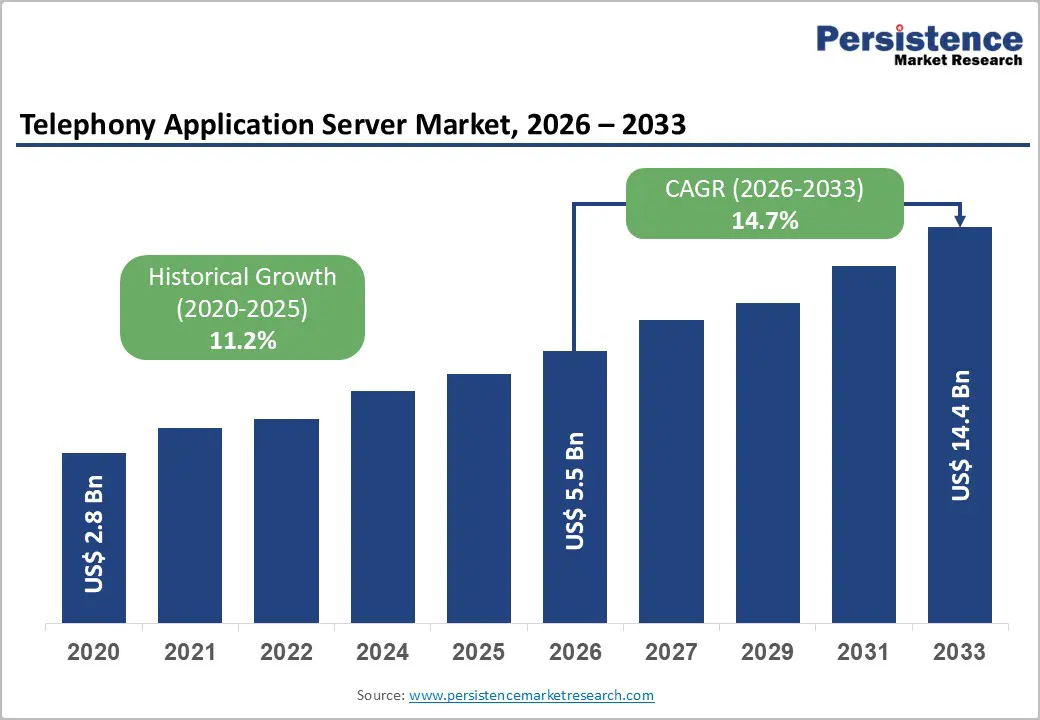
The Global Telephony Application Server Market size was valued at US$ 5.5 billion in 2026 and is projected to reach US$ 14.4 billion by 2033, growing at a CAGR of 14.7% between 2026 and 2033. This expansion reflects structural transformation in enterprise telecommunications infrastructure, driven by accelerating cloud migration, network monetization through API-based services, and integration of artificial intelligence within voice communication platforms.
Telephony application servers function as critical infrastructure enabling unified communications, voice services convergence, contact center modernization, and next-generation telecommunications service delivery across BFSI, healthcare, government, and manufacturing sectors.
Key Industry Highlights:
- Regional Leadership: North America leads the market with 38% share in 2025, driven by advanced cloud adoption, regulatory mandates, and concentration of major telecom operators.
- Fastest-Growing Region: South Asia & Oceania captures 18% share and is the fastest-growing region, fueled by expanding enterprise communications infrastructure and cloud-based telephony adoption in India and neighboring markets.
- Leading End-User Segment: Healthcare dominates with 22% market share, driven by HIPAA-compliant cloud communications, telehealth adoption, and integration with clinical workflows.
- Top Technology Segment: Cloud Communications platforms account for ~40% share in 2025, reflecting the shift from legacy PBX to scalable, multi-tenant cloud telephony solutions.
- Key Growth Driver: Cloud-based unified communications and centralized communication modernization accelerate TAS adoption, enhanced by 5G network monetization via advanced API exposure.
| Key Insights | Details |
|---|---|
|
Telephony Application Server Market Size (2026E) |
US$ 5.5 Bn |
|
Market Value Forecast (2033F) |
US$ 14.4 Bn |
|
Projected Growth (CAGR 2026 to 2033) |
14.7% |
|
Historical Market Growth (CAGR 2020 to 2025) |
11.2% |
Market Dynamics
Growth Drivers
Cloud-Based Unified Communications and Centralized Communications Infrastructure Modernization
Enterprise telecommunications infrastructure has undergone fundamental transition from legacy on-premises PBX systems toward cloud-native unified communications platforms, with the Telephony Application Server Market serving as foundational infrastructure enabling this transformation.
The unified communications and collaboration market is expanding, indicating sustained enterprise capital commitment toward modernized communications architecture. The shift toward cloud-based unified communications accelerates through multiple reinforcing mechanisms: businesses report 82% of cost savings following cloud migration, 94% of companies improve security posture post-migration, and 85% of organizations are adopting cloud-first principles by 2025, creating persistent demand for Telephony Application Server platforms supporting multi-tenant, multi-service cloud environments.
The Telephony Application Server Market benefits from cloud contact center (CCaaS) infrastructure specifically, as organizations consolidate voice communications with omnichannel customer engagement. Regulatory drivers reinforce this transition, with GDPR, HIPAA, and NIS2 security requirements compelling organizations to adopt certified cloud platforms with integrated compliance capabilities, creating certification barriers that establish Telephony Application Server platforms as essential infrastructure within regulated industries.
5G Network Monetization Through Advanced Network APIs and Telecommunications Service Innovation
The global telecommunications industry has allocated over USD 232 billion in cumulative 5G infrastructure investment through 2023, creating incentives to monetize advanced network capabilities through standardized application programming interfaces that expose QoS characteristics, network slicing functionality, and security services to enterprise developers.
The Market experiences demand acceleration from network API monetization services, representing transformational revenue opportunity for telecommunications operators and platform vendors. Security APIs constitute the most prominent 5G monetization opportunity valued at USD 5.3 billion by 2028, enabling enterprises to authenticate employee access and secure customer-facing services through telecom operator infrastructure integration with extended detection and response solutions, identity verification, and KYC automation.
The Telephony Application Server Market's positioning as critical infrastructure for network API exposure, orchestration, and service delivery creates sustained vendor investment in platform capabilities supporting developer-first economics, standardized API frameworks including CAMARA, and advanced monetization models enabling telecommunications service providers to unlock next-generation revenue streams.
Market Restraining Factors
Regulatory Fragmentation and Complex Compliance Requirements Across Jurisdictions
The Telephony Application Server Market faces structural constraint from diverse regulatory requirements spanning data privacy (GDPR, CCPA, California legislation), telecommunications standards, lawful interception mandates, and industry-specific compliance (HIPAA healthcare, PCI-DSS payment card, SOX financial reporting). Different jurisdictions mandate customized Telephony Application Server configurations, creating engineering complexity and restricting vendor economies of scale, while regulatory variations between European Union, United States, India, and China establish distinct product requirements preventing standardized global deployment.
Organizations remain cautious about cloud-based communications adoption despite efficiency gains, with BFSI and healthcare sectors particularly concerned about data theft risks, unauthorized access, and regulatory compliance liability, constraining market growth velocity particularly in regulated industries.
Key Market Opportunities
Telecommunications Service Provider Monetization of Advanced Network Capabilities Through Platform Ecosystems
The Telephony Application Server Market presents substantial monetization opportunity for telecommunications service providers deploying network API exposure platforms, with Ericsson and LotusFlare's December 2025 partnership demonstrating vendor strategy to leverage communication service provider infrastructure for ecosystem-enabled service innovation. Communications service providers are developing sophisticated API marketplaces enabling third-party developers to access quality-of-service characteristics, network slicing capabilities, security services, and edge computing resources, creating new revenue streams supplementing traditional voice service revenue.
The partnership between Ericsson and LotusFlare, utilizing LotusFlare's DNO Cloud platform for Network API Exposure and monetization, exemplifies strategic approach to transform Telephony Application Server platforms into monetization enablers for telecommunications operators. Ericsson's simultaneous partnership with Mobily in February 2025 demonstrated proof-of-concept for quality-of-service APIs on 4G and 5G networks, leveraging Ericsson's Cloud Core Exposure Server and Policy Controller to enable external developers creating advanced telephony and digital services supporting innovation in line with Saudi Arabia's Vision 2030.
The Telephony Application Server Market's expansion into network API monetization creates competitive differentiation opportunities for platform vendors embedding advanced exposure, governance, and monetization capabilities, positioning intelligent Telephony Application Server platforms as essential infrastructure underlying next-generation telecommunications service innovation.
Healthcare Vertical Expansion and Emerging Market Penetration Through Cloud Communications Infrastructure
Healthcare organizations represent the Telephony Application Server Market's fastest-expanding vertical segment, driven by regulatory mandate for HIPAA-compliant communications, mounting pressure to deliver telehealth services normalizing virtual consultations, and integration requirements between clinical workflows and patient communications platforms. Healthcare unified communications market is projected to achieve 10.16% CAGR growth through 2035, driven by expanding virtual care adoption, remote patient monitoring normalization, and clinical collaboration tools integration, creating substantial Telephony Application Server deployment opportunities across hospital systems, physician practices, and health insurance organizations.
The Telephony Application Server Market's expansion into India represents strategic growth vector, driven by Cisco's October 2025 announcement expanding Webex Calling and Webex Contact Center deployment through dedicated data centers in Mumbai and Chennai, enabling enterprise integration with PSTN providers, AI-powered customer interactions, and scalable cloud telephony solutions.
Emerging markets including India, where telecommunications subscriber base reaches 1.21 billion with 86.09% tele-density and internet penetration at 979 million users, create substantial addressable market for cloud-native Telephony Application Server platforms addressing cost-effective service delivery, rapid scalability without infrastructure investment, and advanced feature access historically available only to multinational enterprises.
Category-wise Analysis
Component Type Insights
The software component represents the dominant Telephony Application Server Market segment, capturing 72% of market share in 2026, reflecting enterprise preference for vendor-provided platform functionality, continuous feature enhancement through cloud updates, and consolidated licensing models simplifying procurement.
Telephony Application Server software platforms provide core functionality including call routing, voice processing, multimedia messaging, presence management, and service orchestration, with leading vendors (Ericsson, Nokia, Amdocs, MAVENIR) delivering containerized, microservices-based architectures supporting deployment across public cloud, private cloud, and on-premises environments. The software segment benefits from enterprise recognition that Telephony Application Server platform sophistication encompassing network function virtualization infrastructure integration, policy control, subscriber management, and revenue assurance requires continuous vendor innovation and development investment that perpetual licensing models poorly support.
The services segment represents the fastest-growing Telephony Application Server Market component, encompassing professional services, managed services, and managed automation addressing enterprise implementation, optimization, and operational requirements. Service providers including Ericsson, Nokia, Deloitte, and Accenture expand Telephony Application Server consulting and implementation capabilities addressing cloud migration, network function virtualization transformation, and advanced feature deployment.
End User Insights
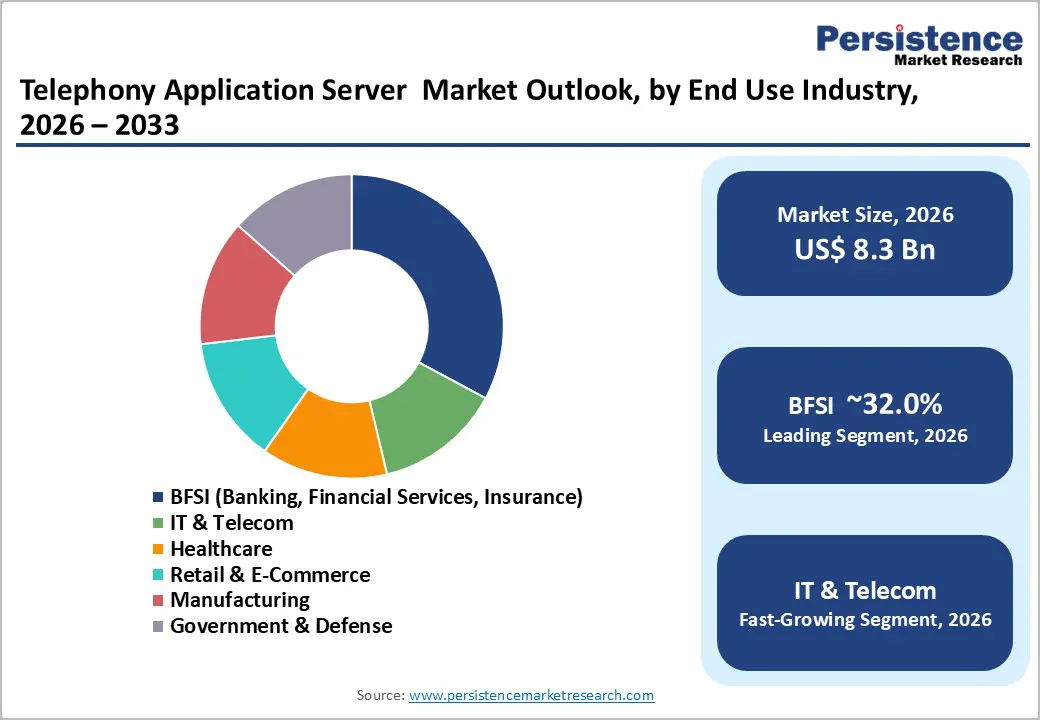
The BFSI sector maintains leadership within the Telephony Application Server Market with 28% market share in 2026, driven by regulatory compliance imperatives, operational complexity of financial services delivery, and persistent need for real-time customer communication. Banks and financial institutions deploy Telephony Application Server platforms to support convergent fixed and mobile voice services, unifying customer contact channels, and enabling sophisticated call routing based on customer value, service complexity, and agent expertise distribution.
The sector's commitment to unified communications adoption remains exceptionally strong, with 30% of BFSI organizations planning UCaaS adoption within the next two years and 25% planning increased investment in cloud communications, supported by recognized cost reduction opportunity of 30% for conferencing tools through integrated UCaaS platforms. Ericsson's April 2020 deployment of multimedia telephony application servers with network functions virtualization infrastructure for Altice Portugal exemplified BFSI applications, enabling convergent fixed and mobile voice service operation while supporting legacy PSTN-equivalent services alongside future multimedia and multi-device telephony applications.
The IT and Telecommunications sector represent the Telephony Application Server Market's fastest-expanding end-use industry, driven by 5G network deployment acceleration, network API monetization requirements, and telecommunications operator modernization imperatives.
Regional Insights and Trends
North America Market Trend
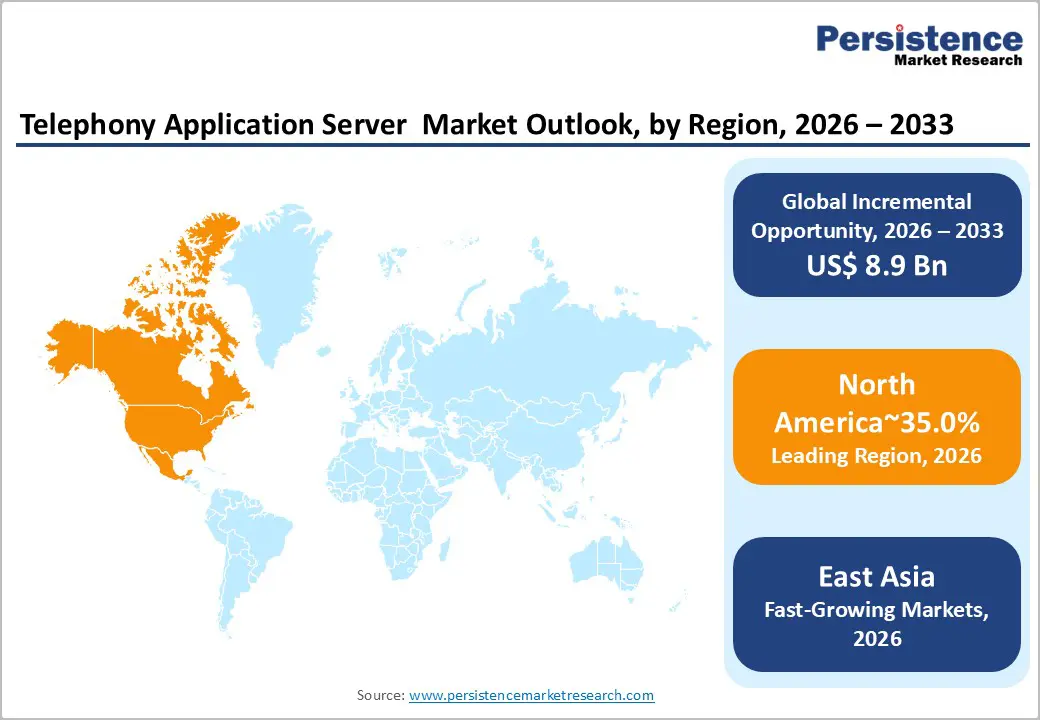
North America maintains 27% of the global Telephony Application Server Market, representing the most advanced telecommunications ecosystem characterized by established cloud infrastructure, sophisticated enterprise IT operations, and aggressive digital transformation investment among financial services, healthcare, and technology sector organizations. The region's unified communications market leadership, driven by large multinational organizations spanning financial services, healthcare, technology, and manufacturing, creates sustained demand for Telephony Application Server platforms supporting global service delivery, regulatory compliance across multi-jurisdictional operations, and advanced feature integration.
Cisco's October 2025 expansion of Webex Calling and contact center services within North America, combined with enhanced AI-powered customer interaction capabilities and PSTN provider integration, exemplifies vendor strategy reinforcing regional market leadership. The region exhibits highest adoption of AI-powered voice analytics, with over 30% of businesses currently deploying AI for call handling and demonstrating average handle time reduction of 60%, establishing North America as primary testing ground for next-generation Telephony Application Server capabilities before global deployment.
East Asia Market Trend
East Asia represents 18% of the global Telephony Application Server Market, with India and China emerging as primary growth drivers from distinct perspectives: India via telecommunications subscriber base acceleration and government policy support, China via internet scale and advanced digital service proliferation.
India's telecommunications sector demonstrates exceptional momentum with subscriber base reaching 1.21 billion and internet users at 979 million, creating persistent demand for Telephony Application Server infrastructure supporting network modernization, mobile-first service delivery, and emerging technology integration. The Indian government's draft National Telecom Policy 2025 emphasizing 5G expansion, 6G research collaboration, and digital inclusion initiatives creates policy environment supporting Telephony Application Server investment throughout telecommunications operators and enterprise customers.
China's digital ecosystem scale with 1.108 billion internet users, 99.7% accessing through mobile devices, and rapid expansion of data-intensive services including live streaming (1B+ users), online gaming, e-government (1.004B users), and generative AI (249M users) drives substantial Telephony Application Server demand for network optimization, service orchestration, and edge computing integration.
Europe Market Trend
Europe commands 25% of the global Telephony Application Server Market, characterized by stringent regulatory environments, mature telecommunications infrastructure, and emphasis on data protection and security standards exceeding global norms. The European Union's information and communication services sector, encompassing 1.4 million enterprises, 7.2 million employees, and generating EUR 667 billion value added, represents substantial Telephony Application Server addressable market driven by digital transformation imperatives and regulatory mandates including GDPR and NIS2 cybersecurity requirements.
European banking sector structure with EUR 43.6 trillion in total assets, 5,304 credit institutions (down 2.9% from prior year), and over 2 million banking sector employees create concentrated demand for Telephony Application Server platforms addressing regulatory compliance, operational efficiency, and customer experience enhancement across large multinational banks and regional specialists. Germany's dominance as contributor of 22.8% of EU sectoral value added and 22.6% of employment establishes the nation as primary Telephony Application Server investment location within the region, supporting vendor presence and customer concentration.
Competitive Landscape
The global Telephony Application Server (TAS) market is consolidated, dominated by a few major players with strong technological capabilities and extensive global presence. Ericsson, Cisco, Avaya, Genesys, Ribbon Communications, and Mitel are the key market leaders, offering solutions across cloud-based TAS, AI-powered contact centers, and multi-device telephony platforms.
These players maintain competitive advantage through continuous innovation, strategic partnerships, and mergers or acquisitions. High entry barriers, including technology expertise, regulatory compliance, and service reliability, favor established companies while limiting new entrants. The market’s consolidated nature allows leading players to influence industry standards, deliver integrated enterprise communication solutions, and cater to high-demand sectors such as BFSI, IT & Telecom, and healthcare. Emerging players focus mainly on niche applications or regional markets, leveraging specialized offerings to compete.
Key Industry Developments
- On February 12, 2025, Ericsson and Mobily successfully completed a proof-of-concept demonstration of Quality-on-Service (QoS) APIs on Mobily’s 4G and 5G networks. The initiative, using Ericsson’s Cloud Core Exposure Server (CCES) and Policy Controller, enables external developers to create advanced telephony and digital services, enhancing user experience and supporting network innovation in line with Saudi Arabia’s Vision 2030.
- On October 1, 2025, Cisco announced the expansion of Webex Calling and Webex Contact Center in India, deploying cloud-based telephony services through dedicated data centers in Mumbai and Chennai. The deployment enables enterprises to integrate with PSTN providers, leverage AI-powered customer interactions, and scale secure, compliant cloud telephony and contact center solutions, enhancing communication quality and operational efficiency.
Companies Covered in Telephony Application Server Market
- Oracle Corporation
- Web Analytics Solutions
- Cisco Systems, Inc.
- Microsoft Corporation
- The Apache Software Foundation
- Red Hat, Inc.
- International Business Machines Corporation
- SAP SE
- Linux Foundation
- Adobe Inc.
- Hewlett Packard Enterprise Company
- Attachmate Group, Inc.
- NEC Corporation
- Bonitasoft S.A.
- CA Technologies
- HostBridge Technology, Inc.
- Nastel Technologies, Inc.
- Compuware Corporation
Frequently Asked Questions
The global Telephony Application Server Market is projected to be valued at US$ 5.5 Bn in 2026.
The BFSI (Banking, Financial Services, Insurance) Segment is expected to account for approximately 28% of the global Telephony Application Server Market by End Use Industry in 2026.
The market is expected to witness a CAGR of 14.7% from 2026 to 2033.
Telephony Application Server Market growth is driven by rapid enterprise migration to cloud-based unified communications and CCaaS platforms, coupled with 5G network monetization through advanced telecom APIs that enable scalable, compliant, and revenue-generating voice and communication services.
Key market opportunities in the Telephony Application Server Market include telecom operator monetization of 4G/5G network capabilities through API exposure platforms and rapid expansion across healthcare and emerging markets via cloud-native, compliant, and scalable communications infrastructure.
The key players in the Telephony Application Server Market include Oracle Corporation, Cisco Systems, Inc., Microsoft Corporation, International Business Machines Corporation (IBM), NEC Corporation, and SAP SE.


