




- Specialty & Fine Chemicals
- Synthetic Menthol Market
Synthetic Menthol Market Size, Share, and Growth Forecast, 2025 - 2032
Synthetic Menthol Market by Product Type (Pharmaceutical Grade, Food Grade), Form (Dry, Liquid), Application (Pharmaceuticals, Oral Care, Tobacco, Food and Beverages, Cosmetics and Personal Care), and Regional Analysis for 2025-2032

Synthetic Menthol Market Size and Trends Analysis
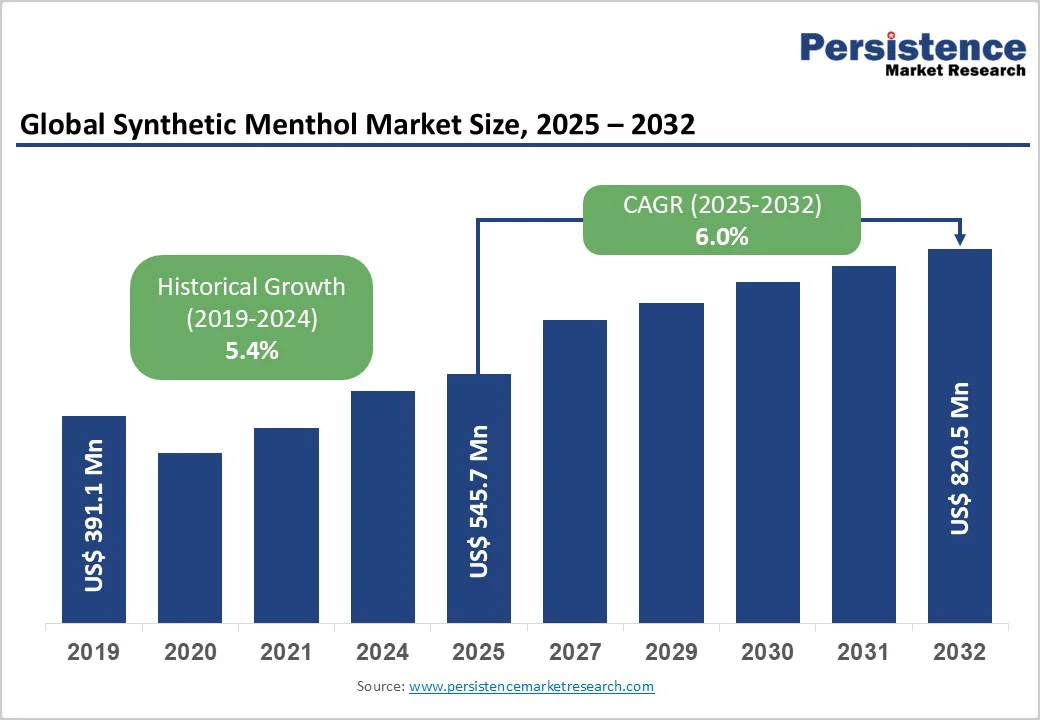
The global synthetic menthol market size is projected to reach US$ 545.7 Mn in 2025, growing to US$ 820.5 Mn by 2032 at a CAGR of 6.0% during the forecast period from 2025 to 2032. The synthetic menthol market is experiencing significant growth, driven by increasing demand for cost-effective, high-purity cooling agents in pharmaceuticals, oral care, and cosmetics. Advancements in synthesis technologies have reduced reliance on natural menthol, ensuring supply chain stability and aligning with eco-friendly production trends. The market's expansion is further supported by consumer preferences for sensory-enhanced products and regulatory emphasis on quality standards, particularly in developed and emerging economies.
Key Industry Highlights:
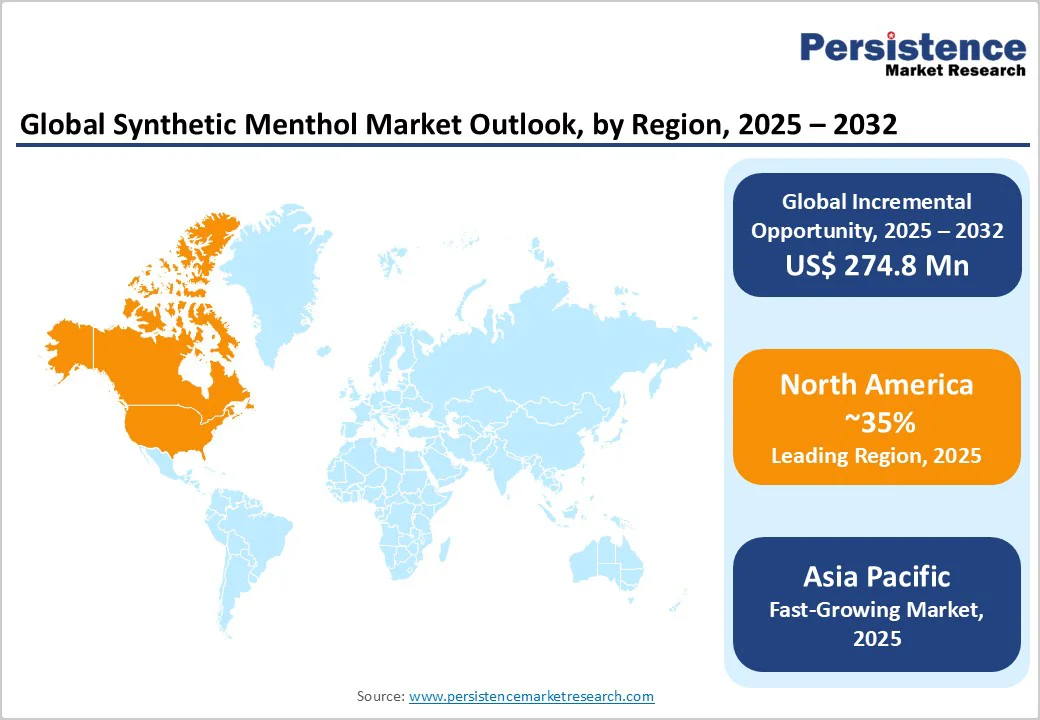
- Leading Region: North America, holding a 35.1% market share in 2025, driven by robust pharmaceutical R&D and advanced chemical infrastructure in the U.S.
- Fastest-growing Region: Asia Pacific, fueled by booming consumer goods sectors and production expansions in China and India.
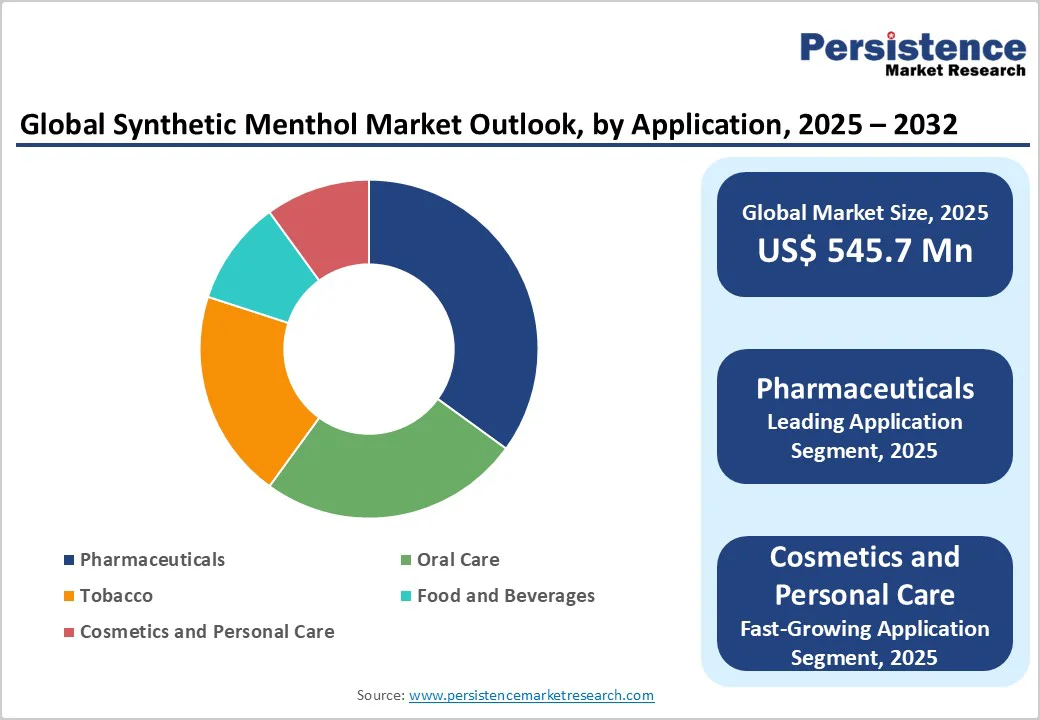
- Dominant Product Type: Pharmaceutical Grade, commanding 71.2% of the market share, due to stringent purity requirements and widespread use in medical formulations.
- Leading Form Segment: Dry, accounting for 60% of market revenue, valued for its stability and ease of integration in tablets and powders.
- Leading Application Segment: Pharmaceuticals, contributing 50% of market revenue, driven by demand for cooling agents in analgesics and oral care.
- Key Market Driver: Global synthetic menthol production reached 25,000 metric tons in 2023, with an 18% YoY increase in pharmaceutical demand.
- Growth Opportunity: Rising adoption in cosmetics, with sensory-enhancing variants boosting consumer appeal by 20% in skincare applications.
|
Key Insights |
Details |
|
Synthetic Menthol Market Size (2025E) |
US$ 545.7 Mn |
|
Market Value Forecast (2032F) |
US$ 820.5 Mn |
|
Projected Growth (CAGR 2025 to 2032) |
6.0% |
|
Historical Market Growth (CAGR 2019 to 2024) |
5.4% |
Market Dynamics
Drivers - Rising Demand for High-Purity and Cost-Effective Synthetic Menthol
The synthetic menthol market is experiencing significant growth, driven by increasing demand for high-purity, cost-effective alternatives to natural menthol. Industries such as pharmaceuticals and consumer goods are major contributors to this trend, as lab-produced menthol provides consistent quality and performance that is difficult to achieve with crop-dependent natural sources. Its exceptional purity not only ensures product effectiveness but also helps reduce production costs and mitigate supply volatility, offering manufacturers a reliable ingredient for large-scale operations. In pharmaceuticals, artificial menthol is widely used as a cooling agent in analgesics, oral care, and respiratory products, enhancing patient comfort and product appeal, which has driven strong adoption across healthcare applications.
Leading companies, including BASF SE and Symrise AG, are employing advanced catalytic processes to optimize production efficiency while minimizing environmental impact, reflecting a growing focus on sustainability in chemical manufacturing. Investments in smart manufacturing facilities further support scalability, enabling companies to meet increasing demand in high-growth regions like North America and Asia Pacific. Collectively, these technological, operational, and sustainability initiatives position lab-produced menthol as a versatile, reliable, and environmentally responsible solution across multiple industrial applications, ensuring long-term market growth and competitiveness.
Restraints - Stringent Regulations and High R&D Costs
The market faces several significant challenges that affect its growth and scalability. Stringent environmental regulations in major markets, including the EU REACH framework and U.S. EPA standards, require manufacturers to adopt advanced emission controls, rigorous purity testing, and sustainable production practices. While necessary for safety and environmental protection, these compliance requirements substantially increase production complexity and operational costs, making it more difficult for smaller players to compete. Certification processes, particularly those involving traceability of waste and raw materials, often lead to delays, further raising operational burdens and slowing time-to-market for new products.
Additionally, supply chain disruptions in sourcing essential raw materials contribute to price volatility, affecting profit margins and operational predictability. These challenges disproportionately impact smaller or newer companies that lack the infrastructure, capital, and economies of scale enjoyed by established players such as BASF SE. Larger firms can absorb higher costs, maintain consistent supply, and invest in technological innovations, further consolidating their market position. While demand for artificial menthol continues to grow across industries, regulatory pressures, high production costs, and supply chain vulnerabilities remain critical hurdles that shape market dynamics and competitive strategies.
Opportunities - Expansion in Cosmetics and Personal Care
The cosmetics and personal care sector represent a major growth avenue for the synthetic menthol market, driven by increasing consumer demand for products that provide cooling, soothing, and refreshing effects. Innovations in formulation technology, such as Symrise AG’s CoolMenthol 10X, have significantly enhanced the sensory experience by improving cooling intensity, making menthol-infused skincare products, balms, and personal care items more appealing to consumers. Alongside these innovations, there is a noticeable shift toward clean-label products, as consumers increasingly prefer ingredients that are perceived as natural, safe, and environmentally friendly. This trend has encouraged manufacturers to focus on high-purity menthol variants and transparent labeling practices, boosting overall market adoption.
Companies are also investing in sustainable production processes, with firms such as Tienyuan Chem leading the way. Such initiatives not only lower formulation costs but also reduce environmental impact, aligning with global sustainability goals. The combination of technological innovation, clean-label preferences, and sustainable production strategies positions the cosmetics and personal care segment for continued growth, particularly in high-demand regions like Asia Pacific and Europe, where consumer awareness and purchasing power support rapid adoption of menthol-based products.
Category-wise Analysis
Product Type Insights
Pharmaceutical-grade dominates the sector with a 71.2% share in 2025, owing to its >99% purity and strict compliance with medical standards. Its high-quality profile ensures significantly lower contamination risks up to 90% making it ideal for drug formulations such as analgesics, respiratory aids, and cough syrups, reinforcing its critical role in pharmaceutical applications.
Food Grade is the fastest-growing segment, driven by a 15% year-on-year increase in beverage and tobacco applications. Rising consumer preference for clean-label and natural-feeling products further fuels demand. Manufacturers are developing high-purity, safe-for-consumption menthol variants, enabling enhanced flavour and cooling effects, while capitalizing on the expanding opportunities in food, beverage, and tobacco industries.
Form Insights
Dry form leads with a 60% market share in 2025. Its stability, ease of storage, and long shelf life make it ideal for large-scale industrial applications, including pharmaceuticals, food, and tobacco products. This form allows precise dosing and consistent performance, reinforcing its preference among manufacturers and sustaining its market leadership.
Liquid form is the fastest-growing, driven by its versatility across cosmetics and pharmaceutical syrups. Its ease of formulation allows seamless incorporation into skincare, personal care, and medicinal products, providing cooling, soothing, and flavor-enhancing effects. This adaptability makes it a preferred choice for manufacturers, fueling rapid market adoption and expansion.
Application Insights
Pharmaceuticals hold a 50% revenue share in 2025, driven by an 18% rise in demand for cooling agents, particularly in analgesics and respiratory products. Menthol’s soothing and cooling properties enhance patient comfort in cough remedies, topical pain relievers, and inhalants. This growing need reflects increasing health awareness and the preference for effective, sensory-enhanced therapeutic formulations.
Cosmetics and Personal Care is the fastest-growing, achieving 22% penetration, particularly in wellness-focused skincare products. Its growth is fueled by rising consumer demand for cooling, soothing, and refreshing formulations, alongside increased awareness of natural and health-oriented ingredients. Manufacturers are innovating high-purity menthol variants to meet these preferences.
Regional Insights
North America Synthetic Menthol Market Trends
North America accounts for a 35.1% market share in 2025, led by the U.S., driven by high demand from pharmaceuticals, personal care, food, and tobacco industries. The United States and Canada are the largest contributors, supported by advanced healthcare infrastructure, robust manufacturing capabilities, and rising consumer awareness of wellness and hygiene products. In pharmaceuticals, menthol is extensively used in cough syrups, analgesics, and topical formulations, while the personal care sector incorporates it in oral care, skincare, and cosmetic products for its cooling and soothing properties. Food and tobacco applications also contribute to growth, with menthol flavoring remaining popular in select segments. Market players focus on innovation, developing high-purity and derivative forms of menthol to meet regulatory standards and evolving consumer preferences. Sustainability and supply chain security are key concerns, prompting investments in green chemistry, energy-efficient production processes, and vertical integration to reduce dependency on volatile raw material imports. Strategic collaborations and acquisitions help companies expand production capabilities and market reach.
Europe Synthetic Menthol Market Trends
Europe holds a 25% market share, led by Germany and the U. K. The region’s market growth is driven primarily by pharmaceutical, cosmetic, and personal care industries, which increasingly demand high-purity menthol for applications such as topical analgesics, cough remedies, oral care, and skincare formulations. Europe emphasizes environmentally responsible production, prompting manufacturers to adopt green chemistry approaches, energy-efficient processes, and sustainable sourcing practices to comply with EU regulations and meet consumer expectations. Germany, France, and the UK are the leading markets, supported by strong pharmaceutical manufacturing infrastructure and research capabilities. Companies operating in the region leverage advanced R&D to innovate new menthol derivatives, optimize yields, and enhance product consistency. Strategic partnerships, acquisitions, and investments in specialized production facilities are common tactics to maintain competitive advantage and secure stable supply chains amid raw material volatility. Consumer trends toward natural and health-oriented products also influence product development strategies.
Asia Pacific Synthetic Menthol Market Trends
Asia Pacific is fastest leading region accounts 30% of the market share and demonstrating robust growth. China and India are the primary growth drivers within the region, leveraging strong industrial capabilities and supportive government policies. In China, pharmaceutical supply deals totaling USD 3.1 Bn highlight the country’s dominant role in supplying high-quality menthol for medical applications, including over-the-counter medications and inhalants. India complements this growth through government-backed initiatives aimed at expanding domestic production capacities, ensuring a stable supply for both local consumption and export markets. Rising health awareness among consumers in the region has further fueled demand, particularly in sectors such as food, beverages, and tobacco, where menthol is widely used for flavoring and cooling effects. This surge in demand has translated into a notable 14% year-on-year growth in these applications.
Competitive Landscape
The global synthetic menthol market is highly consolidated, dominated by a few key players who collectively control around 70% of the market. This concentration allows these companies to leverage technological advancements and strategic expansions to maintain a competitive edge. A major focus within the industry is on research and development aimed at producing high-purity menthol variants, which are increasingly in demand for applications in cosmetics, personal care products, and pharmaceuticals. Companies are also prioritizing sustainability by adopting environmentally friendly production processes, addressing both regulatory requirements and growing consumer awareness. Strategic approaches such as vertical integration and collaborative partnerships enable these players to optimize production efficiency, reduce costs, and secure stable supply chains.
For instance, BASF SE has invested approximately USD 12 Mn in smart synthesis facilities, enhancing production precision and efficiency. Similarly, Tienyuan Chem has allocated USD 300 Mn toward expanding in-house production capacity, improving yield by 15% and mitigating risks associated with raw material price fluctuations. These initiatives collectively reinforce market leadership, ensure consistent product quality, and position companies to capitalize on emerging opportunities in high-growth sectors globally.
Key Developments
- In February 2025, BASF SE announced the commissioning of a new high-purity synthetic menthol production line in Ludwigshafen, Germany, increasing annual capacity by 2,000 tons.
- In December 2024, Symrise AG launched a bio?based synthetic menthol variant produced via fermentation, targeting the clean?label cosmetics and food & beverage segments.
Companies Covered in Synthetic Menthol Market
- BASF SE
- Symrise AG
- Takasago International Corporation
- Tienyuan Chem
- Arora Aromatics
- Swati Menthol & Allied Chem
- Nectar Lifesciences
- Others
Frequently Asked Questions
The global synthetic menthol market is projected to reach US$ 545.7 Mn in 2025, driven by demand for high-purity cooling agents in pharmaceuticals and cosmetics.
Increasing use of menthol in analgesics, cough remedies, oral care, and respiratory aids drives market growth. Its cooling and soothing properties enhance therapeutic formulations and patient comfort, making it a preferred ingredient in medical applications.
The market is expected to grow at a CAGR of 6.0% from 2025 to 2032, following a historical 6.0%, driven by expanding applications.
Demand for cooling, soothing, sensory-enhancing ingredients in skincare, balms, lip care, hair care is rising. Novel formulations (piercing into clean-label, natural or bio-based variants) can capture premium segments.
Leading players include BASF SE, Symrise AG, Takasago International, Tienyuan Chem, Arora Aromatics, Swati Menthol & Allied Chem, and Nectar Lifesciences, holding a 70% market share.


