




- Clothing, Footwear, & Accessories
- Suede Fabric Market
Suede Fabric Market Size, Share, and Growth Forecast 2026 - 2033
Suede Fabric Market by Product Type (Natural (Genuine) Suede, Synthetic (Faux) Suede), by Application (Apparel, Footwear, Automotive Interiors, Furniture & Home Furnishing, Bags & Accessories, Consumer Electronics, Others), and Regional Analysis for 2026 - 2033

Suede Fabric Market Size and Trend Analysis
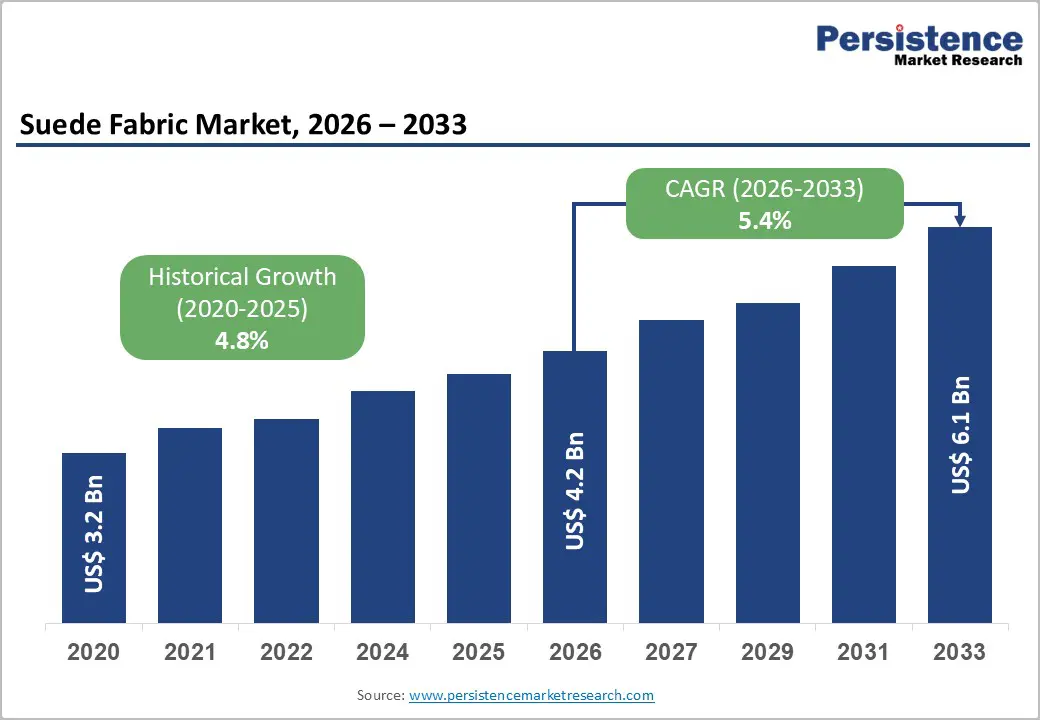
The global suede fabric market size is supposed to be valued at US$ 4.2 billion in 2026 and is projected to reach US$ 6.1 billion by 2033, growing at a CAGR of 5.4% between 2026 and 2033.
The global market is experiencing sustained growth underpinned by three structurally reinforcing demand forces, rising consumer premiumization in apparel and footwear, the accelerating global automotive interior upgrade cycle driving demand for high-quality suede surface materials in luxury and mid-premium vehicle cabins, and the rapid commercial expansion of synthetic (faux) suede technologies that overcome genuine leather's ethical, cost, and durability limitations while replicating its tactile and aesthetic properties with increasing precision.
Key Industry Highlights:
- Leading Region: Europe leads the global Suede Fabric market in premium value and quality benchmark setting, anchored by Hermès and Bally luxury suede procurement, Germany's BMW and Mercedes-Benz automotive interior specification of Alcantara® and CLARINO®, and the European Commission's Green Deal sustainability framework driving certified suede material innovation across the region's luxury fashion and automotive supply chains.
- Fastest Growing Region: Asia Pacific is the fastest-growing region for Suede Fabric consumption and manufacturing, driven by China's Zhejiang synthetic suede production cluster, Toray and Kuraray's Japanese premium synthetic suede leadership, OICA's documented Asian automotive production expansion, and India's Council for Leather Exports (CLE)-documented genuine suede export growth serving global luxury brand supply chains.
- Dominant Product Type: Synthetic (Faux) Suede dominates the Product Type segment with approximately 63% revenue share, anchored by Toray Ultrasuede® and Kuraray CLARINO® automotive OEM specification approvals, Chinese manufacturer cost-competitive synthetic suede volume production for global fashion and furniture supply chains, and the European Commission's animal welfare and sustainability regulatory trajectory constraining natural suede's addressable market.
- Growing Application: Footwear is the dominant and largest Application segment with approximately 34% revenue share, driven by APICCAPS' World Footwear Yearbook documenting over 22 billion pairs annually produced globally, Hermès and Bally's luxury suede footwear collections, mass-market synthetic suede fashion sneaker adoption, and consistent premium footwear procurement sustaining above-average suede fabric demand growth.
- Key Market Opportunity: Sustainable bio-based and recycled synthetic suede development is the key market opportunity, with Toray's February 2025 bio-based Ultrasuede® expansion, European Commission ESPR Digital Product Passport mandates, Alcantara's certified carbon-neutral status, and SBTi net-zero corporate commitments by automotive OEMs and fashion brands collectively driving premium sustainable synthetic suede procurement growth through 2033.
| Key Insights | Details |
|---|---|
| Suede Fabric Market Size (2026E) | US$ 4.2 Billion |
| Market Value Forecast (2033F) | US$ 6.1 Billion |
| Projected Growth CAGR (2026 - 2033) | 5.4% |
| Historical Market Growth (2020 - 2025) | 4.8% |
DRO Analysis
Drivers - Luxury Fashion and Premium Footwear Industry Growth Driving Sustained Suede Fabric Demand Across Apparel and Accessories
The rising global luxury fashion and premium footwear industries, estimated at approximately €400 billion in 2026 with steady volume and value growth across leather goods, footwear, and apparel categories, represent the most commercially significant and margin-rich demand segment for both natural genuine suede and premium synthetic suede fabric supply. Suede fabric's distinctive soft napped texture, sophisticated visual finish, and premium material positioning sustain its status as a preferred surface material in luxury and near-luxury footwear, handbags, apparel, and accessories by global luxury houses including Hermès and Bally, brands whose continued product line expansion across suede-finished goods sustains premium procurement volumes from tannery and synthetic suede suppliers.
The Leather Working Group (LWG), an industry association certifying responsible leather sourcing and environmental compliance across global tanneries, documents steady leather and suede production capacity across certified European and South Asian tanneries serving the luxury fashion supply chain, underpinning the authentic suede fabric's sustained commercial relevance even as synthetic alternatives expand their market share through the forecast period.
Automotive Interior Premiumization and EV Cabin Upgrade Cycle Sustaining Above-Average Synthetic Suede Procurement Growth
The global automotive industry's accelerating interior premiumization trend, driven by consumer demand for luxury-comparable cabin materials across mid-premium and near-luxury vehicle segments and the electric vehicle industry's cabin-centric product differentiation strategy, is generating structurally above-average synthetic suede fabric procurement growth as automotive OEMs and Tier-1 interior suppliers adopt high-quality microfiber synthetic suede as a standard or optional interior surface material for instrument panels, door trims, headliners, seat bolsters, and steering wheel wraps.
Kuraray Co., Ltd.'s CLARINO® synthetic suede, originally engineered for automotive interior applications, and Toray Industries' Alcantara®-equivalent Ultrasuede® variants are specification-approved synthetic suede materials at major European, Japanese, and North American automotive OEMs including BMW, Mercedes-Benz, Volkswagen, and Toyota, where synthetic suede delivers authentic suede aesthetics combined with superior abrasion resistance, UV stability, and cleanability specifications required by automotive interior quality standards.
The International Organization of Motor Vehicle Manufacturers (OICA) documents global vehicle production exceeding 85 million units annually, with the premium and near-premium vehicle segments where suede interior specification is most prevalent representing a growing proportion of total production as consumer preferences across key Asian and European markets migrate toward higher-content interior specifications.
Restraints - Ethical and Sustainability Scrutiny of Natural Animal-Derived Suede Constraining Genuine Suede Demand Growth
The global fashion and consumer goods industry's escalating ethical accountability standards, with the European Commission's Strategy for Sustainable and Circular Textiles under the European Green Deal mandating extended producer responsibility, digital product passports, and supply chain transparency for textile and leather goods sold in EU markets, is generating a progressive institutional and consumer reputational risk environment for natural animal-derived genuine suede products.
Animal rights advocacy organizations and vegan consumer segments are accelerating the fashion industry's transition away from genuine leather and suede toward certified animal-free materials, creating a structural demand substitution pressure that constrains natural suede fabric volume growth in consumer-facing premium apparel and accessory markets, particularly across the EU, UK, and U.S. markets where ethical sourcing scrutiny is most intense and commercially impactful on premium brand procurement decisions.
High Production Cost and Limited Scalability of Premium Natural Suede Processing Constraining Price Competitiveness
Premium natural suede production, involving the skiving, buffing, and finishing of full-grain or split leather hides through multi-stage tannery processes, generates significant raw material, water, chemical, and energy input costs that result in natural suede fabric price points substantially above mass-market textile alternatives.
The Food and Agriculture Organization of the United Nations (FAO) documents that global cattle hide and sheepskin raw material availability is subject to livestock production cycle fluctuations that create input cost volatility for natural suede tanneries, with Pittards and Hermann Oak Leather Co. operating in a natural suede segment where input cost management and premium brand positioning are critical to maintaining commercial viability against the growing cost-performance competitiveness of synthetic microfiber suede alternatives.
Opportunities - Sustainable and Recycled Synthetic Suede Development Aligned with EU Green Deal and Global Brand ESG Commitments
The global fashion and automotive industries' accelerating commitments to circular economy principles, reduced animal product dependency, and verified environmental sustainability credentials, driven by the European Commission's Sustainable Products Regulation (ESPR), the UN Environment Programme (UNEP)'s Fashion Industry Charter for Climate Action, and corporate Science Based Targets initiative (SBTi) net-zero commitments adopted by major apparel, footwear, and automotive OEM brands, are creating a structurally growing commercial opportunity for synthetic suede fabric manufacturers investing in next-generation bio-based polyester, recycled PET microfiber, and biodegradable synthetic suede technologies that deliver premium suede aesthetics with certified low-carbon and circular material credentials.
Toray Industries has commercially launched bio-based variants of its Ultrasuede® product family, incorporating plant-derived polyester components, directly targeting sustainability-mandating brand procurement specifications from fashion houses and automotive OEMs accelerating their material sustainability transitions. The European Commission's Digital Product Passport (DPP) mandate under ESPR requiring material origin and recyclability transparency for textiles sold in EU markets is a further institutional catalyst that will accelerate brand demand for certified sustainable synthetic suede materials with documented low environmental impact profiles, creating a premium pricing and market differentiation opportunity for synthetic suede manufacturers with credibly certified sustainability platforms.
Consumer Electronics and Furniture Segments Emerging as Fast-Growing Non-Traditional Suede Fabric Application Categories
Beyond the traditional apparel, footwear, and automotive suede fabric applications, the consumer electronics accessories and premium furniture sectors are emerging as commercially meaningful and above-average-growth application categories generating new synthetic suede fabric demand from product designers and manufacturers seeking premium tactile finishes for device cases, laptop covers, wireless speaker enclosures, and earphone cushions, as well as luxury furniture upholstery and decorative accent applications where synthetic suede delivers premium visual and tactile quality at price points accessible to mid-market furniture manufacturers.
The Consumer Technology Association (CTA) documents global consumer electronics accessories market growth sustained by continued device ecosystem expansion, with premium device protection and carrying accessories representing a fast-growing synthetic suede fabric application where Toray's Ultrasuede® and microfiber synthetic suede fabrics from Chinese manufacturers including Haining Hongou Textile Co., Ltd. serve global accessories brand supply chains. The European Furniture Industries Confederation (EFIC) documents continued growth in European premium furniture production, with suede-finish upholstery fabrics from Flokser Group and Zhejiang-based Chinese synthetic suede producers serving European furniture upholstery specification growth.
Category-wise Analysis
By Product Type Insights
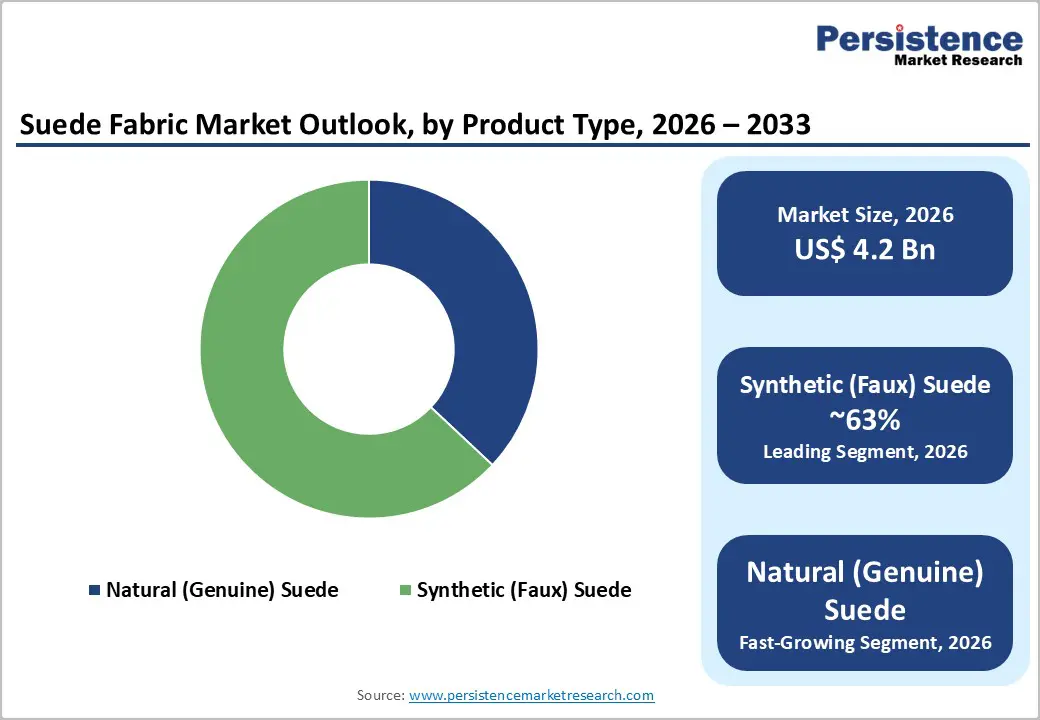
Synthetic (Faux) Suede leads the global Suede Fabric market by product type, commanding approximately 63% of total product type segment revenue in 2026, a dominant and further-expanding position reflecting synthetic suede's decisive competitive advantages over natural genuine suede across the full spectrum of performance, cost, scalability, and sustainability parameters that determine commercial material specification decisions by automotive OEMs, fashion brands, footwear manufacturers, and furniture producers globally. Synthetic microfiber suede, engineered through advanced island-in-sea (IIS) and split microfiber manufacturing technologies perfected by Toray Industries (Ultrasuede®) and Kuraray Co., Ltd. (CLARINO®), delivers abrasion resistance, color fastness, and UV stability performance specifications that natural genuine suede cannot match in demanding automotive and outdoor-exposed applications.
The Leather Working Group (LWG)'s ongoing tannery certification program documents that certified natural suede production capacity remains constrained by raw material availability and water treatment compliance costs, further reinforcing synthetic suede's structural commercial advantage. Natural (Genuine) Suede retains approximately 37% of product type revenue, concentrated in the ultra-premium luxury goods, bespoke footwear, and high-fashion apparel segments where genuine leather provenance and heritage craftsmanship are core brand equity components that justify the natural suede material's premium price point and supply chain complexity.
By Application Insights
Footwear leads the global Suede Fabric market by application, commanding approximately 34% of total application segment revenue in 2026, a dominant position reflecting footwear's status as the single most volume-intensive and commercially diverse end-use application for both genuine and synthetic suede fabric globally, spanning luxury fashion footwear by Hermès, Bally, and Anello & Davide (headquartered in London, UK) through to mass-market fashion sneakers, casual shoes, and boots incorporating synthetic microfiber suede uppers at accessible price points. The World Footwear Yearbook published by APICCAPS (Portuguese Footwear, Components, Leather Goods and Tanning Industries Association) documents global footwear production exceeding 22 billion pairs annually, with the premium and near-premium footwear segments where suede specification is most prevalent representing a consistent and growing material demand base.
Apparel holds the second-largest application share at approximately 22%, driven by seasonal fashion collections featuring suede jackets, skirts, and accessories from luxury and high-street fashion brands. Automotive Interiors hold approximately 18%, with above-average revenue growth driven by Kuraray CLARINO® and Toray Ultrasuede® specification adoption across European and Japanese premium automotive OEM interior programs for instrument panels, headliners, and seat trim applications.
Regional Insights
North America Suede Fabric Trends and Insights
The United States leads North American Suede Fabric market demand, anchored by the country's substantial premium footwear, luxury accessories, and automotive interior consumption base, complemented by the U.S. fashion industry's strong heritage in suede-finish apparel and accessories that sustains consistent genuine and synthetic suede fabric procurement. Hermann Oak Leather Co. serves North American genuine leather and suede supply to premium footwear and accessories brands, while synthetic suede imports from Toray and Kuraray Japanese-origin materials serve the premium automotive and fashion applications. The U.S. Consumer Product Safety Commission (CPSC) and Environmental Protection Agency (EPA) chemical compliance standards for textile materials shape North American synthetic suede product formulation requirements from Asian and European suppliers.
The U.S. textile and apparel industry documented by the National Council of Textile Organizations (NCTO) sustains domestic demand for both genuine and synthetic suede finishing in premium product categories, with sustainability-conscious American fashion brands and automotive OEMs including Ford, General Motors, and Stellantis increasingly specifying certified recycled or bio-based synthetic suede interior materials for their premium North American vehicle programs. Canada's growing premium footwear retail and automotive premium segment sustain secondary but consistent North American suede fabric demand complementing U.S. market leadership.
Europe Suede Fabric Trends and Insights
Europe is the global benchmark for premium suede fabric quality and sustainable production standards, anchored by the concentration of the world's most influential luxury fashion houses and premium leather goods brands in France, Italy, UK, and Spain that specify the highest-quality genuine and synthetic suede materials across their product lines, combined with the European Commission's Green Deal textile sustainability regulatory framework that is actively reshaping suede fabric sourcing and production standards across the European fashion and automotive supply chain. Hermès and Bally source premium genuine suede from Leather Working Group (LWG)-certified European tanneries, with Italy's Solofra and Arzignano tanning districts representing the global center of luxury genuine suede production.
Germany's premium automotive OEM cluster, including BMW, Mercedes-Benz, and Volkswagen Group, represents Europe's largest institutional synthetic suede procurement segment, with Kuraray CLARINO® and Alcantara S.p.A. (headquartered in Milan, Italy), whose Alcantara® branded synthetic suede is the premium benchmark material for European luxury automotive interior applications, serving the German OEM interior materials specification programs. The European Union's REACH Regulation and the European Green Deal's Strategy for Sustainable and Circular Textiles are creating above-average institutional pressure for European synthetic suede manufacturers to certify recycled and bio-based content credentials, generating a regulatory-driven product innovation mandate that Flokser Group and European synthetic suede distributors are actively responding to through certified sustainable material portfolio development.
Asia Pacific Suede Fabric Trends
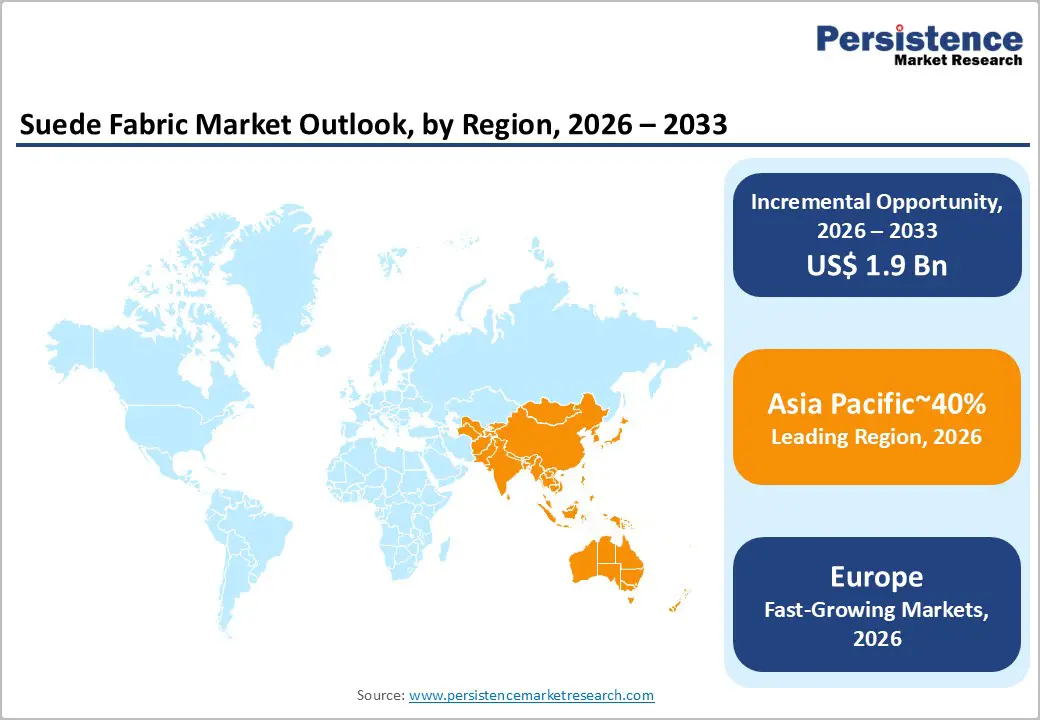
Asia Pacific is the dominant global Suede Fabric manufacturing geography anchored by China's position as the world's largest textile and synthetic fabric manufacturing economy, Japan's role as the global center of premium synthetic suede technology innovation through Toray Industries and Kuraray Co., Ltd., and India's growing leather tanning and genuine suede production base serving both domestic and export markets. China's Zhejiang and Shandong provinces host the world's highest concentration of synthetic microfiber suede manufacturers, including Zhejiang Jiersheng Textile Technology Co., Ltd., Haining Hongou Textile Co., Ltd., and Shanghai Jason Textile Co., Ltd., that serve global fast-fashion, furniture, and consumer electronics accessories supply chains with cost-competitive synthetic suede fabrics.
Japan's Toray Industries, with FY2023 revenues of approximately ¥2.6 trillion (approximately US$ 17 billion), maintains its position as the global premium synthetic suede technology leader through its Ultrasuede® product family, supplying automotive OEMs, luxury fashion brands, and consumer electronics accessories globally. India's Council for Leather Exports (CLE), a Government of India body under the Ministry of Commerce and Industry, documents India as one of the world's largest genuine leather and suede producing and exporting countries, with Indian tanneries supplying suede to European and global fashion brands from Kanpur, Chennai, and Kolkata tanning clusters. Shandong Ruyi Technology Group Co., Ltd., one of China's largest textile conglomerates, represents the commercial scale and vertical integration capability of China's synthetic textile and suede fabric manufacturing ecosystem serving global OEM supply chains.
Competitive Landscape
The global Suede Fabric market is moderately fragmented, with Toray Industries and Kuraray Co., Ltd. commanding premium synthetic suede brand leadership through internationally recognized and OEM-qualified Ultrasuede® and CLARINO® product platforms. Alcantara S.p.A. maintains exclusive premium automotive and luxury goods positioning. Pittards and Hermann Oak Leather Co. lead genuine suede in premium Western markets. Chinese manufacturers, Haining Hongou, Zhejiang Jiersheng, and Suzhou Disheng, dominate volume mid-market synthetic suede procurement.
Key differentiators include certified sustainability credentials, automotive OEM specification approvals, bio-based content certifications, and luxury brand supply heritage. Emerging business model trends include direct-to-brand sustainable material development partnerships, digital material sampling platforms, and blockchain-enabled supply chain provenance documentation for LWG-certified genuine suede.
Key Developments:
- In February 2025, Toray Industries, Inc. expanded its bio-based Ultrasuede® product line, incorporating increased plant-derived polyester content, targeting EU fashion and automotive OEM customers accelerating sustainable material procurement under European Green Deal textile sustainability compliance programs and corporate net-zero commitments.
- In October 2024, Kuraray Co., Ltd. announced expanded CLARINO® synthetic suede production capacity at its Japanese manufacturing facilities, targeting growing automotive interior specification demand from Toyota, Honda, and European premium OEM programs requiring certified high-durability synthetic suede for next-generation EV interior trim applications.
- In March 2023, Alcantara S.p.A. certified its Alcantara® synthetic suede fabric as carbon neutral under verified international carbon accounting standards, becoming the first premium automotive interior suede material brand to achieve certified carbon neutrality, directly targeting BMW, Ferrari, and Lamborghini sustainability-committed interior specification programs.
Companies Covered in Suede Fabric Market
- Toray Industries, Inc.
- Teijin Limited
- Kuraray Co., Ltd.
- Pittards
- Hermès
- Bally
- Shandong Ruyi Technology Group Co., Ltd.
- Zhejiang Jiersheng Textile Technology Co., Ltd.
- Haining Hongou Textile Co., Ltd.
- Rhodia Acetow GmbH
- Flokser Group
- Hermann Oak Leather Co.
- Shanghai Jason Textile Co., Ltd.
- Anello & Davide
- Suzhou Disheng Weaving & Finishing Co., Ltd.
Frequently Asked Questions
The global Suede Fabric market is estimated to be valued at US$ 4.2 Billion in 2026 and is projected to reach US$ 6.1 Billion by 2033, registering a forecast CAGR of 5.4% from 2026 to 2033. The market recorded a historical CAGR of 4.8% between 2020 and 2025, driven by luxury fashion industry premium material demand documented through Bain & Company's global personal luxury goods market analysis, estimated at approximately €362 billion in 2023, and OICA's documented global vehicle production exceeding 85 million units annually sustaining automotive interior synthetic suede procurement.
The primary drivers are the global luxury fashion and premium footwear industry's sustained suede material procurement, with Bain & Company's personal luxury goods data confirming the €362 billion luxury market sustaining genuine and premium synthetic suede demand, and the automotive interior premiumization cycle where OICA's global 85 million unit annual production base and Kuraray CLARINO® and Toray Ultrasuede® OEM specification approvals at BMW, Mercedes-Benz, and Toyota collectively drive above-average synthetic suede procurement growth through the 2026-2033 forecast period.
Synthetic (Faux) Suede leads the Product Type segment with approximately 63% revenue share in 2026, anchored by Toray Industries' Ultrasuede® and Kuraray Co., Ltd.'s CLARINO® premium synthetic suede technology leadership, Alcantara S.p.A.'s certified carbon-neutral automotive interior specification dominance, Chinese manufacturers' cost-competitive volume synthetic suede production for global fashion supply chains, and the European Commission's Green Deal sustainability trajectory progressively constraining natural animal-derived suede's addressable market through regulatory and brand specification pressure.
Europe leads the global Suede Fabric market in premium value, anchored by Hermès (Paris, France) and Bally (Caslano, Switzerland) luxury suede procurement, Alcantara S.p.A.'s Milan-headquartered premium automotive suede supply to BMW, Ferrari, and Lamborghini, Leather Working Group (LWG)-certified Italian and UK genuine suede tannery production, and the European Commission's Sustainable Textile Strategy driving certified sustainable suede material investment that positions Europe as both the highest-value and most innovation-active global Suede Fabric regional market.
The most significant opportunity is sustainable bio-based and recycled synthetic suede development, with Toray's February 2025 bio-based Ultrasuede® product expansion, Alcantara's certified carbon-neutral synthetic suede, European Commission ESPR Digital Product Passport textile mandates, Science Based Targets initiative (SBTi) corporate net-zero commitments by automotive OEMs and fashion brands, and growing consumer demand for certified animal-free premium materials collectively creating above-CAGR revenue growth for sustainably certified synthetic suede fabric manufacturers through 2033.
The leading companies include Toray Industries, Inc. (Tokyo, Japan; Ultrasuede®), Kuraray Co., Ltd. (Tokyo, Japan; CLARINO®), Alcantara S.p.A. (Milan, Italy; Alcantara®), Pittards (Yeovil, UK), Hermann Oak Leather Co. (St. Louis, Missouri, USA), Hermès (Paris, France), Bally (Caslano, Switzerland), Teijin Limited (Tokyo, Japan), and others.


