




- Technology
- Subscriber Data Management Market
Subscriber Data Management Market Size, Share, and Growth Forecast, 2026 - 2033
Subscriber Data Management Market by Solution (Policy Management, Subscriber Data Federation, Identity Management, User Data Repository), Network Type (Mobile Networks, Fixed Networks), Application (Mobile, FMC, Others), and Regional Analysis for 2026 - 2033

Subscriber Data Management Market Size and Trends Analysis
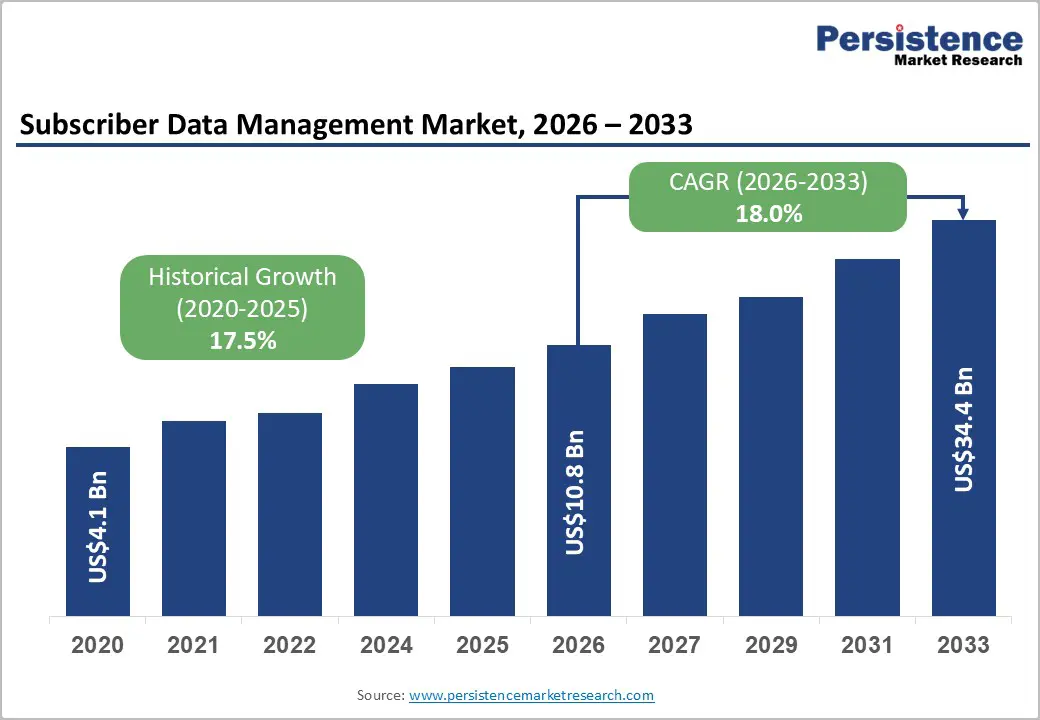
The global subscriber data management market size is likely to be valued at US$10.8 billion in 2026, and is expected to reach US$34.4 billion by 2033, growing at a CAGR of 18.0% during the forecast period from 2026 to 2033, driven by the explosive growth of 5G subscriptions, the proliferation of IoT-connected devices exceeding 18 billion globally in 2026, the migration of telecom operators to cloud-native and containerized core network architectures, and tightening regulatory frameworks including GDPR, the EU Data Act of 2024, and national data sovereignty mandates.
Key Industry Highlights:
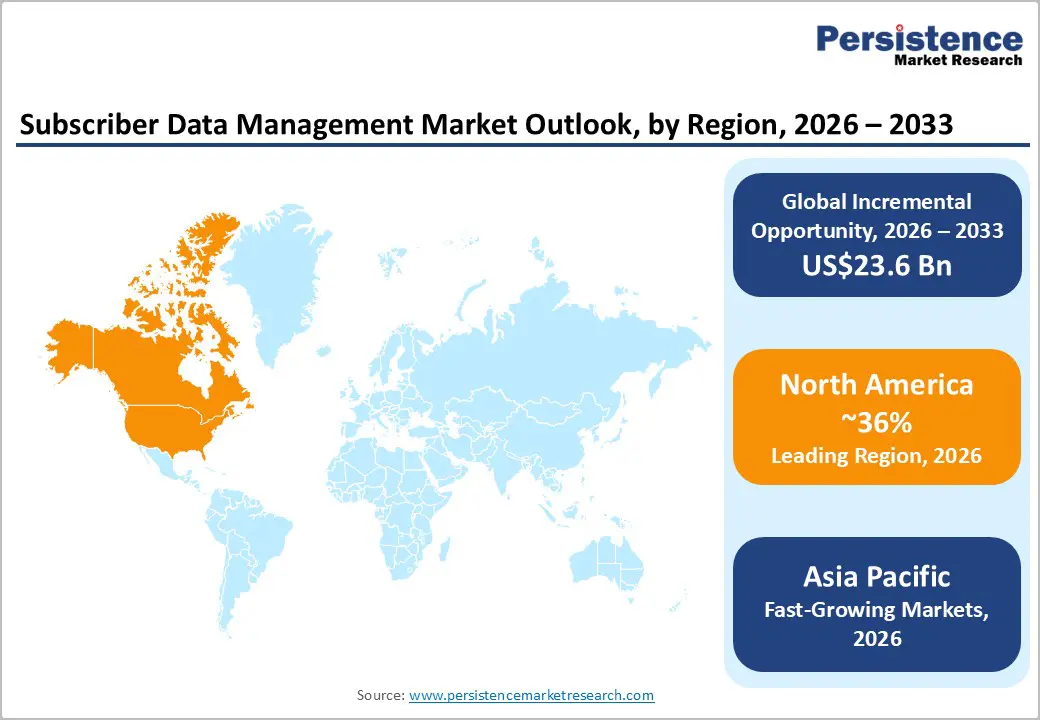
- Dominant Region: North America is expected to dominate the subscriber data management market, capturing ~36% share in 2026, driven by early 5G deployment, cloud-native core adoption, and high mobile and OTT usage, generating large-scale real-time subscriber data.
- Fastest-growing Region: Asia Pacific is the fastest-growing region, driven by rapid 4G/5G expansion, surging mobile and IoT users, and strong investments in cloud-native SDM for network slicing, personalization, and data sovereignty.
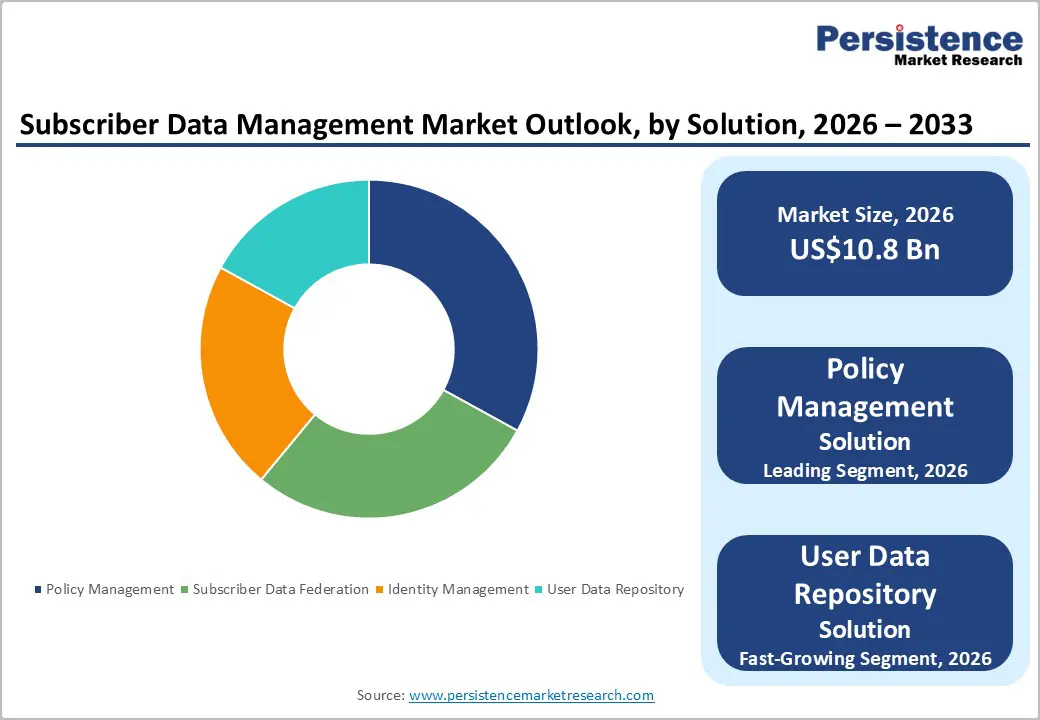
- Leading Product Type: The policy management is expected to dominate, by solution with a revenue share of approximately 33% in 2026, driven by the widespread deployment of 5G core networks and the critical need for dynamic, real-time policy control and QoS enforcement across multi-slice network environments.
- Dominant Network Type: Mobile networks are anticipated to be the dominant network type, accounting for over 62% of market revenue in 2026, driven by the rapid global deployment of 5G standalone (SA) cores, which surpassed 1.6 billion subscriptions globally by end-2024, requiring advanced real-time subscriber data orchestration.
DRO Analysis
Driver - Global 5G Rollout and Rising Mobile Subscriber Demand
The rapid global rollout of 5G networks remains a primary structural driver of market growth. Commercial 5G standalone cores have been deployed across more than fifty countries, with large-scale national implementations generating substantial volumes of subscriber and IoT data that traditional HSS-based architectures struggle to manage efficiently. According to the GSMA, 5G connections are expected to account for a significant share of global mobile subscriptions, with the number of unique users continuing to rise over the coming decade.
The 5G service-based architecture (SBA) mandates cloud-native, scalable subscriber data functions that legacy HSS systems cannot deliver, forcing operators to replace or augment legacy infrastructure with modern SDM platforms. This shift is closely aligned with broader mobile-core investments, as operators increasingly recognize that a robust subscriber data layer is essential to enabling network slicing, enterprise-SLA enforcement, and advanced service monetization strategies.
Restraint - Data Security, Sovereignty, Complexity, and Vendor Lock-In Risks
Growing regulatory complexity around subscriber data sovereignty presents a meaningful operational and financial barrier for telecom operators deploying modern SDM solutions. The EU Data Act and heightened GDPR-style requirements compel operators to redesign architectures so that sensitive subscriber attributes remain within national or regional boundaries, even as roaming and cross-network services operate globally.
For operators with multi-jurisdiction footprints, this leads to substantial investments in compliant, geographically distributed SDM architectures and stricter data-governance processes. Vendor lock-in concerns with proprietary SDM platforms add strategic risk, as switching suppliers involves complex data migration, rigorous revalidation and potential service disruptions that can slow both innovation and competitive dynamics in the SDM ecosystem.
Opportunity - AI-Driven Subscriber Analytics and VoIP/Video over IP Service Expansion
The integration of artificial intelligence and machine learning into SDM platforms is creating a powerful incremental revenue opportunity for market participants through deeper subscriber profiling, predictive churn prevention, and real-time service personalization. AI-driven analytics enhance the precision of subscriber segmentation and behavior modeling, while automated policy engines reduce manual intervention and strengthen quality-of-service enforcement across multi-slice 5G networks.
Leading technology and infrastructure providers have deployed AI-enhanced SDM capabilities that are now being adopted by major Tier-1 operators to optimize monetization and customer retention. Separately, the Voice over IP (VoIP) and Video over IP application segment is emerging as one of the fastest-growing use cases, driven by the global shift to cloud-based communications, remote work, and enterprise unified communications platforms. This trend is driving demand for SDM systems that can manage IP-based service identities, securely authenticate users, and enforce real-time quality-of-service policies at scale.
Category-wise Analysis
Solution Insights
The policy management segment is expected to dominate, accounting for 33% of revenue in 2026. It leads as policy engines sit at the core of 5G service control, enabling real-time QoS enforcement, slice management, and subscriber-centric service orchestration across mobile and IP networks. Ericsson’s policy management framework within its 5G Core SDM platform enables mobile operators to enforce real-time QoS, manage network slicing, and orchestrate subscriber-centric services, highlighting its critical role in next-generation telecom networks.
The user data repository (UDR) represents the fastest-growing, driven by the rising demand for centralized, cloud-native data platforms that provide unified, horizontally scalable storage for subscriber profiles, authentication credentials, policy rules, and service entitlements across both 4G and 5G network environments. Telefonaktiebolaget LM Ericsson’s Cloud Native UDR enables operators to centrally store and manage subscriber profiles, authentication credentials, and policy data across 4G and 5G networks, reflecting the rapid growth of centralized, cloud-native subscriber data platforms.
Network Type Insights
Mobile networks are expected to dominate, accounting for over 62% of the market share in 2026. This dominance is driven by mobile operators forming the core demand base for SDM platforms, relying on them to manage 5G subscribers, enforce policies, and support network slicing, roaming, and service-level assurance across large-scale mobile networks. Huawei Technologies Co., Ltd. provides SDM/UDM solutions to mobile operators such as China Mobile, enabling real-time 5G subscriber management, network slicing, and policy control across large-scale mobile networks.
Fixed Networks are likely to be the fastest-growing, fueled by the accelerating rollout of Fiber-to-the-Home (FTTH) infrastructure globally and the strategic integration of Fixed-Mobile Convergence (FMC) architectures by Tier-1 operators. Nokia Corporation’s UDM platform enables Tier-1 operators to integrate FTTH and mobile networks through fixed-mobile convergence, providing unified subscriber data management across fixed and wireless services.
Application Insights
The mobile application is expected to dominate with over 62% share in 2026, driven by the rapid global adoption of 5G networks, surging mobile data consumption, and the proliferation of mobile-based applications, including streaming, gaming, e-commerce, and enterprise mobility. Telefonaktiebolaget LM Ericsson’s cloud-native UDM platform enables telecom operators to support high-speed 5G mobile applications, such as streaming and gaming, through real-time subscriber data management, underscoring the dominance of mobile-driven demand in the SDM market.
The Voice over IP (VoIP) and Video over IP represent the fastest-growing, fueled by the global shift toward IP-based communication services and cloud-native unified communications platforms. Nokia Corporation’s unified data management (UDM) platform supports VoLTE and VoNR services by enabling real-time subscriber data management for IP-based voice and video communications, demonstrating the growing demand for SDM solutions driven by cloud-native unified communication platforms.
Regional Insights
North America Subscriber Data Management Market Trends
North America is anticipated to dominate, capturing 36% of the share in 2026, the leading region driven by early and extensive 5G deployment, cloud-native core adoption, and high smartphone and OTT-service penetration that generate massive volumes of real-time subscriber data. Telecom operators across the region are investing heavily in SDM platforms to unify subscriber profiles, enforce policies, and support network slicing and analytics-driven monetization.
U.S. Subscriber Data Management Market Insights
The U.S. accounts for the bulk of North America’s SDM market, with major operators like AT&T and Verizon virtualizing their 5G cores and adopting cloud-native SDM to manage tens of millions of mobile and IoT subscribers. Demand is further fueled by strict data-privacy expectations, heavy reliance on digital services, and operators’ push to use subscriber data for personalization, churn reduction, and enterprise-facing 5 G network slice offerings.
Canada Subscriber Data Management Market Insights
Canada represents a relatively smaller but rapidly expanding SDM market, supported by the rollout of millimeter-wave spectrum, which is enhancing high-capacity mobile network coverage across the country. The increasing number of IoT devices, along with government-supported 5G infrastructure initiatives, is accelerating the adoption of advanced SDM solutions that enable real-time data synchronization, seamless roaming, and AI-driven service management across both urban and rural regions.
Europe Subscriber Data Management Market Trends
Europe’s market is expanding, driven by 5G rollout, strict GDPR-style data-sovereignty rules, and operators’ shift from legacy HSS-based systems to cloud-native SDM platforms. The region is the second-largest SDM market globally, with growth underpinned by the need to manage massive subscriber and IoT volumes while complying with stringent privacy and data governance mandates.
Germany Subscriber Data Management Market Trends
Germany is expected to lead Europe’s SDM market by value, supported by large-scale 5G infrastructure, dense industrial IoT and 5G-Enterprise deployments, and a highly regulated data-privacy environment. Operators and enterprises require advanced SDM to manage millions of subscribers and devices, enforce strict data-localization rules, and deliver differentiated, SLA-based network-slice services across Industry 4.0 and smart-city applications.
U.K. Subscriber Data Management Market Trends
The U.K. is a key SDM growth node, with rapid 5G deployment, high mobile internet penetration, and strong regulatory pressure on data privacy, pushing operators to adopt modern SDM architectures. Demand is rising for platforms that unify subscriber profiles, enforce policies, and support network slicing and analytics-driven monetization across both consumer and enterprise-facing 5G offers.
Asia Pacific Subscriber Data Management Market Trends
Is Asia Pacific likely to be the fastest-growing region, fueled by the rapid rollout of 4G and 5G networks, surging mobile and IoT subscriber volumes, and government-led digital-infrastructure programs across China, India, Japan, and Southeast Asia. The region is expanding as operators invest heavily in cloud-native and scalable SDM platforms to support network slicing, analytics-driven personalization, and stricter data-sovereignty requirements.
China Subscriber Data Management Market Trends
China is the largest SDM node in Asia Pacific, with a massive 5G subscriber base and aggressive nationwide 5G-plus IoT deployments in industrial zones, ports, and smart-city projects. Chinese operators and hyperscalers demand advanced SDM to unify millions of consumers and machine-type identities, enforce QoS policies, and feed AI-driven personalization engines that monetize data across e-commerce, OTT video, and cloud services.
India Subscriber Data Management Market Trends
India is one of the fastest-growing regional markets, fueled by the 5 G standalone rollout, rapid IoT proliferation, and rising enterprise-class private network programs. Operators and cloud providers are adopting SDM platforms to manage surging subscriber counts, support network-slicing-based B2B 5 G offers, and comply with evolving privacy and data-sovereignty norms, turning India into a key growth engine for regional SDM vendors.
Competitive Landscape
The global subscriber data management market exhibits a moderately consolidated competitive structure, with leading telecommunications equipment and software vendors, including Telefonaktiebolaget LM Ericsson, Nokia Corporation, Huawei Technologies Co., Ltd., and Oracle Corporation, commanding significant market positions through comprehensive, end-to-end 5G core and SDM portfolio offerings. Nokia holds approximately 15% revenue share, supported by its comprehensive cloud-native SDM platform. Ericsson and Nokia together serve the majority of Tier-1 global operators, while Huawei maintains dominant positions across Asia Pacific and selected emerging markets.
The competitive landscape is increasingly being challenged by cloud-native specialists, particularly Mavenir Systems, Inc., whose open-RAN-compatible SDM platform was selected by Dish Network for its greenfield 5G build and hyperscaler-partnered vendors that combine telecom-grade reliability with public cloud economics. Strategic differentiation is intensifying around AI-driven subscriber analytics, open-API interoperability, and integrated security and identity management capabilities. Ericsson secured a USD 500 million multi-year contract with Bharti Airtel in December 2024 for cloud-native 5G core deployment, the largest such contract in the SDM space in recent years.
Key Industry Developments:
- In February 2023, Enea AB joined the Microsoft Azure Operator Nexus Ready Program, integrating its SDM and traffic management solutions, such as the Subscription Manager and Stratum Data Layer, into the Azure ecosystem to support cloud-native 4G and 5G deployments.
Companies Covered in Subscriber Data Management Market
- Telefonaktiebolaget LM Ericsson
- Nokia Corporation
- Huawei Technologies Co., Ltd.
- ZTE Corporation
- Amdocs Limited
- Mavenir Systems, Inc.
- Oracle Corporation
- Netcracker Technology
- Comarch S.A.
- Openwave Mobility
- Casa Systems
- Hewlett-Packard Enterprise Company
- Cisco
- Samsung Networks
Frequently Asked Questions
The global subscriber data management market is projected to reach US$10.8 billion in 2026.
The subscriber data management market is driven by 5G expansion, rising mobile data traffic, and the shift to cloud-native telecom cores enabling real-time subscriber control, policy enforcement, and advanced services like network slicing.
The subscriber data management market is poised to witness a CAGR of 18.0% from 2026 to 2033.
Key opportunities in the market include cloud-native 5G core adoption, real-time policy control and network slicing, IoT-driven subscriber growth, and unified data platforms enabling fixed-mobile convergence and multi-cloud operations.
Key players in the subscriber data management market include Telefonaktiebolaget LM Ericsson, Nokia Corporation, Huawei Technologies Co., Ltd., ZTE Corporation, Amdocs Limited, Casa Systems, and Hewlett Packard Enterprise Company.


