




- Hardware & Software IT Services
- Satellite IoT Market
Satellite IoT Market Size, Share, and Growth Forecast 2026–2033
Satellite IoT Market by Service (Direct to Satellite, IoT Satellite Backhaul), Organization Size (Large Enterprises, Small & Medium Sized Enterprises), End Use (Transport and Logistics, Energy & Utilities, Agriculture, Environmental), and Regional Analysis, 2026–2033

Satellite IoT Market Size and Trend Analysis
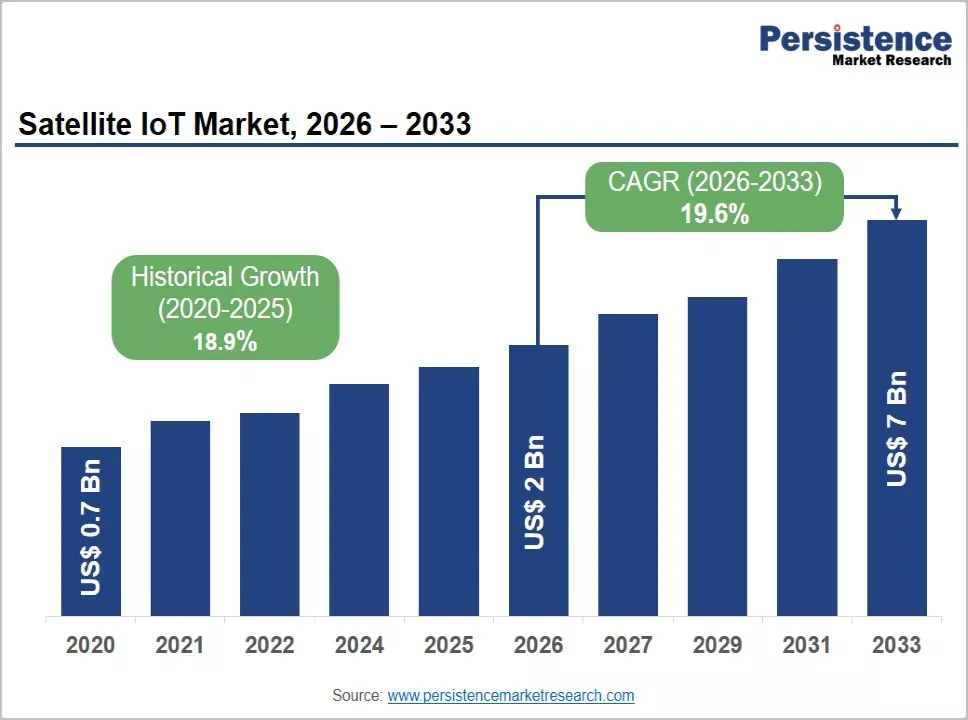
The global satellite IoT market size is likely to be valued at US$ 2.00 billion in 2026 and is projected to reach US$ 7.00 billion by 2033, growing at a CAGR of 19.6% during the forecast period between 2026 and 2033.
The convergence of cellular and satellite connectivity is reshaping how enterprises monitor remote assets, compelling operators to move from proprietary satellite links toward standards-based narrowband non-terrestrial network (NB-NTN) services that work with commodity chipsets and existing mobile operator agreements. This trajectory reflects sustained demand from logistics, energy, agriculture, and maritime users whose assets operate beyond terrestrial coverage, alongside falling module and airtime costs. The 3GPP’s introduction of non-terrestrial network support from Release 17 onward is creating a structural shift that favors operators with global coverage, mobile network partnerships, and certified ecosystems of chipset and module vendors.
Key Industry Highlights
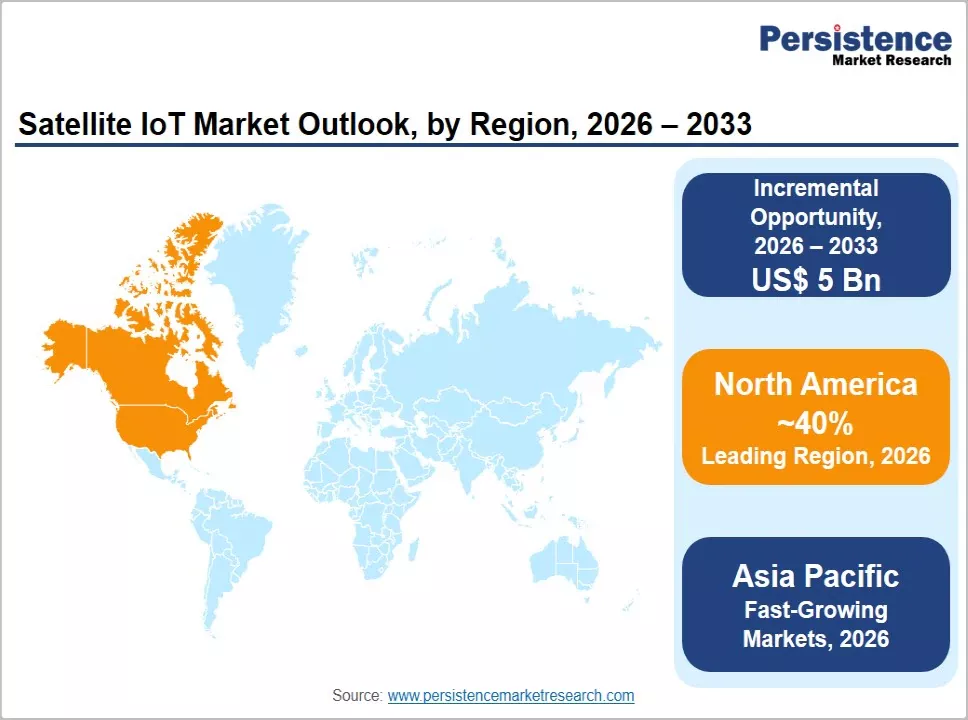
- Dominant Region: North America is forecast to dominate the regional market, holding about 40% market share in 2026. A large installed base of connected trucks, pipelines, and agricultural assets, together with the headquarters of leading satellite IoT operators and a mature enterprise buyer base, is sustaining adoption, a position the region will retain through 2033.
- Fastest-growing Region: Growing at a CAGR of 23.1%, Asia Pacific is outpacing every other region in the satellite IoT industry. Vast rural and maritime areas without terrestrial coverage, rapid precision agriculture adoption in India and Australia, and expanding offshore logistics are jointly accelerating demand for direct-to-satellite connectivity.
- Dominant Service: IoT satellite backhaul holds 56% of market share in 2026, fuelled by its long-standing use in oil and gas, utilities, and mining, where remote sensor networks must aggregate data through satellite links to cloud platforms. Its leadership is structurally stable, as many industrial sites rely on robust, higher-throughput links that low-power direct connections cannot yet match.
- Fastest-growing Service: Direct to satellite is gaining share rapidly as standards-based NB-IoT NTN services allow low-cost devices to talk to satellites without gateways. Iridium’s November 2026 activation of Iridium NTN Direct, billed as the first standards-based NB-IoT and direct-to-device service with truly global coverage, signals that direct-to-satellite connectivity will capture a meaningfully larger share by 2033.
- Leading Organization Size: Large enterprises account for around 72% of market share in 2026, while small and medium-sized enterprises are expected to expand fastest as module prices fall and mobile operators bundle satellite coverage into standard IoT plans.
DRO Analysis
Driver- Standardization of Non-Terrestrial Networks and Mobile Operator Integration
The adoption of 3GPP-standard NB-IoT and LTE-M over satellites is removing the single biggest obstacle to volume deployment: proprietary hardware. Deutsche Telekom launched what it describes as the world’s first multi-orbit IoT roaming service in February 2026, linking its NB-IoT and LTE-M network with Skylo for geostationary coverage and with Sateliot and OQ Technology for low Earth orbit, and extended the portfolio with Iridium in September 2026. Iridium also unveiled the Iridium 9604 module in February 2026, unifying satellite, cellular, and GNSS radios in a single device. These developments allow device makers to build a single product that switches between terrestrial and satellite networks, shortening design cycles and expanding the addressable market.
Restraint- Spectrum Coordination, Power Constraints, and Pricing Sensitivity
Satellite IoT depends on scarce spectrum that must be coordinated through national regulators and the International Telecommunication Union, and licensing delays can slow service launches across regions. Devices that communicate directly with satellites face tight link budgets, which constrain battery life, antenna size, and payload size, limiting use cases to low-data telemetry. Airtime costs still exceed terrestrial alternatives, so price-sensitive agriculture and small-fleet customers may delay adoption until tariffs fall further, and the proliferation of overlapping constellations creates interoperability and roaming uncertainty.
Opportunity- Hybrid Terrestrial–Satellite Architectures for Logistics, Agriculture, and Energy
Hybrid connectivity represents one of the most compelling growth theses in satellite IoT. Enterprises want a single connectivity layer that uses cellular where available and satellite where it is not, with a single SIM and management platform. Myriota, which offers ultra-low-power direct-to-satellite connectivity, has partnered with Viasat to launch a 5G-based non-terrestrial service, while Deutsche Telekom’s program of 15 companies and five research institutions is prototyping satellite IoT across vehicles, maritime fleets, and industrial equipment. Suppliers that integrate satellite connectivity into existing IoT platforms are positioned to capture the premium priced by coverage assurance.
Category-wise Analysis
Service Insights
Why Does IoT Satellite Backhaul Dominate the Satellite IoT Market?
IoT satellite backhaul is projected to account for nearly 56% of market share in 2026, driven by its established deployment base in oil and gas, utilities, mining, and maritime operations, where local sensor networks aggregate data and relay it over satellite links to central platforms. Operators such as Inmarsat Group, now part of Viasat, EUTELSAT COMMUNICATIONS SA, Airbus SE, and Thales S.A. provide the high-throughput geostationary and low Earth orbit links that underpin these networks, and long-term service contracts support recurring revenue.
Direct to satellite is likely to be the fastest-growing service, propelled by low-power devices that communicate straight with satellites using store-and-forward or NB-NTN protocols. ORBCOMM Inc., Swarm Technologies Inc., Myriota Pty Ltd., Kepler Communications Inc., and OQ Technology are pushing hardware costs and airtime prices downward, and Iridium NTN Direct’s global coverage and standards compliance are expected to widen the base of device makers.
Organization Size Insights
What Is Driving Satellite IoT Adoption Among SMEs?
Large enterprises are estimated to lead the organization size segment, capturing nearly 72% of market share in 2026, driven by multinational logistics, energy, and defense operators with distributed assets and the budgets to deploy bespoke connectivity. Global fleet operators use satellite trackers to monitor containers, trailers, and rail cars across regions with unreliable cellular coverage.
Small & medium-sized enterprises are likely to be the fastest-growing segment, catalyzed by plug-and-play modules, bundled mobile operator plans, and pay-as-you-go pricing. Farms, small shipping lines, and utility contractors can now deploy sensors with satellite fallback without building dedicated infrastructure.
End Use Insights
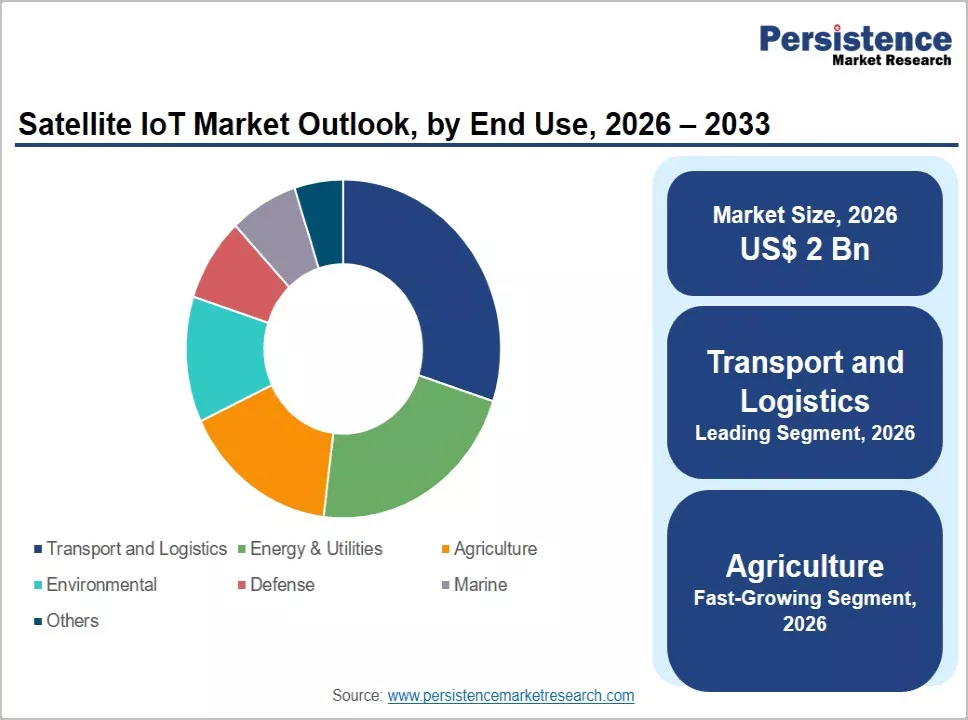
Transport and logistics is estimated to lead the end-use segment, capturing nearly 30% of market share in 2026, driven by the need for end-to-end visibility of containers, trailers, and cold-chain shipments across oceans and rural corridors. Energy & utilities and marine follow closely, as pipeline monitoring, smart metering, vessel tracking, and offshore asset telemetry require coverage that terrestrial networks cannot provide.
Agriculture is likely to be the fastest-growing end use, as soil, livestock, and irrigation sensors enable precision farming on remote land, while environmental and defense applications expand through monitoring and resilient communications requirements.
Regional Insights
North America Satellite IoT Market Trends and Insights
North America is forecast to dominate the regional market, capturing nearly 40% of market share in 2026, propelled by a large base of connected fleets, energy infrastructure, and agriculture, together with the presence of Iridium, ORBCOMM, Globalstar, Swarm, and Northrop Grumman. Regulatory support from the Federal Communications Commission for supplemental coverage from space is easing authorization for hybrid terrestrial–satellite services. Through 2033, the region’s growth will be driven by standards-based NTN services and automotive safety integration.
U.S. Satellite IoT Market Size
The U.S. is projected to hold about 88% of the North America regional market in 2026. Trucking, rail, oil and gas, and agriculture generate sustained demand, while Iridium’s commercial launch of NTN Direct targets automotive safety applications such as airbag crash notification and emergency location. Defense use of resilient low-power connectivity supports further volume.
Canada Satellite IoT Market Size
Canada is likely to command about 12% of the North America regional market in 2026. Vast northern territory, remote resource operations, and long supply chains create strong demand for satellite connectivity, and domestic company Kepler Communications is expanding its low Earth orbit network to serve data relay and IoT customers.
Europe Satellite IoT Market Trends and Insights
Europe is estimated to account for around 17% of market share in 2026, supported by strong satellite manufacturing capability, mobile operator-led integration, and sustainability and logistics applications. Deutsche Telekom’s multi-orbit IoT roaming, Sateliot’s NB-IoT constellation, and Eutelsat’s low Earth orbit services illustrate a regional approach in which mobile operators act as the primary channel to market. The European Union’s efforts to build sovereign satellite connectivity capacity add policy support through 2033.
Germany Satellite IoT Market Size
Germany is projected to account for nearly 24% of the Europe regional market in 2026. The country’s automotive, industrial, and logistics base, together with Deutsche Telekom’s early adopter and prototyping programs, makes it the focal point for connected-vehicle and industrial satellite IoT deployments.
U.K. Satellite IoT Market Size
The U.K. is expected to command nearly 19% of the Europe regional market in 2026. A strong space sector, maritime and offshore energy operations, and active satellite operators underpin demand for tracking and environmental monitoring services.
Which Region Will Drive the Fastest Satellite IoT Growth Through 2033?
Asia Pacific is likely to be the fastest-growing region during the forecast period between 2026 and 2033, expanding at a CAGR of 23.1% and accounting for the equivalent of US$ 0.40 Billion in 2026. Remote agricultural land, expansive maritime zones, and island geography across India, Australia, and Southeast Asia expose gaps in terrestrial coverage. Local startups and global operators are partnering with mobile network operators to deliver affordable low-power connectivity.
China Satellite IoT Market Size
China is anticipated to hold around 31% of the Asia Pacific regional market in 2026. National satellite constellations and state-backed operators are building domestic low Earth orbit IoT capability for logistics, agriculture, and maritime customers, supported by a large manufacturing base for modules and devices.
India Satellite IoT Market Size
India is forecast to account for nearly 19% of the Asia Pacific regional market in 2026. Reforms opening space services to private participation, a large agricultural sector, and an expanding logistics industry are creating demand for affordable satellite-enabled tracking and monitoring.
Competitive Landscape
The global satellite IoT market is moderately consolidated, with a tier of established satellite operators including Iridium Satellite LLC, Inmarsat Group, Globalstar, Inc., ORBCOMM Inc., and EUTELSAT COMMUNICATIONS SA competing on global coverage, spectrum assets, and mobile operator partnerships. Aerospace and defense groups such as Airbus SE, Thales S.A., and Northrop Grumman Corporation contribute manufacturing and system integration capability, while specialist challengers including Swarm Technologies Inc., Kepler Communications Inc., Myriota Pty Ltd., and OQ Technology compete on ultra-low-power direct-to-satellite connectivity and NB-IoT NTN. Competitive differentiation increasingly turns on standards compliance, chipset ecosystem breadth, and the ability to offer multi-orbit service under a single contract.
Key Industry Developments
- In November 2026, SIMPL Wireless launched a Direct-to-Device (D2D) satellite connectivity service to extend Internet of Things (IoT) connectivity beyond traditional cellular network coverage. The service expanded connectivity across more than 500,000 square miles of the U.S. that terrestrial networks did not cover. It enabled supported cellular IoT devices to connect directly to satellites when cellular coverage became unavailable, allowing them to continue transmitting telemetry, GPS location data, messages, and alerts.
- In October 2026, Sateliot successfully launched five new satellites under its Draconis mission to expand its 5G Non-Terrestrial Network (NTN) Internet of Things (IoT) constellation. The company deployed the satellites aboard a SpaceX Falcon 9 rocket, increasing its total number of launched satellites to 11. The new satellites operated at an altitude of 510 km and incorporated improved payloads, onboard data storage systems, central computers, and attitude control technologies.
Companies Covered in Satellite IoT Market
- ORBCOMM Inc.
- Globalstar, Inc.
- Inmarsat Group
- Iridium Satellite LLC
- Thales S.A.
- Airbus SE
- EUTELSAT COMMUNICATIONS SA
- Northrop Grumman Corporation
- Swarm Technologies Inc.
- Kepler Communications Inc.
- Myriota Pty Ltd.
- OQ Technology
Frequently Asked Questions
The global satellite IoT market is valued at US$ 2.00 billion in 2026.
The standardization of satellite connectivity through 3GPP non-terrestrial network specifications.
IoT satellite backhaul holds the largest share of the market at 56% in 2026. Its dominance reflects long-standing use in oil and gas, utilities, mining, and maritime operations, where sensor networks depend on satellite links to reach cloud platforms.
North America dominates the market with a 40% share in 2026. Two structural factors underpin this leadership: a large installed base of connected fleets, energy, and agricultural assets, and the presence of leading satellite IoT operators and a mature enterprise buyer base.
The most significant opportunities lie in hybrid terrestrial-satellite architectures and low-power direct-to-satellite devices for logistics, agriculture, and energy monitoring. Operators that offer single-SIM, multi-orbit connectivity through mobile network partners are best positioned for growth through 2033.
The market is moderately consolidated, with Iridium Satellite LLC, Inmarsat Group, Globalstar, Inc., ORBCOMM Inc., and EUTELSAT COMMUNICATIONS SA as the dominant operators.


