




- Home Appliances
- Roller Shades Market
Roller Shades Market Size, Share, and Growth Forecast 2026 - 2033
Roller Shades Market by Material Type (Synthetic, Natural), Distribution Type (Offline, Online), by Operation Type (Manual, Motorized), by End-user (Residential, Commercial), and Regional Analysis 2026 - 2033

Roller Shades Market Share and Trends Analysis
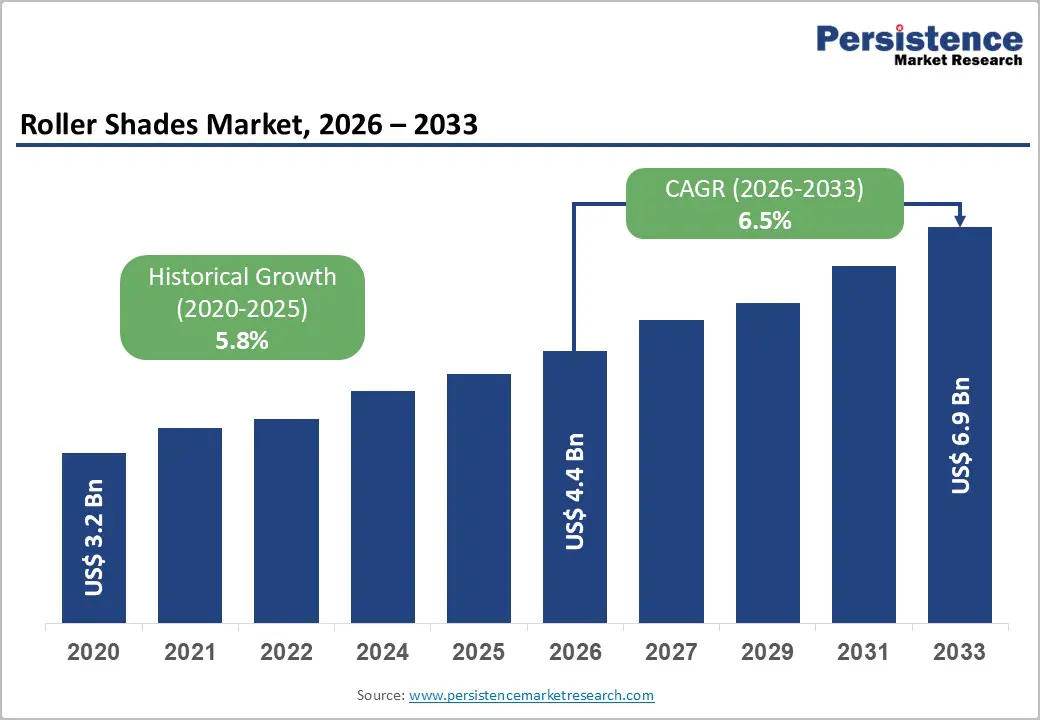
The global roller shades market size is projected to be valued at US$4.4 billion in 2026 and is projected to reach US$6.9 billion by 2033, growing at a CAGR of 6.5% during the forecast period from 2026 to 2033, driven by rapid urbanization, as 68% of the world's population is projected to live in urban areas by 2050, alongside increasing consumer demand for smart home automation and energy-efficient window solutions. The adoption of sustainable materials and solar heat-reflecting fabrics is transforming product offerings, in line with stricter green building standards in developed regions.
Key Industry Highlights:
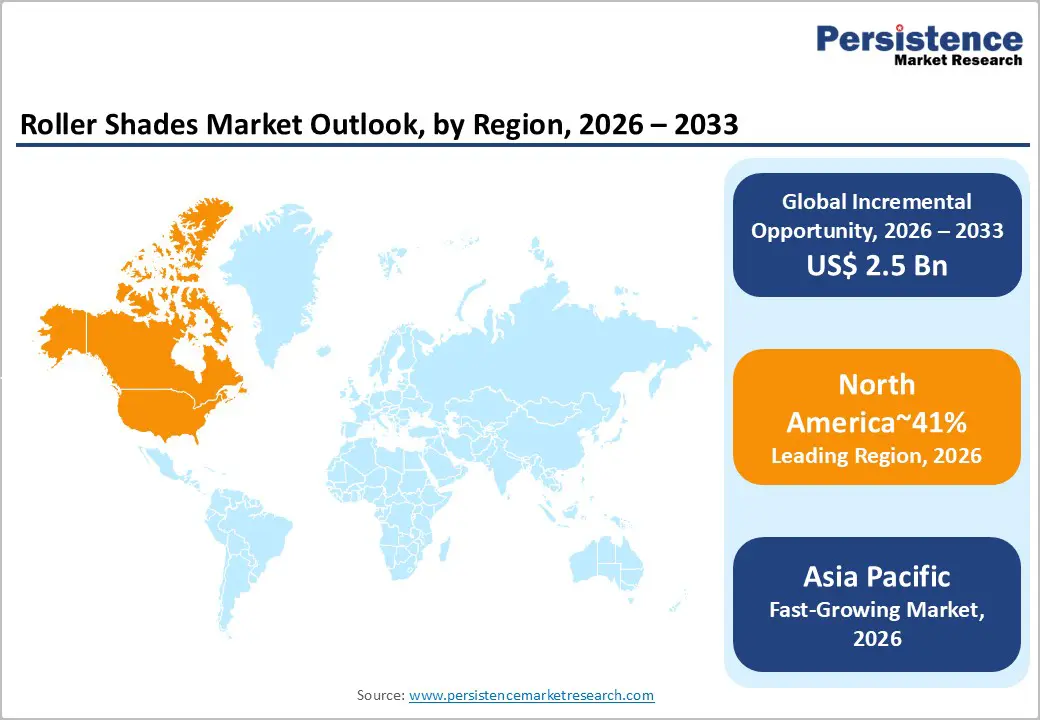
- Leading Region: North America is expected to lead with 41% share, underpinned by mature infrastructure, smart home adoption, and high consumer spending.
- Fastest-growing Region: Asia Pacific is projected to be the fastest-growing, supported by urbanization, manufacturing scale, e-commerce penetration, and rising demand for energy-efficient interior solutions.
- Leading Material Type: Synthetic materials are expected to lead with 56% share, supported by durability, moisture resistance, and low-maintenance performance across commercial and functional residential use cases.
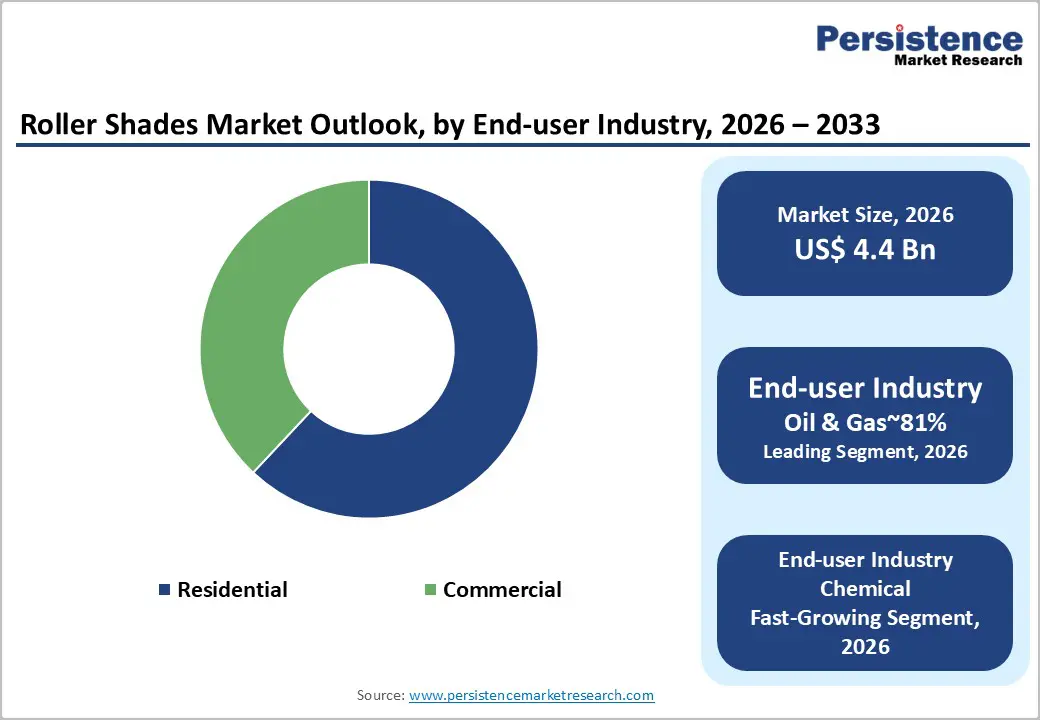
- Leading End-user Industry: Residential applications are expected to lead with 62% share, anchored by high volume, DIY-friendly formats, and lifestyle-driven purchasing behavior.
| Key Insights | Details |
|---|---|
| Roller Shades Market Size (2026E) | US$4.4 Bn |
| Market Value Forecast (2033F) | US$6.9 Bn |
| Projected Growth (CAGR 2026 to 2033) | 6.5% |
| Historical Market Growth (CAGR 2020 to 2025) | 5.8% |
Market Factors - Growth, Barriers, and Opportunity Analysis
Rising Smart Home Integration and Automation Adoption
The rising popularity of smart home technologies is transforming the roller shades market. Motorized and IoT-enabled solutions are becoming key drivers of consumer preference and industry expansion. Integration with voice assistants and mobile apps provides seamless control over lighting and privacy. Communication protocols such as Matter and Zigbee improve connectivity within home automation systems. Automated shades can adjust based on sunlight intensity and occupancy patterns, boosting energy efficiency by reducing HVAC loads in both residential and commercial environments. The added accessibility and convenience, especially for elderly or mobility-impaired users, further support adoption. Premium segments are experiencing faster growth, driven by the perceived value and integrated smart features.
Motorized roller shades are now commanding higher average selling prices compared to manual options. Battery-powered systems, with a lifespan of 18 to 24 months, are helping to overcome consumer hesitation for retrofit installations. Features focused on energy optimization are also contributing to sustainability goals and meeting building efficiency standards. The combination of convenience, automation, and energy efficiency is driving long-term market growth. IoT integration has become a key factor influencing consumer purchasing decisions. In September 2024, Lutron introduced updates to its shading portfolio, including the Natural Light Optimization feature for roller shades. This innovation automated light control, delivering up to 25% energy savings in buildings by maximizing the use of natural light, aligning with sustainability objectives.
Complex Installation and Measurement Requirements
Precision custom fitting for roller shades requires professional installation, which limits adoption among DIY consumers and small-scale buyers. The need for specialized labor and complex measurement requirements makes retrofit projects more challenging, increasing the risk of improper installation. Renovation projects incur higher total ownership costs due to the need for installation and adjustments. This creates a strong demand for professional support and premium service offerings.
The complexity of installation also impacts the scalability of standard product lines. Manufacturers that offer modular or pre-calibrated solutions can help lower these barriers and encourage wider adoption. Cost-conscious consumers may delay upgrades or opt for lower-spec alternatives. Proper alignment and calibration are essential for ensuring operational efficiency and extending shade lifespan. The high installation demands favor providers with established service networks and certified installers, and efficient, repeatable installation processes are becoming a key competitive advantage in the market.
Retrofit No-Drill Motorized Solutions
Retrofit, no-drill motorized roller shades are emerging as a significant opportunity by addressing installation challenges in existing buildings. Battery-powered systems eliminate the need for professional electricians, wall penetrations, or complex wiring, enabling quick deployment, even in spaces with restrictive lease agreements or historical preservation guidelines. App-controlled automation and voice assistant integration offer scheduling, light optimization, and remote control, improving operational efficiency and user convenience in residential, elder care, and commercial retrofit projects.
This solution effectively tackles retrofit market challenges in high-density urban apartments, assisted living facilities, and commercial offices seeking energy-efficiency upgrades without disrupting tenants. The non-invasive installation reduces reliance on labor and lowers overall project costs while enabling seamless integration with smart home systems. Automated shading schedules contribute to energy savings, enhancing ROI and supporting sustainability goals. Suppliers that offer reliable, modular, and system-compatible no-drill products are well-positioned to capture long-term demand in the retrofit segment, setting themselves apart from traditional hardwired alternatives.
Category-wise Analysis
Material Type Insights
Synthetic materials are projected to lead the roller shades market, accounting for approximately 56% share, driven by their unmatched durability, dimensional stability, and colorfastness across commercial, mass-residential, and high-traffic environments. Unlike natural fibers, synthetics withstand UV exposure, moisture, and heavy use, making them the material of choice for large-span windows and solar-screen applications. Advanced manufacturing, including CNC weaving and aluminized backing, enhances performance for heat reflection, acoustic absorption, and precision light control. Brands such as Phifer, Mermet, and Ferrari are expanding portfolios with bio-based synthetics, Precontraint coatings, and Eco-Tex initiatives, embedding synthetic dominance through long-term reliability, energy efficiency, and specification-friendly performance in both residential and commercial projects.
High-performance synthetics are anticipated to be the fastest-growing material segment in the roller shades market, fueled by a shift toward advanced polymers and hybrid synthetic composites. Motorization, urban high-rise design, and commercial-scale projects demand materials that resist warping, sagging, and UV degradation, giving synthetics a structural advantage over natural fibers. Growth is being catalyzed by innovations such as rPET fabrics, TPO coatings, and photo-catalytic surfaces, which enhance sustainability, energy reflection, and indoor air quality. Adoption is further enabled by digital textile printing and engineered light-filtration, allowing highly customized aesthetics with precise solar management. Leading suppliers, including Phifer, Mermet USA, and Serge Ferrari, are scaling these advanced synthetics for both residential and commercial markets, capturing early-cycle demand while embedding long-term specification loyalty.
End-user Industry Insights
Residential users are projected to lead the roller shades market, accounting for approximately 62% share, anchored by lifestyle-driven adoption across home offices, multi-use living spaces, and dense urban housing. Hybrid work has structurally expanded demand for glare control and privacy in SOHO setups, while renovation-over-relocation dynamics elevate window treatments as high-ROI upgrades. Energy efficiency and wellness positioning are accelerating the uptake of blackout and cellular fabrics to manage thermal loads and sleep hygiene. Smart home integration, including Matter-compatible motors such as those from Coulisse, is normalizing motorization within mainstream residential budgets. Portfolio expansion by Hunter Douglas, Lutron, and IKEA reinforces ecosystem lock-in, sustaining replacement cycles and high-volume residential throughput.
Commercial end-users are anticipated to be the fastest-growing segment in the roller shades market, propelled by smart-building retrofits, hospitality refresh cycles, and glass-heavy architectural trends that structurally require high-performance solar control. Asset owners are prioritizing automated shading to meet ESG targets, enhance occupant comfort, and optimize cooling loads in curtain-wall developments. Predictive automation tied to BMS platforms, dual-sided performance fabrics, and antimicrobial, PVC-free materials are expanding performance envelopes for offices, hotels, and healthcare. Enterprise-grade platforms from MechoSystems, Somfy, and Springs Window Fashions are scaling networked deployments, embedding switching costs across large estates. Retrofitting mature building stock and the growth of flexible “third spaces” further compress sales cycles, enabling above-market expansion.
Regional Insights
North America Roller Shades Market Trends
North America is expected to dominate, accounting for approximately 41% of the global market share in 2026, supported by mature residential and commercial infrastructure, high disposable incomes, and sophisticated consumer expectations. The U.S. market leads regional revenue generation, with demand driven by technology integration, smart home adoption, and energy efficiency specifications. Regulatory frameworks, including energy efficiency standards and safety mandates, shape equipment and product requirements, influencing procurement decisions across renovation and new construction projects.
Competitive dynamics emphasize brand differentiation through technological advancement and custom aesthetics, creating premium pricing opportunities while applying pressure on lower-cost alternatives. Distribution channels are omnichannel, integrating large retailers, specialist outlets, and online platforms, which sustain stable demand foundations. The region’s mature, innovation-driven market supports long-term investments in advanced product development and market expansion, reinforcing North America’s continued global leadership in smart and automated window coverings.
Europe Roller Shades Market Trends
Europe is expected to represent the stable mature growth, with Germany, the U.K., France, and Spain serving as primary performance hubs. The region is highly regulated, with energy efficiency mandates and sustainability frameworks shaping product adoption and competitive dynamics. Germany leads regional demand through strong manufacturing capabilities, technological advancement, and urban adoption of energy-efficient and motorized roller shade solutions. Policy incentives promoting renewable energy and building optimization reinforce structural market growth, while EU harmonization of energy performance and material sustainability standards reduces regulatory fragmentation and facilitates cross-border compliance.
The U.K. demonstrates growth driven by renovation activity in older building stock and adoption of smart blinds, while France and Spain contribute steadily despite less stringent regulatory enforcement. Commercial segments prioritize WELL certification and occupant wellness integration. Investment trends favor manufacturers advancing smart building solutions, sustainable materials, and circular economy processes. Combined regulatory oversight, policy alignment, and technological capabilities position Europe as a mature, compliance-focused regional market with stable demand and incremental expansion potential relative to other regions.
Asia Pacific Roller Shades Market Trends
Asia Pacific is expected to be the fastest-growing regional market, driven by structural expansion in China, India, Japan, and ASEAN member states. China establishes leading market positioning, supported by concentrated manufacturing capabilities, urbanization trends, and consumer preference for energy-efficient, customizable interior solutions. India demonstrates significant growth potential, with demand shaped by urbanization, middle-class expansion, and price-sensitive consumer preferences favoring functional, cost-effective solutions. Japan maintains a high-value market profile, emphasizing durability, aesthetics, and technological sophistication, while ASEAN markets reflect fragmented yet rapidly expanding demand facilitated by e-commerce adoption and digital-native consumers.
Regional manufacturing advantages, including labor cost efficiency, raw material proximity, and automation, enhance competitiveness and support supply chain integration across Asia Pacific. Infrastructure improvements and intra-regional trade agreements reinforce market accessibility and operational responsiveness. Investment trends focus on both domestic market penetration and export-oriented manufacturing, enabling companies to capture incremental growth. Combined regulatory oversight, policy momentum, and manufacturing scale solidify Asia Pacific’s position as the primary driver of global market expansion.
Competitive Landscape
The global roller shades market is moderately consolidated, with the top five players Hunter Douglas, Somfy, Springs Window Fashions, Lutron Electronics, and Nien Made Enterprise holding approximately 35-40% of the total market value. Leading firms maintain dominance through capital-intensive manufacturing, proprietary motorization technology, and extensive distribution networks, while regional and local manufacturers capture the remaining share by addressing localized preferences with customized fabrics, cost-efficient production, and flexible service offerings.
Market concentration is higher in motorized and smart-shade segments, where technological sophistication, reliability, and integration capabilities drive premium positioning. The lower end, comprising manual and DIY products, remains fragmented, fostering price-sensitive competition. Competitive differentiation emphasizes lead times, fabric exclusivity, and system reliability rather than solely price, while barriers to entry, including intellectual property protection, distribution relationships, and scale requirements, sustain structural advantages for incumbents and limit meaningful disruption from new entrants.
Key Industry Developments:
- In November 2025, MechoShade launched its “Ascend” sustainability program, partnering with companies such as Cisco and Legrand to promote eco-friendly innovations and reduce operational waste, boosting the market's green credentials.
- In January 2025, the CPSC issued a recall for Chris Dowa Roller Window Shades due to safety hazards, prompting industry-wide improvements in cordless designs and reducing manufacturers' liability risks.
- In November 2024, Griesser AG switched to using green aluminum in manufacturing, cutting CO2 emissions by 30% per kg of aluminum and making roller shades a more sustainable choice for eco-conscious buyers.
- In July 2024, SelectBlinds and LEVOLOR launched an exclusive collaborative collection of roller shades, expanding customizable options and driving revenue with innovative designs for residential and commercial spaces.
Companies Covered in Roller Shades Market
- Hunter Douglas N.V.
- Somfy Systems Inc.
- Springs Window Fashions
- Rollease Acmeda
- Lutron Electronics Co., Inc.
- Nien Made Enterprise Co., Ltd.
- Legrand S.A.
- Graber Blinds
- Velux
- QMotion Incorporated
- Mechoshade Systems
- Schenker Storen
- Tachikawa Corporation
- Aspect Blinds
- Hillarys
- Coulisse
- Silent Gliss
- Griesser AG
Frequently Asked Questions
The global roller shades market is projected to be valued at US$ 4.4 billion in 2026 and is expected to reach US$6.9 billion by 2033, driven by urban housing growth and demand for energy-efficient window solutions.
Demand is increasing due to rapid urbanization, rising adoption of smart home automation, growing focus on indoor comfort, and stricter green building regulations promoting energy-efficient shading systems.
The roller shades market is expected to grow at a CAGR of 6.5% between 2026 and 2033, supported by motorized shade adoption and expanding commercial construction activity.
The fastest growth opportunities are emerging in Asia Pacific, supported by large-scale residential development, expanding middle-class housing demand, and rising penetration of modern interior and smart building solutions.
Key players include Hunter Douglas N.V., Somfy Systems Inc., Springs Window Fashions, Rollease Acmeda, Lutron Electronics Co., Legrand S.A., Nien Made Enterprise, MechoShade Systems, Griesser AG, Velux, and QMotion Incorporated.


