




- Biotechnology
- RNA Analysis Market
RNA Analysis Market Size, Share, Growth, and Regional Forecast, 2026 to 2033
Global RNA Analysis Market by Product (Instruments, Kits & Reagents, Services, and Others), by Technology (Real Time-PCR (qPCR) Technology, Microarray Technology, Sequencing Technology, and Others) by Application (Construction of RNA Expression Atlas, Epigenetics, Infectious Diseases and Pathogenesis, Alternative RNA Splicing, Development & Delivery of RNA Therapeutics, and Others), by End User (Pharmaceutical & Biotechnology Companies, Contract Research Organizations (CROs), Hospitals, and Academic and Research Institutions), and Regional Analysis from 2026 to 2033

RNA Analysis Market Share and Trend Analysis
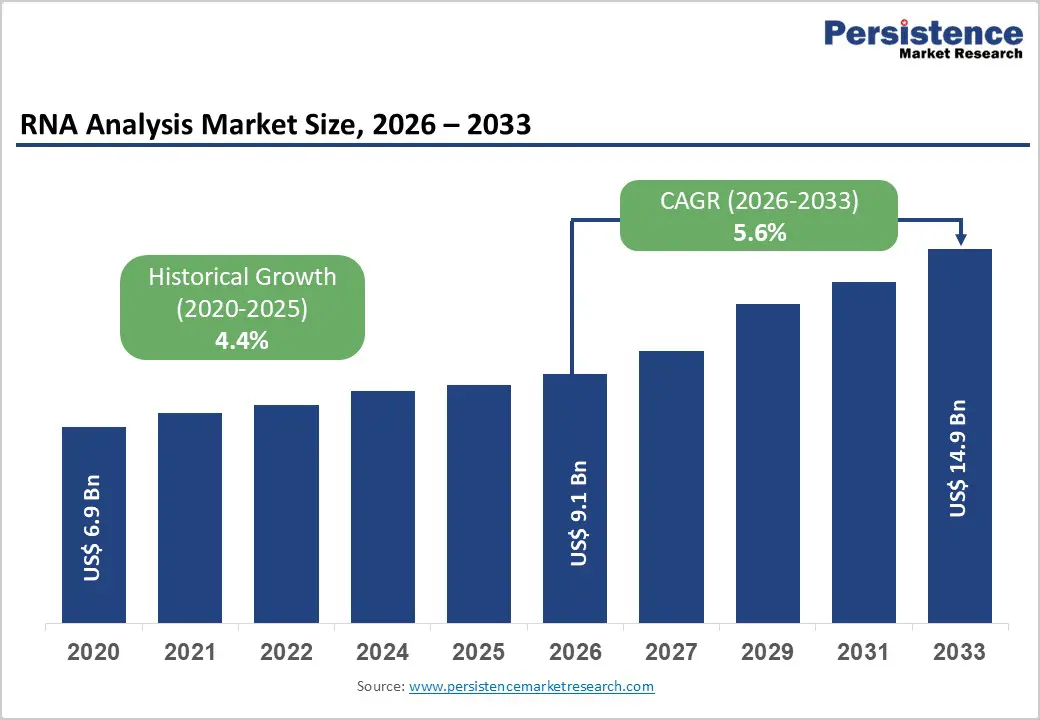
The global RNA analysis market size is estimated to grow from US$ 9.1 Bn in 2026 to US$ 14.9 Bn by 2033. The market is projected to record a CAGR of 5.6% during the forecast period from 2026 to 2033.
Global demand for RNA analysis solutions is increasing steadily, driven by the expanding use of transcriptomics in biomedical research, precision medicine, and drug development. Rising prevalence of cancer, genetic disorders, infectious diseases, and immune-related conditions has significantly increased the need for detailed gene expression profiling. Improvements in sample preparation, sequencing accuracy, and data analytics have expanded the addressable research and clinical user base. Growing adoption of advanced RNA analysis tools, including real-time PCR, next-generation sequencing, and microarray platforms, is enabling deeper insights into disease mechanisms and therapeutic responses.
The shift toward RNA-based diagnostics and therapeutics, such as mRNA vaccines and gene-silencing technologies, is further accelerating adoption, as these approaches require robust RNA characterization throughout development pipelines. Continuous innovation in instruments, reagents, automation, and bioinformatics software is improving workflow efficiency, reproducibility, and scalability. Increasing research funding, expanding academic–industry collaborations, and rising healthcare and life sciences investment in emerging markets are reinforcing long-term demand. Additionally, growing awareness of precision medicine, favorable research funding environments in developed regions, and rapid expansion of genomics infrastructure globally continue to support sustained market growth.
Key Industry Highlights
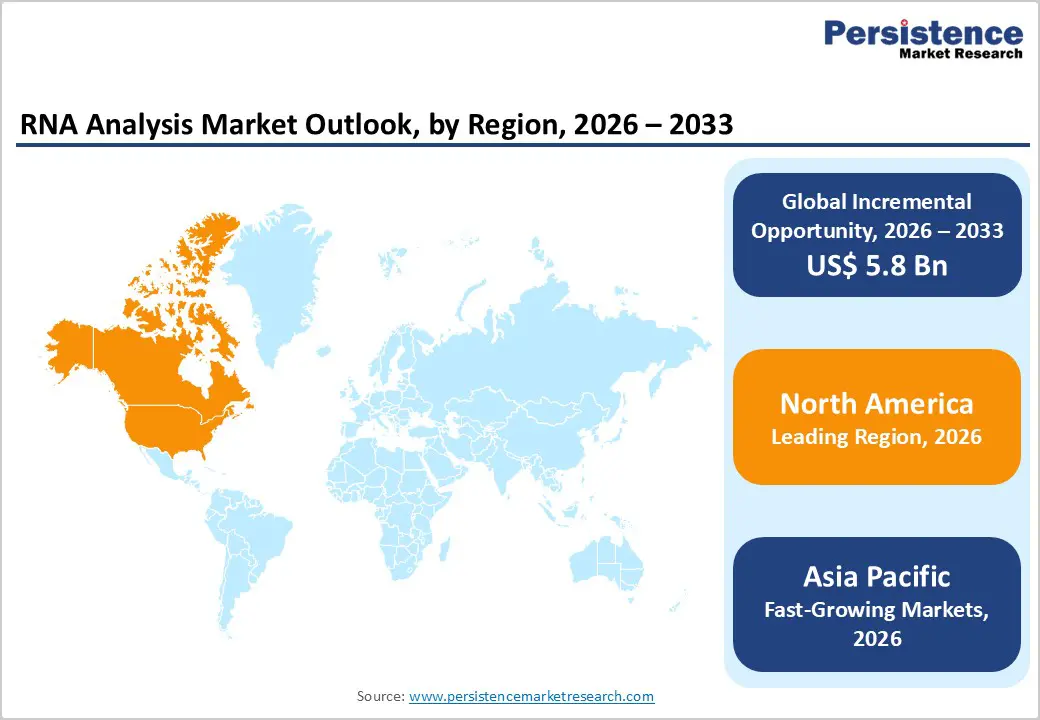
- Leading Region: North America holds the largest share at 47.3%, supported by advanced research infrastructure, high R&D spending, early adoption of transcriptomics technologies, strong funding support, and presence of leading life sciences companies.
- Fastest-Growing Region: Asia Pacific is expanding fastest due to rising research investments, improving genomics infrastructure, growing biotechnology sector, rapid expansion of academic and hospital laboratories, and increasing adoption of sequencing-based RNA analysis.
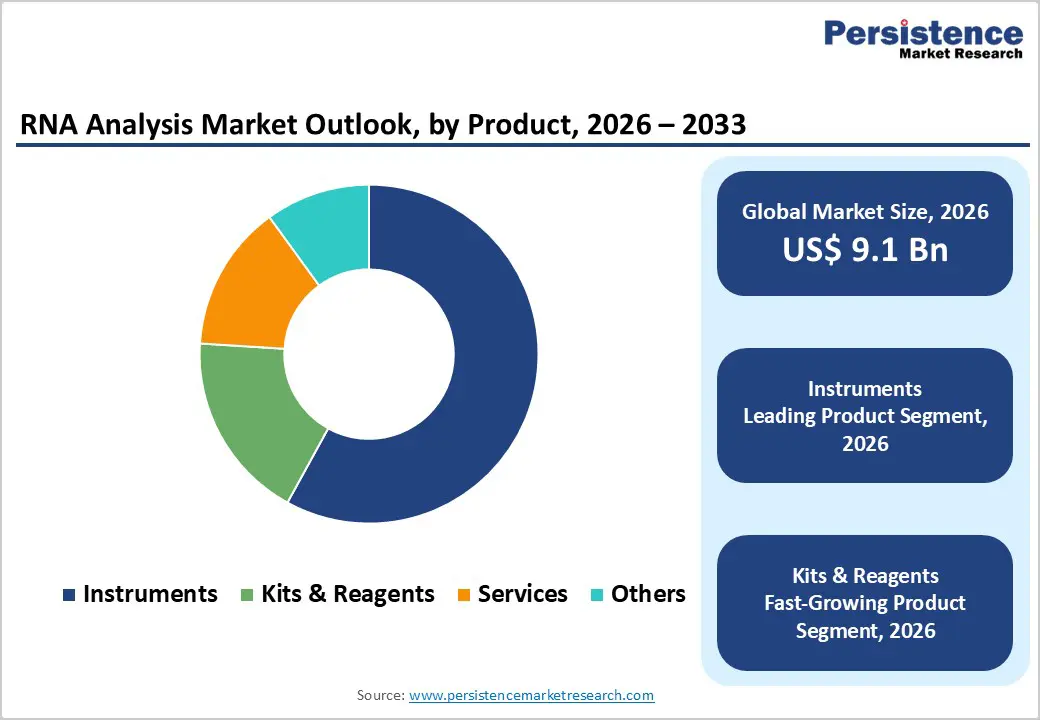
- Leading Product Segment: Instruments dominate the market due to high adoption of advanced RNA profiling platforms, continuous technological upgrades, and widespread use in large-scale research and clinical studies.
- Fastest-Growing Product Segment: Kits & reagents are growing steadily as expanding RNA sequencing volumes, routine expression analysis, and repeat testing drive recurring consumable demand.
- Leading Application Segment: Construction of RNA expression atlas remains the top segment, driven by extensive use in functional genomics, biomarker discovery, and standardized transcriptomic research globally.
- Fastest-Growing Application Segment: Development & delivery of RNA therapeutics is witnessing renewed growth due to increasing mRNA-based drug development, gene-silencing therapies, and rising clinical and commercial interest in RNA-driven treatment modalities.
| Global Market Attributes | Key Insights |
|---|---|
| RNA Analysis Market Size (2026E) | US$ 9.1 Bn |
| Market Value Forecast (2033F) | US$ 14.9 Bn |
| Projected Growth (CAGR 2026 to 2033) | 5.6% |
| Historical Market Growth (CAGR 2020 to 2025) | 4.4% |
Market Dynamics
Driver – Expanding Adoption of Transcriptomics and Precision Medicine Across Research and Clinical Settings
Growth is strongly supported by the accelerating adoption of RNA analysis technologies across biomedical research, clinical diagnostics, and pharmaceutical development. Increasing reliance on transcriptomic data to understand gene expression, disease mechanisms, and cellular responses is driving demand for advanced RNA profiling tools. Rising prevalence of cancer, genetic disorders, infectious diseases, and immune-related conditions has intensified the need for high-resolution molecular insights, where RNA analysis plays a central role. Precision medicine initiatives are further reinforcing uptake, as clinicians and researchers increasingly use RNA signatures for patient stratification, biomarker discovery, and therapy selection.
Technological progress in sequencing platforms, real-time PCR systems, and automated sample preparation has significantly improved sensitivity, scalability, and turnaround time, making RNA analysis more accessible across laboratories. Public and private funding for genomics research, national precision medicine programs, and large-scale population studies are expanding installed instrument bases and consumables usage. Additionally, growing interest in RNA-based therapeutics, including mRNA vaccines and gene-silencing approaches, has positioned RNA analysis as a foundational tool throughout drug discovery and development pipelines. Together, these factors are driving sustained demand and long-term growth across academic, clinical, and industrial end users.
Restraints – High Technology Costs, Data Complexity, and Limited Skilled Workforce Availability
Despite strong growth prospects, several structural challenges continue to limit broader adoption. Advanced RNA analysis platforms, particularly next-generation sequencing systems and high-throughput automation solutions, require substantial upfront capital investment, making them less accessible for smaller laboratories and institutions in cost-sensitive regions. In addition to instrument costs, recurring expenses associated with reagents, consumables, software licenses, and data storage contribute to a high total cost of ownership.
The complexity of RNA workflows and downstream data interpretation further constrains adoption. RNA sequencing and transcriptomic studies generate large, multidimensional datasets that require advanced bioinformatics expertise and computational infrastructure. Shortages of trained bioinformaticians and molecular biology specialists can delay project timelines and reduce operational efficiency. Variability in sample quality, lack of standardized protocols, and challenges in data reproducibility also impact confidence among new adopters.
Regulatory and ethical considerations surrounding genomic data handling, privacy, and cross-border data sharing add additional layers of complexity. Collectively, high costs, technical barriers, and workforce limitations slow penetration in emerging markets and smaller research settings, moderating the overall pace of market expansion.
Opportunity – Growth of RNA-Based Therapeutics, AI-Driven Analytics, and Emerging Market Research Expansion
Substantial opportunities are emerging from the rapid evolution of RNA-based therapeutics and advanced analytical approaches. Increasing development of mRNA vaccines, antisense oligonucleotides, siRNA therapies, and gene-editing technologies is expanding the need for precise RNA characterization throughout preclinical and clinical stages. Integration of artificial intelligence and machine learning with RNA data analysis is enabling faster interpretation, improved pattern recognition, and more predictive insights, enhancing decision-making in drug discovery and diagnostics. Expanding genomics research initiatives in emerging economies offer additional growth potential.
Governments and academic institutions across Asia Pacific, Latin America, and parts of the Middle East are increasing investments in life sciences infrastructure, sequencing facilities, and collaborative research programs. Growth of contract research organizations and outsourcing of transcriptomics services are further lowering entry barriers for smaller biotech firms. Cloud-based bioinformatics platforms, standardized workflows, and automation are improving accessibility and scalability, while partnerships between technology providers, pharmaceutical companies, and research institutes are accelerating innovation. As global focus on molecular-level understanding of disease intensifies, these developments are expected to unlock new revenue streams and strengthen long-term market growth.
Category-wise Analysis
By Product, Instruments Lead Due to High Adoption of Advanced RNA Profiling Platforms
The instruments segment is projected to dominate the global RNA analysis market in 2026, accounting for a revenue share of 58.0%. This leadership is primarily driven by the growing adoption of high-throughput RNA analysis platforms across genomics research, clinical diagnostics, and pharmaceutical R&D. Increasing demand for precise RNA quantification, structural analysis, and transcriptomic profiling has accelerated investments in advanced instruments such as real-time PCR systems, next-generation sequencing platforms, and automated sample preparation systems. Research institutions and biopharmaceutical companies continue to prioritize capital investments in sophisticated instrumentation to support large-scale studies, biomarker discovery, and drug development workflows. Additionally, technological advancements that improve sensitivity, accuracy, and data reproducibility are reinforcing replacement demand for next-generation instruments. The rising focus on precision medicine, infectious disease surveillance, and RNA-based therapeutic development further supports sustained uptake, ensuring instruments maintain their dominant revenue contribution throughout the forecast period.
By Application, Construction of RNA Expression Atlas Leads Due to Broad Research and Clinical Utility
The construction of RNA expression atlas segment is expected to lead the market in 2026, capturing a revenue share of 30.0%. This dominance reflects the critical role of large-scale RNA expression mapping in understanding gene regulation, disease mechanisms, and cellular behavior across diverse biological conditions. RNA expression atlases serve as foundational resources for functional genomics, biomarker identification, and target validation in both academic and industrial research. The expanding use of transcriptomic databases to support drug discovery, personalized medicine, and systems biology studies has significantly increased demand for RNA expression profiling. Furthermore, integration of RNA expression atlases with multi-omics platforms enhances data interpretability and clinical relevance. Ongoing advancements in sequencing depth, data analytics, and cloud-based bioinformatics tools are accelerating atlas construction projects globally. As research organizations increasingly prioritize standardized and reproducible datasets, this application segment is expected to retain its leadership position.
By End User, Pharmaceutical & Biotechnology Companies Lead Due to High R&D Spending and Commercial Scale
Pharmaceutical and biotechnology companies are projected to dominate the global RNA analysis market in 2026, accounting for a revenue share of 40.0%. This leadership is driven by the extensive use of RNA analysis across drug discovery, target validation, toxicogenomics, and development of RNA-based therapeutics such as mRNA vaccines and gene-silencing drugs. These companies rely heavily on RNA profiling to accelerate pipeline development, optimize clinical candidates, and meet regulatory requirements. High R&D budgets enable sustained investments in advanced instruments, reagents, and outsourced analytical services. Additionally, growing collaboration with academic institutions and contract research organizations further expands RNA analysis usage across preclinical and clinical stages. As biopharmaceutical innovation increasingly shifts toward genomics-driven approaches, pharmaceutical and biotechnology companies are expected to remain the largest end-user segment throughout the forecast period.
Region-wise Insights
North America RNA Analysis Market Trends
North America is expected to dominate the global RNA analysis market with a value share of 47.7% in 2026, led primarily by the United States. The region benefits from a highly developed life sciences ecosystem, advanced research infrastructure, and early adoption of cutting-edge genomic technologies. Strong funding support from government agencies, including NIH and other federal research bodies, continues to drive large-scale transcriptomics and RNA-focused research initiatives. The presence of leading pharmaceutical and biotechnology companies accelerates demand for RNA analysis in drug discovery, clinical trials, and RNA-based therapeutic development. Academic and research institutions across the region actively engage in RNA expression mapping, epigenetics, and infectious disease research, further strengthening market growth.
Favorable reimbursement frameworks, robust intellectual property protection, and streamlined regulatory pathways support commercialization of RNA-based diagnostics and therapeutics. In addition, high awareness of precision medicine, availability of skilled professionals, and widespread adoption of advanced sequencing and qPCR platforms are expected to sustain North America’s leadership position throughout the forecast period.
Europe RNA Analysis Market Trends
The European RNA analysis market is projected to grow steadily, supported by strong public research funding, established academic networks, and a growing emphasis on genomics-driven healthcare. Countries such as Germany, the U.K., France, Italy, and Spain lead regional adoption due to well-developed healthcare systems and active participation in large-scale transcriptomics and precision medicine initiatives. European research consortia and cross-border collaborations play a significant role in advancing RNA expression atlas projects, epigenetics research, and RNA biomarker discovery. Public healthcare coverage and structured research funding ensure broad access to RNA analysis tools across hospitals and academic institutions.
Additionally, stringent regulatory standards promote high-quality research outputs and standardized analytical workflows. The region is also witnessing increased adoption of RNA sequencing technologies in oncology, rare disease research, and infectious disease surveillance. Continuous investments in bioinformatics infrastructure, coupled with workforce training programs, are expected to drive consistent market expansion while maintaining Europe’s strong position in global RNA research.
Asia Pacific RNA Analysis Market Trends
The Asia Pacific RNA analysis market is expected to register a higher CAGR of around 7.6% between 2026 and 2033, driven by expanding research capabilities, rising healthcare investments, and increasing focus on genomics and precision medicine. Countries including China, India, Japan, South Korea, and Australia are rapidly strengthening their RNA research infrastructure through government funding, academic expansion, and public–private partnerships.
Growing biopharmaceutical manufacturing and rising participation in global clinical research are accelerating demand for RNA analysis technologies. Improved access to advanced sequencing platforms, increasing adoption of transcriptomics in infectious disease research, and expansion of local biotechnology companies support sustained growth. Additionally, cost-effective research services, expanding CRO presence, and growing emphasis on RNA-based therapeutics contribute to broader market penetration. Awareness initiatives, skill development programs, and integration of bioinformatics platforms further enhance regional capabilities. Collectively, these factors position Asia Pacific as the fastest-growing regional market for RNA analysis over the forecast period.
Market Competitive Landscape
The global RNA analysis market is highly competitive, with strong participation from companies such as Agilent Technologies Inc., Bio-Rad Laboratories Inc., F. Hoffmann-La Roche Ltd., Illumina Inc., and QIAGEN. These players leverage extensive global distribution networks, strong brand recognition, and broad life-science portfolios to address the rising demand for advanced transcriptomic and RNA-based research solutions.
Their product offerings focus on RNA analysis instruments, kits and reagents, sequencing platforms, and end-to-end workflow solutions designed to improve data accuracy, throughput, and reproducibility across research and clinical applications. Continuous innovation in assay development, automation, bioinformatics integration, regulatory compliance, and adherence to international quality and manufacturing standards remains critical for maintaining competitive positioning in the global RNA analysis market.
Key Industry Developments:
- In January 2026, STORM Therapeutics Ltd. announced a strategic collaboration with Alida Biosciences Inc. to advance RNA modification analysis in drug development. Under the partnership, STORM will leverage AlidaBio’s EpiPlex® and EpiScout® NGS platforms to quantitatively assess transcript-specific m6A RNA modifications driven by METTL3 inhibition using its lead candidate, STC-15—the first small-molecule METTL3 inhibitor to enter human clinical trials.
- In February 2025, Boston- and Germany-based biotech startup AIRNA advanced a novel genetic medicine approach by leveraging the body’s natural RNA-editing machinery. Building on over a decade of ADAR biology research, the company is developing reversible RNA-editing therapies and is preparing to advance its lead candidate for alpha-1 antitrypsin deficiency into clinical trials in 2025.
- In September 2023, Deep Genomics announced the publication of a manuscript introducing BigRNA, its AI foundation model designed to uncover RNA-driven disease mechanisms and therapeutic candidates. The model predicts tissue-specific RNA regulation, protein and microRNA binding sites, and the impact of genetic variants and drug candidates, enabling broader and more novel biological insights than task-specific traditional approaches.
Companies Covered in RNA Analysis Market
- Agilent Technologies Inc.
- Bio-Rad Laboratories Inc
- F.Hoffman-La Roche Ltd
- IllUMINA Inc
- QIAGEN
- Thermo Fisher Scientific Inc.
- Danaher
- Lexogen GmbH
- Eurofins Scientific
- Merck KGaA
- PacBio
- Promega Corporation.
- PG Instruments
- Biocompare
- Others
Frequently Asked Questions
The global RNA analysis market is projected to be valued at US$ 9.1 Bn in 2026.
The RNA analysis market is driven by growing adoption of precision medicine, rising genomic research, and rapid advances in sequencing and qPCR technologies.
The global RNA Analysis Market is poised to witness a CAGR of 5.6% between 2026 and 2033.
Major opportunities lie in RNA-based therapeutics, liquid biopsy applications, and expanding use of transcriptomics in drug discovery and clinical diagnostics.
Agilent Technologies Inc., Bio-Rad Laboratories Inc, F.Hoffman-La Roche Ltd, IllUMINA Inc, and QIAGEN are some of the key players in the RNA analysis market.


