


- Executive Summary
- Global Refrigerated Transport Market Snapshot, 2025 and 2032
- Market Opportunity Assessment, 2025 - 2032, US$ Bn
- Key Market Trends
- Future Market Projections
- Premium Market Insights
- Industry Developments and Key Market Events
- PMR Analysis and Recommendations
- Market Overview
- Market Scope and Definition
- Market Dynamics
- Drivers
- Restraints
- Opportunity
- Key Trends
- Macro-economic Factors
- Trade Policies and Tariffs
- Economic Recovery Post-pandemic
- COVID-19 Impact Analysis
- Forecast Factors - Relevance and Impact
- Value Added Insights
- Mode of Transport Adoption Analysis
- Regulatory Landscape
- Value Chain Analysis
- PESTLE Analysis
- Porter’s Five Force Analysis
- Price Analysis, 2024A
- Key Highlights
- Key Factors Impacting Technology Costs
- Pricing Analysis, By Mode of Transport
- Global Refrigerated Transport Market Outlook
- Key Highlights
- Market Volume (Units) Projections
- Market Size (US$ Bn) and Y-o-Y Growth
- Absolute $ Opportunity
- Market Size (US$ Bn) and Volume (Units) Analysis and Forecast
- Historical Market Size (US$ Bn) Analysis, 2019-2024
- Current Market Size (US$ Bn) Analysis and Forecast, 2025 - 2032
- Global Refrigerated Transport Market Outlook: Technology
- Introduction / Key Findings
- Historical Market Size (US$ Bn) and Volume (Units) Analysis, By Technology, 2019 - 2024
- Current Market Size (US$ Bn) and Volume (Units) Analysis and Forecast, By Technology, 2025 - 2032
- Air-blown Evaporators
- Eutectic
- Hybrid
- Fully Electrified
- Market Attractiveness Analysis: Technology
- Global Refrigerated Transport Market Outlook: Mode of Transport
- Introduction / Key Findings
- Historical Market Size (US$ Bn) Analysis, By Mode of Transport, 2019 - 2024
- Current Market Size (US$ Bn) Analysis and Forecast, By Mode of Transport, 2025 - 2032
- Road
- Air
- Sea
- Railway
- Market Attractiveness Analysis: Mode of Transport
- Global Refrigerated Transport Market Outlook: Temperature Range
- Introduction / Key Findings
- Historical Market Size (US$ Bn) Analysis, By Temperature Range, 2019 - 2024
- Current Market Size (US$ Bn) Analysis and Forecast, By Temperature Range, 2025 - 2032
- Chilled
- Frozen
- Deep Frozen
- Market Attractiveness Analysis: Temperature Range
- Global Refrigerated Transport Market Outlook: Application
- Introduction / Key Findings
- Historical Market Size (US$ Bn) Analysis, By Application, 2019 - 2024
- Current Market Size (US$ Bn) Analysis and Forecast, By Application, 2025 - 2032
- Food and Beverage
- Fruits and Vegetables
- Dairy Products
- Fruit Pulp and Concentrates
- Fish, Meat, and Seafood
- Processed Food
- Bakery and Confectionery
- Others
- Pharmaceuticals
- Vaccines
- Blood Banking
- Others
- Others
- Market Attractiveness Analysis: Application
- Key Highlights
- Global Refrigerated Transport Market Outlook: Region
- Key Highlights
- Historical Market Size (US$ Bn) and Volume (Units) Analysis, By Region, 2019 - 2024
- Current Market Size (US$ Bn) and Volume (Units) Analysis and Forecast, By Region, 2025 - 2032
- North America
- Europe
- East Asia
- South Asia and Oceania
- Latin America
- Middle East & Africa
- Market Attractiveness Analysis: Region
- North America Refrigerated Transport Market Outlook
- Key Highlights
- Historical Market Size (US$ Bn) Analysis, By Market, 2019 - 2024
- By Country
- By Technology
- By Mode of Transport
- By Temperature Range
- By Application
- Current Market Size (US$ Bn) Analysis and Forecast, By Country, 2025 - 2032
- U.S.
- Canada
- Current Market Size (US$ Bn) and Volume (Units) Analysis and Forecast, By Technology, 2025 - 2032
- Air-blown Evaporators
- Eutectic
- Hybrid
- Fully Electrified
- Current Market Size (US$ Bn) Analysis and Forecast, By Mode of Transport, 2025 - 2032
- Road
- Air
- Sea
- Railway
- Current Market Size (US$ Bn) Analysis and Forecast, By Temperature Range, 2025 - 2032
- Chilled
- Frozen
- Deep Frozen
- Current Market Size (US$ Bn) Analysis and Forecast, By Application, 2025 - 2032
- Food and Beverage
- Fruits and Vegetables
- Dairy Products
- Fruit Pulp and Concentrates
- Fish, Meat, and Seafood
- Processed Food
- Bakery and Confectionery
- Others
- Pharmaceuticals
- Vaccines
- Blood Banking
- Others
- Others
- Food and Beverage
- Market Attractiveness Analysis
- Europe Refrigerated Transport Market Outlook
- Key Highlights
- Historical Market Size (US$ Bn) Analysis, By Market, 2019 - 2024
- By Country
- By Technology
- By Mode of Transport
- By Temperature Range
- By Application
- Current Market Size (US$ Bn) Analysis and Forecast, By Country, 2025 - 2032
- Germany
- France
- U.K.
- Italy
- Spain
- Russia
- Türkiye
- Rest of Europe
- Current Market Size (US$ Bn) and Volume (Units) Analysis and Forecast, By Technology, 2025 - 2032
- Air-blown Evaporators
- Eutectic
- Hybrid
- Fully Electrified
- Current Market Size (US$ Bn) Analysis and Forecast, By Mode of Transport, 2025 - 2032
- Road
- Air
- Sea
- Railway
- Current Market Size (US$ Bn) Analysis and Forecast, By Temperature Range, 2025 - 2032
- Chilled
- Frozen
- Deep Frozen
- Current Market Size (US$ Bn) Analysis and Forecast, By Application, 2025 - 2032
- Food and Beverage
- Fruits and Vegetables
- Dairy Products
- Fruit Pulp and Concentrates
- Fish, Meat, and Seafood
- Processed Food
- Bakery and Confectionery
- Others
- Pharmaceuticals
- Vaccines
- Blood Banking
- Others
- Others
- Food and Beverage
- Market Attractiveness Analysis
- East Asia Refrigerated Transport Market Outlook
- Key Highlights
- Historical Market Size (US$ Bn) Analysis, By Market, 2019 - 2024
- By Country
- By Technology
- By Mode of Transport
- By Temperature Range
- By Application
- Current Market Size (US$ Bn) Analysis and Forecast, By Country, 2025 - 2032
- China
- Japan
- South Korea
- Current Market Size (US$ Bn) and Volume (Units) Analysis and Forecast, By Technology, 2025 - 2032
- Air-blown Evaporators
- Eutectic
- Hybrid
- Fully Electrified
- Current Market Size (US$ Bn) Analysis and Forecast, By Mode of Transport, 2025 - 2032
- Road
- Air
- Sea
- Railway
- Current Market Size (US$ Bn) Analysis and Forecast, By Temperature Range, 2025 - 2032
- Chilled
- Frozen
- Deep Frozen
- Current Market Size (US$ Bn) Analysis and Forecast, By Application, 2025 - 2032
- Food and Beverage
- Fruits and Vegetables
- Dairy Products
- Fruit Pulp and Concentrates
- Fish, Meat, and Seafood
- Processed Food
- Bakery and Confectionery
- Others
- Pharmaceuticals
- Vaccines
- Blood Banking
- Others
- Others
- Food and Beverage
- Market Attractiveness Analysis
- South Asia & Oceania Refrigerated Transport Market Outlook
- Key Highlights
- Historical Market Size (US$ Bn) Analysis, By Market, 2019 - 2024
- By Country
- By Technology
- By Mode of Transport
- By Temperature Range
- By Application
- Current Market Size (US$ Bn) Analysis and Forecast, By Country, 2025 - 2032
- India
- Southeast Asia
- ANZ
- Rest of South Asia & Oceania
- Current Market Size (US$ Bn) and Volume (Units) Analysis and Forecast, By Technology, 2025 - 2032
- Air-blown Evaporators
- Eutectic
- Hybrid
- Fully Electrified
- Current Market Size (US$ Bn) Analysis and Forecast, By Mode of Transport, 2025 - 2032
- Road
- Air
- Sea
- Railway
- Current Market Size (US$ Bn) Analysis and Forecast, By Temperature Range, 2025 - 2032
- Chilled
- Frozen
- Deep Frozen
- Current Market Size (US$ Bn) Analysis and Forecast, By Application, 2025 - 2032
- Food and Beverage
- Fruits and Vegetables
- Dairy Products
- Fruit Pulp and Concentrates
- Fish, Meat, and Seafood
- Processed Food
- Bakery and Confectionery
- Others
- Pharmaceuticals
- Vaccines
- Blood Banking
- Others
- Others
- Food and Beverage
- Market Attractiveness Analysis
- Latin America Refrigerated Transport Market Outlook
- Key Highlights
- Historical Market Size (US$ Bn) Analysis, By Market, 2019 - 2024
- By Country
- By Technology
- By Mode of Transport
- By Temperature Range
- By Application
- Current Market Size (US$ Bn) Analysis and Forecast, By Country, 2025 - 2032
- Brazil
- Mexico
- Rest of Latin America
- Current Market Size (US$ Bn) and Volume (Units) Analysis and Forecast, By Technology, 2025 - 2032
- Air-blown Evaporators
- Eutectic
- Hybrid
- Fully Electrified
- Current Market Size (US$ Bn) Analysis and Forecast, By Mode of Transport, 2025 - 2032
- Road
- Air
- Sea
- Railway
- Current Market Size (US$ Bn) Analysis and Forecast, By Temperature Range, 2025 - 2032
- Chilled
- Frozen
- Deep Frozen
- Current Market Size (US$ Bn) Analysis and Forecast, By Application, 2025 - 2032
- Food and Beverage
- Fruits and Vegetables
- Dairy Products
- Fruit Pulp and Concentrates
- Fish, Meat, and Seafood
- Processed Food
- Bakery and Confectionery
- Others
- Pharmaceuticals
- Vaccines
- Blood Banking
- Others
- Others
- Food and Beverage
- Market Attractiveness Analysis
- Middle East & Africa Refrigerated Transport Market Outlook
- Key Highlights
- Historical Market Size (US$ Bn) Analysis, By Market, 2019 - 2024
- By Country
- By Technology
- By Mode of Transport
- By Temperature Range
- By Application
- Current Market Size (US$ Bn) Analysis and Forecast, By Country, 2025 - 2032
- GCC Countries
- Egypt
- South Africa
- Northern Africa
- Rest of Middle East & Africa
- Current Market Size (US$ Bn) and Volume (Units) Analysis and Forecast, By Technology, 2025 - 2032
- Air-blown Evaporators
- Eutectic
- Hybrid
- Fully Electrified
- Current Market Size (US$ Bn) Analysis and Forecast, By Mode of Transport, 2025 - 2032
- Road
- Air
- Sea
- Railway
- Current Market Size (US$ Bn) Analysis and Forecast, By Temperature Range, 2025 - 2032
- Chilled
- Frozen
- Deep Frozen
- Current Market Size (US$ Bn) Analysis and Forecast, By Application, 2025 - 2032
- Food and Beverage
- Fruits and Vegetables
- Dairy Products
- Fruit Pulp and Concentrates
- Fish, Meat, and Seafood
- Processed Food
- Bakery and Confectionery
- Others
- Pharmaceuticals
- Vaccines
- Blood Banking
- Others
- Others
- Food and Beverage
- Market Attractiveness Analysis
- Competition Landscape
- Market Share Analysis, 2024
- Market Structure
- Competition Intensity Mapping By Market
- Competition Dashboard
- Company Profiles (Details - Overview, Financials, Strategy, Recent Developments)
- C. R. England Inc.
- Overview
- Segments and Technologys
- Key Financials
- Market Developments
- Market Strategy
- J. B. Hunt Transport Services, Inc.
- Swift Transportation Co.
- Schneider National, Inc.
- Great Dane LLC
- C.H. Robinson Worldwide, Inc.
- Fenagy
- Kuehne + Nagel
- SolarFreeze
- Wabash National Corporation
- Daikin Industries, Ltd.
- Others
- C. R. England Inc.
- Appendix
- Research Methodology
- Research Assumptions
- Acronyms and Abbreviations


- Transportation & Logistics
- Refrigerated Transport Market
Refrigerated Transport Market Size, Share, Trends, Growth, and Forecasts for 2025 - 2032
Refrigerated Transport Market by Technology (Air-blown Evaporators, Eutectic, Hybrid, Fully Electrified), by Mode of Transport (Road, Air, Sea, Railway), by Temperature Range (Chilled, Frozen, Deep Frozen), by Application, and Regional Analysis for 2025 - 2032
Refrigerated Transport Market Share and Trends Analysis
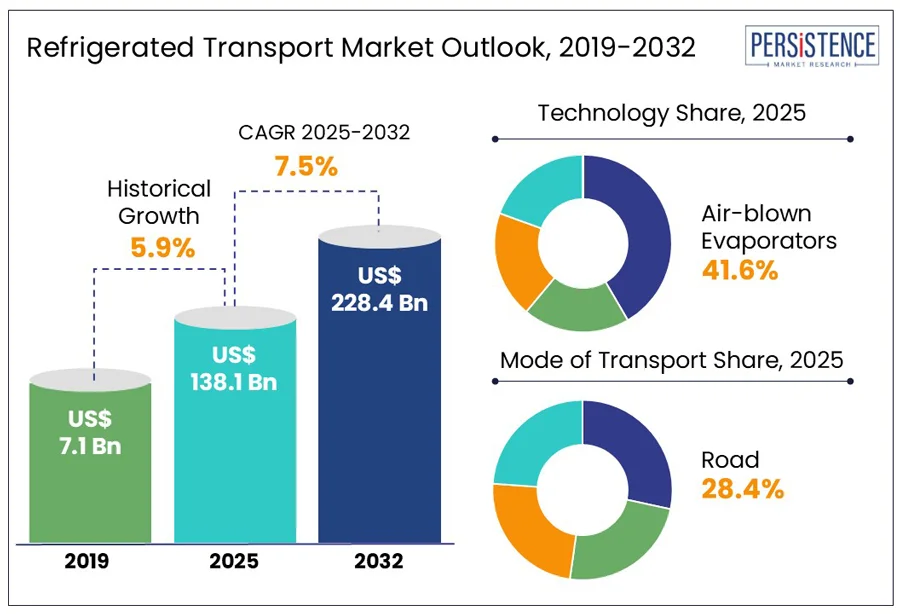
The global refrigerated transport market size is predicted to reach US$ 228.4 Bn in 2032 from US$ 138.1 Bn in 2025. It will likely witness a CAGR of around 7.5% in the forecast period between 2025 and 2032.
As global trade in perishable goods skyrockets and food and pharma supply chains stretch across continents, refrigerated transport has evolved from a support function to a key enabler of quality and compliance. At present, the market sits at a crossroads of innovation, high consumer demand, and strict regulations, with electric reefers, smart tracking, and emission norms reshaping cold logistics.
Key Industry Highlights
- Air-blown evaporators are predicted to hold nearly 41.6% share in 2025 as they ensure uniform cooling and quick temperature recovery, lowering spoilage in sensitive cargo.
- Road transportation is anticipated to generate approximately 28.4% share in 2025 due to its unmatched flexibility and direct door-to-door delivery.
- North America is envisioned to account for about 35.7% share in 2025 amid rising consumer demand for fresh produce and robust cold chain infrastructure.
- Government subsidies for green transport technologies are accelerating electrification in refrigerated fleets.
- Use of blockchain for enhanced cold chain transparency and traceability is gaining traction in refrigerated transport.
|
Global Market Attribute |
Key Insights |
|
Refrigerated Transport Market Size (2025E) |
US$ 138.1 Bn |
|
Market Value Forecast (2032F) |
US$ 228.4 Bn |
|
Projected Growth (CAGR 2025 to 2032) |
7.5% |
|
Historical Market Growth (CAGR 2019 to 2024) |
5.9% |
Market Dynamics
Driver - Strict food safety norms surge smart refrigerated transport adoption
Increasing food safety concerns are directly pushing the refrigerated transport market growth, specifically as global regulatory scrutiny tightens. The European Union’s upgradation of General Food Law Regulation (EU 2019/1381), for instance, has compelled several logistics providers to embrace refrigeration systems that guarantee strict temperature compliance and traceability. Similar norms have mandated real-time monitoring, preventive controls, and recordkeeping during transport, augmenting shippers to invest in smart reefers.
Recent contamination scandals and foodborne outbreaks have further raised concerns in the field of refrigerated trailers. In April 2025, for instance, the U.S. Department of Agriculture (USDA) recalled several types of frozen prepared foods as it revealed that the cilantro used in these products is contaminated with fragments of wood. Similar incidents are expected to lead to a surging demand for validated cold chain networks, mainly for pre-cooked meals, seafood, dairy, and meat. In Southeast Asia, on the other hand, fast-food chains, including CP Foods and Jollibee, have upgraded their entire distribution fleets with digital cold chain tracking following regional audits linked to listeria and salmonella control.
Restraint - Fuel costs and equipment failures expose weak links in refrigerated transport
Fuel inefficiency and equipment malfunctions are emerging as significant vulnerabilities in refrigerated transport. With reefer units consuming significantly more fuel than standard trucks, logistics providers are facing rising cost pressures amid volatile fuel markets. Refrigerated carriers operating on diesel witnessed per-trip costs surge by more than 30% during the 2022 to 2023 energy price spike in Europe. This prompted the reevaluation of fleet composition and routing strategies.
Equipment malfunctions, specifically those involving sensor inaccuracies and compressor failures, are resulting in high-value cargo losses. In early 2024, for instance, a cold chain disruption caused by a refrigeration unit failure at a U.S. Midwest distribution hub led to the disposal of over US$ 2 Mn worth of perishable goods. The incident, reported by FreightWaves, triggered new internal protocols around equipment diagnostics and predictive maintenance using AI and machine learning.
Opportunity - Online grocery boom creates avenues for cold chain logistics
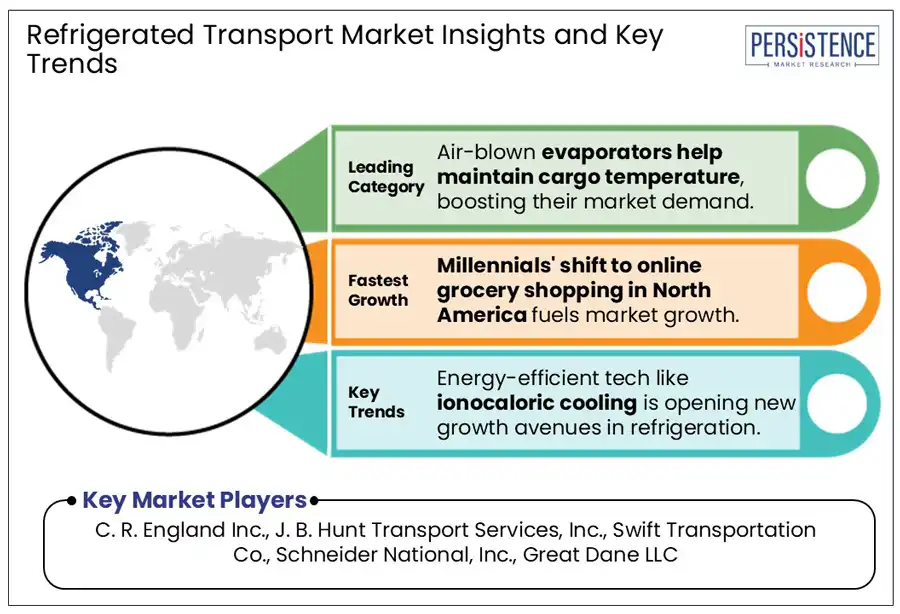
The rise in online grocery shopping and e-commerce is predicted to create new avenues for refrigerated transport service providers, finds Persistence Market Research. Consumers now expect same-day or next-day delivery of fresh produce, ready-to-eat meals, frozen foods, and dairy products. This is further accelerating demand for micro-fulfillment centers equipped with cold storage and last-mile refrigerated fleets. Of late, Walmart, for example, joined hands with Cooler Screens to extend its cold delivery capacity across U.S. metro areas.
Subscription models and direct-to-consumer (D2C) brands are further creating new opportunities for cold logistics. Meal kit services such as Blue Apron and HelloFresh have spurred the development of compact yet energy-efficient cold packaging solutions as well as refrigerated delivery partnerships. In Japan, Oisix ra daichi, a popular organic grocery subscription, reported a 27% year-over-year surge in deliveries of cold goods in 2023 alone, boosting investment in automated chilled sorting lines and temperature-stable packaging.
Category-wise Analysis
Technology Insights
In terms of technology, the market is segregated into air-blown evaporators, eutectic, hybrid, and fully electrified. Among these, the air-blown evaporators segment will likely generate around 41.6% of the refrigerated transport market share in 2025 due to their ability to ensure uniform temperature distribution in the cargo space. These often use high-velocity airflow to circulate chilled air evenly throughout the container, which reduces the risk of localized spoilage. Their ability to quickly re-stabilize temperature is another factor contributing to their high demand.
Fully electrified technology is also gaining traction as it directly addresses the dual pressure of emissions regulations and urban delivery constraints. Several cities in North America and Europe have launched Low-Emission Zones (LEZs) that restrict diesel-powered vehicles. Hence, logistics companies are shifting toward fully electric reefers to maintain access to these areas without penalties. In the recent past, Tesco, for instance, unveiled its first fleet of fully electric refrigerated delivery vans in London using Thermo King’s E-200 all-electric refrigeration units.
Mode of Transport Insights
Based on mode of transport, the market is divided into road, air, sea, and railway. Out of these, road transportation is expected to account for approximately 28.4% share in 2025, backed by its door-to-door accessibility and route flexibility. It enables direct access to farms, retail outlets, warehouses, and processing centers, which is important for maintaining the cold chain for perishable items. The surge in decentralized distribution models boosted by urban grocery delivery is another factor pushing demand for road transport refrigeration equipment.
Refrigerated sea transportation is also seeing a steady growth rate as it enables the long-distance movement of bulk perishables at a relatively lower cost per unit. Sea freight can carry thousands of reefer containers in a single voyage, ensuring economies of scale that are significant for exporters dealing with high-volume seasonal produce. Chile’s blueberry and grape exports to North America and Europe, for example, are heavily reliant on sea transport via specialized refrigerated vessels, especially during peak harvest months.
Regional Insights
North America Refrigerated Transport Market Trends
North America is poised to hold a share of nearly 35.7% in 2025 due to changing consumer behavior favoring e-grocery and meal kits as well as stringent food safety norms. The implementation of the Food Safety Modernization Act (FSMA) and its Sanitary Transportation rule has compelled transporters to invest in innovative temperature monitoring, real-time telematics, and trailer sanitation. Logistics companies are hence retrofitting fleets with smart refrigeration units that deliver continuous GPS tracking and temperature validation. Carrier’s Lynx Fleet platform and Thermo King’s Precedent S-Series, for example, have gained popularity in North America owing to their compliance-ready features.
The U.S. refrigerated transport market is predicted to outpace Canada through 2032, backed by the rapid scaling of cold chain capacity for pharmaceuticals. The emphasis is on biologics and mRNA vaccines that require ultra-low temperatures. Electrification of refrigerated fleets is another key trend, boosted by California’s Advanced Clean Fleets regulation. Hence, companies such as Lineage Logistics have started piloting electric trailers with solar-assist Transport Refrigeration Units (TRUs) in Nevada and California.
Europe Refrigerated Transport Market Trends
In Europe, the European Green Deal and the Fit for 55 package have bolstered the shift toward zero-emission TRUs. London, Oslo, and Amsterdam have implemented low-emission zones that directly impact the operation of diesel-powered reefers. In response, companies such as STEF Group and DFDS have started deploying fully electric and hydrogen-assisted refrigerated trucks. Carrier Transicold’s Vector eCool, a battery-electric trailer system, has already gained momentum among fleets targeting last-mile cold deliveries.
Eastern Europe is poised to experience a significant cold chain market, but with infrastructure lags. As consumption of vaccines and frozen food skyrockets, domestic companies are extending their fleets. Poland-based Frigo Logistics, for example, recently extended and upgraded the refrigeration infrastructure at its distribution center. The new facility will be powered by a solar PV panel installation. It will likely serve international, local, and domestic supply chain companies.
Asia Pacific Refrigerated Transport Market Trends
In Asia Pacific, India is currently witnessing increasing investments in the logistics sector. In May 2025, Celcius Logistics, a Navi Mumbai-based cold chain aggregator, secured nearly Rs. 250 crores in equity and debt funding to extend its operations. In addition, Tamil Nadu is planning to introduce a dedicated warehousing policy by October 2025, focusing on improving cold storage infrastructure, specifically in the delta districts. It aims to support the state's diverse industrial landscape, including perishables and agro-products.
In China, the market is rapidly growing due to the government's strategic initiatives. These include the development of facilities for agricultural products and national cold chain logistics bases. The integration of telematics and IoT in refrigerated transport is further improving real-time fleet management and temperature monitoring. The adoption of electric and hybrid refrigerated vehicles is gaining traction, reducing environmental impact in China.
Competitive Landscape
The refrigerated transport market houses several regional players, specialized cold chain providers, and well-established logistics companies focusing on niche or short-haul segments. Leading players are constantly innovating in terms of telematics integration, energy efficiency, and temperature control technology to gain a competitive advantage. They are mainly embedding AI and IoT-based diagnostics in their transport refrigeration units to support predictive maintenance and reduce spoilage. The market will likely see the influx of several start-ups targeting last-mile refrigerated transport, mainly e-commerce and food delivery sectors.
Key Industry Developments
- In May 2025, TIP Group, in partnership with Mitsubishi Heavy Industries Thermal Transport Europe GmbH and SolarEdge e-Mobility, introduced a new electric refrigerated trailer powered by renewable energy. The new Powered Trailer marks a significant step toward zero-emission, sustainable refrigerated transport.
- In January 2025, SeaCube Containers joined hands with Greensee to introduce new solutions to transform the field of refrigerated transport. This partnership resulted in the launch of SeaCube’s Green and Net-Zero Reefer Leases, setting a new standard for environmental responsibility and energy efficiency in cold chain logistics.
Companies Covered in Refrigerated Transport Market
- C. R. England Inc.
- J. B. Hunt Transport Services, Inc.
- Swift Transportation Co.
- Schneider National, Inc.
- Great Dane LLC
- C.H. Robinson Worldwide, Inc.
- Fenagy
- Kuehne + Nagel
- SolarFreeze
- Wabash National Corporation
- Daikin Industries, Ltd.
- Others
Frequently Asked Questions
The market is projected to reach US$ 138.1 Bn in 2025.
Strict food safety norms and increasing shift toward energy efficient transport are the key market drivers.
The market is poised to witness a CAGR of 7.5% from 2025 to 2032.
Integration of AI in transportation modes and shift toward fully electric options are the key market opportunities.
C. R. England Inc., J. B. Hunt Transport Services, Inc., and Swift Transportation Co. are a few key market players.


