




- Specialty & Fine Chemicals
- Potassium Metabisulfite Market
Potassium Metabisulfite Market Size, Share, and Growth Forecast, 2025 - 2032
Potassium Metabisulfite Market By Grade (Technical Grade, Food Grade, Pharmaceutical Grade), Application (Food and Beverages, Winemaking, Pharmaceuticals, Others), Packaging Type, and Regional Analysis for 2025 - 2032

Potassium Metabisulfite Market Size and Trends Analysis
The global potassium metabisulfite market size is likely to be valued at US$167.4 Billion in 2025, estimated to US$260.1 Billion by 2032, growing at a CAGR of 6.5% during the forecast period from 2025 to 2032, driven by the increasing demand for food preservatives and antioxidants, rising participation in winemaking and beverage production, and advancements in industrial applications for preservation, bleaching, and reduction processes.
The potassium metabisulfite market is further propelled by innovations in high-purity grades and sustainable production methods, catering to preferences for eco-friendly preservatives and tech-integrated solutions in pharma and food sectors.
Key Industry Highlights:
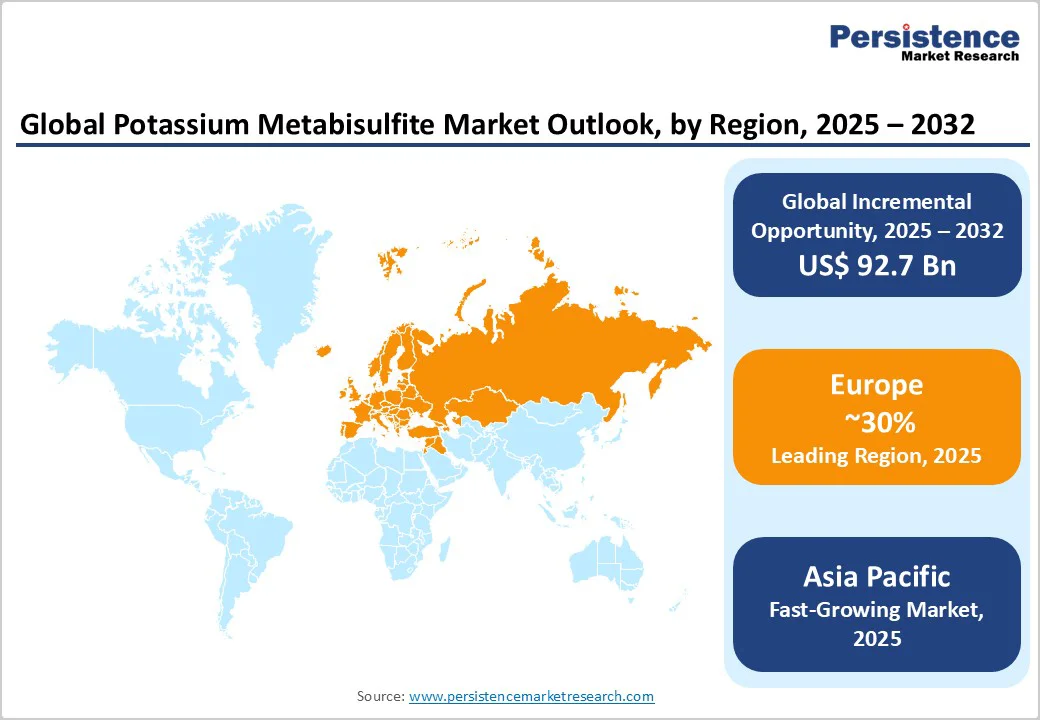
- Leading Region: Europe, commanding a 30% market share in 2025, driven by high wine consumption and premium food preservation in France, Italy, and Germany.
- Fastest-growing Region: Asia Pacific, fueled by urbanization, rising processed food demand, and expanding textiles/pharma in China and India.
- Dominant Grade: Food Grade, holding over 50% of the market share due to beverage and preservation applications.
- Leading Application: Food and Beverages, accounting for nearly 45% of revenue, driven by winemaking and packaging growth.
- Leading Packaging Type: Bags, contributing 35% of market revenue, owing to convenience in mid-scale distribution.
- Key Market Driver: Increasing usage in pharmaceuticals as a stabilizer and reducing agent, along with rising adoption in water treatment and textile processing, fuels market growth.
- Growth Opportunity: Expansion in pharmaceutical-grade KMS for vaccine stabilization and antioxidant formulations amid global biotech boom.
| Key Insights | Details |
|---|---|
|
Potassium Metabisulfite Market Size (2025E) |
US$167.4 Bn |
|
Market Value Forecast (2032F) |
US$260.1 Bn |
|
Projected Growth (CAGR 2025 to 2032) |
6.5% |
|
Historical Market Growth (CAGR 2019 to 2024) |
5.8% |

Market Factors - Growth, Barriers, and Opportunity Analysis
Rising Demand for Food and Beverage Preservation
Rising demand for food and beverage preservation is a key driver for the potassium metabisulfite market. As global consumption of processed, packaged, and ready-to-eat foods increases, manufacturers rely on effective preservatives to maintain product freshness, color, and safety. Potassium metabisulfite serves as a powerful antioxidant and antimicrobial agent, preventing oxidation, discoloration, and microbial growth in products such as dried fruits, juices, wines, and beers. Its ability to inhibit spoilage and extend shelf life makes it indispensable in the food and beverage sector, particularly where long-distance transportation and longer storage times are involved.
The compound is widely used in winemaking and brewing to control fermentation and preserve flavour stability. The rapid expansion of the global food processing industry, driven by urbanization, rising disposable incomes, and changing dietary patterns, further boosts its utilization. Growing consumer preference for quality and consistent taste also supports demand.
Health Concerns & Natural Alternatives
Health concerns and the growing availability of natural alternatives pose notable challenges to the potassium metabisulfite market. Widely used as a preservative and antioxidant, sodium bisulfite can trigger allergic reactions or respiratory issues in sensitive individuals, particularly those with asthma or sulfite intolerance. Regulatory authorities such as the FDA and EFSA have imposed strict labelling requirements for sulfite-containing products, prompting manufacturers to explore safer or plant-based substitutes.
The increasing consumer shift toward clean-label, organic, and chemical-free foods is accelerating the adoption of natural preservatives such as ascorbic acid, rosemary extract, and tocopherols. These alternatives are perceived as healthier and align better with sustainability trends in the food and beverage industries. Growing public awareness of synthetic additives’ potential health impacts is influencing purchasing preferences, especially in developed markets.
Expansion in Pharmaceutical and Water Treatment Applications
Expansion in pharmaceutical and water treatment applications presents a significant growth opportunity for the potassium metabisulfite market. In the pharmaceutical sector, sodium bisulfite is gaining traction as a stabilizer, antioxidant, and reducing agent in drug formulation and vaccine production. Its ability to prevent oxidation and maintain chemical stability of active ingredients makes it valuable for ensuring product quality and shelf life. The surge in global pharmaceutical manufacturing, particularly in emerging economies, along with increased vaccine development and healthcare spending, is expected to drive consistent demand for high-purity grades.
In water treatment, sodium bisulfite is used as a dechlorinating agent to remove residual chlorine and chloramines from industrial and municipal water systems. With rising environmental concerns and stricter water quality regulations, industries are adopting sustainable and effective chemical solutions for wastewater management. Its non-toxic, eco-friendly nature compared to alternatives enhances its appeal in this sector.
Category-wise Analysis
Grade Insights
Food Grade dominates with 50% share in 2025, driven by its versatility in food and beverage applications. Widely used as a preservative, antioxidant, and color stabilizer, it ensures freshness in wines, juices, and dried fruits. Growing global consumption of processed foods continues to reinforce its leading market position.
Pharmaceutical Grade fastest-growing, propelled by rising vaccine production and stringent purity requirements. It is used as a stabilizer and antioxidant in biopharmaceutical formulations to maintain ingredient integrity. The post-pandemic focus on healthcare infrastructure and expanding pharmaceutical manufacturing further boosts demand for high-purity sodium metabisulfite globally.
Application Insights
Food and Beverages lead with 45% share, owing to its extensive use as a preservative, antioxidant, and antimicrobial agent. It helps prevent spoilage, maintain color, and extend shelf life in products such as wine, beer, dried fruits, and juices. Growing demand for processed and packaged foods drives its dominant market position.
Pharmaceuticals' fastest-growing, driven by its role as a stabilizer and antioxidant in drug formulations. It prevents oxidation and degradation of active ingredients, ensuring product efficacy and shelf life. Rising pharmaceutical production, coupled with stringent quality standards, is boosting demand for high-purity sodium metabisulfite globally.
Packaging Type Insights
Bags dominate with 35% share ideal for SMEs. They offer convenient handling, controlled dispensing, and cost-effective packaging for moderate-scale operations in food processing, winemaking, and chemical applications. Their portability and reduced storage space make them ideal for SMEs seeking flexibility and affordability in supply management.
Bulk is the fastest-growing, driven by large-scale demand from food processing, textile, and water treatment industries. Industrial buyers prefer bulk packaging for cost efficiency, ease of transportation, and continuous production needs. Expanding manufacturing capacities and rising exports from Asia Pacific further accelerate the growth of bulk-grade sodium metabisulfite.

Regional Insights
Europe Potassium Metabisulfite Market Trends
Europe 30% share, led by France, Germany, eading due to their strong food processing, beverage, and wine industries. France, one of the world’s top wine producers, generates significant demand for sodium metabisulfite as a preservative and antioxidant in winemaking to prevent oxidation and microbial spoilage. Germany’s well-established food and beverage sector, along with its emphasis on quality and safety standards, further drives consumption in food preservation and brewing applications.
European manufacturers are focusing on high-purity, food-grade sodium metabisulfite to comply with stringent EU regulations on additives and sustainability. The region’s growing demand for eco-friendly and low-residue chemicals has encouraged research into cleaner production technologies. The chemical also finds increasing use in water treatment and textile bleaching, supported by regional industrial advancements.
North America Potassium Metabisulfite Market Trends
North America holds a 25% share in 2025; driven by strong demand from the food & beverage, pharmaceutical, and water treatment sectors. The United States dominates regional consumption, supported by its well-established food processing industry and growing emphasis on product quality and shelf-life extension. Sodium bisulfite is widely used as a preservative, antioxidant, and sterilizing agent in wine, beer, and packaged foods.
The rising popularity of craft breweries and wineries across the U.S. and Canada further supports regional demand. Additionally, the pharmaceutical industry utilizes high-purity grades of sodium metabisulfite in formulation stabilization and chemical synthesis. Stringent food safety and environmental regulations have encouraged manufacturers to invest in advanced purification technologies and sustainable production methods. The region also witnesses increasing adoption in water treatment applications, driven by growing concerns over water quality and industrial wastewater management.
Asia Pacific Potassium Metabisulfite Market Trends
Asia Pacific 35% share in 2025 & fastest-growing, driven by rapid industrialization and expanding end-use sectors. The region’s strong presence in food processing, winemaking, and textile industries fuels steady demand for sodium bisulfite as a preservative, antioxidant, and bleaching agent. Countries such as China, India, and Australia are key contributors, supported by abundant raw material availability, lower production costs, and favourable government initiatives promoting chemical manufacturing.
The growing consumption of processed foods and beverages, coupled with the region’s thriving wine industry, especially in Australia and New Zealand, further strengthens market growth. Additionally, the textile and leather industries in South and Southeast Asia are increasingly adopting sodium metabisulfite for bleaching and dyeing applications. Rising awareness of water treatment and wastewater management also boosts its usage in industrial and municipal facilities.
Competitive Landscape
The global potassium metabisulfite market is highly competitive, driven by the presence of established players investing in capacity expansion, technological advancements, and product innovation to strengthen their market position. Leading manufacturers are focusing on improving production efficiency and enhancing product purity to meet the stringent quality requirements of industries such as food & beverages, pharmaceuticals, and water treatment. Companies are also expanding their manufacturing bases in the Asia Pacific and Europe to capitalize on the growing demand from wine production, food preservation, and textile processing sectors.
Strategic mergers, partnerships, and acquisitions are increasingly common as firms aim to diversify their product portfolios and gain access to new markets. R&D investments are directed toward developing low-residue and eco-friendly formulations to comply with evolving environmental regulations. With rising awareness of food safety and clean-label ingredients, competition is intensifying among players offering high-purity grades suitable for sensitive applications.
Key Industry Developments
- In March 2025, Kemira announced a strategic collaboration with Jiangsu Luyue Chemical Co., Ltd. to co-develop and supply high-purity food-grade potassium metabisulfite globally.
- In July 2024, BASF launched a new food-grade potassium metabisulfite product line aimed at beverage and processed-food applications.
Companies Covered in Potassium Metabisulfite Market
- Merck KGaA
- Tongliao Tianyi Chemical Group Co. Ltd.
- Hangzhou Dayangchem Co. Ltd.
- INEOS Hygienics
- FUJIFILM Wako Pure Chemical Corporation
- BASF
- LOBA CHEMIE PVT. LTD.
- Shandong Luanjing Chemical Tech Co., Ltd.
- Jiaxing Kaili Chemical Co. Ltd.
- Chemtrade Logistics Inc.
- Alfa Aesar
- TCI (Tokyo Chemical Industry Co., Ltd.)
- Mitsubishi Gas Chemical Company, Inc.
Frequently Asked Questions
The global Potassium Metabisulfite Market is projected to reach US$ 167.4 Bn in 2025, driven by F&B preservation and winemaking trends.
The rapid expansion of the global food processing industry, driven by urbanization, rising disposable incomes, and changing dietary patterns, further boosts its utilization.
The market is growing CAGR of 6.5% from 2025-2032, supported by Asia Pacific expansion and industrial uses.
Pharma stabilization, emerging wine markets (India), and sustainable textiles offer high potential.
Merck KGaA, BASF, Aditya Birla, Chemtrade, Alfa Aesar lead with innovative grades and global supply.


