




- Medical Devices
- Global Plantar Plate Repair Market
Global Plantar Plate Repair Market Size, Share, Growth, and Regional Forecast, 2026 to 2033
Global Plantar Plate Repair Market by Repair Type (Non-Operative Management, and Operative Management), by Implant Site (Dorsal Foot, and Plantar Foot), by End User (Hospitals, Specialty Clinics, Ambulatory Surgery Centers, and Others), and Regional Analysis from 2026 to 2033.

Global Plantar Plate Repair Market Size and Trends Analysis
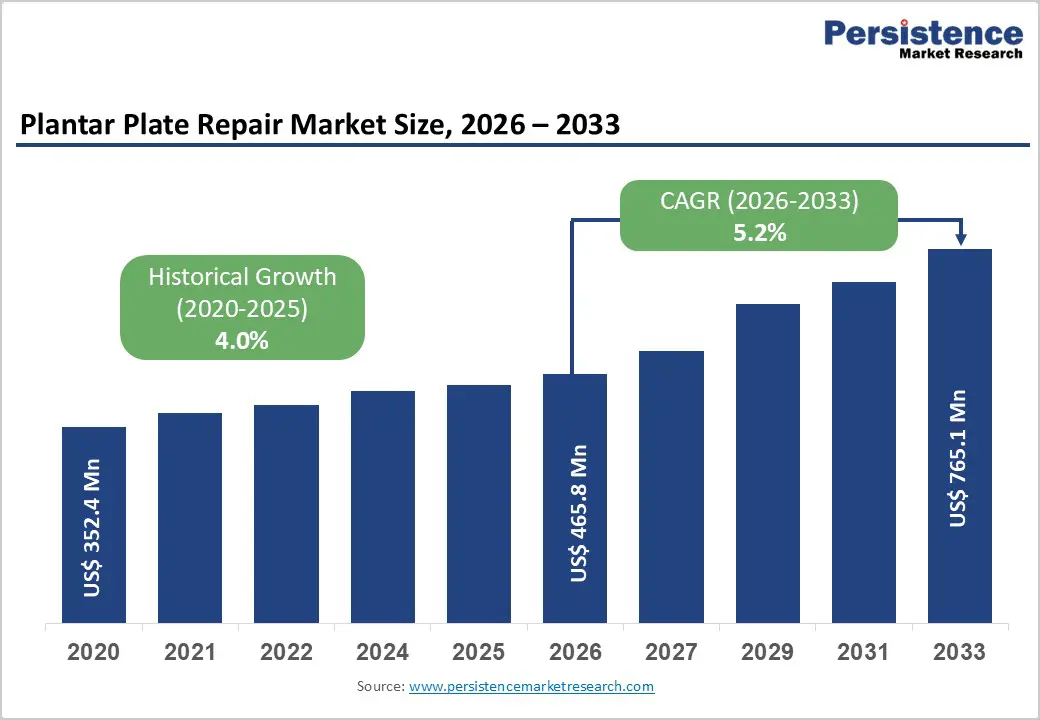
The global plantar plate repair market size is estimated to grow from US$ 465.8 Mn in 2026 to US$ 7.6 Mn by 2033. The market is projected to record a CAGR of 5.2% during the forecast period from 2026 to 2033.
Global demand for plantar plate repair procedures is rising steadily, driven by the increasing prevalence of forefoot disorders, metatarsophalangeal joint instability, and degenerative soft-tissue injuries requiring long-term functional correction. Conditions such as plantar plate tears, metatarsalgia, crossover toe deformity, and hallux valgus–associated instability are creating sustained demand for effective repair solutions that restore joint alignment and mobility. Growing patient preference for durable, outcome-driven interventions, combined with rising expectations for faster recovery and improved quality of life, is accelerating adoption of both operative and non-operative management approaches. Advances in surgical techniques, including minimally invasive dorsal approaches, improved suture fixation systems, and biologic augmentation, are enhancing procedural success rates. Increasing procedure volumes among aging populations, athletes, and individuals with lifestyle-related foot stress further support market expansion. Expanding access to specialized foot and ankle care, improving surgical training, and favorable reimbursement coverage in developed and emerging markets continue to reinforce long-term global growth.
Key Industry Highlights
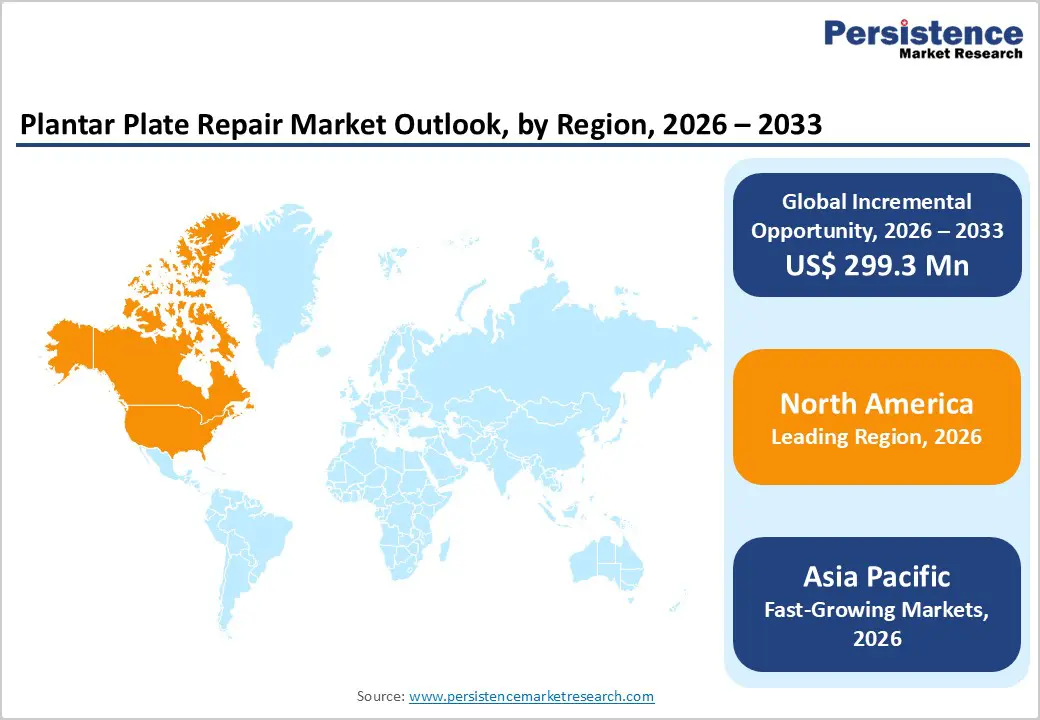
- Leading Region: North America holds the largest market share at 47.6%, supported by advanced orthopedic infrastructure, high adoption of surgical repair techniques, favorable reimbursement, and strong awareness of forefoot pathologies.
- Fastest-Growing Region: Asia Pacific is expanding at the fastest pace due to a large patient base, improving access to orthopedic and podiatric care, rising healthcare expenditure, and growing surgical capacity.
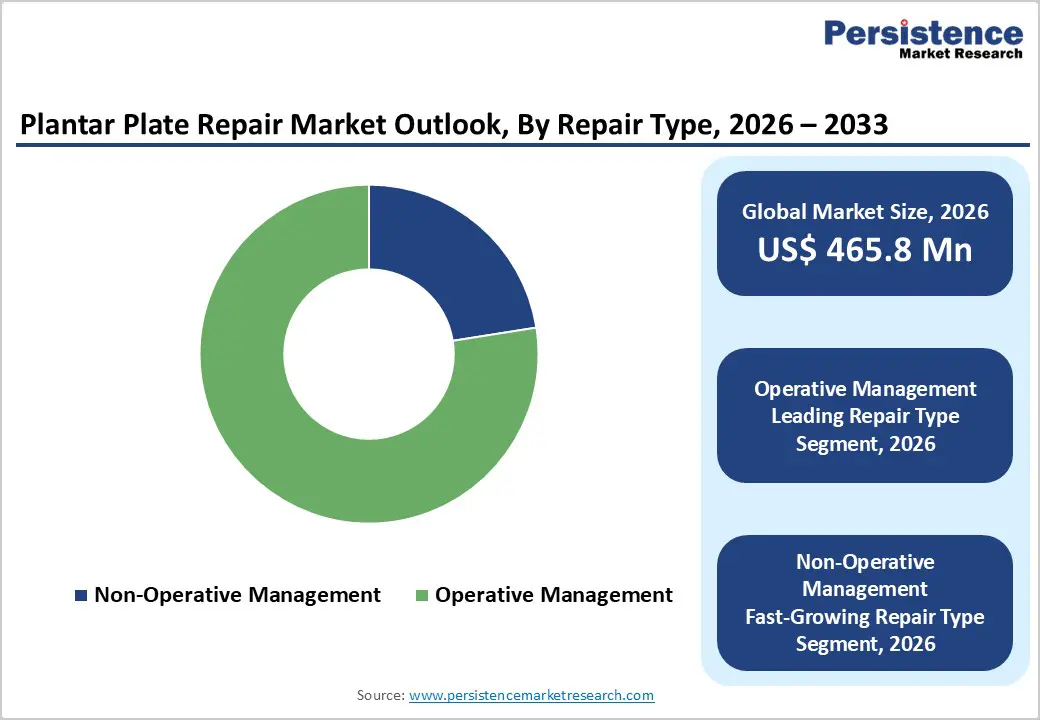
- Leading Repair Type Segment: Operative management dominates the market due to established clinical efficacy, predictable long-term outcomes, and strong surgeon preference for definitive correction.
- Fastest-Growing Repair Type Segment: Non-operative management is witnessing rapid growth as early diagnosis increases and conservative treatment options gain acceptance in mild to moderate cases.
- Leading Implant Site Segment: Dorsal foot remains the largest application segment, driven by broad surgical adoption, procedural safety, and consistent post-operative outcomes.
- Fastest-Growing Implant Site Segment: Plantar foot is expanding rapidly due to improving surgical techniques, earlier intervention rates, and increasing surgeon confidence in plantar access approaches.
| Global Market Attributes | Key Insights |
|---|---|
| Plantar Plate Repair Market Size (2026E) | US$ 465.8 Mn |
| Market Value Forecast (2033F) | US$ 765.1 Mn |
| Projected Growth (CAGR 2026 to 2033) | 5.2% |
| Historical Market Growth (CAGR 2020 to 2025) | 4.0% |
Market Dynamics
Driver – Rising Prevalence of Forefoot Disorders and Advancements in Surgical Repair Techniques
The increasing global prevalence of forefoot pathologies, including plantar plate tears, metatarsophalangeal (MTP) joint instability, metatarsalgia, and crossover toe deformities, is a primary driver of growth in the plantar plate repair market. Aging populations, rising obesity rates, prolonged standing occupations, and increased participation in sports and recreational activities are contributing to higher mechanical stress on the forefoot, leading to ligament degeneration and injury. Improved clinical awareness and advancements in diagnostic imaging, such as high-resolution MRI and ultrasound, are enabling earlier and more accurate identification of plantar plate injuries, thereby expanding the addressable patient pool.
Additionally, advancements in surgical repair techniques are strengthening market demand. The adoption of minimally invasive dorsal approaches, improved suture-based fixation systems, and anatomically designed implants has enhanced procedural outcomes, reduced complication rates, and shortened recovery times. Surgeon familiarity with standardized repair protocols and growing availability of dedicated plantar plate repair systems are further accelerating adoption. As healthcare systems increasingly emphasize mobility preservation, pain reduction, and long-term functional outcomes, operative plantar plate repair is gaining recognition as a definitive and durable treatment option, reinforcing sustained market growth.
Restraints – High Procedure Costs and Limited Access to Specialized Foot and Ankle Care
The plantar plate repair market faces notable restraints related to procedure costs and uneven access to specialized care. Surgical repair often requires advanced fixation devices, specialized instrumentation, and experienced foot and ankle surgeons, contributing to higher overall treatment costs compared to conservative management options. In cost-sensitive healthcare systems, especially in low- and middle-income regions, these factors can limit patient access and delay surgical intervention. Additionally, reimbursement policies for forefoot soft-tissue procedures vary widely across regions, with some payers favoring prolonged conservative treatment before approving operative repair, potentially restricting procedural volumes.
Limited availability of trained orthopedic foot and ankle specialists further constrains market expansion, particularly in emerging markets and rural areas. Hospitals and specialty centers with the necessary surgical expertise and infrastructure are often concentrated in urban regions, leading to referral delays and underdiagnosis. Post-operative rehabilitation requirements and concerns around recovery time may also deter certain patient populations from opting for surgical repair. Together, cost pressures, reimbursement variability, and infrastructure limitations continue to restrain broader adoption of plantar plate repair procedures, despite growing clinical awareness and improving surgical outcomes.
Opportunity – Expansion of Minimally Invasive Surgery and Growth of Outpatient Care Settings
The increasing shift toward minimally invasive surgical techniques presents a significant growth opportunity for the global plantar plate repair market. Innovations in dorsal access approaches, low-profile fixation devices, and refined suture repair systems are enabling surgeons to achieve effective ligament reconstruction with reduced soft-tissue disruption. These advancements are improving post-operative recovery, lowering complication rates, and expanding the suitability of surgical repair to a broader patient population, including elderly and active individuals seeking faster functional restoration.
Furthermore, the rapid expansion of ambulatory surgery centers and specialty orthopedic clinics is creating new avenues for market growth. As healthcare systems prioritize cost efficiency and outpatient care, select plantar plate repair procedures are increasingly being performed outside traditional hospital settings. This shift is supported by shorter procedure times, improved anesthesia protocols, and streamlined post-operative pathways. Emerging markets in Asia Pacific, Latin America, and the Middle East are also investing heavily in orthopedic infrastructure and surgical training, improving access to advanced foot and ankle care. Strategic collaborations between device manufacturers and healthcare providers, coupled with ongoing innovation in repair technologies, are expected to further unlock long-term growth opportunities over the forecast period.
Category-wise Analysis
By Repair Type, Operative Management Dominates Owing to Superior Surgical Outcomes and High Clinical Preference
The operative management segment is projected to dominate the global plantar plate repair market in 2026, accounting for a revenue share of 77.5%. Segment leadership is supported by strong clinical evidence demonstrating superior outcomes in moderate to severe plantar plate tears, particularly in cases unresponsive to conservative treatment. Surgical repair enables direct correction of ligament disruption, toe instability, and metatarsophalangeal joint deformities, resulting in improved functional recovery and reduced recurrence rates. Growing adoption of minimally invasive and dorsal surgical approaches has further enhanced procedural safety and patient outcomes. Increasing surgeon familiarity, standardized operative techniques, and expanding availability of specialized fixation devices and soft-tissue repair systems continue to support widespread adoption. While non-operative management remains relevant for early-stage or mild cases, operative intervention remains the preferred option for definitive treatment, reinforcing its dominant market position.
By Implant Site, Dorsal Foot Approach Leads Due to Procedural Safety and Broad Surgeon Adoption
The dorsal foot segment is expected to dominate the global plantar plate repair market in 2026, accounting for a revenue share of 53.8%. This dominance is driven by the widespread clinical preference for the dorsal surgical approach, which offers improved visualization of the plantar plate while minimizing disruption to weight-bearing plantar tissues. Surgeons favor dorsal access due to lower risks of wound complications, faster post-operative recovery, and easier integration with concurrent forefoot corrective procedures. The dorsal approach also allows efficient use of modern fixation devices and suture-based repair systems, supporting procedural consistency and reproducibility. Growing adoption of minimally invasive dorsal techniques, combined with favorable patient outcomes and reduced post-surgical morbidity, continues to strengthen this segment’s leadership. While plantar approaches are gaining attention with advancing techniques, the dorsal foot segment remains the most established and widely adopted implant site globally.
By End User, Hospitals Maintain Market Leadership Supported by Advanced Surgical Infrastructure
The hospitals segment is projected to dominate the global plantar plate repair market in 2026, accounting for a revenue share of 59.3%. This leadership reflects the high volume of complex forefoot procedures performed in hospital settings, supported by advanced surgical infrastructure and access to multidisciplinary orthopedic teams. Hospitals are the primary centers for managing severe plantar plate injuries, revision surgeries, and patients with comorbidities requiring comprehensive perioperative care. Availability of advanced imaging, anesthesia services, and post-operative rehabilitation facilities further strengthens hospital-based adoption. In addition, hospitals serve as key training centers for orthopedic surgeons, driving early uptake of novel repair systems and surgical techniques. While ambulatory surgery centers are gaining traction for select cases, hospitals continue to dominate due to their capacity to manage complex cases and deliver integrated surgical care.
Region-wise Insights
North America Plantar Plate Repair Market Trends
The North America plantar plate repair market is expected to dominate globally with a value share of 47.6% in 2026, led primarily by the U.S. The region benefits from a highly developed healthcare system, strong adoption of advanced orthopedic surgical techniques, and early uptake of minimally invasive foot and ankle procedures. High awareness among orthopedic surgeons and podiatrists regarding plantar plate pathology supports early diagnosis and timely surgical intervention. Favorable reimbursement frameworks and broad insurance coverage enhance patient access to operative repair procedures, including advanced fixation systems.
The presence of leading orthopedic device manufacturers, extensive clinical research activity, and rapid commercialization of innovative implants further support market growth. North America also demonstrates high procedure volumes driven by an aging population, rising incidence of forefoot deformities, and increased participation in sports-related activities. Strong clinical training programs, established treatment protocols, and continuous investment in next-generation surgical technologies reinforce the region’s leadership in the global plantar plate repair market.
Europe Plantar Plate Repair Market Trends
The Europe plantar plate repair market is expected to grow steadily, supported by rising prevalence of forefoot disorders, aging demographics, and increasing focus on preserving mobility and quality of life. Countries such as Germany, the U.K., France, Italy, and the Nordic region are key contributors due to well-established public healthcare systems and broad access to orthopedic surgical services.
European healthcare frameworks emphasize evidence-based practice, encouraging adoption of surgical techniques with proven clinical outcomes. Growing use of minimally invasive dorsal repair approaches aligns with regional priorities to reduce hospital stays and post-operative complications. Expansion of orthopedic centers of excellence, improved access to specialist foot and ankle surgeons, and increasing procedural standardization are supporting consistent market growth. Additionally, strong regulatory harmonization, cross-border clinical collaborations, and rising investment in advanced orthopedic implants are strengthening Europe’s role in the global plantar plate repair landscape.
Asia Pacific Plantar Plate Repair Market Trends
The Asia Pacific plantar plate repair market is expected to register a relatively higher CAGR of around 7.1% between 2026 and 2033, driven by a large patient population, rising awareness of foot and ankle disorders, and rapid expansion of healthcare infrastructure. Countries such as China, India, Japan, South Korea, and Southeast Asian nations are witnessing increasing diagnosis rates for forefoot deformities linked to aging, lifestyle changes, and sports participation. Improving access to orthopedic care, rising healthcare expenditure, and government initiatives aimed at strengthening surgical capabilities are accelerating market growth.
Expansion of hospital networks, specialty orthopedic centers, and trained surgeons is improving availability of advanced plantar plate repair procedures. Collaborations between regional healthcare providers and global orthopedic device manufacturers are enhancing technology transfer and procedural adoption. Growing emphasis on early surgical intervention, functional recovery, and patient mobility is expected to sustain strong momentum for plantar plate repair adoption across the Asia Pacific region.
Competitive Landscape
The global plantar plate repair market is highly competitive, with strong participation from Paragon 28, Arthrex Inc., DePuy Synthes Inc., Stryker, Zimmer Biomet, and CONMED Corporation. These companies benefit from comprehensive foot and ankle portfolios, advanced soft-tissue fixation and implant technologies, and well-established global distribution networks. Competitive strategies focus on expanding plantar plate–specific repair systems, refining minimally invasive surgical techn
iques, and improving procedural outcomes through surgeon-friendly instrumentation.
Investments in clinical education, product line extensions, and geographic expansion particularly in emerging markets are intensifying competition. Continuous innovation in fixation methods, biomaterials, and surgical approaches is expected to drive sustained market evolution over the forecast period.
Key Industry Developments:
- In April 2025, Paragon 28, a leading medical device company dedicated exclusively to the foot and ankle orthopedic market, announced the expansion of its hammertoe and soft-tissue portfolio with the launch of the Paratrooper™ Plantar Plate Repair System. The Paratrooper™ system features a low-profile, all-suture implant design that enables a minimally invasive and innovative approach to plantar plate repair and the correction of forefoot deformities, supporting improved surgical precision and functional outcomes.
Companies Covered in Global Plantar Plate Repair Market
- Paragon 28
- Arthrex Inc.
- DePuy Synthes Inc.
- Stryker
- Zimmer Biomet
- CONMED Corporation
- Smith + Nephew
- Wright Medical Group N.V.
- 26Apothecary
- Orthofix Medical Inc.
- Medartis AG
- Integra LifeSciences
- Exactech, Inc.
- Orthomed
- Others
Frequently Asked Questions
The global Plantar Plate Repair Market is projected to be valued at US$ 465.8 Mn in 2026.
The market is driven by the rising incidence of foot disorders and plantar plate injuries, increasing adoption of minimally invasive surgical techniques, and a growing geriatric population seeking effective interventions.
The global plantar plate repair market is poised to witness a CAGR of 5.2% between 2026 and 2033.
Key opportunities lie in the development of advanced minimally invasive procedures, novel implants and biomaterials, enhanced imaging guidance technologies, and expanded access in emerging healthcare markets.
Paragon 28, Arthrex Inc., DePuy Synthes Inc., Stryker, Zimmer Biomet, and CONMED Corporation are some of the key players in the plantar plate repair market.


