




- Home Care & Utilities
- Outdoor Flooring Market
Outdoor Flooring Market Size, Share, and Growth Forecast, 2026 - 2033
Outdoor Flooring Market by Material Type (Wood & Laminate, Composite, Concrete, Ceramic & Porcelain, Stone, Rubber, Synthetic Fiber & Fabric, Others), Flooring Type (Decking, Tiles & Pavers, Artificial Turf, Outdoor Rugs & Carpets, Resilient Flooring, Non-Resilient Flooring), Installation Method (Interlocking, Floating, Traditional), and Regional Analysis for 2026 - 2033

Outdoor Flooring Market Size and Trends Analysis
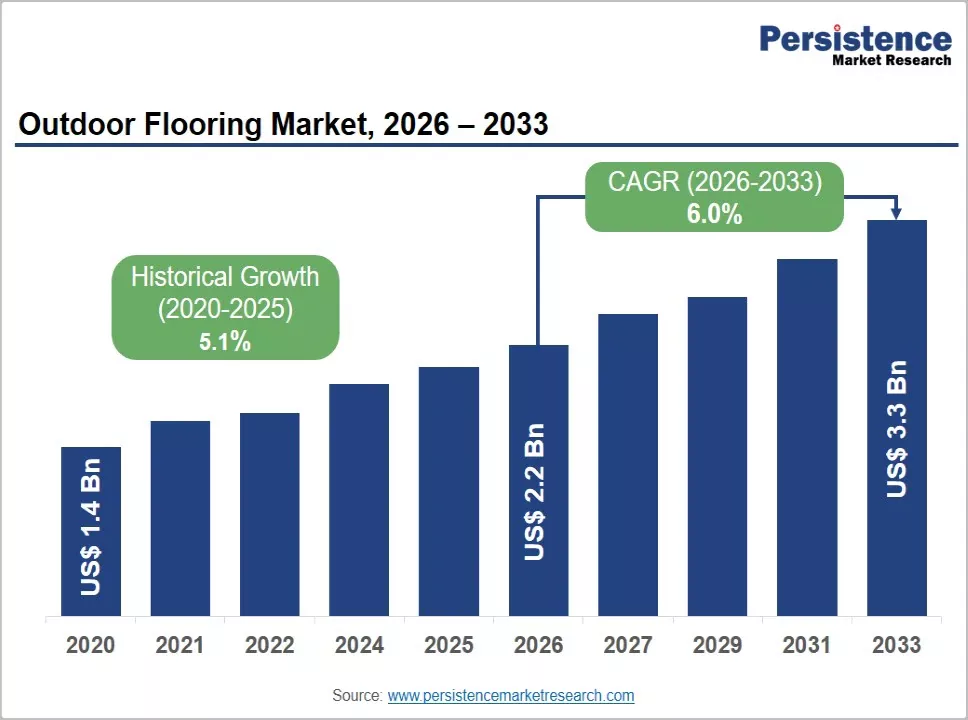
The global outdoor flooring market size is likely to be valued at US$2.2 billion in 2026 and is estimated to reach US$3.3 billion by 2033, growing at a CAGR of 6.0% during the forecast period 2026 - 2033, driven by the rising demand for durable exterior living surfaces.
Demographic shifts toward outdoor lifestyle integration accelerate the adoption of weather-resistant surfaces across residential and commercial properties. Urban population concentration expands outdoor amenity requirements in multi-unit and single-family developments. Regulatory frameworks promoting low-maintenance and recycled-content materials increase the specification of composite and ceramic options over traditional timber. Technology adoption in interlocking systems and UV-stable formulations reduces installation time and lifecycle costs.
Key Industry Highlights:
- Leading Flooring Type: Decking is expected to hold around 38% market share in 2026, driven by residential outdoor living expansion.
- Fastest-Growing Flooring Type: Tiles & pavers are projected as the fastest-growing segment, supported by infrastructure and hardscape projects.
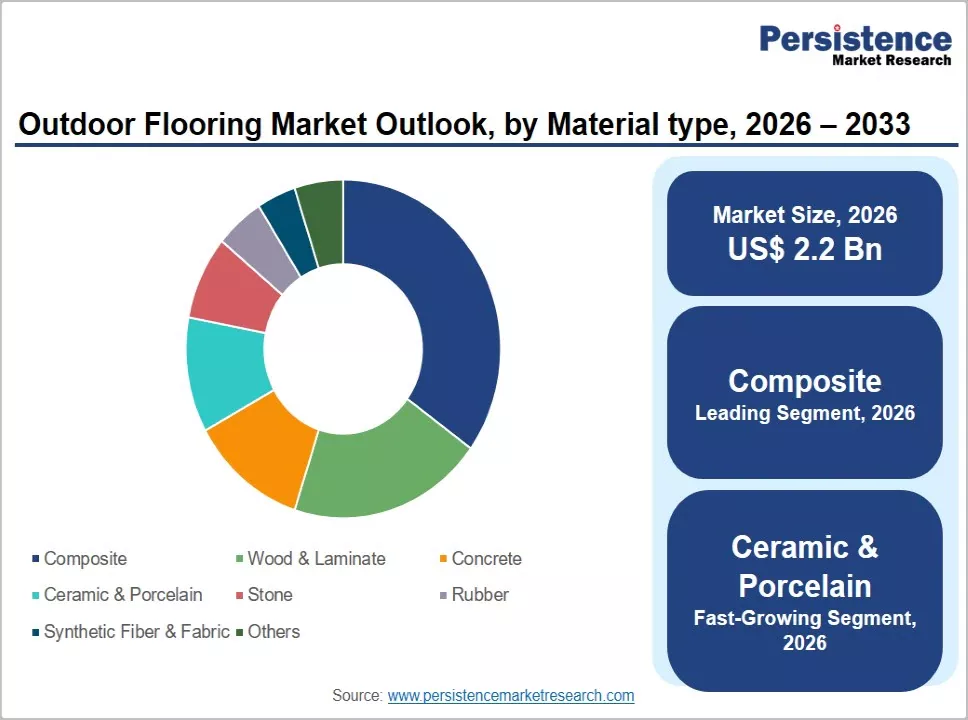
- Leading Material: Composites are estimated to hold roughly 35% market share in 2026, due to low-maintenance performance and recycled content.
- Fastest-Growing Material: The ceramic & porcelain segment is forecast to record the fastest growth, driven by frost resistance and design range.
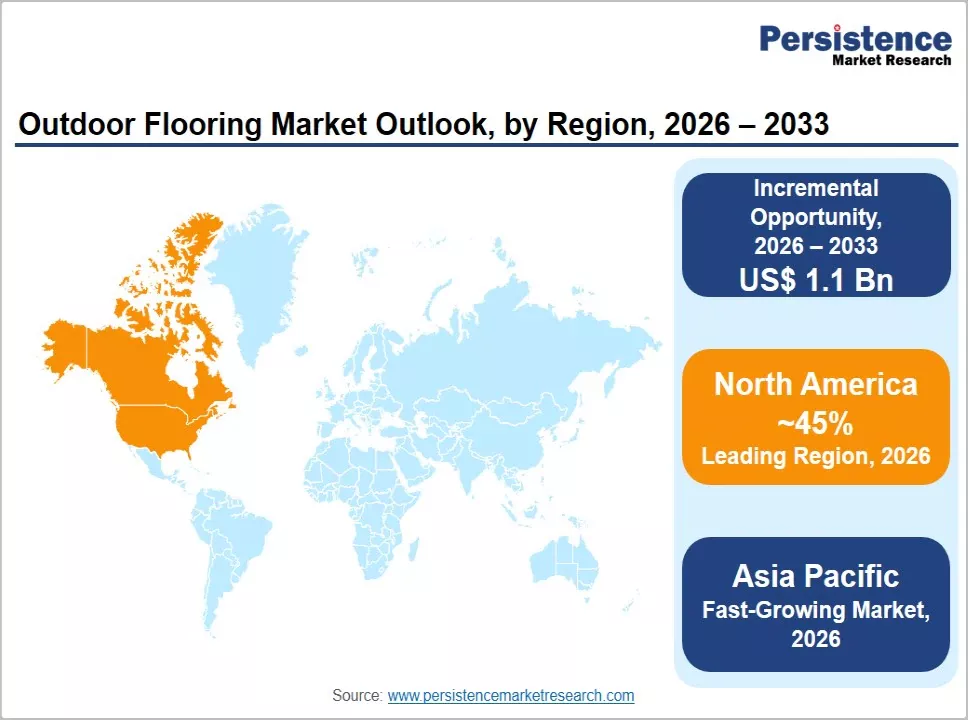
- Regional Leadership: North America is projected to capture roughly 45% of the market share by 2026, while Asia Pacific is also forecast to record the fastest growth due to urbanization and infrastructure scale.
- Competitive Environment: Moderately fragmented structure with Trex, AZEK, Fiberon, Mohawk, and Tarkett as principal participants.
- Innovation Trends: Higher recycled content and fire-resistant formulations expand specification in regulated markets.
DRO Analysis
Driver - Infrastructure and commercial development programs
Public and commercial construction programs generate large-area outdoor flooring requirements for plazas, parks, hospitality terraces, and transportation hubs. Federal and state infrastructure allocations direct funding toward pedestrian-friendly surfaces that must withstand heavy traffic and weather extremes. Concrete, stone, and rubber systems satisfy load-bearing and slip-resistance standards required by municipal codes. Project scale drives bulk procurement of tiles, pavers, and synthetic turf, creating predictable order volumes for manufacturers. Regulatory emphasis on accessibility and drainage further elevates demand for modular and permeable designs.
Commercial operators in hospitality and retail sectors upgrade exterior spaces to attract foot traffic. Capital expenditure on outdoor flooring raises property utilization rates and supports higher occupancy metrics. The causal chain runs from infrastructure budgets through material selection to sustained manufacturer shipments.
Restraint - Raw material price volatility and supply constraints
Fluctuations in polymer resin and wood-fiber costs compress manufacturer margins on composite products. Supply-chain disruptions in recycled plastic feedstock limit production scalability during peak construction seasons.
Higher input costs transfer partially to end-users, slowing conversion from traditional wood in price-sensitive segments. Inventory buffers become necessary yet raise working-capital requirements. Margin pressure restricts capacity expansion investments and delays new product introductions.
Opportunity - Recycled-content material innovation pathways
Manufacturers that increase post-consumer recycled content can strengthen specification preference under green building programs. Trex reported sourcing nearly one billion pounds of recycled and reclaimed materials in 2025, supporting its use of recycled feedstocks in composite decking, reducing reliance on virgin feedstocks and supporting circular-material procurement initiatives.
An actionable pathway involves expanding closed-loop collection networks and increasing recycled content while maintaining structural performance. Market growth is supported by regulatory incentives and corporate sustainability targets that increase demand for certified products, while procurement mandates can accelerate adoption in public infrastructure projects.
Category-wise Analysis
Material Type Insights
Composites are expected to lead the outdoor flooring market, accounting for 35% market share in 2026. Composite boards combine wood fiber and recycled polymers to deliver low maintenance and resistance to rot. Trex and Fiberon formulations incorporating over 90% recycled content illustrate the commercial scale of this approach. Demand rises as residential and commercial owners prioritize longevity over initial cost. UV stabilizers and capped surfaces extend service life beyond conventional timber, supporting higher average selling prices.
The ceramic & porcelain segment is likely to be the fastest-growing segment, propelled by improved frost resistance and design versatility. Porcelain tiles withstand freeze-thaw cycles in northern climates while offering broad aesthetic options. A commercial plaza project in a temperate zone replaced stone with large-format porcelain to reduce weight and maintenance. Adoption accelerates in hospitality and public spaces where visual impact and durability intersect. Manufacturing advances lower unit costs and expand color ranges.
Flooring Type Insights
Decking is projected to lead the market, capturing around 38% of the market share in 2026. Decking systems form primary surfaces for residential outdoor living and elevated commercial terraces. Fiberon Wildwood boards using 94% recycled mix demonstrate material efficiency in high-volume residential applications. Structural performance under foot traffic and furniture loads sustains preference. Integration with railing and lighting accessories increases system value.
Tiles & pavers are likely to be the fastest-growing segment, fueled by infrastructure and hardscape projects. Tiles and pavers provide modular coverage for plazas, walkways, and pool decks. A municipal park renovation utilized interlocking concrete pavers to achieve rapid installation and permeable drainage. Volume grows with public spending on pedestrian infrastructure. Aesthetic customization and load ratings support commercial specification.
Installation Method Insights
The traditional segment is likely to lead with a projected 45% of the outdoor flooring market share in 2026 due to established contractor familiarity and code acceptance. Traditional fastening remains standard for structural decks and heavy-load areas. A multi-family housing project employed conventional joist-and-screw methods to meet local engineering requirements. Labor availability and proven performance sustain share. Material compatibility with existing substructures favors continuity.
Interlocking is anticipated to be the fastest-growing segment, fueled by labor efficiency and renovation demand. Interlocking profiles reduce on-site cutting and fastening time. A hospitality terrace upgrade completed installation 30% faster with click-lock composite tiles versus traditional methods. Growth follows from shorter project cycles and lower skill thresholds. Modular designs expand use in both residential and light commercial settings.
Regional Insights
North America Outdoor Flooring Market Trends
North America is forecast to lead the regional market, capturing around 45% of the global market revenue in 2026, driven by sustained residential renovation spending and a mature composite manufacturing base. The U.S. Census Bureau data record residential construction near a seasonally adjusted annual rate of US$ 900 billion through late 2025. High homeownership rates channel capital into decking and patio surfaces. Composite producers maintain extensive distribution networks that support rapid product availability. Regulatory emphasis on fire-resistant and recycled materials in western states accelerates specification of advanced PVC and composite lines.
U.S. Outdoor Flooring Market Insights
The U.S. is anticipated to dominate the North America market, capturing nearly 88% of market share in 2026. Private residential spending supports continuous renovation of existing outdoor spaces. Trex distribution realignment with Specialty Building Products in 2026 expands national reach. Fire-code compliant products address western wildfire zones. Growth stems from conversion of traditional wood decks to composite systems. Infrastructure and commercial plaza projects add steady tile and paver volumes. Local manufacturing capacity shortens lead times.
Canada Outdoor Flooring Market Insights
Canada is expected to hold around 12% of the North America market in 2026. Residential construction and climate-adapted materials support steady demand. Freeze-thaw resistant ceramics and composites gain preference in central and eastern provinces. Provincial green-building incentives raise specification rates. Distribution networks of major producers ensure product availability. Multi-family outdoor amenity upgrades contribute volume. Cold-climate performance standards guide material selection.
Europe Outdoor Flooring Market Trends
Europe is expected to command around 25% of the global market share in 2026. Circular-economy directives favor high-recycled-content composites and ceramics. Public park and pedestrian infrastructure programs generate consistent demand for durable pavers. Manufacturers supply region-specific formulations that meet VOC and recycled-content thresholds. Regulatory pressure accelerates adoption of certified materials. Commercial and public projects drive bulk orders. Material durability under variable weather sustains specifications.
Germany Outdoor Flooring Market Insights
Germany is projected to lead, accounting for 28% of the Europe market in 2026. Industrial and residential renovation activity supports volume. Porcelain and concrete systems dominate commercial applications. Energy-efficient building codes reward low-maintenance exterior surfaces. Local production capacity supports short lead times. Public plaza upgrades add steady orders. Contractor familiarity with traditional methods remains high. Specification shifts toward recycled composites. Demand concentrates in urban renewal projects.
U.K. Outdoor Flooring Market Insights
The U.K. is anticipated to hold about 18% of the Europe market in 2026. Residential garden and patio upgrades drive demand. Composite decking gains share as timber prices fluctuate. Urban densification raises outdoor amenity requirements in multi-unit developments. Local codes emphasize slip resistance and drainage. Distribution channels expand product access. Renovation cycles sustain steady volume. Material preference favors low-maintenance options. Growth follows housing improvement spending.
Asia Pacific Outdoor Flooring Market Trends
Asia Pacific is forecast to be the fastest-growing market for outdoor flooring, stimulated by rapid urbanization and large-scale infrastructure investment. Residential and commercial construction volumes generate high demand for cost-effective concrete, ceramic, and synthetic surfaces. Public park and transit-oriented development projects specify modular tiles and artificial turf. Local manufacturing scale reduces landed costs. Infrastructure capital outlays drive bulk material procurement and subsequent volume growth.
China Outdoor Flooring Market Insights
China is expected to lead, commanding around 30% of the Asia Pacific market in 2026. Urban green-space mandates support ceramic and concrete installations. Residential construction and commercial plaza development expand volume. Domestic producers scale output to meet internal demand. Modular systems shorten project timelines. Public infrastructure programs generate large orders. Material selection prioritizes durability and cost. Growth tracks urban expansion rates. Local supply chains ensure availability.
India Outdoor Flooring Market Insights
India is estimated to hold nearly 23% of the Asia Pacific market in 2026. Residential and hospitality construction drive elevated growth rates. Synthetic turf and interlocking pavers address rapid project timelines. Infrastructure corridor development raises volume. Middle-income housing increases outdoor surface demand. Local manufacturing expands capacity. Cost-effective materials dominate specification. Growth follows public and private investment levels. Modular designs support faster installation cycles.
Competitive Landscape
The global outdoor flooring market is moderately fragmented, with competition spread across established manufacturers, regional specialists, and private-label suppliers. Five prominent participants include Trex Company, The AZEK Company, Fiberon, Mohawk Industries, and Tarkett. These companies offer broad product portfolios covering composite decking, resilient flooring, tiles, and other outdoor flooring solutions. Their strong distribution networks and established brands support market presence across residential and commercial applications.
Competition is mainly shaped by material durability, weather resistance, low-maintenance performance, recycled content, design flexibility, and distribution reach. Composite flooring manufacturers are focusing on products that combine wood-like appearance with improved resistance to moisture, fading, and wear. Ceramic and porcelain suppliers compete through design variety and surface durability, while resilient flooring providers emphasize installation flexibility and maintenance benefits.
Key Industry Developments:
- In May 2026, Continental Surface Solutions launched d-c-fix Outdoor Floor in the U.S., a roll-out vinyl flooring solution for decks, patios, balconies, and porches. The company designed the product for quick, DIY-friendly installation over existing surfaces without sanding, staining, or special tools. The flooring offered weather and moisture resistance, UV protection, and low maintenance while providing a wood-like appearance. It was available in Brown Oak Wood, Grey Oak Wood, and Brown Chevron Wood finishes through major retailers.
- In April 2026, SPAN FLOORS launched Terrafina Exterior Decking, a contemporary outdoor decking solution featuring extra-wide 400 mm planks and lengths exceeding three meters. The company designed the composite decking with soft pastel wood tones to create visual continuity between indoor and outdoor spaces. Terrafina offered resistance to moisture, temperature changes, abrasion, and insects, while its splinter-free, slip-resistant surface supported residential terraces, hospitality spaces, rooftops, and pool decks.
Companies Covered in Outdoor Flooring Market
- Trex Company, Inc.
- Mohawk Industries, Inc.
- Shaw Industries Group, Inc.
- Tarkett S.A.
- Beaulieu International Group
- Forbo Holding AG
- Gerflor Group
- Mannington Mills, Inc.
- ECORE International
- Fiberon
Frequently Asked Questions
The global outdoor flooring market is projected to reach US$2.2 billion in 2026.
The outdoor flooring market is driven by rising outdoor living spaces, residential and commercial construction, demand for durable low-maintenance flooring, and growing interest in attractive outdoor designs.
The outdoor flooring market is poised to witness a CAGR of 6.0% from 2026 to 2033.
Key opportunities include eco-friendly and recycled flooring materials, premium composite decking, innovative weather-resistant products, and expanding applications in commercial outdoor spaces.
The key market players include Shaw Industries Group, Tarkett, Beaulieu International Group, Forbo Holding, Gerflor Group, Mannington Mills, ECORE International, and Fiberon.


