




- Metals & Minerals
- Onyx Stone Market
Onyx Stone Market Size, Share, and Growth Forecast, 2026 - 2033
Onyx Stone Market by Product Type (Raw, Polished, Slabs, Tiles), Application (Construction & Building, Jewelry Making, Interior Decoration, Furnishing Manufacturing, Others), End-User (Industrial, Commercial, Residential), and Regional Analysis for 2026 - 2033

Onyx Stone Market Share and Trends Analysis
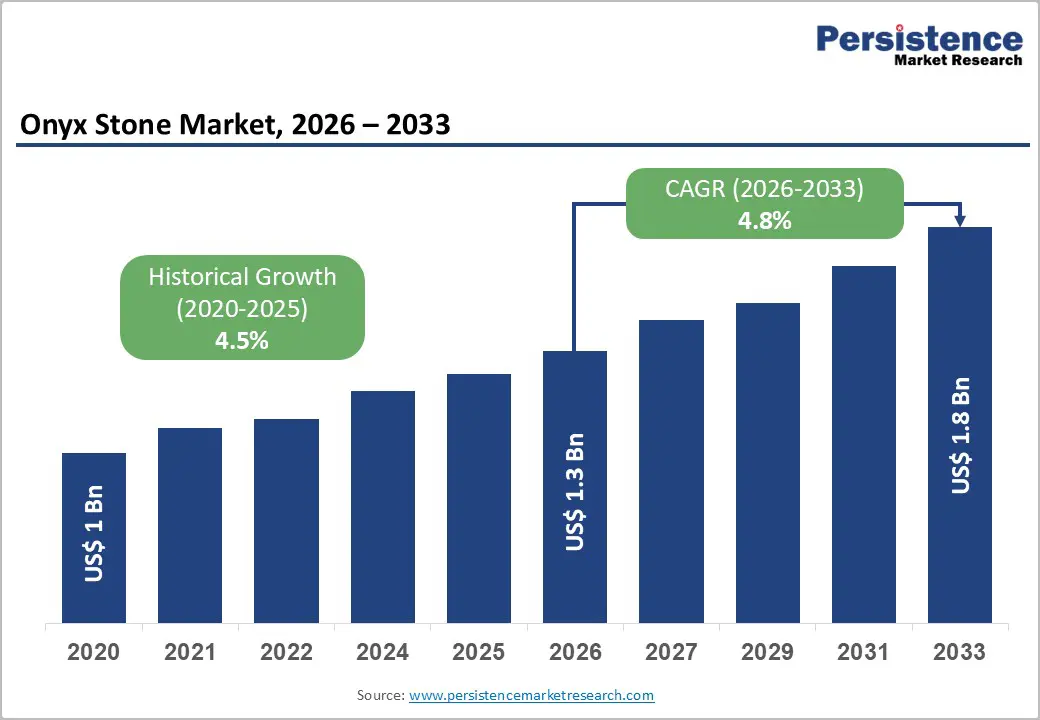
The global onyx stone market size is likely to be valued at US$ 1.3 billion in 2026, and is projected to reach US$ 1.8 billion by 2033, growing at a CAGR of 4.8% during the forecast period 2026 - 2033.
Market growth is primarily driven by rising demand in residential, commercial, and hospitality construction projects, where aesthetic appeal and material uniqueness are prioritized, supported by broader urbanization and growth in disposable income in emerging markets. Interior decoration remains the largest application, increasingly favored for backlit and polished onyx panels that enhance design value in high-end properties.
Supply chains are gradually strengthening, though material fragility and quality variation continue to pose challenges that influence pricing and logistics. Technological advancements such as computer-numerical control (CNC) machining, water-jet cutting, and digital design integration are enhancing product differentiation and enabling bespoke applications.
Key Industry Highlights
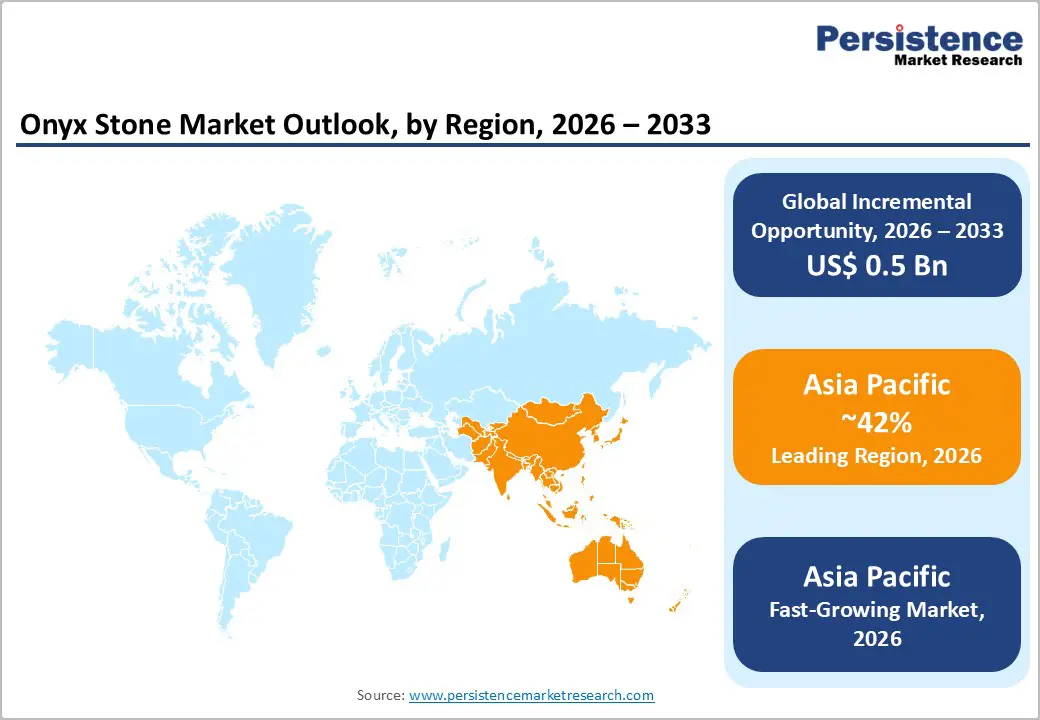
- Dominant Region: Asia Pacific is expected to lead in 2026 with about 42% share, as well as be the fastest-growing market, supported by booming luxury construction and a strong demand for decorative stone in high-end interiors.
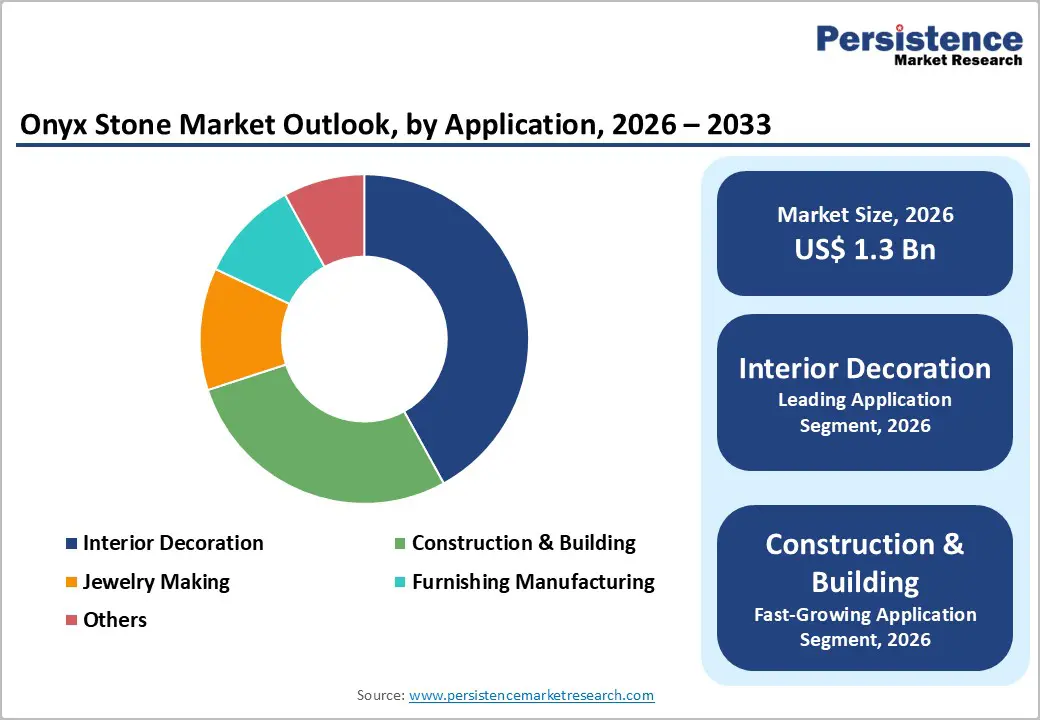
- Leading Application: Interior decoration is set to lead with an estimated 42% share in 2026, underpinned by a strong demand for premium finishes and decorative interiors.
- Fastest-growing Application: The construction & building segment is expected to post the highest 2026 - 2033 CAGR, driven by the increasing use of onyx slabs and tiles in large-scale commercial and residential developments.
| Key Insights | Details |
|---|---|
| Onyx Stone Market Size (2026E) | US$ 1.3 Bn |
| Market Value Forecast (2033F) | US$ 1.8 Bn |
| Projected Growth (CAGR 2026 to 2033) | 4.8% |
| Historical Market Growth (CAGR 2020 to 2025) | 4.5% |
Market Factors - Growth, Barriers, and Opportunity Analysis
Surging Demand for Onyx Stone in Luxury Construction and Interior Decoration
The surge in high-end residential and commercial projects drives adoption of premium materials that convey sophistication and exclusivity. Onyx stone, with distinctive translucency, rich veining, and natural color variations, serves as a preferred choice for architects and interior designers aiming to create visually striking environments. Its ability to transform ordinary surfaces into artistic focal points aligns with the growing emphasis on experiential spaces in luxury construction, where aesthetics and design uniqueness remain critical to property value and client appeal. The material delivers statement features such as backlit walls, countertops, and flooring, elevating perceived quality of interiors and contributing to aspirational living and commercial spaces.
Rising disposable incomes and desire for personalized living and working environments support integration into bespoke designs. Onyx stone offers versatility in classical and contemporary applications, enabling designers to innovate with textures, translucence, and lighting effects. Association with opulence resonates with affluent clients seeking differentiation and prestige in architectural projects. Alignment of material properties with luxury design aspirations drives increasing adoption across high-value constructions and premium interior projects globally.
High Cost and Availability Constraints
Onyx stone is expensive owing to its natural rarity and labor-intensive extraction process. High-quality onyx deposits are limited geographically, often located in remote regions, requiring specialized equipment and skilled labor for mining and handling. The stone’s delicate nature increases the risk of breakage during extraction, transportation, and processing, driving up overall production expenses. Crafting polished or intricately designed pieces demands precision and time, further amplifying the final cost for buyers and positioning onyx as a premium material accessible to a niche segment with sufficient purchasing power.
Availability constraints arise from limited natural reserves and high demand from luxury construction, interior design, and decorative applications. Seasonal and regional variations in mining output create supply inconsistencies, while stringent environmental regulations in key production countries restrict large-scale extraction. Supply chain challenges, including fragile handling requirements and transportation risks, complicate consistent delivery and slow adoption across commercial and residential projects seeking unique and high-end architectural materials.
Innovation in Sustainable and Engineered Variants
Innovation in sustainable and engineered variants is a key opportunity as it addresses the growing demand for environmentally responsible and customizable materials in construction and interior design. Traditional onyx extraction faces limitations in resource availability and ecological impact, driving architects, designers, and manufacturers to explore alternatives that combine aesthetic appeal with sustainability. Engineered variants allow precise control over color, pattern, and translucency, offering design flexibility that natural stone cannot consistently deliver. This capability aligns with contemporary trends where projects require unique visual identity, consistency across large surfaces, and reduced material waste.
Sustainable and engineered solutions also create cost and efficiency advantages. Controlled production minimizes defects, reduces transportation requirements, and optimizes installation timelines, appealing to large-scale commercial and residential projects. These innovations strengthen value propositions by merging high-end luxury with operational efficiency. As buyers increasingly prioritize eco-conscious choices without compromising quality or visual impact, stakeholders who invest in engineered and sustainable offerings can secure differentiation, premium positioning, and long-term partnerships with forward-looking designers and construction firms.
Category-wise Analysis
Purity Type Insights
Polished onyx is likely to be the leading segment with a projected 35% of the market revenue share in 2026 due to its unmatched aesthetic appeal, refined finish, and ability to enhance natural translucency. Its premium perception positions it as the preferred choice for high-end applications in countertops, wall cladding, and decorative features. Consistent demand in luxury projects reinforces its dominance, with architects and designers favoring polished surfaces for light reflection, pattern accentuation, and overall interior elegance, supporting sustained premium pricing and market leadership.
Onyx slabs are anticipated to be the fastest-growing segment from 2026 to 2033 due to increasing adoption of large-format surfaces in modern countertops and expansive installations. Rising demand in luxury residential projects reflects a preference for seamless, bold designs that emphasize continuity and visual impact. Slabs provide efficiency in installation, reduce joint visibility, and align with high-end commercial and residential trends, establishing them as the material of choice for designers seeking balance between scale, functionality, and sophisticated aesthetics.
Application Insights
Interior decoration is projected to hold 42% of the onyx stone market revenue share in 2026, supported by sustained demand for premium visual finishes in residential, hospitality, retail, and commercial interiors. Onyx is extensively specified for wall cladding, backlit panels, reception areas, staircases, and decorative partitions where visual impact is a priority. Natural translucency enables dramatic lighting effects that elevate spatial perception and brand identity in luxury environments. Designers value the material for versatility across classic and contemporary themes, while property developers leverage it to differentiate high-end projects. Strong alignment with bespoke interior concepts, rising renovation activity in urban centers, and preference for statement materials sustain consistent adoption
Construction and building are estimated to be the fastest-growing segment from 2026 to 2033, underpinned by rapid urban expansion, infrastructure investment, and premiumization of large-scale developments. Onyx slabs and tiles are increasingly integrated into commercial complexes, airports, corporate offices, and mixed-use developments for flooring, façades, and architectural highlights. The material supports large-format installations, reduced joint visibility, and cohesive design expression, aligning with modern construction aesthetics. Growth in luxury residential towers and landmark infrastructure projects accelerates demand, as developers seek materials that combine durability with visual distinction.
End-User Insights
Commercial end-users are slated to hold a dominant position, with an anticipated 38% of the market revenue share in 2026, backed by extensive use across hotels, offices, retail complexes, and premium public spaces. Onyx is widely selected for lobbies, reception areas, conference zones, and feature walls where durable elegance and visual impact are critical. Large-scale commercial developments favor materials that convey luxury while maintaining structural reliability under high footfall conditions. Design-led hospitality projects increasingly integrate onyx for signature interiors that enhance brand identity and guest experience. Corporate offices adopt onyx in executive spaces to reflect sophistication and permanence.
The residential segment is forecast to be the fastest-growing between 2026 and 2033, driven by rising renovation activity and a growing preference for personalized interior spaces. Homeowners increasingly invest in premium materials for kitchens, bathrooms, staircases, and accent walls to elevate property value and visual appeal. Onyx aligns with demand for bespoke design elements that create distinctive focal points within living spaces. Expanding urban housing, premium apartments, and luxury villas support higher penetration of decorative stone applications. Interior designers promote onyx for its translucency and natural pattern variation, enabling customized lighting effects and artistic installations.
Regional Insights
North America Onyx Stone Market Trends
North America remains a significant player in the market for onyx stone, driven by well-established construction and real estate sectors, particularly in luxury residential, commercial, and hospitality developments. High demand for premium interior finishes in hotels, corporate offices, and upscale residences supports steady consumption of polished slabs and decorative tiles. Designers and architects prioritize materials that combine durability with aesthetic sophistication, making onyx a preferred choice for feature walls, countertops, and backlit installations. Advanced logistics and proximity to established quarries enhance supply chain efficiency, enabling timely delivery of large-format stone and customized engineered variants to meet design specifications.
The regional market is gaining steady momentum due to consistent investment in high-value real estate and renovation projects, which sustain demand for luxury materials despite moderate overall growth. Market uptake is supported by trends in bespoke interior design and increasing adoption of engineered onyx solutions for consistent color and pattern across large installations. High awareness of premium materials among consumers and professionals encourages incorporation of onyx in commercial and residential projects, driving steady revenue. The North America market also benefits from established import channels and local fabrication capabilities, allowing suppliers to meet precise specifications efficiently.
Europe Onyx Stone Market Trends
Europe remains a notable contributor in the onyx stone market, supported by strong demand in luxury residential, commercial, and hospitality developments. Architectural trends in countries such as Italy, Spain, and Germany emphasize high-end interior finishes, where onyx is valued for translucency, intricate veining, and ability to create dramatic visual effects. Designers and architects increasingly integrate onyx into wall cladding, feature panels, and backlit installations to achieve premium aesthetics. Established fabrication and supply networks across the continent facilitate efficient sourcing of both natural and engineered onyx, supporting complex and large-scale projects while maintaining quality standards.
Market growth is also influenced by rising interest in bespoke interior solutions and renovation projects in heritage and modern structures. Buyers often prioritize materials that combine sustainability with luxury appeal, prompting manufacturers to introduce engineered and eco-efficient onyx variants that reduce waste and improve consistency. The hospitality sector, including high-end hotels, restaurants, and corporate offices, continues to support volume adoption, as developers seek distinctive, long-lasting materials. Proximity to major onyx quarries in Southern Europe and North Africa enhances access to premium stone while optimizing logistics.
Asia Pacific Onyx Stone Market Trends
Asia Pacific is positioned to dominate in 2026, capturing an estimated 42% of the onyx stone market share, reflecting large-scale urbanization, booming luxury construction projects, and strong preference for decorative stone in premium residential and commercial spaces. Countries such as China, India, and Indonesia are driving demand for high-end interior finishes, where onyx serves both aesthetic and status purposes in luxury developments. Proximity to onyx-producing areas reduces logistics costs and improves supply chain efficiency, supporting timely delivery of large-format slabs and polished stone. Architectural trends emphasizing translucency, bespoke design, and backlit installations enhance material appeal, enabling suppliers to maintain premium pricing.
Asia Pacific is also forecast to be the fastest-growing market from 2026 to 2033, fueled by rising disposable incomes, the sophistication of interior design, and the expansion of affluent urban populations. Demand is concentrated on personalized and statement-making interiors, with large-format onyx slabs and engineered variants offering consistency, durability, and design flexibility. Rapid modernization in Tier-1 and Tier-2 cities supports the adoption of luxury materials across commercial and residential construction, while government-driven infrastructure and tourism projects incorporate premium stone finishes.
Competitive Landscape
The global onyx stone market structure is moderately fragmented, characterized by the presence of established international suppliers alongside a wide base of regional processors and fabricators. Leading players collectively account for a combined market share in double digits, supported by differentiated portfolios across polished slabs, tiles, and customized decorative products. Competition centers on consistent material quality, advanced cutting and polishing capabilities, and the ability to deliver large-format and design-specific solutions. Companies with strong sourcing networks and processing infrastructure are better positioned to meet demand from luxury residential, hospitality, and commercial projects, where uniformity, translucency, and surface finish are critical decision factors.
Key participants such as Marble Centre International (MCI), XIAMEN OPTIMUM STONE, Island Stone, Project Stone Australia, and CMC compete through a mix of scale, specialization, and regional reach. These players focus on expanding value-added offerings, including engineered onyx variants, precision fabrication, and project-based customization. Strategic emphasis is placed on supply chain reliability, international distribution capability, and compliance with environmental and sustainability standards to meet evolving buyer expectations. Competitive differentiation increasingly relies on the ability to support architects and developers with design collaboration, timely delivery, and consistent quality across large projects, reinforcing long-term relationships rather than purely price-driven competition.
Key Industry Developments
- In December 2025, Surfaces Galore reported that interior designers and homeowners increasingly favored rare white onyx stone for its luminous tones and delicate natural veining, highlighting its ability to brighten kitchens, bathrooms, and feature walls, while installers noted that the material’s unique aesthetic had transformed spaces into refined, high-end interiors.
- In June 2025, the stone industry advanced toward sustainable and policy-aware production of onyx slabs, as companies such as Caronstone adopted eco-friendly quarrying methods, water recycling systems, ethical sourcing practices, and compliance with environmental regulations to lower emissions and support green building initiatives.
- In April 2025, designers such as Cara Woodhouse of Cara Woodhouse Interiors and Hugo Leader-Williams of Blakes London increasingly used onyx stone for showpiece interior elements including backlit feature walls, sculptural sinks, and statement countertops, while boutique stone brand SolidNature highlighted the material’s dramatic translucency and rich veining as key factors shaping high-end interior design trends.
Companies Covered in Onyx Stone Market
- Marble Centre International (MCI)
- XIAMEN OPTIMUM STONE CO., LTD.
- Island Stone.
- Project Stone Australia PTY LTD
- CMC
- Jiya Crystal & Craft.
- Onyx Marble & Granite
- KalingaStone
- ESKANDARISTONE.
- Mont Surfaces
Frequently Asked Questions
The global onyx stone market is projected to reach US$ 1.3 billion in 2026.
Rising demand for luxury interiors, large-format slabs, and sustainable engineered variants drives the market.
The market is poised to witness a CAGR of 4.8% from 2026 to 2033.
Innovation in sustainable and engineered onyx variants, along with growing adoption in luxury residential and commercial projects, presents key market opportunities.
Key players include Marble Centre International (MCI), XIAMEN OPTIMUM STONE CO., LTD., Island Stone, Project Stone Australia PTY LTD, CMC, and Jiya Crystal & Craft.


