




- Clothing, Footwear, & Accessories
- North America Luxury Goods Market
North America Luxury Goods Market Size, Share, Trends, Growth, Regional Forecasts 2026–2033
North America Luxury Goods Market By Product Type (Clothing & Apparel, Footwear, Leather Goods, Accessories, Jewelry, Watches), Distribution Channel (Offline Channels, Online Channels, Omnichannel Retail) and Country Analysis for 2026 to 2033

North America Luxury Goods Market Trends & Analysis
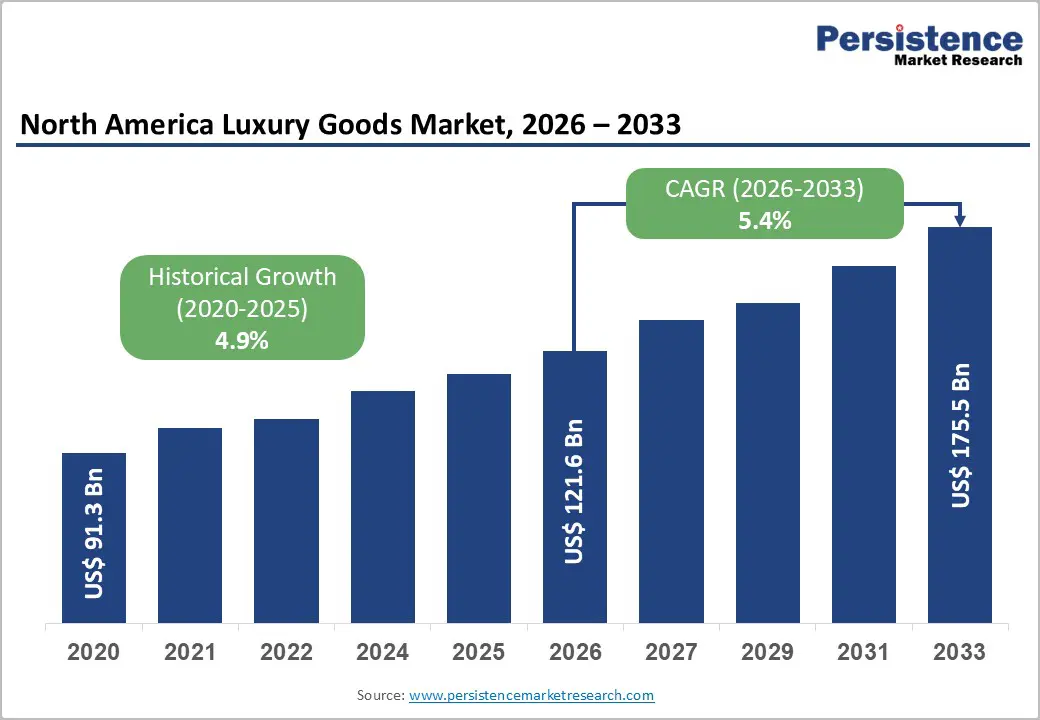
The North America luxury goods market size is projected to reach US$ 121.6 Bn in 2026 and further expand to US$ 175.5 Bn, registering a CAGR of 5.4% during the forecast period. Market growth is primarily supported by the rising concentration of high-net-worth individuals, sustained consumer wealth expansion, and rapid adoption of digital luxury commerce across urban North America. Clothing & Apparel continues leading product demand supported by broad consumer appeal, premium brand engagement, and expanding luxury lifestyle spending.
Increasing consumer preference for heritage luxury brands, investment-oriented purchasing behavior, and rising Gen Z demand for premium accessories. The United States continues to dominate regional demand with an 86% revenue share, while New York and Los Angeles remain key global luxury retail and omnichannel innovation hubs.
Key Industry Highlights:
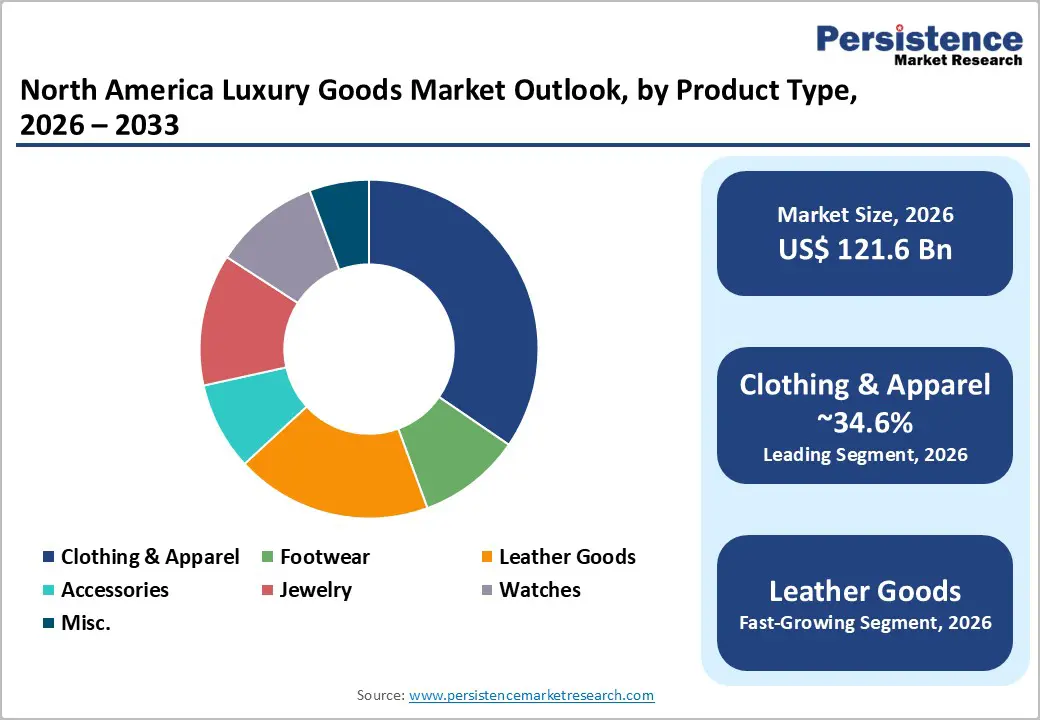
- Leading Segment: Clothing & Apparel leads at 34.6% product share; Leather Goods is the fastest growing at 7.8% CAGR, driven by investment-grade purchasing behaviour among millennial HNWIs.
- Channel Shift: Offline Channels retain 68.2% distribution dominance; Online Channels growing at 6.4% CAGR signal an accelerating structural channel rebalancing toward digital-first luxury.
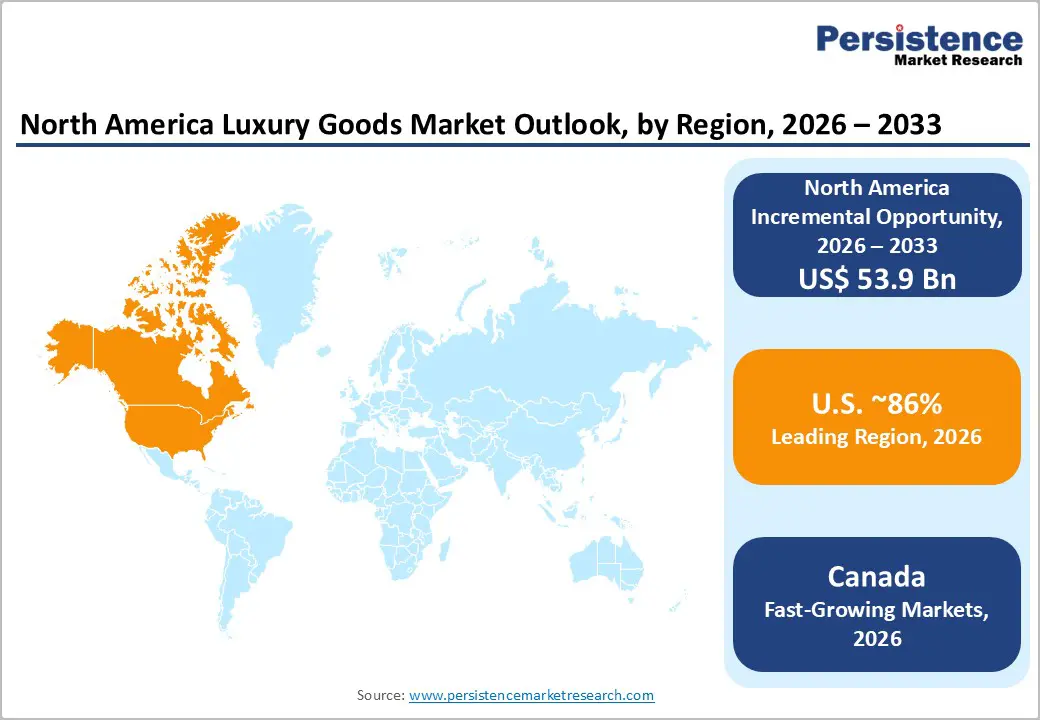
- Country Leader: U.S. commands 86% share with Northeast & West Coast anchoring USD 50.6 Bn; Canada expands fastest at 6.6% CAGR with Central Canada & Pacific Coast at USD 9.0 Bn.
- Competitive Shift: LVMH and Richemont lead revenue and innovation; Kering's 12% revenue decline in 2024 and Luxury Ventures fund launch by LVMH signal a market leadership realignment and portfolio consolidation phase.
- Strategic Theme: Kering–L'Oréal USD 4.7 Bn beauty division sale and Burberry's 18% return-rate reduction through AR validate sustainability-tech integration and portfolio refocus as the dominant strategic priorities for 2026–2033.
Market Dynamics Analysis
Drivers - Expanding HNWI Population and Rising Disposable Income
North America continues to represent one of the world’s largest concentrations of high-net-worth consumers, with the United States accounting for a substantial share of the global HNWI population. Rising household wealth levels and improving real income growth among affluent and upper-middle-income consumers are significantly supporting demand for premium apparel, leather goods, jewelry, and luxury timepieces. Strong household net worth expansion across the region continues providing a stable financial foundation for elevated discretionary luxury spending despite broader macroeconomic uncertainties.
Millennial and Gen Z consumers are further accelerating luxury market expansion across North America, collectively representing a rapidly growing share of luxury product purchasers. These demographics increasingly prioritize brand authenticity, craftsmanship, exclusivity, and social identity value, strongly benefiting established luxury brands with heritage positioning. Continued revenue growth reported by major luxury conglomerates across the Americas further validates the resilience of wealth-driven luxury demand and sustained premium consumer spending behavior in the region.
Digital Transformation and E-commerce Acceleration
The digitization of luxury retail is significantly transforming consumer engagement and sales channels across North America. Luxury brands are increasingly deploying AI-driven personalization, AR-based virtual try-on tools, and exclusive online product launches to replicate and enhance premium in-store experiences. Technologies improving purchase confidence and reducing return rates are strengthening the commercial viability of digital luxury retail, while major online luxury platforms continue demonstrating strong revenue contribution from North American consumers. These developments highlight the growing maturity and scalability of the region’s online luxury ecosystem.
At the same time, luxury brands are accelerating investments in direct-to-consumer digital infrastructure to improve customer ownership and margin performance. The launch of exclusive online-only collections and digitally limited product drops is enabling brands to reduce wholesale dependency while increasing profitability per unit sold. Supported by rapid growth in luxury e-commerce platforms and evolving digital-native consumer behavior, the online channels segment is projected to expand at a positive CAGR.
Restraints - Market Saturation and Intensifying Competitive Differentiation Pressure
The North American luxury goods landscape, particularly in metropolitan centres such as New York, Los Angeles, and Toronto, is significantly saturated with flagship stores, luxury multi-brand retail concepts, and digital marketplaces. The proliferation of accessible luxury, pre-owned resale platforms, and accessible premium brands compresses the perceptual exclusivity gap. New luxury openings in 2025 were challenging to differentiate as New York's Madison Avenue, Fifth Avenue, and SoHo maintained the highest concentration of competing luxury retail globally. Sustaining brand desirability and consumer preference in a densely competitive environment is a structural growth barrier.
Shifting Consumer Values and Experiential Luxury Substitution
Younger luxury consumers are progressively redefining value away from physical product ownership toward curated experiences, authenticity, and sustainability alignment. This structural behavioural shift, documented across 72% of North American luxury consumers now prioritizing ethical sourcing, challenges traditional product-led revenue models. Brands that fail to embed sustainability, traceability, and experiential value dimensions risk accelerating consumer attrition to competitors offering certified eco-luxury alternatives. Kering's revenue declined 12% in 2024 to €17.2 billion and a further 14% in Q1 2025, illustrating the commercial consequences of insufficient brand-value realignment.
Opportunities - Leather Goods Premiumization and Investment-Grade Accessories
Leather Goods represent the strongest growth opportunity within the North America luxury goods market, projected to expand at a CAGR of 7.8%, the highest among all product categories. Growth is being driven by the increasing perception of luxury leather products as both lifestyle and investment-oriented purchases. Iconic products such as Hermès Birkin and Kelly bags continue demonstrating strong resale appreciation, attracting affluent millennial and Gen Z consumers seeking long-term value retention alongside premium brand ownership. As a result, the addressable leather goods market in North America is expected to surpass US$ 32 Bn by 2030, creating substantial incremental revenue opportunities for luxury brands.
Sustainability trends are further strengthening segment growth potential across the region. Increasing adoption of regenerative leather sourcing, bio-based materials, and circular luxury initiatives is resonating strongly with environmentally conscious consumers. Luxury brands combining certified material traceability with craftsmanship heritage are increasingly achieving premium pricing advantages across direct-to-consumer and digital retail channels.
Sustainable Luxury and Online, Omnichannel Luxury Retail Expansion
North American luxury consumers are increasingly associating premium purchasing with sustainability, ethical sourcing, and brand transparency. The market for certified sustainable luxury products is expected to witness strong high single-digit growth, supported by rising consumer preference for environmentally responsible brands and traceable supply chains. Regulatory developments including SEC climate disclosure requirements and broader ESG-driven investment frameworks are further encouraging luxury companies to strengthen carbon-neutral operations, resale integrations, and sustainable sourcing strategies. As a result, sustainability is rapidly evolving from a brand positioning initiative into a measurable competitive and revenue-driving advantage across the luxury ecosystem.
Online Channels, currently accounting for 20.8% of market distribution share, represent one of the strongest future growth opportunities for luxury brands in North America. Rapid adoption of AI-driven personalization, social commerce, live-stream luxury events, and exclusive digital product launches is reshaping consumer engagement patterns. Additionally, Gen Z’s digital-native purchasing behavior and the expanding affluent remote-working population are significantly broadening the online luxury consumer base beyond traditional coastal retail markets.
Category-wise Insights
Product Type Analysis
Clothing & Apparel leads the North America Luxury Goods Market with a 34.6% revenue share in 2026, supported by broad consumer appeal across gender, age, and lifestyle categories. Designer ready-to-wear collections, luxury streetwear collaborations, and seasonal couture launches from brands such as Chanel, Saint Laurent, and Ralph Lauren continue driving strong consumer engagement and repeat purchasing behavior. Compared to categories such as watches and jewelry, luxury apparel benefits from wider aspirational spending across a broader affluent and upper-middle-income consumer base.
Leather Goods represent the fastest-growing segment, projected to expand at a CAGR of 7.8% in the coming years. Rising investment-oriented purchasing behavior, increasing focus on sustainable sourcing practices, and strong resale market appreciation reinforce primary luxury product demand among millennial and Gen Z affluent consumers.
Distribution Channel Insights
Offline Channels hold a dominant 68.2% share of the North America Luxury Goods Market in 2026, supported by the continued importance of in-store sensory experiences, personalized client engagement, and the ceremonial value associated with luxury retail environments. Flagship stores across New York, Beverly Hills, and Miami Beach function not only as sales outlets but also as immersive brand experience centers. Exclusive events, personal shopping services, and bespoke customer experiences continue to sustain strong consumer preference for offline luxury retail despite growing digital adoption.
Online Channels represent the fastest-growing distribution segment, projected to expand at a CAGR of 6.4% through 2033. Growth is driven by increasing adoption of AR-based virtual try-ons, AI-personalized shopping experiences, invite-only digital product launches, and expanding direct-to-consumer luxury brand platforms, reducing wholesale dependency.
Country Market Insights
United States Luxury Goods Market
The U.S. accounts for 86% of the North America Luxury Goods Market, representing approximately US$ 104.6 Bn in 2026. Market leadership is driven by the world’s largest high-net-worth consumer base, strong brand loyalty, and a highly developed omnichannel luxury retail ecosystem. Additionally, FTC authenticity standards and evolving SEC ESG disclosure requirements continue favouring established global luxury conglomerates with strong compliance and operational capabilities.
Northeast & West Coast Luxury Goods Market
The Northeast and West Coast collectively account for approximately US$ 50.6 Bn, led by New York’s Fifth Avenue and Madison Avenue corridors alongside Los Angeles’ Rodeo Drive and Melrose luxury retail districts. These regions continue to generate the highest luxury retail revenue concentration in North America, supported by strong flagship investments from major luxury groups including LVMH, Kering, and Richemont. New York particularly remains a leading market for luxury store expansion and premium brand retail activity in 2025.
The South and Midwest represent steadily expanding luxury retail markets, supported by growing high-net-worth migration and rising affluent consumer spending. Cities including Miami, Houston, Chicago, and Dallas continue witnessing luxury retail footprint expansion driven by resort-oriented shopping demand, corporate relocation trends, and nearshoring-led regional economic growth attracting affluent professional demographics.
Canada Luxury Goods Market
Canada accounts for approximately 14% of the North America Luxury Goods Market and is projected to record the region’s fastest growth at a 6.6% CAGR through 2033. Growth is driven by rising urban high-net-worth populations, immigration-led consumer diversification, and expanding luxury retail investments across Toronto and Vancouver. Additionally, CUSMA/USMCA alignment and efficient trade frameworks continue supporting cross-border luxury brand expansion and operations.
Central Canada & Pacific Coast Luxury Goods Market
Central Canada and the Pacific Coast collectively account for approximately US$ 9.0 Bn, supported by Toronto’s Bloor-Yorkville luxury district and Vancouver’s Robson Street and Pacific Centre, which represent some of Canada’s highest-value luxury retail destinations. Market growth is driven by rising affluent consumer populations, strong immigration-led wealth expansion, multicultural luxury purchasing behavior, and increasing flagship investments by major European luxury brands across key metropolitan retail corridors.
Quebec and Atlantic Canada represent emerging yet steadily growing luxury markets, led by Montreal’s Sainte-Catherine Street luxury retail corridor. The region benefits from a well-established affluent bilingual consumer base, strong tourism-driven retail activity, and expanding demand for premium fashion, accessories, and experiential luxury consumption across urban centers.
Competitive Landscape
The North America luxury goods market is moderately consolidated, with major conglomerates including LVMH, Kering, Richemont, Chanel, and Hermès collectively dominating regional luxury revenue and brand influence. Competitive differentiation is primarily driven by heritage brand positioning, exclusive supply chain control, flagship retail expansion, and accelerating digital commerce capabilities. Additionally, resale-focused luxury platforms and sustainability-led premium brands are emerging as disruptive trends influencing evolving market competition.
Innovation and brand desirability continue defining the market’s strategic landscape. LVMH and Richemont maintain leadership through diversified portfolios and strong digital investments, while Kering focuses on core brand reinvention and portfolio optimization. Hermès sustains premium pricing through scarcity-driven positioning, whereas emerging luxury brands increasingly leverage sustainability initiatives and experiential retail concepts to strengthen engagement with younger affluent consumers.
Strategic Developments:
- In November 2023, LVMH agreed to acquire Los Angeles-based luxury eyewear brand Barton Perreira for USD 80 million, strengthening its accessories portfolio with a California-heritage brand aligned to U.S. luxury consumer taste.
- In November 2024, Burberry deployed AR-powered virtual scarf try-on technology across its North America digital platforms, reducing return rates by 18% and increasing average digital order values by 12%, validating technology-led luxury retail conversion strategies.
- In October 2025, Kering divested its beauty division to L'Oréal under a 50-year exclusive licensing agreement, enabling strategic refocus on core luxury fashion and leather goods Houses while co-creating a joint innovation venture in fragrance and cosmetics.
North America Luxury Goods Market – Key Insights & Details
| Key Insights | Details |
|---|---|
| Historical Market Value (2020) | US$ 91.3 Bn |
| Current Market Value (2026) | US$ 121.6 Bn |
| Projected Market Value (2033) | US$ 175.5 Bn |
| CAGR (2026–2033) | 5.4% |
| Leading Region | United States |
| Dominant Product Type | Clothing & Apparel, 34.6% |
| Top-ranking Product | Leather Goods, 7.8% CAGR |
| Incremental Opportunity | US$ 53.9 Bn |
Companies Covered in North America Luxury Goods Market
- LVMH Moët Hennessy Louis Vuitton
- Kering Group
- Compagnie Financière Richemont SA
- Chanel Limited
- Hermès International S.A.
- The Estée Lauder Companies Inc.
- Rolex SA
- Giorgio Armani S.p.A.
- Patek Philippe SA
- The Swatch Group
- Prada S.p.A.
- Burberry Group plc
- Ralph Lauren Corporation
- Tapestry, Inc.
- Capri Holdings Limited
Frequently Asked Questions
North America luxury goods market is valued at US$ 121.6 Bn in 2026, projected to reach US$ 175.5 Bn by 2033, representing a cumulative USD 53.9 Bn incremental opportunity.
Rising HNWI population, digital commerce acceleration, and demand for sustainable premium goods from millennial and Gen Z consumers, with Richemont's Americas revenue growing +16% in FY2025, are the primary structural drivers.
The market is projected to grow at a CAGR of 5.4% from 2026 to 2033, with Leather Goods accelerating at 7.8% CAGR and Online Channels growing at 6.4% CAGR as the two fastest sub-segment trajectories.
Leather goods premiumisation (7.8% CAGR), online channel digital luxury (6.4% CAGR), and ESG-aligned sustainable luxury positioning, backed by 72% consumer sustainability preference, represent the three highest-value actionable opportunities.
Leather goods premiumisation (7.8% CAGR), online channel digital luxury (6.4% CAGR), and ESG-aligned sustainable luxury positioning, backed by 72% consumer sustainability preference, represent the three highest-value actionable opportunities.
LVMH, Kering, Richemont, Chanel, and Hermès are the dominant conglomerates; Ralph Lauren and Tapestry lead as North America–headquartered players with significant regional brand equity and retail footprints.


