




- Food Packaging
- North America Liquid Packaging Market
North America Liquid Packaging Market Size, Share, and Growth Forecast, 2026 - 2033
North America Liquid Packaging Market by Material (Plastic, Paper & Paperboard), Packaging Type (Rigid Packaging, Flexible Packaging), Packaging Format, End Use, and Regional Analysis for 2026 - 2033

North America Liquid Packaging Market Size and Trends Analysis
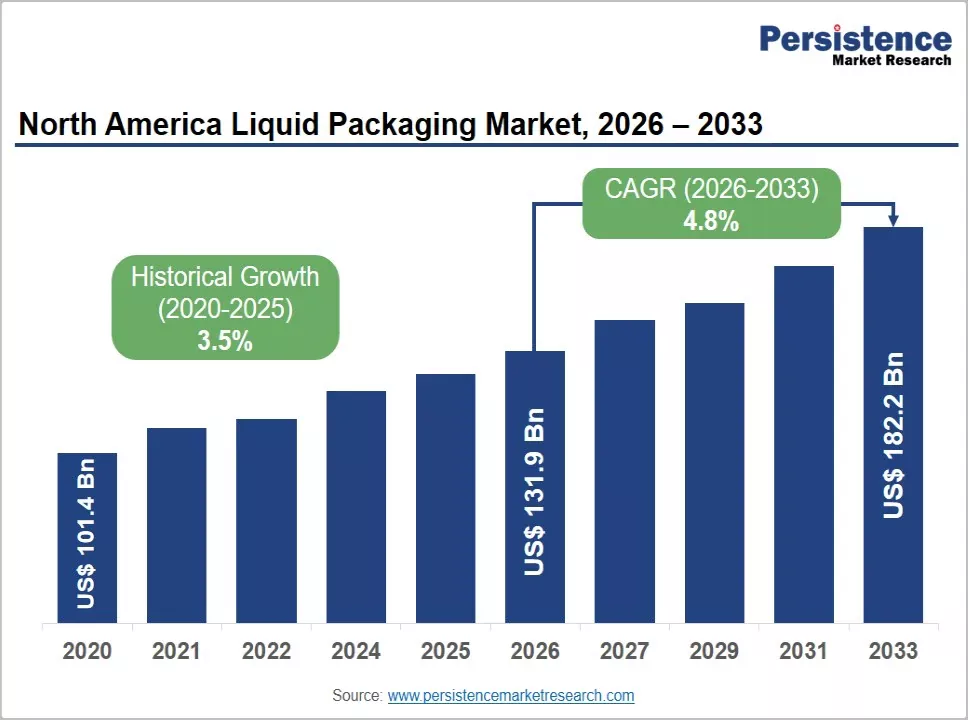
The North America liquid packaging market size is likely to be valued at US$ 131.9 billion in 2026 and is expected to reach US$ 182.2 billion by 2033, growing at a CAGR of 4.8% during the forecast period from 2026 to 2033.
Market growth is supported by rising demand for convenient, lightweight, and sustainable packaging formats, alongside increasing consumption of packaged beverages and ready-to-drink products. The growing adoption of sustainable liquid packaging solutions and advanced liquid food packaging technologies is further influencing product innovation, as manufacturers focus on recyclable materials, extended shelf life, and improved packaging efficiency.
Key Industry Highlights
- Leading Country: The U.S. dominates, accounting for approximately 80.5% of market revenue, supported by its extensive beverage manufacturing base, packaged food consumption, and established packaging infrastructure.
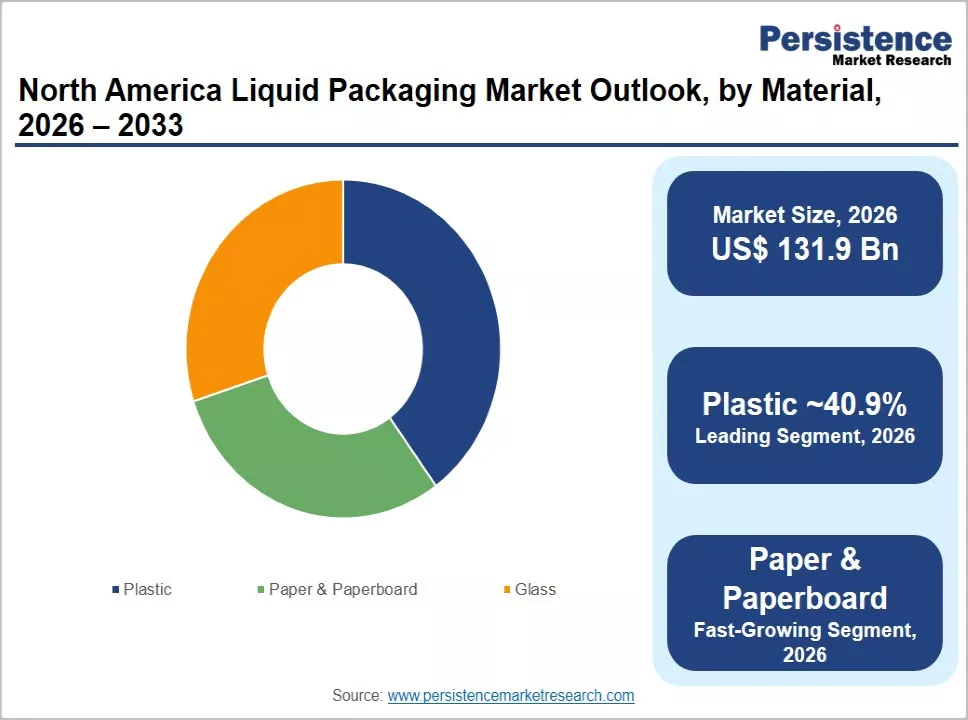
- Dominant Material: Plastic leads the material segment with a 40.9% revenue share in 2026, supported by its extensive use in beverage bottles, dairy containers, household liquids, and pharmaceutical packaging.
- Leading Packaging Type: Rigid packaging is identified as the leading packaging type, with an estimated 36.8% share in 2026.
DRO Analysis
Drivers - Expansion of Ambient Beverage Distribution Strengthens Demand for Specialized Liquid Packaging
The expansion of shelf-stable dairy, plant-based beverages, nutritional drinks, and ready-to-drink coffee is increasing demand for aseptic liquid packaging solutions in North America. Beverage manufacturers are adopting multilayer cartons and specialized barrier containers to protect products against oxygen, moisture, and light exposure while maintaining product quality during extended distribution.
These formats reduce dependence on refrigerated transportation and provide greater flexibility in supplying retailers across geographically dispersed markets. The growing presence of oat milk, almond milk, and functional beverages is further widening the application base for long-shelf-life beverage packaging formats. For example, in June 2026, Tetra Pak introduced a 48-ounce Tetra Brik Aseptic Edge carton for the U.S. and Canadian markets, targeting dairy, juice, plant-based beverages, and ready-to-drink coffee applications.
Foodservice Dispensing and Bulk Liquid Distribution Increase Flexible Packaging Adoption
The extensive use of liquid concentrates, beverage syrups, sauces, liquid eggs, and food ingredients across North American foodservice operations is supporting demand for bag-in-box liquid packaging systems. Unlike conventional rigid containers, these systems combine flexible inner bags with protective outer cartons, enabling controlled dispensing and efficient storage of bulk liquids.
Beverage fountain operators, institutional kitchens, and food processors benefit from reduced handling requirements and the ability to dispense products without repeatedly exposing the remaining contents to air. Growing applications in bulk beverage dispensing packaging and commercial food ingredient distribution are strengthening demand for larger-capacity flexible formats.
Restraint - Multilayer Material Structures Complicate Recovery and Recycling Operations
The widespread use of paperboard, polyethylene, and aluminum combinations in aseptic cartons creates material separation requirements that differ from conventional single-material packaging. Although these structures provide effective barriers against oxygen, moisture, and light, their recovery depends on access to specialized carton collection, sorting, and processing facilities.
Differences in municipal recycling acceptance across the U.S. and Canada also affect the availability of consistent post-consumer material streams. This limits the development of closed-loop liquid carton recycling systems and creates challenges in establishing reliable end markets for recovered packaging fibers and polymer-aluminum residues. The issue is particularly relevant to multilayer beverage carton waste management, where recycling performance depends on both collection access and downstream processing capabilities.
Opportunities - Advanced Barrier Materials Create Scope for Next-Generation Carton Development
The transition toward renewable fiber-based structures and alternative barrier technologies creates opportunities for packaging manufacturers to improve the material composition of liquid cartons while maintaining product protection. Developments in paper-based barriers, polymer coatings, and aluminum-free multilayer structures are expanding possibilities for recyclable aseptic liquid packaging materials.
These innovations are particularly relevant to dairy, juice, and plant-based beverage manufacturers seeking packaging formats that combine extended shelf life with improved material recovery potential. The development of paper-based liquid packaging barrier technologies also creates opportunities for suppliers to differentiate their portfolios through material innovation. Tetra Pak's paper-based barrier solution for its Tetra Brik Aseptic range represents an example of this technological direction.
Nontraditional Bag-in-Box Applications Expand Commercial Packaging Demand
The application of bag-in-box technology beyond traditional beverage categories creates additional opportunities across North American foodservice, food processing, and institutional distribution channels. Cold-brew coffee, liquid eggs, culinary broths, beverage concentrates, and dispensing syrups represent relevant applications where controlled dispensing and bulk storage are important operational requirements.
Packaging suppliers have scope to develop foodservice bag-in-box packaging solutions with improved fitments, dispensing valves, and oxygen-barrier films suited to different liquid formulations. Expansion into bulk liquid food packaging formats also provides opportunities to serve processors and commercial buyers seeking alternatives to conventional rigid containers. The increasing use of bag-in-box containers for cold-brew coffee, liquid egg products, and soda fountain syrups illustrates the potential for diversification beyond established wine and beverage applications.
Category-wise Analysis
Material Segment Insights
Plastic dominates the North America liquid packaging market, accounting for an estimated 40.9% revenue share in 2026. Its leadership is supported by its extensive use in beverage bottles, dairy containers, liquid detergent packaging, pharmaceutical bottles, and industrial liquid containers. Plastic packaging offers a favorable combination of lightweight construction, impact resistance, design flexibility, and compatibility with high-speed filling operations. PET bottles are widely used for water, carbonated drinks, juices, and ready-to-drink beverages, while HDPE containers serve milk, household cleaners, and personal care formulations. The availability of different polymer grades and container designs also allows manufacturers to meet product-specific requirements for barrier protection, dispensing, and storage.
Paper and paperboard represent an important material category, particularly in liquid cartons used for milk, juice, plant-based beverages, and shelf-stable nutritional drinks. Their adoption is supported by fiber-based construction, efficient stacking, lightweight transportation, and the ability to incorporate barrier layers that protect liquid contents from oxygen, moisture, and light. Aseptic cartons are particularly relevant because they support ambient distribution and reduce dependence on refrigerated supply chains for suitable products. Innovation in paper-based barrier structures is creating further opportunities to improve carton material composition and recyclability. Glass maintains a specialized position in premium beverages, alcoholic drinks, sauces, and certain pharmaceutical applications because of its chemical inertness, product compatibility, and ability to preserve flavor without interaction between the container and its contents.
Packaging Type Analysis
Rigid packaging holds the leading position in the North America liquid packaging market, accounting for an estimated 36.8% revenue share in 2026. Its dominance reflects the extensive use of bottles, jars, cartons, cans, and other structured containers across beverages, dairy products, pharmaceuticals, and household liquids. Rigid formats provide structural stability during filling, stacking, warehousing, and transportation, making them suitable for high-volume retail distribution. Their established compatibility with automated filling, capping, labeling, and sealing equipment further strengthens their adoption among large beverage and consumer goods manufacturers. PET beverage bottles, HDPE milk containers, glass beverage bottles, and metal cans represent important applications. The established retail infrastructure for these formats and their ability to accommodate different closure, dispensing, and barrier requirements sustain their leading position.
Flexible packaging is the fastest-growing packaging type, supported by increasing applications of pouches, sachets, spouted pouches, and bag-in-box systems. These formats offer efficient material utilization, reduced transportation weight, and adaptable designs for liquid products with different dispensing requirements. Spouted pouches are gaining relevance in juices, liquid baby food, sauces, and personal care products, while bag-in-box formats serve beverage concentrates, syrups, liquid ingredients, and commercial foodservice applications. Their ability to accommodate single-serve, refillable, and bulk dispensing formats is expanding their application across retail and institutional distribution channels. Flexible packaging also provides opportunities for packaging manufacturers to develop high-barrier structures that improve protection against oxygen and moisture while reducing packaging material consumption.
Competitive Landscape
The North America liquid packaging market is characterized by the presence of established multinational packaging manufacturers and specialized regional suppliers competing across plastic containers, flexible packaging, liquid cartons, glass bottles, and metal containers. Competition is shaped by manufacturing scale, material innovation, product protection capabilities, filling-system compatibility, and long-term supply agreements with food and beverage manufacturers. Amcor plc, Tetra Pak, Berry Global, Sonoco Products Company, and SIG Group hold prominent positions through their extensive packaging portfolios and established customer relationships.
Market participants are strengthening their competitive positions through acquisitions, production capacity expansion, lightweight packaging development, and investments in recyclable material structures. The combination of Amcor and Berry Global in April 2025 strengthened Amcor's presence across flexible and rigid packaging, including bottles, containers, films, and closures.
Key Industry Developments
- In June 2026, Tetra Pak launched a new 48-ounce Tetra Brik Aseptic Edge carton format for the U.S. and Canadian markets. Designed for dairy, juice, plant-based beverages, and ready-to-drink coffee, the format features a tethered cap, improved shelf presentation, and a carton structure made primarily from renewable materials.
- In April 2026, Amcor introduced an upgraded version of its Apex premium PET jars incorporating Elevate technology for improved hot-fill performance. The containers are designed for pasta sauce manufacturers and support filling temperatures of up to 205°F, providing an alternative to traditional glass jars with improved production-line stability and reduced transportation weight.
Companies Covered in North America Liquid Packaging Market
- Amcor plc
- Tetra Pak
- Berry Global
- SIG Group
- Sonoco Products Company
- Sealed Air Corporation
- Mondi plc
- ProAmpac
- Elopak ASA
- Pactiv Evergreen
Frequently Asked Questions
The North America liquid packaging market is estimated to reach US$ 119.9 billion in 2026.
The market is projected to reach US$ 165.9 billion by 2033, driven by increasing demand for packaged beverages, aseptic cartons, and flexible liquid packaging solutions.
Key trends include the adoption of recyclable liquid packaging materials, expansion of aseptic carton applications, development of paper-based barrier technologies, lightweight plastic containers, and increasing use of bag-in-box and spouted pouch formats.
Plastic is the leading material segment, accounting for 40.9% of market revenue in 2026 according to the previously referenced market estimate. Its dominance reflects its extensive use in beverage bottles, dairy containers, pharmaceutical packaging, and household liquid products.
The market is expected to grow at a CAGR of 4.74% from 2026 to 2033.
Major companies with established liquid packaging portfolios include Amcor plc, Tetra Pak, Berry Global, Sonoco Products Company, and SIG Group.


