




- Automotive
- Motorcycle Tires Market
Motorcycle Tires Market Size, Share, and Growth Forecast, 2026 - 2033
Motorcycle Tires Market by Product Type (Tubed Tires, Radial Tires, Tubeless Tires), Motorcycle Type (Standard, Sports, Scooters, Cruiser), Distribution Channel (Aftermarket, Original Equipment Manufacturer (OEM)), and Regional Analysis for 2026-2033

Motorcycle Tires Market Share and Trends Analysis
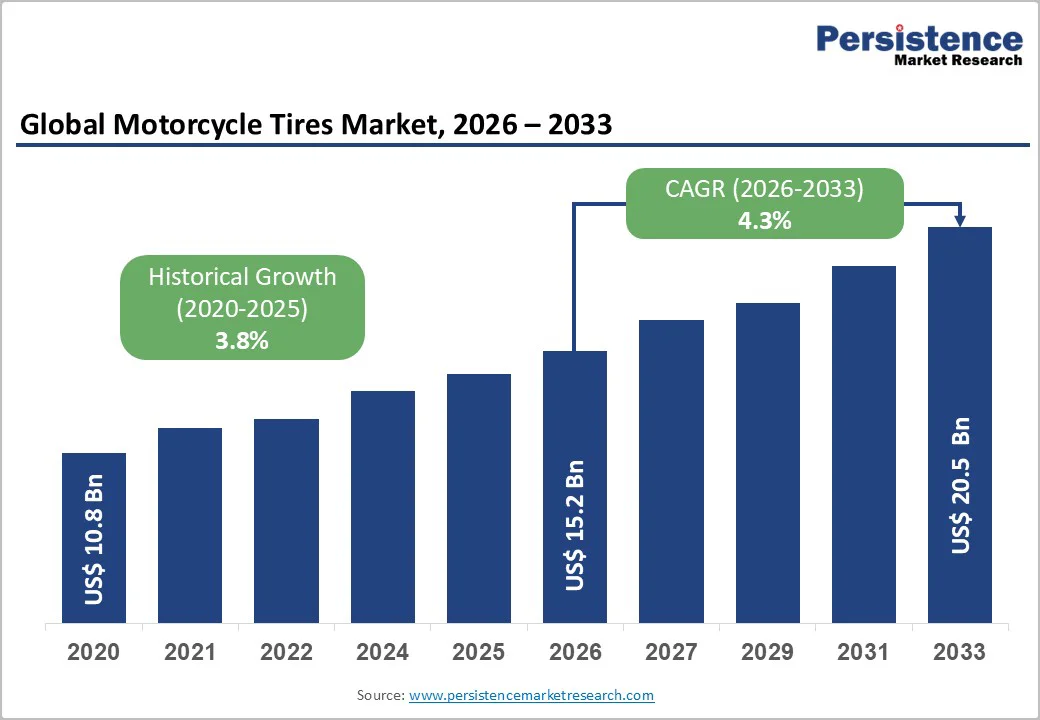
The global motorcycle tires market size is likely to be valued at US$ 15.2 billion in 2026, and is estimated to reach US$ 20.5 billion by 2033, growing at a CAGR of 4.3% during the forecast period 2026−2033. Market expansion is driven mainly by the surge in motorcycle production across Asia Pacific, where urbanization and demand for affordable transportation continue to rise. Increasing replacement rates, fueled by higher mileage usage and more frequent riding, also contribute to sustained demand. Regulatory requirements for enhanced rider safety, alongside the growing adoption of advanced tire technologies, are further accelerating market growth. Product innovation, with a focus on fuel efficiency and durability, is meeting evolving consumer expectations, while a strong aftermarket provides reliable supply chains and supports steady growth in both OEM and replacement segments.
Key Industry Highlights
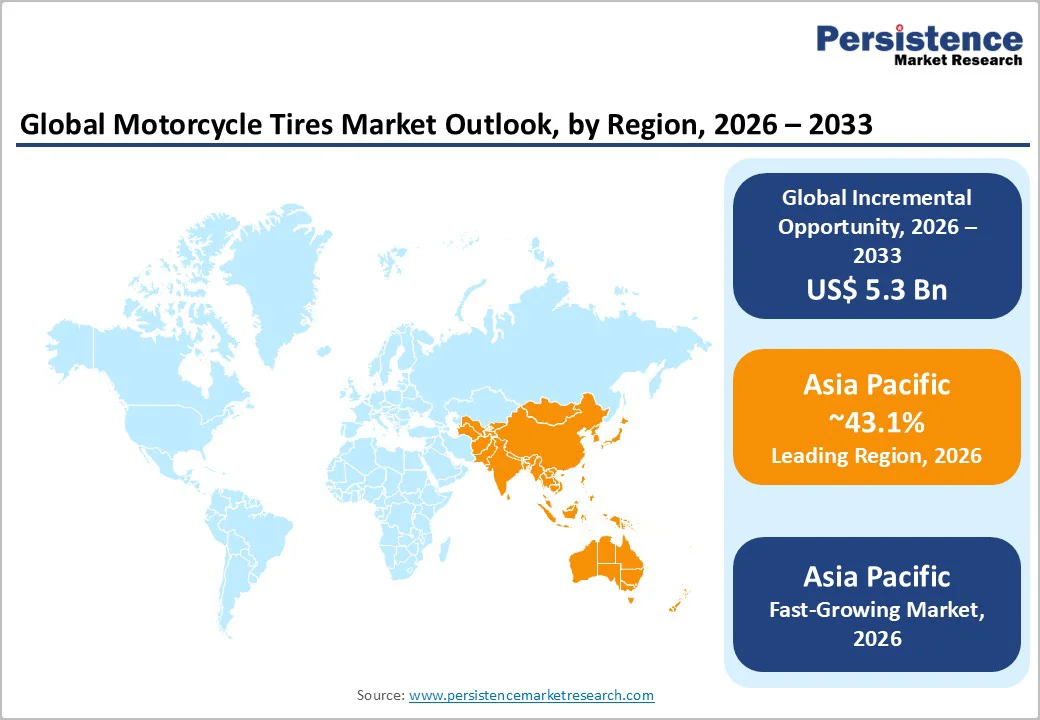
- Dominant Region: Asia Pacific is expected to command about 43.1% market share in 2026, as motorcycles are deeply embedded in everyday mobility in the region.
- Fastest-growing Regional Market: Asia Pacific is set to be the fastest-growing regional market through 2033 due to rising incomes and an expanding middle class.
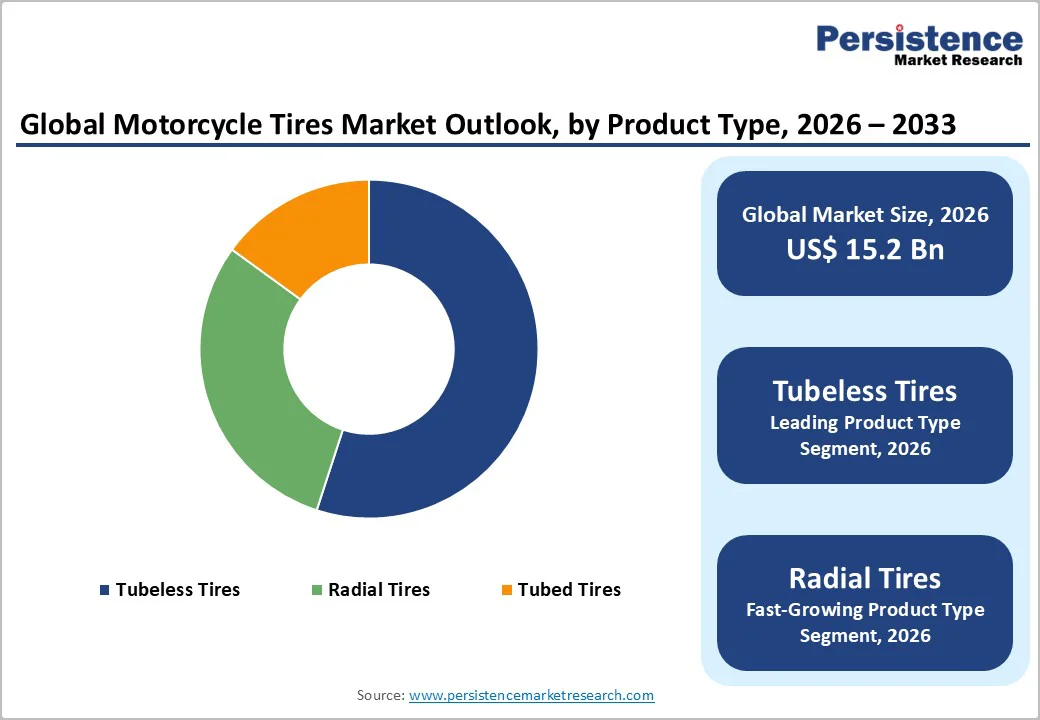
- Leading & Fastest-growing Product Type: Tubeless tires are likely to lead with an approximately 55% revenue share in 2026, while radial tires are slated to be the fastest-growing from 2026 to 2033.
- Dominant & Fastest-growing Motorcycle Types: The standard segment is slated to dominate with an estimated 60% of revenue share in 2026, whereas the sports segment is expected to grow the fastest during the 2026-2033 forecast period.
- Market Drivers: Rising motorcycle ownership in developing economies, closely tied to everyday mobility needs, is primarily fueling market growth.
- Market Opportunities: The purchasing of motorcycle tires is steadily moving from purely physical shops to a mix of online and offline experiences that work together, creating new revenue opportunities.
| Key Insights | Details |
|---|---|
| Motorcycle Tires Market Size (2026E) | US$ 15.2 Bn |
| Market Value Forecast (2033F) | US$ 20.5 Bn |
| Projected Growth (CAGR 2026 to 2033) | 4.3% |
| Historical Market Growth (CAGR 2020 to 2025) | 3.8% |
Market Factors – Growth, Barriers, and Opportunity Analysis
Increase in Motorcycle Ownership in Developing Economies
Rising motorcycle ownership in developing economies is closely tied to everyday mobility needs. In many Asian countries, motorcycles are often the most practical way to move through crowded cities and expanding suburbs, especially where public transport networks are incomplete or unreliable. As people move to cities and their incomes improve, they look for affordable, flexible transport that can handle traffic, narrow streets, and longer commuting distances, and motorcycles fit this need very well.
A growing middle class also plays a major role. As household incomes rise from low to moderate levels, many families can finally afford private motorized transport, but cars remain too expensive to buy and maintain. Motorcycles fill this gap by offering a relatively low upfront cost, lower fuel expenses, and flexibility for work, family, and small business use such as deliveries or commuting to industrial zones. Government policies and local economic conditions reinforce this pattern. In several countries, authorities support two-wheeler use directly or indirectly through fuel pricing, road infrastructure that favors smaller vehicles, or limited investment in mass transit outside core city centers.
Volatile Raw Material Prices
The unpredictability of raw material prices has created a constant balancing act for motorcycle tire manufacturers. When the cost of key ingredients like rubber and petroleum-based chemicals swings up and down, it becomes difficult for companies to predict how much it will actually cost to produce each tire. If costs rise suddenly and selling prices cannot be adjusted quickly, manufacturers earn less on every unit they sell, which puts pressure on profitability, especially in value-focused product lines.
These challenges become even more complex when companies operate across many countries. Tires are often produced in one region and sold in another, so changes in exchange rates can either amplify or offset raw material cost movements. When a local currency weakens against the currency used to buy materials or settle export contracts, the same shipment of raw materials or finished tires can become significantly more expensive or less profitable. As a result, manufacturers must constantly revise their pricing, sourcing, and inventory strategies to avoid sudden losses, all while trying to remain competitive in markets where customers are highly price sensitive.?
Growth of Online and Omnichannel Tire Retailing
Motorcycle tire buying is steadily moving from purely physical shops to a mix of online and offline experiences that work together. Riders now often start their journey on a phone or laptop, using websites and apps to understand which tire fits their bike, compare different brands, read reviews, and check prices. This makes the process more transparent and convenient, especially for owners who may not have a trusted local dealer nearby. Retailers and manufacturers are making this process even smoother by offering fast home delivery and optional installation services either at home or a partner location.
This means a customer can order a tire online and choose to have it delivered to their doorstep or schedule a professional fitting at a nearby center. Such digital experiences are not just about convenience; they also help sellers reach new customer segments, respond more quickly to demand, and provide better after-sales support than traditional sales channels alone. These new methods allow consumers across cities and rural areas an easier access to the best products, and encourage brand loyalty by removing much of the hassle from the shopping and fitting experience.
Category-wise Analysis
Product Type Insights
Tubeless tires is poised to be the leading segment with an approximate 55% market revenue share in 2026. These tires are designed so that the air is held directly within the structure, rather than in a separate inner tube, which makes punctures less sudden and easier to manage on the road. This slower loss of air gives riders more time to react and stay in control, which translates into a clear safety advantage over traditional tube-type tires. They are also lighter and create less internal friction, which helps improve fuel efficiency and ride comfort, both of which matter to daily commuters and long-distance riders.
Radial tires likely to be fastest-growing segment from 2026 to 2033, since they are known to deliver a clear performance upgrade that matches how the premium and high?performance motorcycle market is evolving. Their construction uses a more flexible sidewall and a stiffer tread area, which allows the tire to keep a wider, more stable contact patch with the road. This translates into better grip, more precise cornering, and greater stability at higher speeds, which are critical for sports and adventure motorcycles where riders push the bike harder in varied conditions.
Motorcycle Type Insights
The standard segment is slated to be dominate with an estimated 60% of the motorcycle tires market revenue share in 2026, as they form the backbone of everyday transportation in densely populated, budget-conscious areas around the world. These bikes are built for practicality, with simple designs that prioritize reliability, ease of use, and low running costs, making them the go-to choice for millions of people navigating busy city streets or rural routes. In high-density urban environments, where traffic congestion is a daily challenge, their compact size and nimble handling allow riders to weave through crowds, park easily, and complete short trips without the hassle or expense of larger vehicles.
The sports segment is expected to be the fastest-growing between 2026 and 2033, due to their unique position at the intersection of lifestyle, performance, and rising disposable incomes. Many riders, especially in cities, now see motorcycles not just as basic transport but as a way to enjoy weekend rides, road trips, and organized tours. These bikes offer stronger engines, advanced electronics, and distinctive styling, so they appeal to enthusiasts who are willing to pay more for a richer riding experience and stronger brand image.?
Distribution channel Insights
Aftermarket is anticipated to be the leading segment with an approximate 70% of market revenue share in 2026. Every motorcycle comes with a set of original tires, but those tires wear out and must be replaced several times over the vehicle’s lifetime. That means one motorcycle can generate multiple replacement tire purchases, while it only ever generates one original equipment sale. In markets where bikes are used as daily workhorses commuting, deliveries, and commercial transport this replacement cycle is even faster because tires experience more wear and tear.
The OEM segment is foreseen to register the highest CAGR during the 2026-2033 forecast period. The prolific growth of this segment is closely tied to the wave of new motorcycle and e?bike launches, especially in markets where production is expanding and product technology is advancing. OEMs are now working more closely with tire specialists to co-develop products that integrate features such as low rolling resistance for electric models, improved grip for advanced braking systems, and compatibility with sensors or tire-pressure monitoring. As a result, the expansion prospects of this segment appear bright, aiding the motorcycle tires market growth in the process.
Regional Insights
Asia Pacific Motorcycle Tires Market Trends
Asia Pacific is predicted to be the largest as well as fastest-growing market with an approximate 43.1% of the motorcycle tires market share in 2026. Across the region, motorcycles are deeply embedded in everyday mobility, economic activity, and industrial production. Dense urbanization, congested roads, and limited public transport in many cities make two?wheelers the most practical way to commute, work, and deliver goods, so the number of bikes in daily use is far higher than in most other regions. This huge active fleet generates strong, recurring demand for tires, both from original fitment on newly produced motorcycles and from frequent replacements as bike-riders clock heavy mileage on often challenging road conditions.
Rising incomes and an expanding middle class are pushing an increasing number of consumers to upgrade to newer and sometimes more premium models, including electric two?wheelers, which further lifts the value of tire sales. Governments in large markets such as India and key ASEAN countries are also tightening safety and performance regulations for tires and promoting cleaner, more efficient vehicles, which encourages upgrades to better?quality products rather than basic, low?cost options. Regional manufacturers such as MRF, CEAT, and TVS Srichakra reinforce this momentum by investing in local plants, product innovation.
Europe Motorcycle Tires Market Trends
Europe plays a major role in the motorcycle tire market expansion because the regional market combines strong demand, strict regulations, and advanced technology development. The region has a large base of riders who use motorcycles for both daily commuting and leisure, especially in countries such as Germany, the U.K., Italy, Spain, and France. This has created a steady flow of replacement demand, particularly for high-quality and performance-oriented tires. Urban riders, touring enthusiasts, and motorsport participants all look for tires that deliver reliable grip, safety, and comfort in varied weather conditions, which supports a healthy premium segment.
European Union (EU) rules on safety, rolling resistance, noise, and emissions push manufacturers to design tires that are safer, more efficient, and less harmful to the environment. This has encouraged the development of eco-friendly compounds, low?rolling?resistance designs, and products certified for responsible sourcing. Leading companies such as Pirelli and Continental use Europe as a proving ground for these innovations, launching tires with features such as certified sustainable rubber and built?in sensors for monitoring pressure and temperature.
North America Motorcycle Tires Market Trends
North America is a major market for motorcycle tires, since bike-riding here is deeply linked to lifestyle, recreation, and long-distance travel, particularly in the United States. Touring, cruiser, and sports motorcycles are very popular, and owners of these bikes tend to invest in high-quality, branded tires that match their performance and comfort expectations. This creates a strong replacement market, as riders frequently change tires for safety, handling improvements, seasonal use, or customization, rather than waiting until they are completely worn out.
The regional market also benefits from the strong focus on innovation and safety by relevant stakeholders. Leading global manufacturers regularly launch new tire lines in North America, using it as a showcase for advanced designs that improve grip, mileage, and comfort for both conventional and electric motorcycles. U.S. safety and performance standards, guided by agencies such as the National Highway Traffic Safety Administration (NHTSA), encourage the use of reliable, compliant products and push manufacturers to maintain high quality.
Competitive Landscape
The global motorcycle tires market landscape remains moderately fragmented, with a blend of global leaders and strong regional manufacturers competing across key geographies. Major brands such as Bridgestone, Michelin, Pirelli, and MRF collectively hold a substantial share of global two-wheeler tire sales, underpinned by broad product portfolios, deep OEM relationships, and entrenched aftermarket reach. Competitive positioning increasingly depends on brand reputation, demonstrated performance, and pricing discipline, but also on the ability to sustain dense distribution networks and responsive service in high-growth markets. ?
To sharpen their edge, leading players are actively expanding both their product ranges and regional footprints, with targeted offerings for premium, commuter, and electric motorcycles. Strategic collaborations and partnerships with vehicle manufacturers, large dealer groups, and e-commerce platforms have become standard practice, enabling tighter integration into OEM supply chains, better digital visibility, and more convenient replacement options for riders. This combination of portfolio expansion and ecosystem partnerships supports customer loyalty and raises the competitive bar for smaller, less diversified brands.
Key Industry Developments
- In October 2025, Bridgestone announced that it is set to launch the Battlax Racing Street RS12 in early 2026, a premium road-legal sports tire engineered with professional racing technology to deliver the highest dry grip performance of the lineup.
- In October 2025, Continental introduced the TKC 80² adventure tire and the ContiSportAttack 5 supersport tire for 2026. The TKC 80² is a 50:50 on/off-road tire with a redesigned block pattern, new compound, and optimized carcass to improve grip, stability, self-cleaning, and wet-weather performance for modern adventure bikes.
- In August 2025, CST introduced new scooter tires that claim a projected lifespan of up to 18,100 km, targeting riders who prioritize durability and lower running costs. The design and compound are optimized to extend tread life while still maintaining reliable grip and everyday performance for urban commuting.
Companies Covered in Motorcycle Tires Market
- Bridgestone Corporation
- Michelin
- Pirelli & C. S.p.A.
- MRF Ltd.
- CEAT Ltd.
- TVS Srichakra Ltd.
- Continental AG
- Dunlop Tyres
- Metro Tyres Ltd.
- Kenda Rubber Ind.
- LEVORIN
- Birla Tyres
- Ralson India Ltd.
- Apollo Tyres
Frequently Asked Questions
The global motorcycle tires market is projected to reach US$15.2 Billion in 2026.
Escalating motorcycle ownership, increasing tire replacement needs, and ongoing advances in tire technology focused on safety, performance, and efficiency are driving the market.
The market is poised to witness a CAGR of 4.3% from 2026 to 2033.
Key opportunities lie in developing specialized tires for electric two‑wheelers, targeting premium and high‑performance segments, and expanding digitally enabled services such as online/omnichannel tire retail and smart, sensor‑equipped products.
Bridgestone, Michelin, Pirelli, and MRF are some of the key players in the market.


