




- Medical Devices
- Morgue Refrigerator Market
Morgue Refrigerator Market Size, Share, and Growth Forecast, 2026 - 2033
Morgue Refrigerator Market by Product Type (Positive Temperature Morgue Refrigerators, Negative Temperature Morgue Refrigerators), Capacity (Small Capacity, Others), End-user (Hospitals, Forensic Labs, Others), and Regional Analysis for 2026 – 2033

Morgue Refrigerator Market Size and Trends Analysis
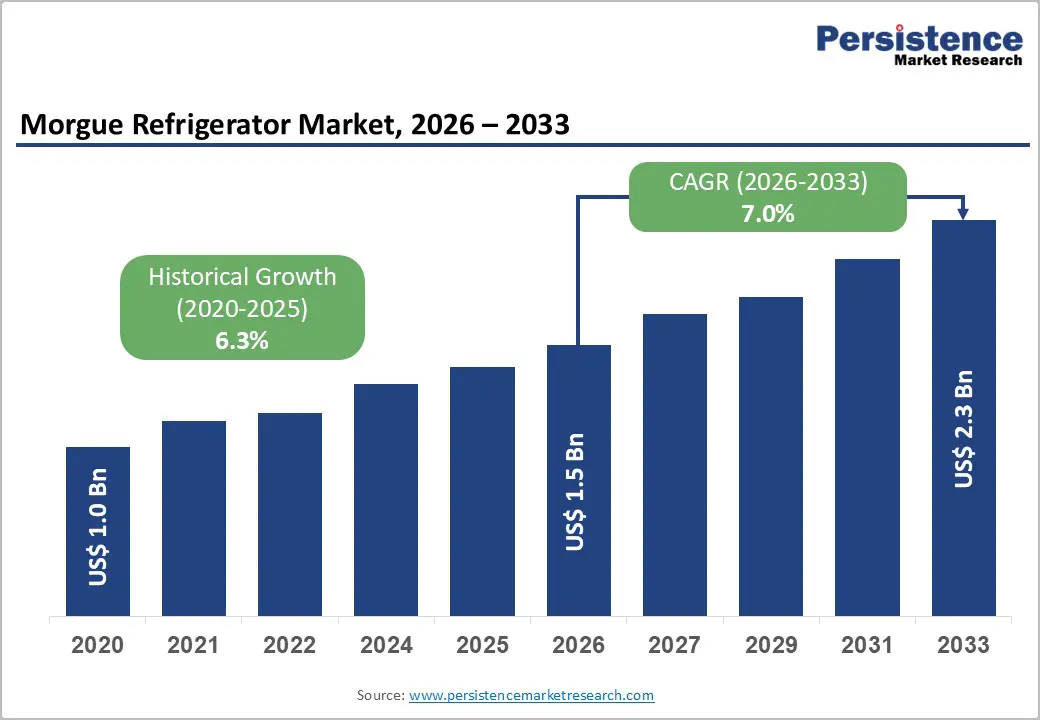
The global morgue refrigerator market size is likely to be valued at US$1.5 billion in 2026, and is expected to reach US$2.3 billion by 2033, growing at a CAGR of 7.0% during the forecast period from 2026 to 2033, driven by the increasing prevalence of hospital mortuary infrastructure expansion, rising number of forensic and pathology autopsies, and growing demand for reliable, energy-efficient cadaver storage solutions.
Growing demand for negative-temperature morgue refrigerators, particularly in hospitals and forensic laboratories, is accelerating adoption across end-user segments. Advances in IoT-enabled temperature monitoring, eco-friendly refrigerants, and modular designs are further increasing adoption by improving compliance, traceability, and reducing operating costs. The increasing recognition of morgue refrigerators as critical for dignified body preservation, infection control, and regulatory compliance in emerging healthcare and forensic markets remains a major driver of market growth.
Key Industry Highlights:
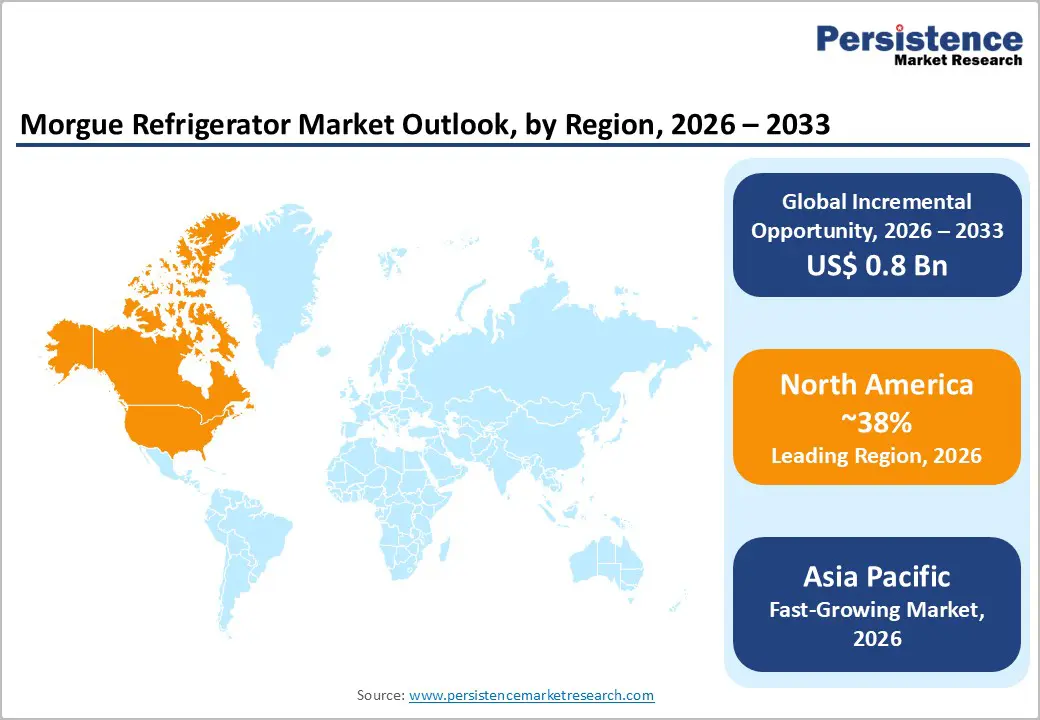
- Leading Region: North America, anticipated to account for a 38% market share in 2026, driven by high autopsy volumes, advanced forensic infrastructure, and strong demand in the U.S.
- Fastest-growing Region: Asia Pacific, fueled by rapid hospital construction, increasing forensic lab investments, and growing awareness of mortuary standards in China and India.
- Dominant Product Type: Negative temperature morgue refrigerators, to hold approximately 68% of the market share, as they remain the standard for long-term storage.
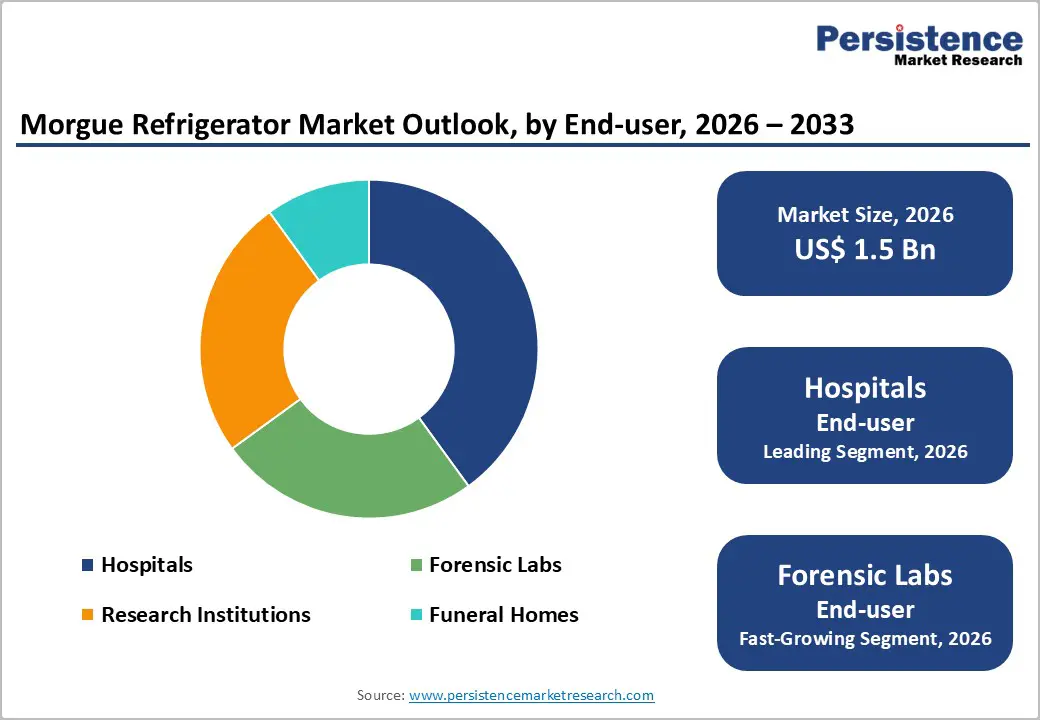
- Leading End-user: Hospitals, to account for over 52% of the market revenue in 2026, due to centralized mortuary facilities and high case load.
| Global Market Attributes | Key Insights |
|---|---|
| Morgue Refrigerator Market Size (2026E) | US$1.5 Bn |
| Market Value Forecast (2033F) | US$2.3 Bn |
| Projected Growth CAGR (2026-2033) | 7.0% |
| Historical Market Growth (2020-2025) | 6.3% |
Market Factors – Growth, Barriers, and Opportunity Analysis
Growth Analysis – Rising Hospital Mortuary Infrastructure and Autopsy Volumes
Hospitals are increasingly expanding mortuary infrastructure due to growing death rates from aging populations, chronic diseases, and acute healthcare events such as pandemics. Traditional hospital morgues were designed for modest capacity and short-term body storage, but modern pressures demand larger, more sophisticated facilities. Extended waits for family arrangements, delayed forensic investigations, and transfers to external facilities have highlighted capacity gaps. In response, hospitals are investing in climate-controlled, scalable mortuary units with advanced tracking systems to ensure dignified, secure, and organized handling of the deceased.
Autopsy volumes are rising, driven by multiple factors. Clinicians and families increasingly seek autopsy insights to confirm diagnoses, understand sudden or unexplained deaths, and improve future care. Legal and forensic demands have also grown; with more stringent death investigations and higher expectations for accurate cause-of-death determinations, forensic departments see heavier workloads. Improved public health surveillance, particularly for emerging diseases, relies on autopsy data to detect patterns, refine treatments, and assess disease burden.
Increasing Forensic Lab and Funeral Home Investments
Investments in forensic laboratories and funeral homes are growing as societies face more complex demands around death investigation, public safety, and end-of-life services. Forensic laboratories, once primarily focused on basic crime scene analysis, now conduct advanced scientific testing, ranging from DNA sequencing to digital forensics, driven by rising crime rates, sophisticated criminal activity, and expanding legal requirements. Law enforcement agencies and public health systems are allocating more funds to upgrade equipment, adopt cutting-edge technologies, and recruit specialized scientists. Faster, more accurate forensic results improve judicial outcomes, aid in solving cold cases, and support public trust in legal systems. In addition, forensic labs play a critical role in identifying unknown victims, monitoring emerging health threats through death data, and contributing to disaster response efforts.
Funeral homes are seeing increased investment as consumer preferences evolve and mortality rates rise due to aging populations and chronic health conditions. Families now expect a wider range of services, including personalized memorials, eco-friendly burials, and digital remembrance options. To meet these expectations, funeral operators are renovating facilities, implementing modern service offerings, and adopting technology for online planning and coordination.
Barrier Analysis – High Capital Cost and Limited Budget in Emerging Markets
In emerging markets, high capital costs and limited budgets create significant challenges for infrastructure development and service delivery across sectors. These economies often aim to modernize healthcare, transportation, energy, and industrial capacity, but the scale of investment required is enormous. Building advanced facilities such as state-of-the-art hospitals, diagnostic centers, or technology parks requires substantial upfront expenditures for land acquisition, construction, sophisticated equipment, and skilled labor. For many governments and local businesses, this level of financing far exceeds available public funds or internal reserves.
Revenue streams in emerging markets are often constrained. Lower average incomes mean reduced tax collections for governments and limited spending power among private consumers. This gap between ambitious development needs and constrained financial resources forces difficult trade-offs. Policymakers must prioritize essential services, such as primary healthcare and basic education, over long-term capital projects, thereby slowing modernization efforts. Private investors may be reluctant to commit funds where regulatory uncertainty, currency volatility, or weak legal frameworks heighten financial risk.
Energy Consumption and Environmental Regulations
Energy consumption and environmental regulations are becoming significant considerations for sectors that rely on continuous power, heavy equipment, and temperature-controlled environments such as healthcare facilities, mortuaries, and forensic laboratories. These operations often require uninterrupted electricity for refrigeration units, climate-controlled storage, advanced diagnostic equipment, and ventilation systems. High energy use not only increases operational costs but also raises environmental concerns, especially in regions striving to reduce carbon emissions.
Governments and regulatory bodies are responding by enacting stricter environmental standards that limit greenhouse gas emissions and enforce sustainable practices. For instance, facilities may be required to monitor and report their energy use, adopt cleaner fuels, or meet energy-efficiency benchmarks. While these regulations aim to protect the environment and public health, they also compel organizations to invest in costly upgrades, such as energy-efficient HVAC systems, renewable energy sources, and waste-management technologies. For many institutions, especially those with tight budgets, balancing compliance with environmental mandates and maintaining reliable operations is a challenge. Retrofitting older buildings can be costly, and new infrastructure must be designed with both energy efficiency and regulatory adherence in mind.
Opportunity Analysis – Innovation in IoT-Enabled and Energy-Efficient Morgue Refrigerators
Innovation in IoT-enabled and energy-efficient morgue refrigerators is transforming how mortuary facilities manage body storage, making operations smarter, safer, and more sustainable. Traditional mortuary refrigerators consume substantial power and require frequent manual temperature checks to maintain precise temperature control. With the integration of the Internet of Things (IoT), these units become network-connected systems capable of real-time monitoring and remote management. Sensors continuously track internal conditions such as temperature, humidity, and door status and send alerts to staff if any parameter deviates from set limits. This proactive monitoring minimizes the risk of spoilage or equipment failure and enhances reliability, particularly during peak-demand periods.
Energy efficiency is another critical focus. Modern morgue refrigerators employ advanced insulation, variable-speed compressors, and optimized airflow designs, which significantly reduce electricity consumption relative to older models. Combined with smart power management, these systems adjust cooling intensity based on actual load, lowering energy usage during off-peak times without compromising performance. This not only cuts operating costs for facilities but also aligns with broader environmental goals by reducing carbon footprints.
Integration with Hospital Information Systems
Integration with Hospital Information Systems (HIS) represents a significant opportunity for improving the efficiency and reliability of mortuary and forensic operations. HIS is a centralized digital platform that manage patient records, clinical workflows, and administrative data across a hospital. By connecting morgue equipment, especially IoT-enabled refrigerators and tracking systems, to HIS, facilities can create a seamless flow of information from the moment a death is recorded to the final disposition of remains.
This integration eliminates manual data entry, reducing errors and ensuring that all relevant personnel have access to up-to-date information. For example, when a body is admitted to a mortuary, the system can automatically log the arrival time, the assigned storage location, temperature records, and details of scheduled autopsies or releases. These data points become part of the patient’s electronic record and can be accessed by clinicians, pathologists, and administrative staff without duplication or delay. HIS integration supports compliance and traceability. Automated logs help facilities meet regulatory requirements by documenting the chain of custody, environmental conditions, and service histories. This transparency is particularly valuable for forensic cases where legal scrutiny is high.
Category-wise Analysis
Product Type Insights
Negative temperature morgue refrigerators are anticipated to dominate the market, accounting for approximately 68% of the market share in 2026. Their dominance is driven by their ability to preserve human remains over extended periods with minimal degradation. These units maintain temperatures well below freezing, ensuring the integrity of bodies for autopsies, forensic investigations, or delayed family retrieval. Their reliability, advanced insulation, and energy-efficient designs make them particularly suitable for hospitals, forensic labs, and high-volume mortuary facilities. Negative-temperature mortuary refrigeration is provided by the Labotemp Scientific MOR-10 Labotemp Mortuary Refrigerator. This professional unit supports both standard refrigeration and deep-freezing modes, capable of lowering temperatures to as low as −30°C, which is crucial for long-term preservation of bodies for forensic, autopsy, or delayed release purposes far beyond normal cool storage ranges.
Positive temperature morgue refrigerators represent the fastest-growing product type, as they offer practical, cost-effective solutions for short-term body storage in hospitals, clinics, and smaller mortuary facilities. Operating at temperatures slightly above freezing (typically 2°C to 8°C), they maintain dignity and slow decomposition without the higher energy use and mechanical complexity of deep-freeze units. Their lower upfront cost, easier maintenance, and suitability for everyday use, along with extended long-term storage, make them attractive for emerging healthcare settings. LABIX Mortuary Freezer LBX143 A is a specialized mortuary refrigeration unit designed to operate in the +2°C to +8°C range, which is the standard “positive temperature” setting used for short-term body storage in hospitals, funeral homes, and mortuary facilities. These temperatures significantly slow decomposition while preserving the appearance of the deceased without the higher energy draw of deep-freeze systems, making them more cost-effective for routine use.
End-user Insights
Hospitals are expected to dominate the market, accounting for nearly 52% of revenue in 2026, driven by their high patient volumes and ongoing need for body storage. With growing admissions, increasing autopsy and forensic investigations, and rising mortality rates due to chronic diseases and aging populations, hospitals require reliable, high-capacity mortuary refrigerators. They are investing in both positive and negative temperature units to maintain body integrity, ensure compliance with regulations, and support operational efficiency. Morgue Refrigerator/9 Body Independent Cooling by Labotemp is designed specifically for hospital and healthcare facility morgues to store multiple bodies under controlled conditions. These units are commonly used in hospital mortuaries to ensure the dignified, hygienic preservation of remains while awaiting autopsy, identification, or release.
Forensic labs represent the fastest-growing end-user, driven by increasing demand for accurate and timely criminal investigations, autopsies, and forensic casework. Rising crime rates, complex legal requirements, and the need for meticulous evidence preservation are driving labs to invest in reliable refrigeration solutions that maintain body integrity and prevent decomposition. Advanced, IoT-enabled, and temperature-controlled mortuary refrigerators allow forensic teams to store specimens securely, track the chain of custody, and comply with regulatory standards. Morgue Fridge/Cadaver Refrigerator Freezer (2-Cabinet Model) by Fatali Medical Equipment is designed for use not only in hospitals and morgues but also for forensic labs where bodies must be preserved for extended legal and investigative purposes. These units offer precise temperature control and dual independent cabinets to support forensic examinations and evidence preservation requirements.
Regional Insights
North America Morgue Refrigerator Market Trends
North America is projected to dominate, accounting for nearly 38% of the market share in 2026, driven by the region’s high autopsy volumes, advanced forensic infrastructure, and high public awareness of dignified storage benefits. Distribution systems in the U.S. and Canada provide extensive support for morgue refrigerator programs, ensuring wide accessibility across negative-temperature, medium-capacity, and hospital populations. Increasing demand for compliant, convenient, and easy-to-monitor forms is further accelerating adoption, as these formats improve traceability and reduce barriers associated with basic units.
Innovation in morgue refrigerator technology, including stable IoT-enabled, improved energy-efficient delivery, and targeted forensic enhancement, is attracting significant investment from both public and private sectors. Government initiatives and CDC campaigns continue to promote use to address decomposition risks, regulatory concerns, and emerging forensic threats, thereby creating sustained market demand. The growing focus on large-capacity grades and specialty uses, particularly in hospitals and other settings, is expanding the target applications for morgue refrigerators.
Europe Morgue Refrigerator Market Trends
Europe's growth in the morgue refrigerator market is driven by increased awareness of proper storage practices and the benefits of compliance, supported by robust regulatory systems and government-led programs to modernize mortuaries. Countries such as Germany, France, the U.K., and Italy have well-established healthcare and forensic frameworks that promote the regular use of morgue refrigerators and encourage the adoption of innovative storage solutions, including IoT-enabled and negative-temperature units. These high-compliance options are particularly attractive to hospitals, regulation-conscious laboratories, and funeral homes, enhancing preservation capabilities and improving coverage rates.
Technological advancements in morgue refrigerator design, including improved insulation, targeted delivery systems, and greater energy efficiency, are further driving market growth. European authorities are increasingly backing research and trials for refrigerators designed to meet both routine and specialized needs, boosting market confidence. The growing focus on convenient, eco-friendly options aligns with the region’s commitment to preventive regulatory compliance and energy transition goals. Public awareness campaigns and promotional efforts are broadening the market's reach in both hospital and forensic sectors, while suppliers continue to invest in production and the development of new variants to improve efficacy.
Asia Pacific Morgue Refrigerator Market Trends
Asia Pacific is likely to be the fastest-growing market for morgue refrigerators in 2026, driven by rising healthcare and forensic awareness, increasing government initiatives, and expanding application programs across the region. Countries such as China, India, Japan, and South Korea are actively promoting refrigerator campaigns to address mortuary growth and emerging compliance needs. Morgue refrigerators are particularly attractive in these regions due to their scalable administration, ease of installation, and suitability for large-scale hospital and lab drives in both urban and rural populations.
Technological advancements are supporting the development of stable, effective, and easy-to-deploy morgue refrigerators, which can withstand challenging climatic conditions and minimize energy dependence. These innovations are critical for reaching domestic facilities and improving overall preservation coverage. Growing demand for negative-temperature, medium-capacity, and hospital applications is contributing to market expansion. Public-private partnerships, increased healthcare expenditure, and rising investment in morgue refrigerator research and production capacity are further accelerating growth. The convenience of refrigerator delivery, combined with improved preservation and reduced risk of decomposition, positions it as a preferred choice.
Competitive Landscape
The global morgue refrigerator market is highly competitive, featuring a mix of established life-science equipment leaders and emerging mortuary-focused specialists. In North America and Europe, companies such as Thermo Fisher Scientific Inc., Mopec Inc., KUGEL Medical GmbH & Co. KG, Mortech Manufacturing Company Inc., and LEEC Limited are at the forefront. These players leverage strong R&D capabilities, extensive distribution networks, and deep hospital and forensic lab relationships to maintain leadership. Their portfolios increasingly include negative-temperature refrigerators, IoT-enabled monitoring systems, and energy-efficient designs that support long-term preservation, reduce decomposition risks, and ensure compliance with stringent regulatory standards.
In Asia Pacific, local manufacturers are gaining traction with cost-competitive and scalable solutions, making mortuary refrigeration more accessible in emerging healthcare markets. These solutions emphasize modularity, ease of installation, and lower operational costs, which are critical in budget-constrained regions. Market strategies include strategic partnerships, collaborations, and acquisitions, which allow companies to combine technological expertise, expand their product portfolios, and accelerate commercialization. Focus on energy-efficient refrigeration technologies not only addresses rising electricity costs but also supports sustainability initiatives.
Key Industry Developments:
- In March 2023, Lira University Teaching Hospital acquired a modern morgue refrigerator for use at its mortuary to preserve dead bodies.
Companies Covered in Morgue Refrigerator Market
- Thermo Fisher Scientific Inc.
- Mopec Inc.
- KUGEL medical GmbH & Co. KG
- Mortech Manufacturing Company Inc.
- LEEC Limited
- SM Scientific Instruments Pvt. Ltd.
- Angelantoni Life Science S.r.l.
- Fiocchetti S.r.l.
- Funeralia GmbH
- Hygeco International Products
- CEABIS S.p.A.
- Mortuary Solutions Inc.
- Roftek Ltd.
- UFSK International GmbH & Co. KG.
Frequently Asked Questions
The global morgue refrigerator market is projected to reach US$1.5 billion in 2026.
Increasing hospital admissions, aging populations, and higher autopsy volumes are driving demand for reliable mortuary refrigeration in hospitals, forensic labs, and funeral homes.
The morgue refrigerator market is poised to witness a CAGR of 7.0% from 2026 to 2033.
Hospitals and forensic labs are increasingly investing in IoT-enabled, energy-saving refrigeration systems, creating opportunities for technology-driven product innovation and upgrades.
Thermo Fisher Scientific Inc., Mopec Inc., KUGEL medical GmbH & Co. KG, Mortech Manufacturing Company Inc., and LEEC Limited are the key players.


