


- Executive Summary
- Global Mining Waste Management Market Snapshot, 2026 and 2033
- Market Opportunity Assessment, 2026 – 2033, US$ Bn
- Key Market Trends
- Future Market Projections
- Premium Market Insights
- Industry Developments and Key Market Events
- PMR Analysis and Recommendations
- Market Overview
- Market Scope and Definition
- Market Dynamics
- Drivers
- Restraints
- Opportunity
- Challenges
- Key Trends
- COVID-19 Impact Analysis
- Forecast Factors – Relevance and Impact
- Value Added Insights
- Value Chain Analysis
- Key Market Players
- Regulatory Landscape
- PESTLE Analysis
- Porter’s Five Force Analysis
- Consumer Behavior Analysis
- Price Trend Analysis, 2020-2025
- Key Factors Impacting Product Prices
- Pricing Analysis, By Mining Method
- Regional Prices and Product Preferences
- Global Mining Waste Management Market Outlook
- Market Size (US$ Bn) Analysis and Forecast
- Historical Market Size (US$ Bn) Analysis, 2020-2025
- Market Size (US$ Bn) Analysis and Forecast, 2026–2033
- Global Mining Waste Management Market Outlook: Mining Method
- Historical Market Size (US$ Bn) Analysis, By Mining Method, 2020-2025
- Market Size (US$ Bn) Analysis and Forecast, By Mining Method, 2026–2033
- Surface Mining
- Underground Mining
- Market Attractiveness Analysis: Mining Method
- Global Mining Waste Management Market Outlook: Mineral Type
- Historical Market Size (US$ Bn) Analysis, By Mineral Type, 2020-2025
- Market Size (US$ Bn) Analysis and Forecast, By Mineral Type, 2026–2033
- Thermal Coal
- Coking Coal
- Iron Ore
- Gold
- Copper
- Lead
- Zinc
- Others
- Market Attractiveness Analysis: Mineral Type
- Global Mining Waste Management Market Outlook: Waste Type
- Historical Market Size (US$ Bn) Analysis, By Waste Type, 2020-2025
- Market Size (US$ Bn) Analysis and Forecast, By Waste Type, 2026–2033
- Overburden/Waste Rock
- Tailings
- Mine Water
- Market Attractiveness Analysis: Waste Type
- Market Size (US$ Bn) Analysis and Forecast
- Global Mining Waste Management Market Outlook: Region
- Historical Market Size (US$ Bn) Analysis, By Region, 2020-2025
- Market Size (US$ Bn) Analysis and Forecast, By Region, 2026–2033
- North America
- Latin America
- Europe
- East Asia
- South Asia and Oceania
- Middle East & Africa
- Market Attractiveness Analysis: Region
- North America Mining Waste Management Market Outlook
- Historical Market Size (US$ Bn) Analysis, By Market, 2020-2025
- By Country
- By Mining Method
- By Mineral Type
- By Waste Type
- Market Size (US$ Bn) Analysis and Forecast, By Country, 2026–2033
- U.S.
- Canada
- Market Size (US$ Bn) Analysis and Forecast, By Mining Method, 2026–2033
- Surface Mining
- Underground Mining
- Market Size (US$ Bn) Analysis and Forecast, By Mineral Type, 2026–2033
- Thermal Coal
- Coking Coal
- Iron Ore
- Gold
- Copper
- Lead
- Zinc
- Others
- Market Size (US$ Bn) Analysis and Forecast, By Waste Type, 2026–2033
- Overburden/Waste Rock
- Tailings
- Mine Water
- Market Attractiveness Analysis
- Historical Market Size (US$ Bn) Analysis, By Market, 2020-2025
- Europe Mining Waste Management Market Outlook
- Historical Market Size (US$ Bn) Analysis, By Market, 2020-2025
- By Country
- By Mining Method
- By Mineral Type
- By Waste Type
- Market Size (US$ Bn) Analysis and Forecast, By Country, 2026–2033
- Germany
- France
- U.K.
- Italy
- Spain
- Russia
- Rest of Europe
- Market Size (US$ Bn) Analysis and Forecast, By Mining Method, 2026–2033
- Surface Mining
- Underground Mining
- Market Size (US$ Bn) Analysis and Forecast, By Mineral Type, 2026–2033
- Thermal Coal
- Coking Coal
- Iron Ore
- Gold
- Copper
- Lead
- Zinc
- Others
- Market Size (US$ Bn) Analysis and Forecast, By Waste Type, 2026–2033
- Overburden/Waste Rock
- Tailings
- Mine Water
- Market Attractiveness Analysis
- Historical Market Size (US$ Bn) Analysis, By Market, 2020-2025
- East Asia Mining Waste Management Market Outlook
- Historical Market Size (US$ Bn) Analysis, By Market, 2020-2025
- By Country
- By Mining Method
- By Mineral Type
- By Waste Type
- Market Size (US$ Bn) Analysis and Forecast, By Country, 2026–2033
- China
- Japan
- South Korea
- Market Size (US$ Bn) Analysis and Forecast, By Mining Method, 2026–2033
- Surface Mining
- Underground Mining
- Market Size (US$ Bn) Analysis and Forecast, By Mineral Type, 2026–2033
- Thermal Coal
- Coking Coal
- Iron Ore
- Gold
- Copper
- Lead
- Zinc
- Others
- Market Size (US$ Bn) Analysis and Forecast, By Waste Type, 2026–2033
- Overburden/Waste Rock
- Tailings
- Mine Water
- Market Attractiveness Analysis
- Historical Market Size (US$ Bn) Analysis, By Market, 2020-2025
- South Asia & Oceania Mining Waste Management Market Outlook
- Historical Market Size (US$ Bn) Analysis, By Market, 2020-2025
- By Country
- By Mining Method
- By Mineral Type
- By Waste Type
- Market Size (US$ Bn) Analysis and Forecast, By Country, 2026–2033
- India
- Indonesia
- Thailand
- Singapore
- ANZ
- Rest of South Asia & Oceania
- Market Size (US$ Bn) Analysis and Forecast, By Mining Method, 2026–2033
- Surface Mining
- Underground Mining
- Market Size (US$ Bn) Analysis and Forecast, By Mineral Type, 2026–2033
- Thermal Coal
- Coking Coal
- Iron Ore
- Gold
- Copper
- Lead
- Zinc
- Others
- Market Size (US$ Bn) Analysis and Forecast, By Waste Type, 2026–2033
- Overburden/Waste Rock
- Tailings
- Mine Water
- Market Attractiveness Analysis
- Historical Market Size (US$ Bn) Analysis, By Market, 2020-2025
- Latin America Mining Waste Management Market Outlook
- Historical Market Size (US$ Bn) Analysis, By Market, 2020-2025
- By Country
- By Mining Method
- By Mineral Type
- By Waste Type
- Market Size (US$ Bn) Analysis and Forecast, By Country, 2026–2033
- Brazil
- Mexico
- Rest of Latin America
- Market Size (US$ Bn) Analysis and Forecast, By Mining Method, 2026–2033
- Surface Mining
- Underground Mining
- Market Size (US$ Bn) Analysis and Forecast, By Mineral Type, 2026–2033
- Thermal Coal
- Coking Coal
- Iron Ore
- Gold
- Copper
- Lead
- Zinc
- Others
- Market Size (US$ Bn) Analysis and Forecast, By Waste Type, 2026–2033
- Overburden/Waste Rock
- Tailings
- Mine Water
- Market Attractiveness Analysis
- Historical Market Size (US$ Bn) Analysis, By Market, 2020-2025
- Middle East & Africa Mining Waste Management Market Outlook
- Historical Market Size (US$ Bn) Analysis, By Market, 2020-2025
- By Country
- By Mining Method
- By Mineral Type
- By Waste Type
- Market Size (US$ Bn) Analysis and Forecast, By Country, 2026–2033
- GCC Countries
- Egypt
- South Africa
- Northern Africa
- Rest of Middle East & Africa
- Market Size (US$ Bn) Analysis and Forecast, By Mining Method, 2026–2033
- Surface Mining
- Underground Mining
- Market Size (US$ Bn) Analysis and Forecast, By Mineral Type, 2026–2033
- Thermal Coal
- Coking Coal
- Iron Ore
- Gold
- Copper
- Lead
- Zinc
- Others
- Market Size (US$ Bn) Analysis and Forecast, By Waste Type, 2026–2033
- Overburden/Waste Rock
- Tailings
- Mine Water
- Market Attractiveness Analysis
- Historical Market Size (US$ Bn) Analysis, By Market, 2020-2025
- Competition Landscape
- Market Share Analysis, 2024
- Market Structure
- Competition Intensity Mapping By Market
- Competition Dashboard
- Company Profiles (Details – Overview, Financials, Strategy, Recent Developments)
- EnviroServ
- Overview
- Segments and Mining Method
- Key Financials
- Market Developments
- Market Strategy
- Interwaste Holding Ltd.
- Veolia Environment S.A.
- Tetronics International
- Golder Associates Inc.
- John Wood Group plc
- Ramboll Group
- Tetra Tech Inc.
- Cleanaway Environmental Services
- Seche Environment Company
- Aevitas
- Averda
- EnviroServ
- Appendix
- Research Methodology
- Research Assumptions
- Acronyms and Abbreviations


- Mining & Services
- Mining Waste Management Market
Mining Waste Management Market Size, Share, and Growth Forecast, 2026 - 2033
Mining Waste Management Market By Mining Method (Surface Mining, Underground Mining), Mineral Type (Thermal Coal, Coking Coal, Iron Ore, Gold, Copper, Lead, Zinc, Others), Waste Type (Overburden/Waste Rock, Tailings, Mine Water), and Regional Analysis for 2026 – 2033
Mining Waste Management Market Size and Trends Analysis
The global mining waste management market size is likely to be valued at US$262.2 billion in 2026, and is expected to reach US$368.9 billion by 2033, growing at a CAGR of 5.0% during the forecast period from 2026 to 2033, driven by stringent environmental regulations, rising demand for sustainable resource recovery, and technological advancements in waste recycling and treatment. Innovations in bioremediation and zero-waste initiatives are accelerating adoption, particularly for high-volume minerals such as iron ore and coal, while circular economy principles enhance value extraction from mine water and waste rock. The mining waste management market remains pivotal for compliance and ESG (Environmental, Social, and Governance) goals in resource-intensive industries.
Key Industry Highlights:
- Leading Region: Asia Pacific, anticipated to account for 45% market share in 2026, driven by massive coal and iron ore production in China and India, coupled with regulatory pushes for waste minimization.
- Fastest-growing Region: Asia Pacific, fueled by infrastructure-driven mining expansions and investments in tailings management technologies.
- Dominant Mining Method: Surface mining, to hold approximately 60% of the market share in 2026, as it generates higher volumes of overburden and supports scalable waste processing.
- Leading Mineral Type: Iron ore is expected to account for over 25% of revenue in 2026, due to its massive output and focus on sustainable beneficiation.
- Leading Waste Type: Tailings are estimated to contribute nearly 50% of the market share in 2026, owing to risks of dam failures and global mandates for safe storage.
| Key Insights | Details |
|---|---|
| Mining Waste Management Market Size (2026E) | US$262.2 Bn |
| Market Value Forecast (2033F) | US$368.9 Bn |
| Projected Growth (CAGR 2026 to 2033) | 5.0% |
| Historical Market Growth (CAGR 2020 to 2025) | 4.5% |
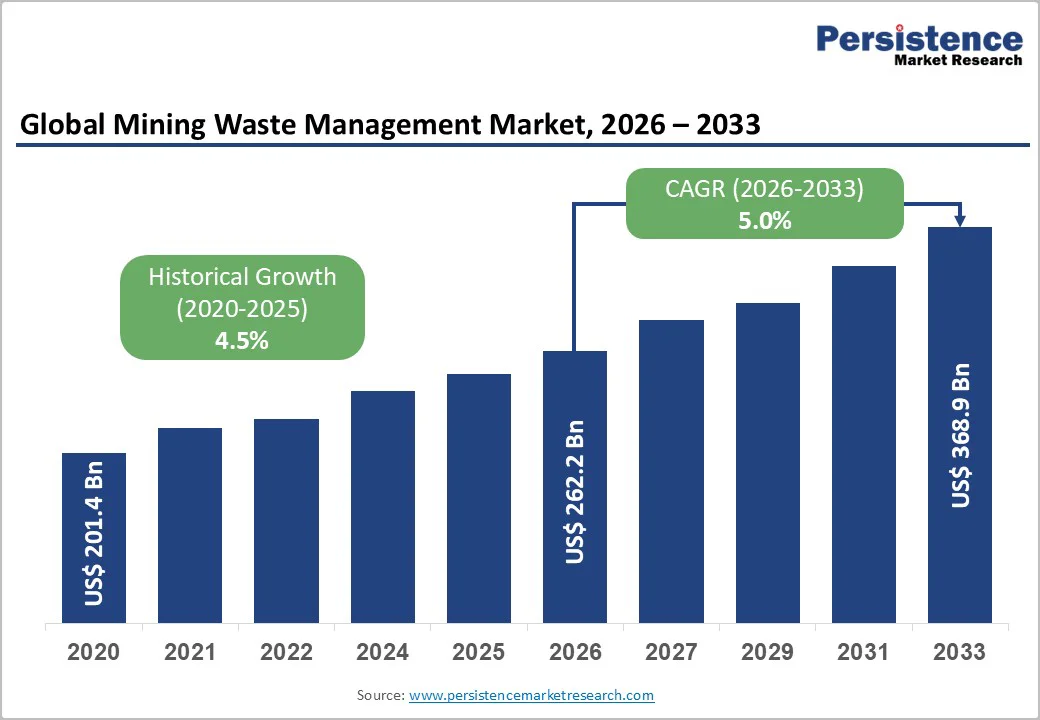
Market Factors – Growth, Barriers, and Opportunity Analysis
Rising Demand for Sustainable Mining Practices and Regulatory Compliance
The rising demand for sustainable mining practices and stronger regulatory compliance is reshaping the global mining sector. Governments worldwide are tightening environmental standards to mitigate land degradation, water contamination, and carbon emissions, pushing mining companies to adopt cleaner and more responsible extraction methods. This shift is further accelerated by growing investor and consumer expectations for transparent, ethical, and ESG-aligned operations. As a result, miners are increasingly integrating renewable energy sources, advanced waste-management systems, and low-impact drilling technologies to reduce ecological footprints.
Stricter compliance frameworks covering worker safety, emissions reporting, biodiversity protection, and responsible disposal of tailings are compelling companies to modernize their processes and invest in real-time monitoring solutions. Digital tools such as IoT sensors, automation, and AI-driven predictive analytics are becoming essential for meeting regulatory thresholds and improving operational accountability.
High Capital and Operational Costs
High capital and operational costs remain a major constraint for the mining industry, significantly influencing project planning, profitability, and long-term viability. Developing a new mine requires substantial upfront investment in exploration, site preparation, heavy machinery, safety systems, and advanced processing infrastructure. These expenses are further amplified by the need for modern equipment that meets stringent environmental and safety standards. Fluctuating global prices for fuel, energy, and specialized materials add to overall cost burdens.
Mining companies face continuous expenses related to workforce training, equipment maintenance, regulatory compliance, and waste-management systems. Remote mine locations often require extensive logistics, including transportation networks, on-site power generation, and water-treatment facilities, all of which increase daily operating costs. Labor shortages and the need for skilled technical staff also raise wage requirements, further pressuring margins.
Advancements in Waste Recycling and Resource Recovery Technologies
Advancements in waste recycling and resource recovery technologies are transforming the mining sector by enabling more efficient use of materials and reducing environmental impact. Modern mineral processing techniques such as hydrometallurgical extraction, bioleaching, and advanced flotation allow companies to recover valuable metals from low-grade ores, tailings, and previously discarded waste streams. This not only improves resource efficiency but also extends the life of existing mines without requiring new large-scale excavation.
Innovations in automated sorting, AI-driven material characterization, and high-precision sensors are further enhancing recovery rates by identifying recyclable components with greater accuracy. As recycling technologies improve, mining operations are increasingly able to extract critical minerals such as lithium, cobalt, copper, and rare earth elements from secondary sources, supporting the growing demand for clean energy solutions. Circular economy models are gaining traction, encouraging the reuse of by-products for construction materials, industrial applications, or energy generation. These advancements significantly reduce landfill requirements, minimize pollution, and lower operational costs by turning waste into valuable assets.
Category-wise Analysis
Mining Method Insights
Surface mining is expected to lead the market in 2026, capturing about 60% of the total share, driven by its large operational scale and substantial overburden removal. This method produces high volumes of waste rock, tailings, and soil, increasing the demand for effective disposal, recycling, and site-rehabilitation solutions. Its accessibility to near-surface mineral deposits and comparatively lower operating costs give it a clear advantage over underground mining. A notable example is Kennecott Utah Copper’s Bingham Canyon Mine, one of the world’s largest open-pit copper operations, which moves millions of tons of material each year and relies on extensive waste-management systems to mitigate environmental impacts.
Underground mining represents the fastest-growing segment, driven by the increasing extraction of deep-seated minerals such as gold, zinc, and rare earth elements. As shallow deposits decline, companies are shifting to underground operations to access high-grade ores, leading to a rise in waste generation from drilling, blasting, and ore processing. This growth increases the demand for specialized waste-handling solutions, including backfilling, slurry management, and controlled disposal systems. For example, modern underground gold mines use paste backfill technology, where processed tailings are pumped back into mined-out voids to enhance stability and reduce surface waste accumulation.
Mineral Type Insights
Iron ore is anticipated to, hold over 25% share in 2026, driven by its high production volumes and extensive global demand for steel manufacturing. Large-scale iron ore extraction generates significant amounts of overburden, tailings, and beneficiation waste, increasing the need for sustainable waste-handling solutions. Companies are investing in advanced tailings filtration, dry stacking, and the reuse of waste materials to reduce environmental impact. For example, major iron ore mines in Australia and Brazil have adopted dry tailings disposal systems to minimize water usage and enhance site safety, demonstrating the growing focus on efficient waste management in iron ore operations.
Copper emerges as the fastest-growing, due to rising global demand for electrical infrastructure, renewable energy systems, and electric vehicles. As copper ore grades continue to decline, mining companies must process larger volumes of rock to extract the same amount of metal, resulting in increased tailings and waste rock generation. This accelerates the need for advanced waste-management solutions such as thickened tailings, dry stacking, and improved water-recycling systems. For example, large copper mines in Chile are adopting high-capacity filtration technologies to manage growing tailings volumes more sustainably while supporting increased production requirements.
Waste Type Insights
Tailings are anticipated to dominate with nearly 50% the market share in 2026, due to the large quantities generated during mineral processing. As ore grades decline, more material must be crushed and milled, resulting in higher tailings volumes that require safe storage and advanced treatment systems. Tailings management is becoming increasingly important with rising regulatory pressure and the need to prevent environmental hazards. For example, Newmont Corporation has adopted dry stacking technology at mines such as Boddington in Australia, where filtered tailings are compacted to reduce water usage and improve stability, mitigating risks associated with traditional tailings dams.
Overburden/Waste rock is the fastest-growing, as expanding surface and deep mining operations increasingly involve the removal of large volumes of soil and rock to access mineral deposits. Declining ore grades further contribute to higher stripping ratios, generating more waste material that must be handled, stored, or repurposed responsibly. Mining companies are adopting advanced land reclamation, backfilling, and reuse techniques to manage this rising waste efficiently. For example, BHP Group repurposes overburden from its coal and iron ore mines for mine-site rehabilitation and infrastructure development, reducing environmental impact while supporting sustainable land restoration initiatives.
Regional Insights
North America Mining Waste Management Market Trends
North America is projected to hold 20% of the share in 2026, driven by stricter environmental regulations, rising sustainability expectations, and increasing demand for critical minerals. The region, led by the U.S. and Canada, accounts for a significant share of global mining waste activities due to its large-scale metal and mineral production. Mining operators are shifting toward advanced waste-handling methods such as dry stacking, thickened tailings, and water-recycling technologies to reduce environmental risks and comply with evolving regulatory standards.
Growing concerns over legacy tailings dams and water contamination are further accelerating the adoption of safer, more efficient systems. Companies are investing in resource recovery technologies to extract valuable metals from tailings and waste rock, supporting circular-economy initiatives, and improving operational efficiency. Strong ESG-driven pressure from investors and communities is also shaping market strategies, pushing miners to prioritize sustainable waste management and long-term site rehabilitation.
Europe Mining Waste Management Market Trends
Europe is projected to have a 25% share in 2026, driven by strict environmental regulations, technological innovation, and strong commitments to sustainability. The region operates under comprehensive frameworks such as the Extractive Waste Directive, which mandates safe storage, monitoring, and rehabilitation of tailings, waste rock, and overburden to prevent soil and water contamination. These regulatory measures push mining companies to adopt advanced waste-handling systems, including enhanced liners, improved drainage solutions, and continuous stability monitoring.
Europe is also rapidly integrating digital technologies, such as AI-based modeling, drone inspections, and real-time sensor networks, to improve the safety and efficiency of tailings facilities. In line with the circular economy vision, the region is emphasizing resource recovery from mining waste by extracting residual metals and reusing process water to reduce environmental impact. Growing interest in critical raw materials further encourages the reprocessing of old tailings and abandoned mine sites. Additionally, greater focus on water conservation and ecosystem protection is influencing waste management strategies across key mining regions.
Asia Pacific Mining Waste Management Market Trends
Asia Pacific is likely to be the dominant and fastest-growing region, accounting for 45% of the share in 2026, due to the region’s large-scale mining activities, rising mineral demand, and increasing emphasis on environmental protection. Countries such as China, India, Australia, and Indonesia are major contributors, generating substantial volumes of tailings, waste rock, and overburden as mining intensifies to support industrial growth and infrastructure development.
Governments across the region are tightening environmental regulations, prompting mining companies to adopt advanced waste-management solutions such as dry stacking, lined tailings storage, and water-recycling systems to reduce ecological risks. There is a growing shift toward sustainable mining practices, with operators investing in technologies that recover valuable minerals from waste and support circular-economy goals. The push for ESG compliance and safer disposal methods is further guiding modernization efforts within the sector. As the demand for critical minerals continues to rise, the region is increasingly focusing on efficient, responsible waste handling to balance economic growth with environmental stewardship.
Competitive Landscape
The global mining waste management market is highly competitive, driven by stringent environmental regulations, increasing mining activities, and the growing demand for sustainable waste-handling solutions. Companies in this space compete on technology innovation, compliance capabilities, service quality, and cost efficiency. As governments impose tighter controls on tailings storage, water usage, and land rehabilitation, service providers and mining firms are investing heavily in advanced systems such as dry stacking, thickened tailings, real-time monitoring, and resource recovery technologies. This has intensified competition among equipment manufacturers, engineering firms, and waste management specialists offering integrated solutions.
Large multinational companies leverage their global presence, strong technical expertise, and long-term contracts with major mining operators to maintain a competitive edge. Meanwhile, regional players focus on niche offerings such as site-specific waste treatment, reclamation services, and local regulatory support to strengthen market positioning. The industry is also witnessing increased collaboration between mining companies, technology innovators, and environmental organizations to develop safer and more efficient waste-handling practices. Additionally, the shift toward circular economy models encourages competition in tailings reprocessing and mineral recovery.
Key Industry Developments
- In September 2025, Weir entered a strategic partnership with MINEXXT to roll out advanced thickening and tailings-management technology. The collaboration delivers higher-density tailings, recovers up to 90% of process water for reuse, and reduces the storage footprint, enhancing both environmental performance and operational efficiency.
- In May 2023, Newmont launched the GeoStable Tailings Consortium (GSTC), a multi-company initiative aimed at developing “geo-stable” tailings and waste-rock blends. This approach seeks to produce more stable, engineered landforms and reduce process water consumption compared with conventional tailings storage.
Frequently Asked Questions
The global mining waste management market is projected to reach US$262.2 billion in 2026.
Stringent ESG regulations and sustainable recovery tech propel growth, with 80% waste reduction targets boosting investments.
The mining waste management market is poised to witness a CAGR of 5.0% from 2026 to 2033.
Resource recovery from tailings and AI-optimized treatment offer US$150 billion potential by 2033. Circular economy shifts in Asia Pacific enable 70% recycling gains for metals such as copper.
The key players include Veolia Environment S.A., Tetra Tech Inc., Ramboll Group, and Cleanaway Environmental Services.


